US SEC Closes Biden-Era Investigation Into Ondo Finance Without Charges

bitcoinistОпубликовано 2025-12-09Обновлено 2025-12-09

Введение

The US Securities and Exchange Commission (SEC) has closed its two-year investigation into Ondo Finance without filing any charges. The probe, initiated in 2024 under the Biden administration, examined whether the platform’s tokenized real-world assets (RWA) and its ONDO token complied with federal securities laws. Ondo Finance described the decision as a "meaningful milestone" for the tokenization industry, reflecting a broader shift in U.S. regulatory policy toward embracing innovation. The SEC has since added tokenization to its formal agenda, recognizing its potential to modernize capital markets. Ondo, a leader in the RWA sector, aims to advance the seamless movement of tokenized assets across blockchains.

The US Securities and Exchange Commission (SEC) concluded its Biden-era probe into DeFi platform Ondo Finance, and whether its tokenized products complied with federal securities laws, without any charges, following the Trump administration’s pro-industry approach and focus on tokenization.

Case Closes: SEC Ends Ondo Finance Probe

On Monday, Ondo Finance announced it had received formal notice that the US SEC’s two-year investigation into the platform, which started during the Biden administration, had concluded in late November with no charges.

The platform now joins the list of crypto companies that have seen their cases and probes dismissed or closed without any enforcement actions this year, including Gemini, Kraken, Ripple, Coinbase, and Uniswap Labs.

The SEC initiated the probe in 2024 to examine whether firms’ tokenization of Real-World Assets (RWA) complied with federal securities laws, the platform explained. Additionally, it sought to determine whether the ONDO token was a security.

“Ondo’s growth and leadership in the emerging tokenization category made us a focus, but not a justified target,” the announcement added. At the time, the US regulatory environment was characterized by a “regulation by enforcement” approach, which led to caution and confusion.

Nonetheless, they “remained steadfast in its conviction that regulated, transparent tokenization models like Ondo’s are not only compatible with investor-protection principles, but can strengthen them.”

To Ondo Finance, this marks a “meaningful milestone” for the broader tokenization industry, which will push innovation, compliance, security, and investor protection forward, as the sector gains momentum and becomes a priority on the federal agency’s agenda.

It’s worth noting that Ondo has solidified its position as a leader in the RWA sector with strategic partnerships, expansions, and the launch of its own Layer-1 blockchain, which aims to bridge the gap between traditional finance and decentralized finance.

As reported by Bitcoinist, the firm aims to advance its mission to “democratize” access to high-quality US financial assets and ensure tokenized assets move seamlessly across major blockchains.

A New Chapter For Tokenized Securities

In the Monday statement, the platform also highlighted that the SEC’s decision reflects a broader shift in US policy, with regulators reassessing the methods used during the Biden era for the crypto industry. Earlier this year, a White House report recognized the sector as foundational to the future of the global financial system and named Ondo Finance among the key players.

Notably, the regulatory agency has added tokenization to its formal agenda. In the SEC’s Investor Advisory Committee meeting last week, the regulatory agency affirmed it is evaluating tokenization to modernize the issuance, trading, and settlement of public equities.

In his remarks, SEC chairman Paul Atkins stated, “Distributed ledger technology and the tokenization of financial assets, including securities, have the potential to transform our capital markets. Our financial markets have long been the envy of the world, and to ensure that they remain so, U.S. firms and investors must have the opportunity to leverage this technology as they lead the future of global capital markets.”

Atkins added that the agency’s role is to enable market participants to operate and innovate under clear guardrails, ensuring that the US markets remain the most dynamic, transparent, and trusted in the world.

“The resolution of the SEC inquiry marks the end of one chapter for Ondo and the beginning of another. Put simply, the time is now for tokenized securities to become a core part of U.S. capital markets. The future of global finance, including U.S. capital markets, will be onchain and Ondo will help lead that transition,” the announcement concluded.
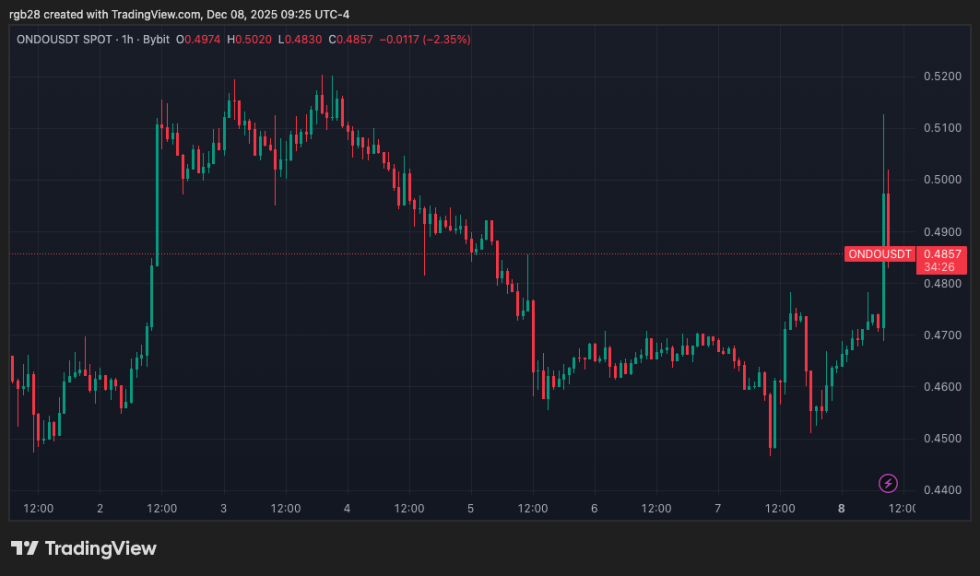
ONDO is trading at $0.48 in the one-week chart. Source: ONDOUSDT on TradingView

Похожее

Why Is It Difficult for Retail Investors to Break Free from the Loss Cycle of High-Frequency Trading?

Why Retail Traders Struggle to Escape the High-Frequency Trading Loss Cycle Retail investors often fall into a trap of continuous losses in cryptocurrency markets due to high-frequency day trading, which is structurally skewed against them. The author, sharing from personal experience, explains that frequent trading without informational advantages—such as access to real order flow, liquidity maps, or market maker positions—inevitably leads to financial ruin over time. The key insight is that winning isn’t just about making profits but about preserving them. Most successful retail traders actually succeed by trading less: catching major market moves, then stepping back to avoid giving back gains. In contrast, constant trading—often driven by overconfidence and the false belief that discipline and risk management alone can beat the market—results in consistent losses. The article compares modern day trading to a "casino disguised as a café," where inexperienced traders, especially young ones, mistake gambling for a learnable skill. They rely on superficial tools like TradingView charts without understanding that institutional traders use advanced systems like Bloomberg terminals with exclusive data. Ultimately, the author advises retail traders to reduce trading frequency, avoid day trading, and focus on long-term strategies instead of chasing quick wins. The real tragedy is not losing money but believing that high-frequency trading is a sustainable strategy rather than a form of gambling.

比推1 мин. назад

Why Is It Difficult for Retail Investors to Break Free from the Loss Cycle of High-Frequency Trading?

比推1 мин. назад

Bull vs. Bear Debate: Is Stablecoin Leader CRCL Worth Buying? Why Can't High-Growth Earnings Drive the Stock Price?

"Circle (NYSE: CRCL), the issuer of USDC, has sparked intense debate in the crypto community following its Q3 2025 earnings report. Despite reporting strong growth—revenue up 66% YoY to $740 million and net income of $214 million, driven by a 108% increase in USDC circulation—its stock price fell significantly post-earnings and remains near its IPO price of $64. The core disagreement revolves around Circle’s business model and sustainability. Critics, including Jiang Zhuorer, argue that Circle operates like a bank, earning primarily through interest on reserve assets (mainly U.S. Treasuries), but is highly vulnerable to interest rate cuts. They highlight that ~60% of revenue is paid to distributors like Coinbase, leaving thin margins that could turn negative in a low-rate environment. They also warn of competition from traditional financial giants like JPMorgan and potential policy changes. Proponents, such as BTCdayu and qinbafrank, counter that Circle is building a long-term, network-driven infrastructure play. They compare it to Amazon or JD.com, arguing that current profit-sharing is a strategic cost to achieve scale, compliance advantage, and eventual market dominance in a winner-take-all industry. They believe USDC’s合规 (compliance) edge and institutional trust will drive adoption to multi-trillion dollars, outweighing interest rate risks. Short-term concerns include significant post-IPO lockup expirations adding selling pressure, and structural barriers like U.S. tax treatment of USDC as a property (not cash), hindering retail payment adoption. The debate encapsulates a clash between cyclical concerns (rates, costs, competition) and structural optimism (scale, compliance, network effects)."

Odaily星球日报1 ч. назад

Bull vs. Bear Debate: Is Stablecoin Leader CRCL Worth Buying? Why Can't High-Growth Earnings Drive the Stock Price?

Odaily星球日报1 ч. назад

Торговля

Спот
Фьючерсы
活动图片