UnitedHealth Up 2.8%: As Funds Shift From AI to Healthcare, How Far Can Defensive Trading Go?

Published on 2026-10-16Last updated on 2026-10-16

Abstract

On October 15th, the S&P 500 index reversed its losses to close higher. Investor concerns over the financing costs for AI companies drove a flow of funds into the healthcare and consumer sectors. UnitedHealth Group gained 2.8%, joining Eli Lilly and Walmart as key contributors to the index's advance. With U.S. producer prices posting their largest increase in four and a half years, the outlook for interest rates remains a crucial backdrop for determining whether the strength in defensive sectors can be sustained.

Trading Snapshot

Catalyst|AI stocks under pressure, funds shift to healthcare and consumer staples. Key Data|UnitedHealth rose 2.8% on October 15; the healthcare sector gained 1.84%; the S&P 500 closed up 0.33%. Watchpoint|Inflation data and Fed rate hike expectations. Risk|If the sector rotation reverses, the relative strength of defensive stocks may also weaken.
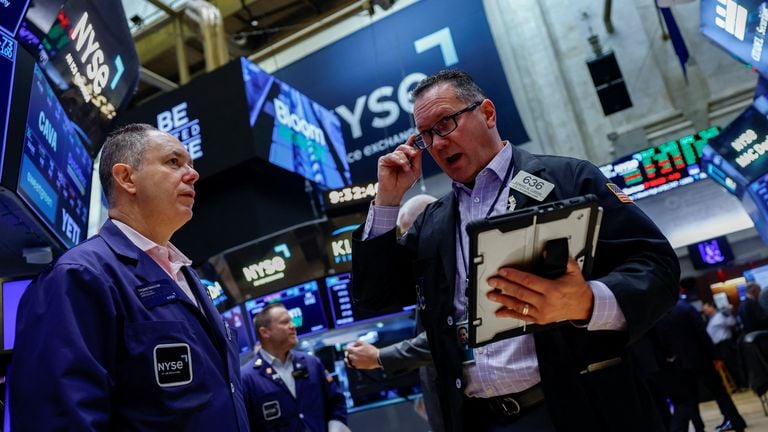
On October 15, the S&P 500 Index rebounded after falling in early trading and ended the day higher. Investors concerned about AI stocks shifted to Eli Lilly, UnitedHealth, and other healthcare and consumer stocks.

Some tech stocks fell as investors scrutinized the high debt burdens of AI-related companies, as rising interest rates could put more pressure on these firms.

Pharmaceutical maker Eli Lilly gained over 3%; UnitedHealth rose 2.8% and Walmart gained 1.4% after a ratings upgrade from Deutsche Bank. These three companies were significant contributors to the S&P 500's gains for the day.

While chipmaker TSMC posted record profits for the sixth consecutive quarter with AI demand remaining strong, its cautious outlook for the period up to 2027 led to a 1.8% decline in Nvidia's stock price.

Dell Technologies fell 6.9%, and Hewlett Packard Enterprise dropped 7.1%. Both server makers had already weakened significantly in the previous session, amid market concerns that higher borrowing costs would impact AI-related companies.

The yield on the 10-year U.S. Treasury note retreated but remained near multi-year highs, as investors continued to focus on inflation pressures linked to high oil prices.

Jed Ellerbroek, a portfolio manager at Argent Capital Management in St. Louis, said that whether financing a new single-family home or a large data center, costs are rising, which affects many areas of the stock market. He noted that the day's best-performing stocks belonged to non-cyclical, defensive companies.

The Philadelphia Semiconductor Index fell 0.9%, extending its losing streak to seven consecutive sessions.

The S&P 500 index rose 0.33% to close at 7,744.06 points.

The Nasdaq Composite Index gained 0.08% to 26,713.03 points; the Dow Jones Industrial Average advanced 1.08% to 52,177.69 points.

Approximately 20.7 billion shares traded on U.S. exchanges for the day, higher than the 17.6 billion average over the past 20 trading days.

Eight of the S&P 500's 11 sectors advanced. The healthcare sector led gains, up 1.84%, followed by the materials sector, up 1.71%.

After hitting a record high last week, the S&P 500 is still up about 13% year-to-date in 2026, with most of the gains driven by AI-related stocks.

The S&P 500's forward P/E ratio at the time was around 19 times, near its lowest level since 2023. Ellerbroek believes the index's relatively low forward P/E ratio suggests investors may have started pricing in the possibility that the high earnings growth driven by AI leaders could eventually come to an end.

Thursday's data showed U.S. producer prices rose in September at the fastest pace in four and a half years as costs for both goods and services increased. This is the latest sign of inflation spreading beyond energy products.

Consumer inflation data released on Wednesday came in higher than expected, fueling market expectations for further Fed rate hikes and pushing U.S. stocks lower that day.

Joe Saluzzi, co-head of Themis Trading in New Jersey, said some rotation is happening among large-cap stocks, but similar situations have occurred before; concerns about AI seem to resurface every few months.

According to the CME FedWatch Tool, interest rate traders at the time priced in a 67% probability of a Fed rate hike before the December policy meeting, up from 62% on Wednesday.

Space company Rocket Lab said the maiden launch of its larger Neutron rocket would be delayed until next year, sending its shares down 6.6%.

Agrochemicals company FMC slashed its third-quarter outlook, causing its stock to tumble more than 30%.

The ratio of advancing to declining S&P 500 constituents was about 3.1 to 1.

The S&P 500 had 24 constituents reaching new 52-week highs and none hitting new lows for the day; the Nasdaq had 61 stocks reaching new highs and 393 hitting new lows.


Related Reads

How Various Assets Have Performed So Far This Year: Bitcoin at -22% Return, Dead Last

As of November 13, 2026, Bitcoin has posted a -22.0% year-to-date return, ranking last among major asset classes. In contrast, the Philadelphia Semiconductor Index gained 43.2% despite a sharp pullback from its mid-year peak of 106.6%, while the S&P 500 and Nasdaq Composite held steady gains of roughly 8% to 10%. Even the CSI 300 (-13.3%) and gold GLD (-10.3%) outperformed Bitcoin. The article argues the key difference lies in the presence of real buying support. Semiconductors are backed by massive capital expenditure and order backlogs from major tech companies, giving them an earnings floor even after steep corrections. Bitcoin, by contrast, lacks such support. After spot ETFs helped Wall Street finish building core positions in 2024–2025, 2026 brought neither broad macro liquidity nor a new narrative capable of drawing fresh capital. ETF inflows slowed from a flood to a seasonal trickle. Without sustained new buyers, Bitcoin's high beta works only to the downside: in a stock-picking, zero-sum market it becomes the asset everyone wants to sell into strength. The article further notes that Bitcoin's positioning is losing focus. It has failed to act as either a "digital gold" hedge or a high-beta proxy for tech stocks. It lagged the Nasdaq and S&P 500 during the tech rally, and fell harder than gold when global assets contracted in November. The conclusion: Wall Street treats Bitcoin not as a safe haven but as a highly liquid, 24/7 liquidation tool—the first asset sold when institutions need to meet margin calls or lock in yearly profits. Crypto has been admitted to the table, but often as the one picked to pay the bill.

marsbit18m ago

How Various Assets Have Performed So Far This Year: Bitcoin at -22% Return, Dead Last

marsbit18m ago

From QR Codes to Physical Goods: How Consumer RWA Verifies Products and Rights

A single QR code can be printed on two bottles and scanned twice to open the same page, so verifying a physical item requires confirming the binding between the bottle in hand and its listed number. Consumer RWA verification has two parts: whether the goods or services are real, and whether the rights recorded in the digital credential are valid. For rights provenance, take a co-branded gift box: authorization documents define the term and scope in which a brand may use the co-branded mark, production and warehousing records show whether the box was stocked by batch, and rights registration states what holders can redeem and who delivers it. Linking all three lets consumers check authorization scope, supply, and their own eligibility. Identifiers, events, and evidence must work together. High-value items can use unique serial numbers, uniform-spec goods can use batch numbers, and courses or events can use session numbers. Events such as warehousing, sampling, outbound shipment, receipt, and redemption should be tied to the corresponding object, with operation time and responsible party retained. Test reports correspond to submitted samples; linking results to specific goods also requires checking the sample, batch, and inbound/outbound records. Ordinary batch goods can combine serialized QR codes with abnormal-scan records, while high-value items may add tamper-evident labels or independent authentication. Trusted records must also reflect current status. If a coffee batch has 500 bags at warehousing, 10 used for sampling, and 100 reserved for other channels, then absent other changes, 390 bags remain available for new rights. The warehousing record shows historical quantity; current redeemable quantity must be updated based on actual occupancy. A query page should at minimum state the goods or service, evidence source, last update time, and whether the credential is currently usable.

marsbit54m ago

From QR Codes to Physical Goods: How Consumer RWA Verifies Products and Rights

marsbit54m ago

10 Years Is Too Slow: Gu Quanquan's Team Challenges Dario, Compressing Cancer Cure to 4 Years

A UCLA professor, Quanquan Gu, has founded Geodesic Intelligence, a 15-person startup that after only five months has released NovaAtom-Lite, an all-atom structure prediction model that outperforms DeepMind's Isomorphic Labs flagship IsoDDE on FoldBench, the toughest biomolecular benchmark. The model predicts the 3D coordinates of every heavy atom in protein, DNA, RNA, and ligand complexes with near-experimental precision. NovaAtom-Lite posted top scores on two core pharma tests: antibody-antigen binding (79.07% success, 31 points above AlphaFold 3 and 3.5 above IsoDDE, with 2.2x AlphaFold 3's accuracy at high-precision thresholds) and protein-ligand binding (top 1 on both RMSD and contact metrics). On the Runs N' Poses benchmark, which separates memorization from genuine physics understanding, NovaAtom-Lite's lead grows on the most novel, out-of-distribution ligands (47.6% vs AlphaFold 3's 24%), showing it learns transferable physical rules rather than memorizing structures. The model also supports test-time scaling—raising sampling from 1 to 100 seeds lifts antibody success from 74.3% to 83.1%—and condition constraints, where a single contact-pair hint boosts success to 91.28% and full pocket hints lift hard-case ligand accuracy by nearly 16 points. It solved two nightmare cases: a wildly flexible 22-residue MERS nanobody loop (0.56 Å error, all 25 samples correct) and the KRAS G13D hidden switch-II pocket (0.98 Å ligand RMSD vs OpenDDE's 17.74 Å). Gu previously led ByteDance's SeedFold, the first model to beat AlphaFold 3 on FoldBench, forcing Isomorphic Labs to respond with IsoDDE. A stronger NovaAtom-Pro is coming. Days after launch, a16z cited NovaAtom-Lite in a report arguing pharma is entering its "GPT-3 moment," naming Geodesic as the sole company highlighted in its industry map. Geodesic's closed loop spans structure prediction, scientific reasoning, and wet-lab validation—aiming to compress drug discovery from a decade to four years.

marsbit1h ago

10 Years Is Too Slow: Gu Quanquan's Team Challenges Dario, Compressing Cancer Cure to 4 Years

marsbit1h ago

Trading

Spot
活动图片