Selling Smartphones, Now Competing for the Stablecoin On-Ramp

marsbitPublished on 2026-10-09Last updated on 2026-10-09

Abstract

Samsung, the electronics giant, is integrating USDC stablecoin functionality into its Samsung Wallet for eligible Galaxy users in the US, partnering with Coinbase, Bastion, Solana, and Sui. This move, set for a late-October rollout to potentially 82 million devices, aims to simplify crypto access by allowing users to buy and send USDC directly from a familiar interface without managing separate wallets or private keys. The service will offer two main functions: sending USDC to external crypto wallets/exchanges (with no fees from Samsung) and cross-border remittances to bank accounts in over 60 countries (for a fee, with local currency payout). Partners provide key infrastructure: Bastion handles custody and compliance, Coinbase offers sub-custody, while Solana and Sui provide blockchain support, with Sui enabling gas-free USDC transfers. This marks a new phase in Samsung's seven-year Web3 journey, which began with blockchain wallet features on Galaxy phones in 2019, later expanding to NFT explorations and integrations with Coinbase. Beyond consumer products, Samsung affiliates have invested in digital asset infrastructure, such as acquiring a stake in Upbit operator Dunamu. The core advantage for Samsung lies not in blockchain tech, but in its massive user base and existing wallet ecosystem. The key test is whether this integration can transform stablecoins from a niche crypto feature into a practical, everyday financial tool for mainstream users.

Author: KarenZ, Foresight News

Samsung's story with Crypto began as early as seven years ago.

In 2019, Samsung had already started attempting to install crypto wallets and private key management tools into its phones.

Seven years later, Samsung's focus has further extended to financial services such as stablecoin transfers and cross-border remittances.

On October 7, Samsung Electronics America, Inc. announced a collaboration with Coinbase, Bastion, Solana, Sui, and others to introduce USDC stablecoin functionality into the Samsung Wallet, with a planned rollout to eligible Galaxy users in the US in the last week of October. The potential device scale for this service reaches 82 million units.

From crypto asset management on mobile devices, to NFT and exchange platform partnerships, and even equity investments in crypto exchanges, various Samsung business entities have already undertaken multiple explorations. This latest collaboration adds a more direct use case: users can interact with stablecoins for the purpose of completing a transfer.

82 Million Galaxy Devices: Samsung Puts USDC into Its Mobile Wallet

When using a self-custody crypto wallet, users typically need to manage their private keys themselves and handle issues like network selection and address compatibility. The stablecoin functionality Samsung is preparing to offer aims to simplify some of these operations: users won't need to install a separate crypto app or manage their private keys.

USDC, a US dollar stablecoin issued by Circle, will be the first supported. Eligible US Galaxy users will be able to purchase and send USDC directly within the Samsung Wallet in the future.

According to the announcement, the new functionality primarily includes two types of transfer scenarios.

The first involves sending USDC to compatible external crypto wallets or exchange accounts. Samsung will not charge fees for this type of transfer. However, the receiving platform may charge fees, and transfer speed depends on the blockchain network conditions.

The second involves remitting funds to eligible bank accounts in over 60 countries, where the recipient receives the funds in their local currency without needing a crypto wallet. This path will incur a fee, which varies depending on the destination and the remittance amount.

Another notable number in the announcement is 82 million. However, a footnote in Samsung's announcement clarifies that this refers to the number of Galaxy devices in the US that are compatible with Samsung Wallet. Actual use is subject to additional requirements such as service eligibility and identity verification.

Several companies are involved in this collaboration, each handling different aspects.

Bastion will provide asset custody, compliance management, and cross-border remittance functionalities. Coinbase, through its Coinbase Prime Vault, will serve as a sub-custodian for the USDC involved. Samsung provides the user interface and device-side security capabilities and does not hold customer funds.

Solana and Sui provide support for the relevant blockchain networks, with the two announcements emphasizing different technical features.

The Solana Foundation described that users will be able to perform Solana-based USDC cross-border transfers through the familiar Samsung Wallet interface, utilizing integrated fiat on/off-ramps and local currency conversion features.

Sui emphasized fee-less stablecoin transfers. According to its explanation, users can send USDC on the Sui network without needing to hold SUI first to pay network fees, thanks to Sui's previously introduced Gasless Stablecoin Transfers feature.

Based on the disclosed functionalities, Samsung is preparing to offer stablecoin transfers and cross-border remittances first. For consumers, the significance of this change is the ability to access these services from a familiar wallet interface, reducing the steps required when using standalone crypto tools.

From Blockchain Wallets to NFTs: Samsung's Seven-Year Web3 Exploration

Samsung's connection to the crypto industry can be traced back to 2019.

That year, Samsung introduced a blockchain wallet and Keystore private key protection capabilities for the Galaxy S10, along with a Blockchain Platform SDK for developers. Developers could integrate blockchain functionalities into mobile applications, while users could manage crypto assets and access decentralized applications through their phones.
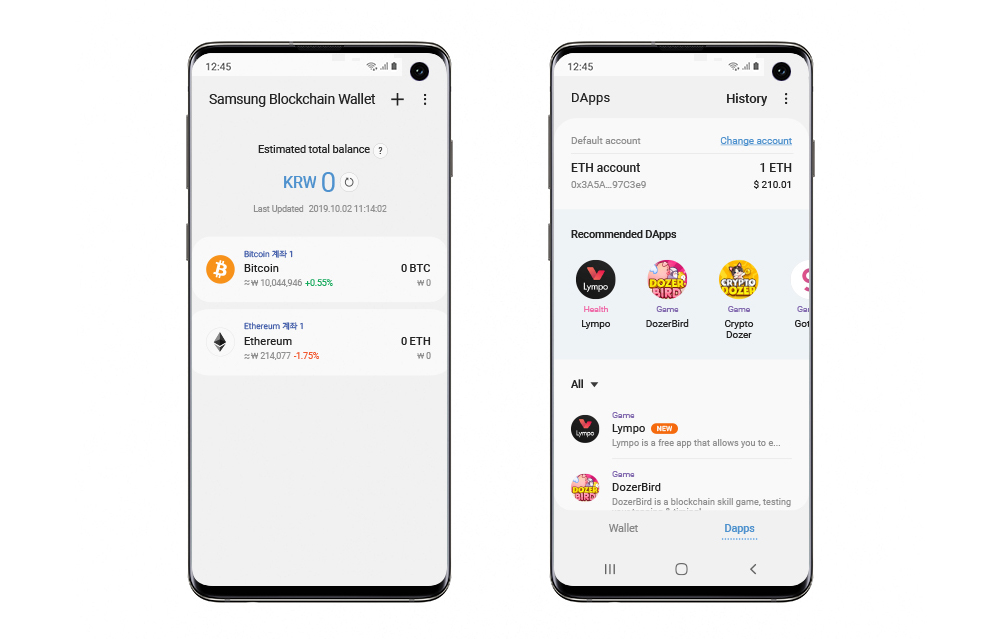
In 2021, the Samsung Blockchain Wallet added support for connecting to external hardware wallets like Ledger Nano S and Nano X, allowing users to view and manage related crypto assets through Galaxy devices.

The focus of products during this phase was on private key protection, asset management, and developer tools, primarily catering to those who already needed to use blockchain applications.

In 2022, Samsung launched Samsung Wallet, consolidating features like payment cards, membership cards, passwords, and digital keys into one app. The announcement at that time also stated that its crypto asset-related functionalities included centralized viewing of portfolio values from certain exchanges.

In the same year, Samsung also explored NFTs across different consumer electronics scenarios, but the scope of cooperation between TVs and Galaxy devices needs to be understood separately.

In the TV sector, Samsung collaborated with the NFT marketplace Nifty Gateway (which it had acquired) to provide NFT browsing, purchasing, trading, and display capabilities for certain TV products. Notably, Nifty Gateway officially announced its closure in February 2026.

Within the Galaxy ecosystem, Samsung signed Letters of Intent with partners like Theta Labs, planning to allow Galaxy NFT holders to access discounts, points, and other offline benefits through verification. The focus here was on connecting digital collectibles with consumer perks.

By 2025, Samsung's partnership with Coinbase further extended to payment gateways for crypto transactions. In July, they announced the integration of Samsung Pay within the Coinbase app, making it easier for eligible users to buy crypto assets or fund their accounts; in October, Samsung offered Coinbase One membership benefits to eligible Samsung Wallet users.

Compared to previous collaborations, the USDC functionality announced in October 2026 proposes a new product direction: offering a stablecoin transfer and cross-border remittance experience directly within the Samsung Wallet.

From this perspective, the scenarios Samsung is exploring are extending to more specific fund transfer needs. However, these represent attempts across different products and stages.

Investing in Upbit's Parent Company: Samsung Goes Deeper into Digital Asset Infrastructure

Beyond consumer-facing wallets, Samsung-affiliated companies have also entered the digital asset infrastructure field through equity investments.

An official statement from Samsung SDS shows that in May 2026, Samsung Securities, Samsung SDS, and Samsung Credit Card decided to collectively acquire a 4% stake in Dunamu, totaling 612.8 billion Korean Won (currently valued at $457 million). Among them, Samsung Securities took 2%, while Samsung SDS and Samsung Credit Card each took 1%. Dunamu is the operator of the South Korean crypto exchange Upbit.

Samsung SDS's subsequent Q2 earnings briefing described this investment as equity acquired in May, proposing to combine its own IT services, cloud computing, and security capabilities with Dunamu's blockchain technology to expand in the digital asset infrastructure market.

The same page also disclosed that Samsung SDS has been accumulating related technical capabilities through projects like the Korea Securities Depository's tokenized securities platform and the full-process verification of stablecoin issuance to settlement conducted with Korean financial institutions.

This indicates that Samsung SDS's work already involves technical aspects of stablecoin issuance and settlement. However, process verification is different from publicly issuing and operating a stablecoin.

Another point that needs clarification is the controversy surrounding the participant list for Open USD (OUSD) this year.

At the end of June, the stablecoin project Open Standard announced its US dollar stablecoin Open USD (OUSD) and a related list of companies. Names like Samsung Electronics, Dunamu, Visa, and Mastercard appeared in related reports.

However, according to a July 3 report by the Korean media Chosun Biz, several Korean companies listed stated that they had not engaged in formal cooperation discussions with the OUSD issuer. Companies like Dunamu stated they had only received inquiries about participation interest and had not formally confirmed joining.

Upbit also told Cointelegraph that it was not involved in the issuance of Open USD and had only expressed willingness to potentially participate in the expansion of the OpenStandard ecosystem in the future.

Three months later, Samsung Electronics officially announced support for USDC in Samsung Wallet. Compared to the controversial corporate list associated with OUSD, this collaboration has official announcements from participants like Samsung, Solana, and Sui, clarifying the launch plan and respective responsibilities.

Conclusion

Over the past seven years, Samsung and its affiliates have explored digital assets, starting from private key protection, asset management, and NFTs on mobile devices, extending to exchange platform partnerships and financial infrastructure. Now, with USDC entering Samsung Wallet, stablecoin transfers and cross-border remittances become a new business direction. However, online shopping and offline stablecoin payments belong to potential future additions.

Behind this, Samsung's greatest advantage may not be blockchain technology, but its vast base of device users and existing digital wallet ecosystem. For Samsung, the truly interesting aspect to observe will be whether stablecoins can transition from a crypto feature to a daily financial tool that ordinary users are willing to use.


Related Questions

QWhat is the key feature Samsung announced for Samsung Wallet in October 2026, and which stablecoin does it involve?

AIn October 2026, Samsung Electronics America announced it would introduce USDC (USD Coin) stablecoin functionality into the Samsung Wallet for eligible Galaxy users in the US. The feature will allow users to purchase and send USDC directly within the wallet.

QWhich companies are Samsung partnering with for its new stablecoin functionality in Samsung Wallet, and what are their main roles?

ASamsung is partnering with multiple companies: Coinbase (providing sub-custody for USDC via Coinbase Prime Vault), Bastion (handling asset custody, compliance, and cross-border remittances), Solana Foundation, and Sui (both providing blockchain network support for the USDC transfers and related features).

QWhat is one major advantage for users sending USDC on the Sui blockchain as part of this new Samsung Wallet feature?

AA major advantage for users sending USDC on the Sui blockchain through Samsung Wallet is the 'Gasless Stablecoin Transfers' feature, which allows users to send USDC without needing to hold SUI tokens to pay for network transaction fees.

QHow has Samsung's exploration of Web3 and digital assets evolved from 2019 to 2026 according to the article?

ASamsung's exploration has evolved significantly: starting in 2019 with integrating blockchain wallets and private key management into phones; expanding to NFT initiatives and partnership with Coinbase for crypto purchases in 2022-2025; and in 2026, focusing on direct stablecoin (USDC) transfers and cross-border remittance services within Samsung Wallet. Samsung affiliates have also invested in digital asset infrastructure, such as acquiring a stake in Dunamu, the operator of the Upbit exchange.

QWhat is Samsung's potential key advantage in promoting stablecoin usage, as suggested in the article's conclusion?

ASamsung's potential key advantage is not necessarily its blockchain technology, but its massive installed base of Galaxy device users and its existing digital wallet ecosystem (Samsung Wallet). The real test is whether stablecoins can transition from a crypto feature into an everyday financial tool that regular users are willing to adopt.

Related Reads

From QR Codes to Physical Goods: How Consumer RWA Verifies Products and Rights

A single QR code can be printed on two bottles and scanned twice to open the same page, so verifying a physical item requires confirming the binding between the bottle in hand and its listed number. Consumer RWA verification has two parts: whether the goods or services are real, and whether the rights recorded in the digital credential are valid. For rights provenance, take a co-branded gift box: authorization documents define the term and scope in which a brand may use the co-branded mark, production and warehousing records show whether the box was stocked by batch, and rights registration states what holders can redeem and who delivers it. Linking all three lets consumers check authorization scope, supply, and their own eligibility. Identifiers, events, and evidence must work together. High-value items can use unique serial numbers, uniform-spec goods can use batch numbers, and courses or events can use session numbers. Events such as warehousing, sampling, outbound shipment, receipt, and redemption should be tied to the corresponding object, with operation time and responsible party retained. Test reports correspond to submitted samples; linking results to specific goods also requires checking the sample, batch, and inbound/outbound records. Ordinary batch goods can combine serialized QR codes with abnormal-scan records, while high-value items may add tamper-evident labels or independent authentication. Trusted records must also reflect current status. If a coffee batch has 500 bags at warehousing, 10 used for sampling, and 100 reserved for other channels, then absent other changes, 390 bags remain available for new rights. The warehousing record shows historical quantity; current redeemable quantity must be updated based on actual occupancy. A query page should at minimum state the goods or service, evidence source, last update time, and whether the credential is currently usable.

marsbit15m ago

From QR Codes to Physical Goods: How Consumer RWA Verifies Products and Rights

marsbit15m ago

10 Years Is Too Slow: Gu Quanquan's Team Challenges Dario, Compressing Cancer Cure to 4 Years

A UCLA professor, Quanquan Gu, has founded Geodesic Intelligence, a 15-person startup that after only five months has released NovaAtom-Lite, an all-atom structure prediction model that outperforms DeepMind's Isomorphic Labs flagship IsoDDE on FoldBench, the toughest biomolecular benchmark. The model predicts the 3D coordinates of every heavy atom in protein, DNA, RNA, and ligand complexes with near-experimental precision. NovaAtom-Lite posted top scores on two core pharma tests: antibody-antigen binding (79.07% success, 31 points above AlphaFold 3 and 3.5 above IsoDDE, with 2.2x AlphaFold 3's accuracy at high-precision thresholds) and protein-ligand binding (top 1 on both RMSD and contact metrics). On the Runs N' Poses benchmark, which separates memorization from genuine physics understanding, NovaAtom-Lite's lead grows on the most novel, out-of-distribution ligands (47.6% vs AlphaFold 3's 24%), showing it learns transferable physical rules rather than memorizing structures. The model also supports test-time scaling—raising sampling from 1 to 100 seeds lifts antibody success from 74.3% to 83.1%—and condition constraints, where a single contact-pair hint boosts success to 91.28% and full pocket hints lift hard-case ligand accuracy by nearly 16 points. It solved two nightmare cases: a wildly flexible 22-residue MERS nanobody loop (0.56 Å error, all 25 samples correct) and the KRAS G13D hidden switch-II pocket (0.98 Å ligand RMSD vs OpenDDE's 17.74 Å). Gu previously led ByteDance's SeedFold, the first model to beat AlphaFold 3 on FoldBench, forcing Isomorphic Labs to respond with IsoDDE. A stronger NovaAtom-Pro is coming. Days after launch, a16z cited NovaAtom-Lite in a report arguing pharma is entering its "GPT-3 moment," naming Geodesic as the sole company highlighted in its industry map. Geodesic's closed loop spans structure prediction, scientific reasoning, and wet-lab validation—aiming to compress drug discovery from a decade to four years.

marsbit30m ago

10 Years Is Too Slow: Gu Quanquan's Team Challenges Dario, Compressing Cancer Cure to 4 Years

marsbit30m ago

Anthropic Misses Out on 'Largest IPO in History'—Who Should Foot the Bill?

Anthropic's IPO has gone from being touted as a potential record-breaking "largest IPO in history" to falling short of that title. Months ago, analysts estimated its IPO could surpass SpaceX, but current data shows it will not. Both its fundraising size and initial market capitalization fall below SpaceX's records of $75 billion raised and $1.78 trillion initial valuation. Anthropic's IPO is priced at $70–78 per share, offering 825 million shares, for a base fundraising of roughly $57.75–64.35 billion. Even with the 15% over-allotment fully exercised, proceeds would reach about $74 billion—still below SpaceX's $75 billion initial raise (and SpaceX's final over-allotment total of $86.25 billion). Anthropic's initial market cap is estimated at $1.26–1.41 trillion, well below both the earlier $2 trillion expectations and SpaceX's $1.78 trillion. However, combined with a $26 billion private placement, Anthropic's total fundraising could approach $100 billion. Three main factors are cited for the setback. First, after Democrats swept both chambers in the U.S. midterm elections, they pushed aggressive AI regulation, with some lawmakers calling for a pause on advanced AI development and a ban on superintelligence. Second, Nvidia founder Jensen Huang resigned as CEO amid a scandal, disrupting the AI supply chain; Nvidia was expected to subscribe about $10 billion of Anthropic's $26 billion private placement, and its instability threatens market confidence. Third, Anthropic's Q3 results show hidden concerns: revenue hit $16.956 billion (up ~11.27x year-over-year), but sequential growth slowed from 144.2% to 46.7%, new quarterly revenue fell from $6.824 billion to $5.401 billion, GAAP operating profit swung from a $974 million gain to a $567 million loss, and adjusted operating margin dropped from 19% to 15%. Notably, reports suggest Huang's ouster involved Democratic figures and media, and that Anthropic founder Dario and the company itself provided funding to related political organizations and donated tens of millions to Democratic midterm campaigns. In this light, Anthropic's dashed "largest IPO" dream is tied to its political bets.

Odaily星球日报1h ago

Anthropic Misses Out on 'Largest IPO in History'—Who Should Foot the Bill?

Odaily星球日报1h ago

Asian chip stocks tumble ahead of Nvidia Q3 earnings

Asian semiconductor stocks fell on Monday ahead of Nvidia's quarterly earnings, as analysts look for signs that the AI spending boom remains on track amid uncertainty over the chipmaker's leadership and future growth. Japanese chip-testing equipment maker Advantest dropped about 10.4%, semiconductor inspection equipment maker Lasertec declined more than 10.7%, and chipmaking equipment supplier Tokyo Electron fell 5.7%. South Korean memory-chip makers Samsung Electronics and SK Hynix lost 5.8% and 4.2%, respectively, while Taiwan Semiconductor Manufacturing Co. slipped 3.8%. The broad decline could reflect caution toward AI-linked stocks ahead of Nvidia's results, though the weakness came amid a wider sell-off in regional equity markets, with Japan's Nikkei 225 down 2% and South Korea's Kospi losing 2.6%. Nvidia is scheduled to release its fiscal third-quarter results on Tuesday, followed by an earnings call. The results will be Nvidia's first since founder Jensen Huang resigned as CEO. Investors and analysts will be watching how Nvidia responds to the AI demand boom while its leadership is in turmoil. Morningstar said it will be looking to see whether the mid-term elections have led to any concern about future demand and whether Nvidia's outlook for the industry has changed. In August, Nvidia forecast fiscal third-quarter revenue of $108 billion, plus or minus 2%, excluding any data center compute revenue from China. Analysts expect Nvidia to report slightly higher quarterly revenue of $109.3 billion, including $101.8 billion from its data center business, according to Visible Alpha consensus figures published by S&P Global Market Intelligence. S&P Global said revenue expectations had risen since the previous quarter on anticipated strength in Nvidia's Blackwell chips. Morningstar analysts also said they expect another "beat-and-raise quarter" out of Nvidia, given strong capex trends among hyperscalers and enterprises, adding they would be stunned if Nvidia provided an earnings miss or weak forecast. Nvidia shares closed Friday down 2.01% at $162.85.

cointelegraph1h ago

Asian chip stocks tumble ahead of Nvidia Q3 earnings

cointelegraph1h ago

Trading

Spot
活动图片