Pi Network Price Forecast: Can PI Hold $0.081 as Pi Outlines Its Stablecoin Plans?

cryptonews.ruPublished on 2026-10-09Last updated on 2026-10-09

Abstract

**Pi Network Price Forecast: Can PI Hold $0.081?** The price forecast for Pi Network (PI) on October 10 remains cautious below $0.0872, a level it must reclaim to reduce selling pressure after a recent drop. PI is currently trading around $0.0817, holding just above the Bollinger Band lower limit at $0.0811, a critical support level. The price remains below all key moving averages, with the 20-day EMA at $0.0871 acting as the first major resistance. Key support and resistance levels are identified at $0.0811/$0.0800/$0.0700 and $0.0871/$0.0899/$0.0948, respectively. In related news, Pi Network published a blog post on October 8 outlining its approach to stablecoins, stating that PI will remain the ecosystem's primary currency while stablecoins play a complementary role for payments. The network also confirmed a partnership with Open Standard, the company behind the $OUSD stablecoin. Despite a broader market rally, PI has fallen over 13% in the past month, while Bitcoin gained nearly 5%. This underperformance is attributed in a market report to high daily token unlocks outpacing demand. **Price Outlook:** * **Bullish Target ($0.09):** Possible if PI holds the $0.0811 support and reclaims the 20-day EMA at $0.0871. * **Bearish Risk ($0.07):** Likely if PI loses the $0.0811 support and closes below $0.0800.

The Pi Network price forecast for October 10 remains cautiously below $0.0872, a level PI must reclaim to alleviate pressure following a recent drop.

Pi Network Price Analysis: Can PI Maintain Bollinger Band Support?
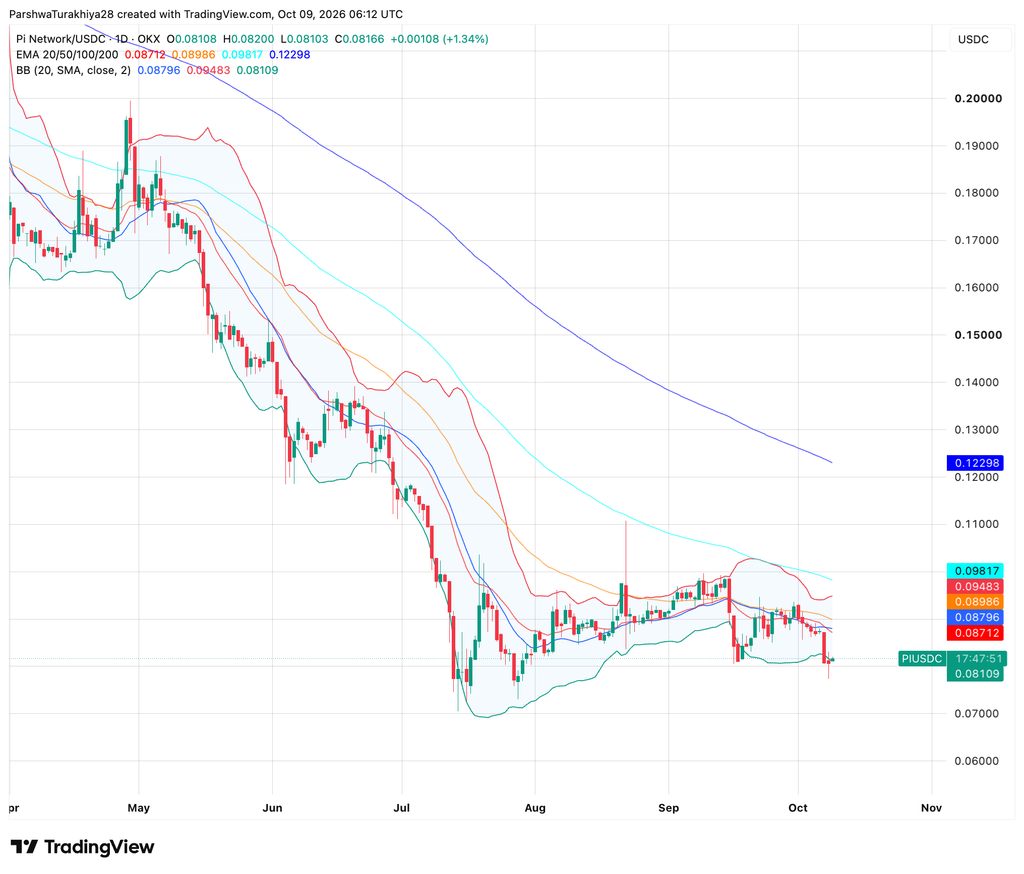
Pi Network Price Analysis (Source: TradingView)

PI is trading around $0.0817 today, up 1.34% after dipping to a low of $0.0810, which landed right on the lower Bollinger Band at $0.0811. This band has acted as support during the recent decline, so a close below it would be the first sign sellers are regaining control.

The price remains below all major moving averages, with the 20-day EMA at $0.0871 as the first hurdle on any bounce, followed by the 50-day at $0.0899. The 100-day and 200-day EMAs are significantly higher at $0.0982 and $0.1230, showing how far PI has fallen relative to its previous trend.

PI Support and Resistance Levels for October 10, 2026

Price Level
Resistance $0.0871
Resistance $0.0899
Resistance $0.0948
Support $0.0811
Support $0.0800
Support $0.0700

PI News: Pi Network Details Its Approach to Stablecoins

Pi Network published a blog post on October 8, explaining how it plans to integrate stablecoins into its ecosystem. The post states that Pi, the network's native token, should remain the primary currency within the network, with stablecoins playing a more niche and complementary role in cases where price stability is crucial for them, such as payments and settlements.

Related: Starknet Price Forecast: STRK Up 39% as Network Weighs First Layer Shift for Quantum Security

The post also mentions Pi's partnership with Open Standard, the company behind the $OUSD stablecoin, noting they share a similar philosophy as $OUSD is governed by a consortium of over 200 companies. Pi Network stated it would explore reward programs for its users, called Pioneers, as part of this partnership, though it did not specify a launch date or technical details, calling this phase one of establishing principles rather than releasing a product.

PI News: PI Down 13% Over Month, Bitcoin Up Nearly 5%

Pi Network (@PiCoreTeam) has seen its $PI token fall more than 13% over the past month, while $BTC and major altcoins posted gains over the same stretch.https://t.co/ciSzRv8pgv

— BSCN Newswire (@BSCNWire) October 8, 2026

PI has fallen over 13% in the past month, despite gains in the broader market, with Bitcoin up nearly 5% over the same period, according to a report citing BSCNews data. The token now ranks around 89th by market cap, significantly below its 2026 high around $0.27, reached earlier this year after listing on Kraken.

The report links the weakness to token unlocks outpacing demand, with Pi's exchange, automated market maker, and launchpad still largely operating in testnet rather than mainnet mode. It also notes a community proposal to add a token burn mechanism, though Pi Network has not yet indicated if it will respond.

Pi Network Price Forecast: Can PI Reach $0.09 or Fall to $0.07?

Bull Case, Target: $0.09

PI holds the lower Bollinger Band around $0.0811 and reclaims the 20-day EMA at $0.0871. This would open up the 50-day EMA at $0.09, and further development of the $OUSD partnership would add to the case.

Bear Risk, Risk Level: $0.07

PI loses the lower Bollinger Band at $0.0811 and the round-number support at $0.0800. Closing below this zone would open up $0.07, with strong token unlocks remaining a headwind.

Related: Cardano Price Forecast: ADA Rebounds to $0.24, But Can It Continue Rising?

FAQ: PI Forecast for October 10, 2026

What is the Pi Network price forecast for October 10, 2026?

Pi Network (PI) could recover toward $0.0871 and then $0.0899 if it holds the lower Bollinger Band around $0.0811. A close below $0.0800 would bring $0.0700 into play.

Why is PI falling while the rest of the crypto market rises?

PI has fallen over 13% in the past month, while Bitcoin is up nearly 5%, according to a market report. The report cites significant daily token unlocks—around 6.5 million PI per day—as a key reason demand is struggling to keep up.

What did Pi Network say about stablecoins?

Pi Network stated on October 8 that it plans to keep PI as the primary currency, while stablecoins will play a smaller, complementary role for payments and price stability. It also confirmed its partnership with Open Standard, the company behind the $OUSD stablecoin, with details to be released later.


Related Questions

QWhat is the key resistance level that Pi (PI) needs to reclaim according to the technical analysis in the article?

AAccording to the technical analysis in the article, the key resistance level that Pi (PI) needs to reclaim is $0.0872. Recovering this level is crucial to reduce selling pressure following its recent decline.

QWhat critical support level is provided by the Bollinger Bands for the PI token's current price?

AThe critical support level provided by the Bollinger Bands for the PI token is $0.0811, which is the lower band. The price recently tested this level, and a close below it would signal increased bearish control.

QAccording to Pi Network's October 8th blog post, what role will stablecoins play in its ecosystem?

AAccording to Pi Network's October 8th blog post, stablecoins will play a narrower, complementary role in its ecosystem. The native PI token will remain the primary currency, while stablecoins will be used for specific cases where price stability is crucial, such as payments and settlements.

QWhich company has Pi Network partnered with regarding stablecoins, and what is the associated stablecoin ticker?

APi Network has partnered with Open Standard, the company behind the stablecoin $OUSD (Open USD).

QWhat is one of the primary reasons cited in the article for PI's 13% price drop over the past month, despite broader market gains?

AOne of the primary reasons cited for PI's 13% price drop over the past month is significant daily token unlocks, reportedly around 6.5 million PI per day, which are outpacing demand and creating selling pressure.

Related Reads

The Lighter Attack: How a Single API Key Drained Tens of Millions of Dollars?

On November 16, a security incident hit Lighter, a decentralized perpetual contract trading platform. Roughly $15.48 million in USDC was drained from two large market-maker accounts (#714710 and #714723), though Lighter officially confirmed only that a single trader's API key was compromised—not the protocol or smart contracts. The attacker reportedly exploited a leaked API key that lacked direct withdrawal permissions by chaining legitimate product features: closing the victim's trading positions to free margin, creating a 0% fee public pool funded with about $10,000 from an attacker-controlled account to secure ~99.99% of pool shares, then using the victim account's internal transfer permissions to move USDC into the pool in ~$1 million batches. Because internal transfers between accounts linked to the same L1 address may not require additional signatures, and such transfers may not have minted new shares for the victim, the attacker's dominant share position appreciated and could be redeemed for the victim's funds. On-chain records show about 10.39 million USDC withdrawn via withdrawPendingBalance, then swapped through CoW Protocol into ~5,764 ETH/WETH, with some funds later moved to Hyperliquid and converted to XMR. Lighter's LIT token fell over 12% in 24 hours. Lighter attributed the root cause to the affected account using unofficial SDK signing code that reused nonces, allowing private key recovery from public signature data; the official SDK was unaffected. The Guardian mechanism paused withdrawals, the security committee returned about $5 million USDC, and deposits/withdrawals have resumed. Lighter now requires wallet signatures for transfers to public pools, makes API key signatures non-public, and plans IP whitelists, API key permissions and limits, plus monitoring for nonce reuse.

marsbit1h ago

The Lighter Attack: How a Single API Key Drained Tens of Millions of Dollars?

marsbit1h ago

Trading

Spot
活动图片