Moore Threads Plunges 20% to Limit Down in Early Trading, Company Responds

marsbitPublished on 2026-09-07Last updated on 2026-09-07

Abstract

On September 7th, China's domestic GPU maker Moore Threads' stock price hit the 20% daily limit-down during morning trading on the Sci-Tech Innovation Board (STAR Market). This marked the first such steep decline since its listing in December 2025. The immediate trigger was a large-scale unlocking of restricted shares. A total of 25.77 million IPO-related shares became tradable, representing 5.48% of the total shares and an estimated market value of approximately 13.39 billion yuan. This nearly doubled the company's tradable share count, placing significant short-term selling pressure on the market. In response, the company's securities affairs representative stated that the unlocking was a normal post-IPO event, with the shares primarily held by institutional investors from the initial offering. The company emphasized its operations remain normal with no major changes to its fundamentals, urging investors to view the price volatility rationally. Financially, Moore Threads' latest half-year report showed strong growth. Revenue for the first half of 2026 reached 1.74 billion yuan, a 147.42% year-on-year increase, surpassing its full-year 2025 revenue. While still reporting a net loss, the loss narrowed significantly compared to the same period last year. As a key player in China's domestic GPU sector, the company continues to advance its product lines for desktops and data centers. Market analysts note that while share unlockings cause short-term volatility, long-term stoc...

On September 7th, domestic GPU company Moore Threads hit the 20% limit down in early trading on the STAR Market. This marks the first time the company has experienced a 20% limit down since its listing on the STAR Market in December 2025.

As of the midday close, the company's stock price stood at 415.48 yuan, down 103.87 yuan or 20.00% from the previous trading day. Its total market capitalization fell below the 200 billion yuan mark, settling at approximately 195.3 billion yuan.
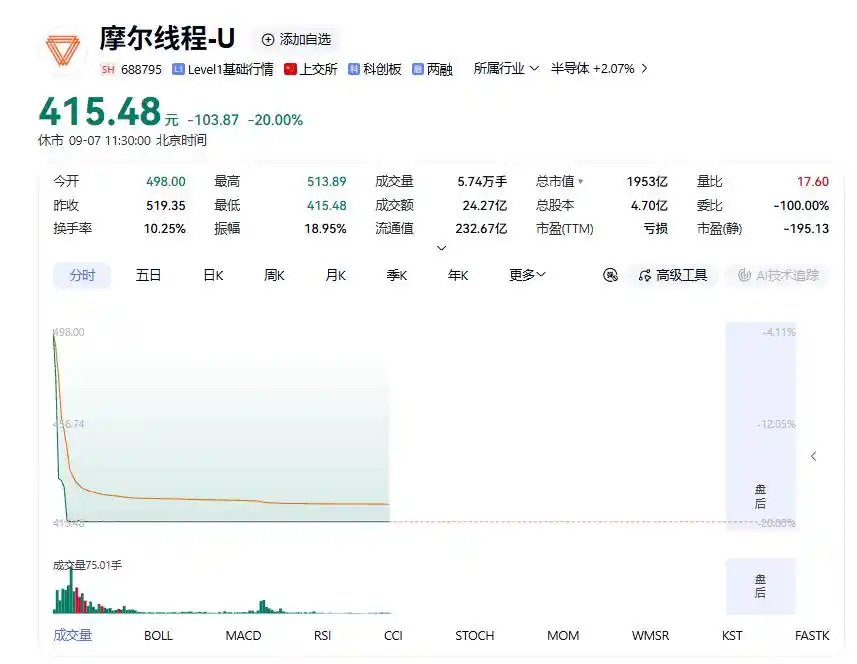
The direct trigger for this sharp stock price movement was the large-scale lifting of sales restrictions on shares. According to the company's previous announcement, on September 7th, a total of 25.7745 million shares of IPO offline placement shares became tradable upon the lifting of their sales restrictions. These shares account for 5.48% of the company's total share capital and were subject to a lock-up period of 9 months from the listing date. Based on the closing price of 519.35 yuan per share on September 4th, the market value corresponding to this batch of shares is approximately 13.386 billion yuan.

Prior to this lifting, Moore Threads had only 30.2255 million shares in public circulation. After the restriction lift, the number of publicly traded shares will increase to 56 million, nearly doubling the public float. For STAR Market stocks, which are often newly listed and have a relatively small public float, such a concentrated release of a large volume of tradable shares created significant selling pressure in the secondary market in the short term, serving as the core driver behind the stock price hitting the limit down.

From a broader market perspective, according to Wind data, a total of 16 listed companies had restricted shares becoming tradable on September 7th, with a combined volume of 521 million shares and a corresponding market value of approximately 27.785 billion yuan. Moore Threads' lifted shares were among the largest in terms of value on that day.

In response to the limit-down incident, Moore Threads quickly issued an official statement.

The company's securities affairs representative stated in an interview with the media that the day marked the lifting of restrictions on a large volume of shares from the offline placement during the IPO, which is a normal post-listing capital market event. The shares becoming tradable mainly belong to mutual fund institutions and offline investors who participated in the IPO subscription. The representative also emphasized that the company's current production and operations are normal, with no significant changes in its fundamentals. The company called on investors to rationally view the stock price fluctuations caused by the lifting and make rational investment decisions.

Other company personnel also told the media that this lifting of restrictions represents the normal expiration of the lock-up period for IPO shares, and the market does not need to overinterpret it.

From an operational perspective, the company's latest interim report data supports the assessment of stable fundamentals.

In the first half of 2026, Moore Threads achieved operating revenue of 1.736 billion yuan, a significant year-on-year increase of 147.42%, with revenue scale already surpassing the full-year 2025 level. Gross profit reached 989 million yuan, up 103.78% year-on-year, indicating synchronized improvement in profitability. On the profit front, the company's net profit attributable to shareholders and net profit attributable to shareholders after deducting non-recurring items narrowed by 95.73% and 52.37% year-on-year, respectively, showing significant reduction in losses and continuous improvement in profitability.

As a core player in the domestic GPU sector, Moore Threads continues to advance its product line layout in areas such as desktop graphics cards and data center GPUs. The industry logic of import substitution remains a long-term focus for the market.

It is worth noting that this lifting of restrictions is not the largest one for Moore Threads post-listing.

According to the IPO prospectus schedule, on December 7th, 2026, the company will face an even larger wave of lifted restrictions, with 185.9064 million restricted shares becoming tradable, accounting for 39.55% of the total share capital, leading to a more substantial expansion of the public float.

Some market analysts point out that short-term stock price volatility caused by the lifting of share restrictions is a normal market phenomenon. The medium- to long-term trend of a stock ultimately depends on the company's fundamentals and industry growth logic. Future developments in domestic GPU technology iteration and commercialization progress will be the core variables affecting the company's valuation.

Source: Galaxy Business Observation

This article is from "ZAKER Finance"

Related Questions

QWhat directly triggered the 20% drop in MTT's stock price?

AThe direct trigger was the large-scale lifting of trading restrictions (解禁) on locked-up shares from the initial public offering's offline placement. Approximately 25.7745 million shares, accounting for 5.48% of the total shares, became tradable.

QAccording to the company, what is the current status of its fundamental operations?

AAccording to the company's official response, its production and operations are normal, and there have been no significant changes to its fundamentals. Its latest semi-annual report also shows a significant year-on-year increase in revenue and a notable narrowing of losses.

QWhat major shareholder event is expected for Moore Threads in December 2026?

AAccording to the company's prospectus, a much larger-scale lifting of trading restrictions on locked-up shares is expected on December 7, 2026. Approximately 185.9064 million shares, representing 39.55% of the total shares, will become tradable, significantly increasing the free float.

QHow did the lifting of trading restrictions on September 7th affect Moore Threads' free float of shares?

APrior to the lifting, Moore Threads' free float was 30.2255 million shares. After the 25.7745 million shares were added, the free float increased to approximately 56 million shares, nearly doubling in size.

QWhat are the key factors mentioned in the article that will influence Moore Threads' valuation in the long run?

AThe article states that the company's long-term valuation will ultimately depend on its fundamental performance and industry growth logic. Specifically, the progress in technological iteration and the commercial adoption of its domestic (Chinese) GPU products are highlighted as the core variables.

Related Reads

Changing Gas Metering Could Break Smart Contracts? Ethereum Urgently Halts Hoodi Fork to Investigate Eight Major Security Risks

Ethereum core developers have paused the Hoodi testnet upgrade after security auditors found that two upcoming Gas improvement proposals could invalidate long-standing assumptions underpinning many deployed smart contracts. The proposals, EIP-8037 and EIP-8038, part of the Glamsterdam upgrade, aim to reprice state storage by decoupling state creation from state access and setting dynamic weights for certain opcodes, in order to curb unchecked growth of Ethereum's state data. However, this overhaul disrupts static Gas constants that developers have relied on as fixed system parameters. ChainSecurity identified eight invariant risks. Many contracts and off-chain infrastructure depend on hardcoded Gas limits, for example to prevent reentrancy or bound execution scope; higher costs could cause cross-contract calls to run out of Gas and revert. Other risks lie in error-handling logic that relies on precise prediction of inner execution costs, and in proxy contracts that forward Gas based on fixed ratios, potentially distorting execution paths or locking funds in incomplete state-machine branches. To avoid systemic compatibility failures and cascading disruptions across multisig wallets, bridges, and lending protocols, developers agreed at an ACD meeting not to hard-fork Hoodi until the affected contracts are fully mapped and compatibility guidance is issued. Because much logic lives off-chain in proprietary routing, settlement scripts, and liquidation bots, the Ethereum Foundation acknowledged it cannot audit the entire ecosystem alone. It has published a public repository detailing the eight affected invariants, sample problem code, and prompt templates for audit and scanning tools, so teams can check their own logic. Findings will be reviewed at next week's ACD meeting, when Hoodi activation conditions will be reassessed.

marsbit2h ago

Changing Gas Metering Could Break Smart Contracts? Ethereum Urgently Halts Hoodi Fork to Investigate Eight Major Security Risks

marsbit2h ago

What Exactly Drives the Value of Layer 1?

This analysis by Marc Arjoon, CFA, examines what actually drives Layer 1 valuation through time-series regression on major L1 assets. Short-term, all L1 price movements remain dominated by Bitcoin beta. Over longer horizons, Ethereum's market cap has fully decoupled from its own protocol revenue—a deliberate policy outcome of Dencun and higher gas limits rather than a demand collapse—with its 2025 rally driven instead by spot ETF and corporate treasury demand. Solana, by contrast, shows revenue and market cap moving in tandem, both rising ~15x since January 2023 and peaking the same week. Active addresses and DEX volumes show weak weekly correlations and large divergences despite long-cycle drift. Testing Metcalfe's Law, the fitted elasticity of market cap to active addresses is only 0.56 for Ethereum and 0.62 for Solana and BNB—closer to the square root of addresses than the square. None of six valuation multiples reliably mean-reverts; Mcap/REV is the only one that predicts positive 13-week returns from low valuation quantiles on Ethereum and TRON. No L1 has Bitcoin's deep holder base: only 4% of Solana and 10% of Ethereum supply has been dormant over three years versus 42% for Bitcoin. Ethereum's pricing anchors to peer capital share—59% of L1 market cap, 70% of DeFi TVL, 75% of tokenized RWA—rather than on-chain activity, where it holds just 5% of active addresses. Across chains, market cap rank correlates strongly with TVL (Spearman 0.87) and stablecoin supply (0.63) but weakly with transactions (0.17). The core conclusion: L1s are valued less as fee-generating businesses and more as monetary assets competing for capital settlement and liquidity share.

marsbit2h ago

What Exactly Drives the Value of Layer 1?

marsbit2h ago

Trading

Spot
活动图片