Ledger’s early implant warnings deserved more action, Karpelès says

cointelegraphPublished on 2026-10-17Last updated on 2026-10-17

Abstract

Former Mt. Gox CEO Mark Karpelès says Ledger received multiple reports of malicious hardware implants months before its latest security crisis, but issued no public warning. Security researcher Joe Grand alerted Ledger on March 4, 2026, about an implant in a Nano X bought via Lazada Thailand in August 2025; Ledger acknowledged and investigated internally but did not proactively warn customers. Karpelès said at least two people had contacted Ledger about tampered devices since December 2025. Ledger's crisis surfaced October 9, when losses were linked to wallets sold through Southeast Asian reseller CryptoBilis; Ledger confirmed one device had an unauthorized implant. The tampered device's Lazada seller, "LedgerXXX," was not an authorized Thai reseller. OneKey's sales head Archie noted marketplaces host many independent sellers, making authorized stores hard to identify; OneKey removed reseller listings pending stricter checks. Grand also alerted Trezor in August 2026 about tampered wallets from unauthorized TikTok and Facebook sellers. Trezor said counterfeit devices occasionally appear via unauthorized sellers and treats such reports as early warnings, while its no-compromise claim applies only to authorized resellers.

French hardware wallet maker Ledger received multiple reports of malicious hardware implants months before its latest security crisis, according to Mark Karpelès, former CEO of the collapsed Bitcoin exchange Mt. Gox.

Karpelès told Cointelegraph he was aware of at least two people who contacted Ledger about tampered devices dating back to December 2025. Karpelès said he hasn’t encountered any public warning Ledger issued in response.

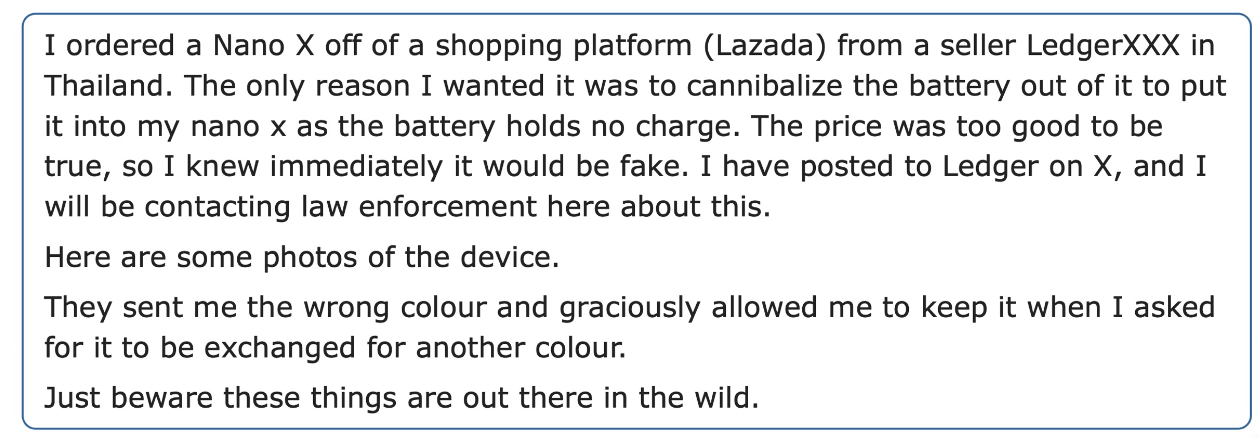
Joe Grand, a security researcher, told Cointelegraph he alerted Ledger on March 4, 2026, about a malicious implant in a Nano X purchased through online marketplace Lazada Thailand in August 2025.

Grand said Ledger acknowledged his findings and said it was investigating internally, but he criticized the company for not proactively warning customers about the threat.
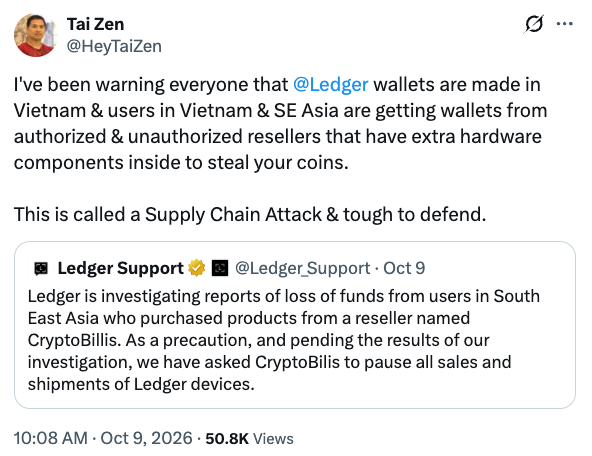
Vietnamese crypto educator Tai Zen contacted Ledger about a suspected hardware wallet implant in December 2025, according to Mark Karpelès. Source: Tai Zen

Ledger’s ongoing security crisis surfaced Oct. 9, when crypto losses were reported involving wallets sold through CryptoBilis, a reseller authorized in Southeast Asia. Ledger has confirmed that one affected device contained an unauthorized implant.

Ledger declined to comment when asked about its handling of Grand’s disclosure, and referred Cointelegraph to its public statements on X.

“Maybe Ledger not responding to a single event of an implant found on a Ledger purchased from a shady dealer is normal,” Karpelès said. He added:

However the increasing number of reports they must have received, and the increasing quality/technology used should have alerted them enough to act, and at least remind customers to be careful.”

Marketplace listings expose reseller verification gaps

In a presentation shared with Cointelegraph, Grand identified the seller of the tampered Ledger as “LedgerXXX” on Lazada. At the time of writing, LedgerXXX is not listed as an authorized reseller in Thailand, though Lazada’s Ledger storefront is.

Cointelegraph sought clarification from both Grand and Ledger on the seller’s identity and authorization status when the device was purchased.

OneKey’s head of sales, Archie, told Cointelegraph that marketplaces such as Lazada host numerous independent sellers, making it difficult for customers to distinguish authorized stores from other listings.
Source: Grand Idea Studio (Joe Grand)

Following the recent incidents, OneKey removed its reseller listings pending stricter checks, saying manufacturers must take responsibility for protecting customers rather than relying solely on buyers to identify trustworthy sellers.

Unauthorized wallet sales still raise security concerns

Grand’s findings were not limited to Ledger. In August 2026, he also alerted Trezor about tampered Trezor One and Model T wallets purchased from unauthorized sellers on TikTok and Facebook.

Trezor told Cointelegraph that counterfeit wallets occasionally appear through unauthorized sellers, as it had warned in 2022 about modified devices sold on Russian marketplaces. The company said that its recent claim of no evidence of compromised devices applied only to new wallets sold through authorized resellers.

Related: Trezor reduces resellers as a ‘preventative step’ amid Ledger tampering reports

Still, Trezor said it treats reports involving unauthorized sellers as early warnings and uses researchers’ findings to improve security checks.

“What changes the picture is a new technique, or a first case coming through an authorised channel,” Trezor said. “Either one means the problem has moved closer to ordinary buyers, and that’s when we’d move fastest, including warning customers directly.”

Magazine: Scammer Loses $4.8M Stored On Tampered Ledgers: Asia Express

Related Questions

QWhat did Mark Karpelès claim about Ledger's early implant warnings?

AKarpelès claimed Ledger received multiple reports of malicious hardware implants months before its latest security crisis, including at least two people contacting Ledger about tampered devices as far back as December 2025, and that he had not seen any public warning issued by Ledger in response.

QWho alerted Ledger about a malicious implant in a Nano X, and when?

ASecurity researcher Joe Grand alerted Ledger on March 4, 2026, about a malicious implant in a Nano X purchased through Lazada Thailand in August 2025.

QHow did Ledger respond to Joe Grand's disclosure according to the article?

ALedger acknowledged Grand's findings and said it was investigating internally, but Grand criticized the company for not proactively warning customers about the threat. Ledger declined to comment on its handling of Grand's disclosure and referred Cointelegraph to its public statements on X.

QWhat concerns about marketplace reseller verification gaps are highlighted in the article?

AThe article highlights that marketplaces like Lazada host numerous independent sellers, making it difficult for customers to distinguish authorized stores from other listings. Grand identified the seller of the tampered Ledger as 'LedgerXXX' on Lazada, which was not listed as an authorized reseller in Thailand at the time of writing.

QWhat did Trezor say about tampered devices from unauthorized sellers and how it handles such reports?

ATrezor said counterfeit wallets occasionally appear through unauthorized sellers, as it warned in 2022 about modified devices sold on Russian marketplaces, and that its recent claim of no evidence of compromised devices applied only to new wallets sold through authorized resellers. It also said it treats reports involving unauthorized sellers as early warnings and uses researchers' findings to improve security checks.

Related Reads

Vitalik "Exposes the Shortcomings" of Burn Efficacy, ETH Value Narrative Shifts

Vitalik Buterin argues that Ethereum should focus more on ETH's store-of-value property rather than relying on fee burning to support its valuation. He explains that fee-burning-based valuation rests on a net present value logic—market cap equals annual burned fees divided by discount rate—but this has never provided a truly solid floor. Much of the past burning came from activity within the crypto ecosystem itself, so if ETH's price fell sharply, that revenue would fall too. Only demand from outside crypto can make such a valuation floor convincing, and while RWA growth may help, mature businesses are unlikely to recreate the massive fee consumption seen during speculative frenzies. He also warns of the costs of pursuing fee burning: to justify ETH's ~$270bn market cap through burning, Ethereum would need to operate like a world-class corporation such as L'Oréal—requiring sustained R&D spending (potentially ~700k ETH per year, cutting validator income by roughly two-thirds), active governance, and higher gas prices that could exclude users most in need of privacy and security. Maximizing "price × usage" conflicts with letting as many people as possible use the network within safe resource limits. As a store-of-value asset, the most important metric is survival. Users value decentralization and CROPS (censorship and capture resistance, open source, privacy, security), which also matter to institutions. Ethereum should make prudent security tradeoffs, address quantum computing and AI risks, stabilize the core protocol, push innovation to layer 2, resist complexity and capture-prone reward mechanisms, and support privacy tools, account abstraction, FOCIL, and reduced infrastructure dependence. Store-of-value and application growth are synergistic: more native RWA and decentralized assets on L1 increase ETH's usefulness. Ethereum's social meaning is broad access to decentralization, privacy, and security—and ETH's value comes from these guarantees.

marsbit58m ago

Vitalik "Exposes the Shortcomings" of Burn Efficacy, ETH Value Narrative Shifts

marsbit58m ago

US Stock Market Trends (November 9): Nasdaq Rebounds 1% on Friday, Nvidia Launches Investigation into Jensen Huang Over the Weekend

US stocks closed mixed on Friday, November 6: the Nasdaq rebounded 1.09% to 24,579.42, the S&P 500 rose 0.31% to 7,376.86, and the Dow fell 237.33 points (-0.46%) to 51,285.73. Chip stocks partly recovered after Thursday's selloff, with Micron up about 5%, Nvidia up nearly 3%, AMD up as much as 9%, and Intel up nearly 7% intraday. For the week, the Nasdaq fell 3.4%, the S&P 500 lost 2.7%, and the Dow dropped 0.9%; the tech sector ETF (XLK) had its worst week since early April 2025, down about 8%. October nonfarm payrolls came in at 165,000, far above the 59,000 expected, while unemployment fell to 4.1%. Markets priced a roughly 76.8% chance of a 25-basis-point rate hike at the December 8-9 meeting. WTI settled at $90.83 a barrel, up 0.34%, but fell about 13% for the week; Brent settled at $98.32 and fell over 16% weekly. The 10-year Treasury yield closed at 4.86%. Over the weekend, Nvidia's board launched an independent investigation into reports that CEO Jensen Huang may have been a target of foreign intelligence activity. The board said there is no reason to believe national security or company secrets were compromised, and Huang will remain CEO. Huang admitted to an extramarital affair and apologized. On Monday in Asia, Japan's Nikkei 225 rose about 2% and Taiwan's weighted index gained over 2%, while US futures were mixed, with Nasdaq 100 futures down about 0.2%. Key upcoming events include US inflation data and Nvidia's Q3 earnings on November 17.

marsbit58m ago

US Stock Market Trends (November 9): Nasdaq Rebounds 1% on Friday, Nvidia Launches Investigation into Jensen Huang Over the Weekend

marsbit58m ago

Vitalik 'Exposes' the Limitations of Burning, ETH Value Narrative Shifts

Vitalik Buterin argues that Ethereum should focus more on ETH's store-of-value property rather than relying on fee burning to support its valuation. He explains that fee-burn-based valuation rests on a net present value logic—market cap equals annual burned fees divided by a discount rate—but notes this never provided a truly solid floor. Much of the burning during 2021–2023 came from within the crypto ecosystem itself, so if ETH's price fell, that revenue would fall too. Only demand from outside crypto can make such a valuation floor more convincing, and while RWA growth may help, mature businesses are unlikely to replicate the massive fee consumption seen during speculative manias. He warns that relying on fee burning to justify ETH's ~$270B market cap would require Ethereum to operate like a world-class corporation (roughly L'Oréal's scale), needing sustained R&D spending—perhaps ~700K ETH annually—and highly interventionist governance, both of which create political problems and undermine decentralization and anti-capture properties. Pursuing burning also implies pursuing higher gas prices, potentially excluding users who most need privacy and security; maximizing "price × usage" differs from maximizing safe access for as many people as possible. As a store-of-value asset, the most important metric is survival. Users most value decentralization and CROPS (censorship and capture resistance, open source, privacy, security), which also matter to institutions for risk management and compliance. Ethereum should make prudent security tradeoffs, address quantum computing and AI risks, stabilize the core protocol while shifting innovation to upper layers, and resist complexity-adding features and capture-prone reward mechanisms. Users should be able to hold assets safely and privately, with confidence transactions won't be blocked. Reducing dependence on infrastructure providers matters—he can run a node on a laptop, syncing in under six hours with about one-eighth of disk space, better than 2019. Store-of-value and application growth are synergistic: more native RWA and decentralized assets on L1 increase what holding ETH enables—trustless swaps or using ETH as collateral—boosting its utility, with tradeoffs smaller than maximizing fees.

Odaily星球日报1h ago

Vitalik 'Exposes' the Limitations of Burning, ETH Value Narrative Shifts

Odaily星球日报1h ago

ICLR 2027 First Round Review: Quite a Few Pain Points

ICLR 2027's first-round reviews have sparked widespread complaints among researchers, with many sharing examples of poor-quality or clearly AI-generated feedback on social media. One reviewer asked an author to explain what "standard deviation" means; another review began with the telltale chatbot opener "Certainly! Here is a review of the paper," while two other reviews appeared to be near-identical copies of the same template. One author received criticism for using AI-assisted writing despite having properly disclosed it, and another reviewer openly admitted lacking the expertise to evaluate the paper—prompting debate over whether the real fault lies with reviewer assignment rather than the reviewer. A recurring concern, raised by Jiaxin Pei of UT Austin, is that AI reviewers cannot distinguish between a paper's ordinary limitations and the critical flaws that actually undermine its core contributions. Large language models can list hundreds of limitations for any paper, including the best ones, but they cannot judge which issues truly matter. As a result, reviews grow longer and demand more experiments while the real determinants of paper quality get buried. ICLR 2027 organizers have acknowledged the strain: rapid growth in submissions, a shortage of qualified reviewers, and AI lowering the barrier to paper production. They introduced measures including submission caps, stricter reciprocal review obligations, and rules permitting limited, disclosed AI use in reviewing—with penalties for low-quality or hallucinated AI-generated reviews. Author-reviewer discussion runs until November 18, with final decisions expected December 16.

marsbit1h ago

ICLR 2027 First Round Review: Quite a Few Pain Points

marsbit1h ago

Without Warning, OpenAI Suddenly Mass-Bans Accounts

OpenAI has abruptly banned a large number of ChatGPT accounts without prior notice or email warnings, deleting accounts outright. Affected users see only an error message stating their account has been deleted or deactivated. The purge heavily targets accounts in the Philippines and Turkey, low-cost Team plans, and accounts using reverse proxy relays, and even long-standing paying users with months of subscription have been hit. Free API accounts, shared team accounts, and $200/month Pro accounts were all affected. Developers report losing years of conversation history and personal data locked in the cloud, with appeals unsuccessful. Some speculate OpenAI is cracking down on account stacking to prevent users from exploiting cheap subscriptions. OpenAI's status page showed elevated error rates for some US commercial Mastercards, though OpenAI characterized the incident as a payment channel issue rather than account bans. Users are advised to appeal via OpenAI's official form with account details and Request ID. This move follows earlier steps: OpenAI previously merged ChatGPT and Codex into a single token pool and, five days ago, imposed device and payment card limits, preventing multiple paid subscriptions on one card or device. Starting November 20, new usage policies require third-party API gateways to obtain official written authorization, and from December, Plus, Pro, and Business plans will share a single quota calculated by token consumption. Users are advised to regularly back up cloud conversations and sync Codex projects locally, as the era of freely exploiting AI compute appears to be over.

marsbit1h ago

Without Warning, OpenAI Suddenly Mass-Bans Accounts

marsbit1h ago

Trading

Spot
活动图片