Justin Sun Prize’s new round honors human–AI collaboration on Erdős problems

cointelegraphPublished on 2026-10-06Last updated on 2026-10-06

Abstract

On October 5, 2026, the Justin Sun Prize announced new recipients for contributions to solving Erdős problems: independent researcher Wouter van Doorn, Ph.D. student Quanyu Tang, and researcher Yanyang Li. Their collaborative work resolved multiple long-standing mathematical questions from a catalog of over 1,200 problems. Notably, they solved Erdős Problem #650, a project that exemplified human-AI collaboration, utilizing ChatGPT for proof strategy and the Aristotle AI system to assist in formal verification with the Lean software. Van Doorn also produced computer-checkable proofs for problems #369, #457, and #469, while Tang resolved #1044 and contributed to #1196. The prize emphasizes rigorous, verifiable proof and supports advances in mathematics, formal verification, and AI-assisted discovery. Awards are distributed in cryptocurrency.

Geneva, Switzerland, October 5, 2026 — The Office of Justin Sun today announced the newest recipients of the Justin Sun Prize: independent researcher Wouter van Doorn, mathematics Ph.D. student Quanyu Tang, and mathematics researcher Yanyang Li from Nanjing’s Southeast University, recognized for contributions spanning six Erdős problems.

Wouter van Doorn is an independent number theorist who began researching mathematics as an undergraduate in 2010 and continued collaborating and publishing after leaving academia following his master’s degree. Quanyu Tang (汤泉宇) is a mathematics Ph.D. student at the University of Science and Technology of China whose research spans number theory, combinatorics and AI-assisted mathematical discovery.

Erdős problems are mathematical questions posed or popularized by Hungarian mathematician Paul Erdős about numbers, patterns and other mathematical structures. Often simple to state but difficult to solve, they have helped shape research in number theory and combinatorics, with some remaining open for decades. The Erdős catalog, compiled and maintained by Thomas Bloom, a mathematician and Royal Society University Research Fellow at the University of Manchester, has more than 1200 problems.

Van Doorn and Tang worked with Yanyang Li, from Southeast University’s School of Mathematics in Nanjing, to solve Erdős Problem #650, determining exactly how many integers can always be matched to distinct multiples within a specified interval. Van Doorn also produced computer-checkable proofs in Lean, software for verifying mathematical reasoning, for #369, concerning consecutive integers with restricted prime factors; #457, about whether a short run of consecutive integers can collectively contain every prime in a given range; and #469, concerning whether the reciprocals of a special class of numbers expressible as sums of their divisors add to a finite total.

Tang separately resolved #1044, establishing a sharp lower limit for boundary lengths of regions defined by polynomials, and contributed alongside Li to a wider team’s solution of #1196, bounding weighted sums over sets of integers in which no member divides another.

Their work on #650 offers a concrete example of how human judgment and AI can complement each other. ChatGPT helped develop the proof strategy, while Aristotle, an AI system for mathematical reasoning, repaired a gap during Lean formalization. The researchers then simplified the argument and wrote the final proofs and exposition.

“This experience taught me how public feedback can sharpen a research question, and how AI-assisted discovery can combine mathematical judgment, collaboration and rigorous verification,” Tang said.

These are the program’s first confirmed awards, recognizing both mathematical discovery and the work needed to make proofs independently checkable. Information about the Justin Sun Prize, its problem catalog and recipient contributions is available through the program’s public GitHub repository.

The prizes will be paid out in either USDT on TRON (TRC-20) or USDC on Ethereum (ERC-20) based on the recipient’s choice. For more information, please visit www.hejustinsun.com/prize.

About the Office of Justin Sun

The Office of Justin Sun supports Justin Sun’s global business, philanthropic and public initiatives across technology, blockchain, artificial intelligence, scientific research, investment, art and space exploration.

Justin Sun is the Ambassador and former Permanent Representative of Grenada to the World Trade Organization and the Founder of TRON. TRON is the leading blockchain for the stablecoin revolution, processing over $13 trillion in volume since its inception. In the world’s emerging markets, people rely on USDT on TRON to access the global financial system.

A protégé of Alibaba founder Jack Ma, Sun has been recognized internationally for his work in the digital asset industry, including a Forbes cover profile in April 2025 and multiple appearances on the Forbes 30 Under 30 list. In August 2025, he flew aboard Blue Origin’s NS-34 mission, becoming the 712th person in history to travel to space. His broader interests span technology, investment, philanthropy, art, gaming, and space exploration.

Office of Justin Sun Contact:

info@hejustinsun.com

About Justin Sun Prize

The Justin Sun Prize is an academic initiative established by Justin Sun to support advances in mathematics, formal verification, and AI-assisted scientific discovery. The prize is decentralized and built around the principle that mathematical work should be judged by the strength, rigor, and verifiability of the proof itself, not the prestige or reputation of those submitting it.

Justin Sun established the prize in his own name as a long-term commitment to return wealth created through mathematics and technology back to mathematics itself. Its legacy is intended to be defined by the body of work it recognizes and the laureates whose discoveries stand the test of time. The prize links clearly defined mathematical challenges to machine-verifiable proof. Its guiding principles are openness, public benefit and open-source access.

Visit https://www.hejustinsun.com/prize for more information.

Media contact

thejustinsunprize@hejustinsun.com
Trending Cryptos

Related Questions

QWho are the recipients of the latest round of the Justin Sun Prize and what is a key aspect of their recognized work?

AThe recipients are independent researcher Wouter van Doorn, mathematics Ph.D. student Quanyu Tang, and mathematics researcher Yanyang Li. A key aspect of their work is their contributions to solving multiple Erdős problems, with their work on problem #650 highlighting human-AI collaboration.

QWhat is an Erdős problem and who maintains a major catalog of these problems?

AErdős problems are mathematical questions posed or popularized by Hungarian mathematician Paul Erdős. They are often simple to state but difficult to solve. A major catalog of over 1200 such problems is compiled and maintained by Thomas Bloom, a mathematician and Royal Society University Research Fellow at the University of Manchester.

QIn the solution to Erdős Problem #650, what specific roles did AI tools ChatGPT and Aristotle play according to the article?

AIn the solution to Erdős Problem #650, ChatGPT helped develop the proof strategy, while the AI system Aristotle repaired a gap during the Lean formalization process. The researchers then simplified the argument and wrote the final proofs and exposition.

QWhat are the stated guiding principles of the Justin Sun Prize as described in the article?

AThe stated guiding principles of the Justin Sun Prize are openness, public benefit, and open-source access. It is built around the principle that mathematical work should be judged by the strength, rigor, and verifiability of the proof itself.

QHow are the Justin Sun Prize payments made to recipients?

AThe prize payments are made in the form of either USDT on the TRON network (TRC-20) or USDC on the Ethereum network (ERC-20), based on the recipient's choice.

Related Reads

Nomura Research Report Interpretation: US Stock ETFs Absorb $6.9 Billion in a Single Week, Stock-Bond Divergence Continues to Intensify

Nomura's FX Insights report, dated November 16, 2026, notes that although foreign inflows into U.S. equity ETFs and mutual funds rose to $6.9 billion in the week of November 9–13, up from $5.4 billion the prior week, the dip-buying momentum slowed somewhat in the latter half of the week. Nearly 39% of the weekly total (about $2.5 billion) flowed in on November 9 alone, extending the bargain-hunting seen after the previous week's selloff, when $2.1 billion entered on November 6. Daily buying stayed above $1 billion (November 11: $1.6 billion; November 12: $1.4 billion), but Nomura says the overall pace has begun to ease slightly. Divergence between equities and bonds is intensifying. U.S. bond ETFs and mutual funds saw $287 million of net outflows during the week, extending the prior week's $182 million outflow. Emerging-market thematic ETF inflows fell to $1.4 billion from $2.2 billion, with the split again favoring equities: $1.9 billion into stock funds versus $425 million of net outflows from bond funds. Asia-Pacific cross-border flows showed clear signs of braking. Net purchases of U.S. portfolio assets by previously active Korean retail investors plunged to $768 million from $2.6 billion, driven mainly by a sharp contraction in Korean retail buying of U.S. stocks. Taiwanese investors continued selling dollar assets, offloading another $439 million of USD-denominated bonds after net sales of $697 million the prior week.

marsbit35m ago

Nomura Research Report Interpretation: US Stock ETFs Absorb $6.9 Billion in a Single Week, Stock-Bond Divergence Continues to Intensify

marsbit35m ago

Goldman Sachs Research Report Interpretation: S&P 500 Seen Rising to 8,700 by End of Next Year, AI Investment Shift Spawns Four Major Themes

Goldman Sachs' 2027 US equity outlook, dated November 17, 2026, argues the bull market isn't over but has entered its middle phase. Healthy economic fundamentals and sustained AI investment should lift the S&P 500 to 8,700 by end-2027, implying roughly 17% upside. However, as AI capex growth peaks, market focus shifts from infrastructure spending to practical monetization. Earnings growth will cool: S&P 500 EPS growth slows from about 30% in 2026 to 11% in 2027 (core growth around 18% excluding tech giants' investment income). Valuation looks relatively safe—the 12-month forward P/E contracted 19% in 2026 to about 18x, near the 10-year average. The 8,700 target is derived from 2028 earnings estimates at 18x P/E; with high rates and AI uncertainty, systemic multiple expansion is unlikely, so gains must be earnings-driven. The AI relay baton is passing. Hyperscaler capex contributed 12 percentage points of 2026 index earnings growth, but its year-over-year growth is expected to plunge from 105% to 73% in 2027, with depreciation pressure eroding profits—by 2028, cloud capex could be a 5-point net drag on S&P 500 earnings. Goldman favors companies that can genuinely monetize AI or use it to boost productivity, especially asset-heavy, physical-economy productivity beneficiaries. Corporate leverage is rising: investment-grade and high-yield issuance could reach $2.8 trillion in 2027, with cloud providers borrowing heavily on and off balance sheet. Buyback growth stalled in Q3, with the buyback yield at 1.4%—a 20-year low outside recessions. "Buyback aristocrats" with strong free cash flow and sustained share reduction are scarce assets. With earnings growth near single digits, style tilts toward self-sustaining growth. Goldman likes secular growth stocks, favoring energy infrastructure (rare earnings acceleration) and transportation (cyclical upside). Defense matters too: high earnings concentration is a risk, so cheap healthcare and some consumer staples offer protection, while mid-caps—with underextended earnings and low P/Es—help diversify mega-cap risk. This is a summary of third-party research; ratings, targets and forecasts are the analyst's views, not investment advice. Markets carry risk; decisions should be independent.

marsbit45m ago

Goldman Sachs Research Report Interpretation: S&P 500 Seen Rising to 8,700 by End of Next Year, AI Investment Shift Spawns Four Major Themes

marsbit45m ago

Gold Rush 2027: Wall Street Giants Predict Bull Market Endures, Opportunities Hidden in Structural Trends

Global markets enter 2027 at a crossroads, balancing AI-driven FOMO against bubble fears, lingering inflation, and geopolitical risk. Major Wall Street outlooks converge on one theme: AI remains the dominant investment thesis, but storytelling alone no longer justifies valuations. Morgan Stanley upgraded global equities to overweight with an S&P 500 target of 8,700 by end-2027, citing EPS growth from $369 to $420. Goldman Sachs sees roughly 16% total return for the S&P 500 over 12 months, though it warns of a "Great Halving" in earnings growth—S&P 500 EPS growth falling from 36% to 11%. Stocks can still rise because tech valuations have compressed to the 20th percentile of the past two decades. AI capex is projected at $1.8 trillion in 2027, but hyperscaler spending growth is peaking and depreciation pressures are mounting, challenging AI "shovel sellers." China assets are being re-rated, with Goldman overweight Hong Kong and Morgan Stanley preferring A-shares. Energy and infrastructure emerge as hard constraints: the world faces a $106 trillion infrastructure gap, and grid upgrades, transformers, and storage are high-conviction plays. Oil could fall to $78/barrel, but Middle East escalation is the biggest tail risk. In asset allocation, the Beta era is ending. Goldman favors "growth scarcity"—overweight US and Japan, underweight Europe. Morgan Stanley stresses quality and recommends overweight US Treasuries as a hedge. Bonds are back, with global aggregate yields at 5.3%, a two-decade high, and negative stock-bond correlation likely to return. Alternatives gain ground; JPMorgan estimates 30% in diversified alternatives lifts expected returns to 7.5% and Sharpe ratios by 21%. It also quantified Bitcoin for the first time—10% base-case annualized return, 55% volatility—but excluded it from strategic allocation. Overall, 2027 rewards discipline: dancing with volatility and locking in genuine value as growth becomes scarce.

marsbit55m ago

Gold Rush 2027: Wall Street Giants Predict Bull Market Endures, Opportunities Hidden in Structural Trends

marsbit55m ago

All Four Lines of Defense Broken: How Many Cards Does Bitcoin Have Left to Play?

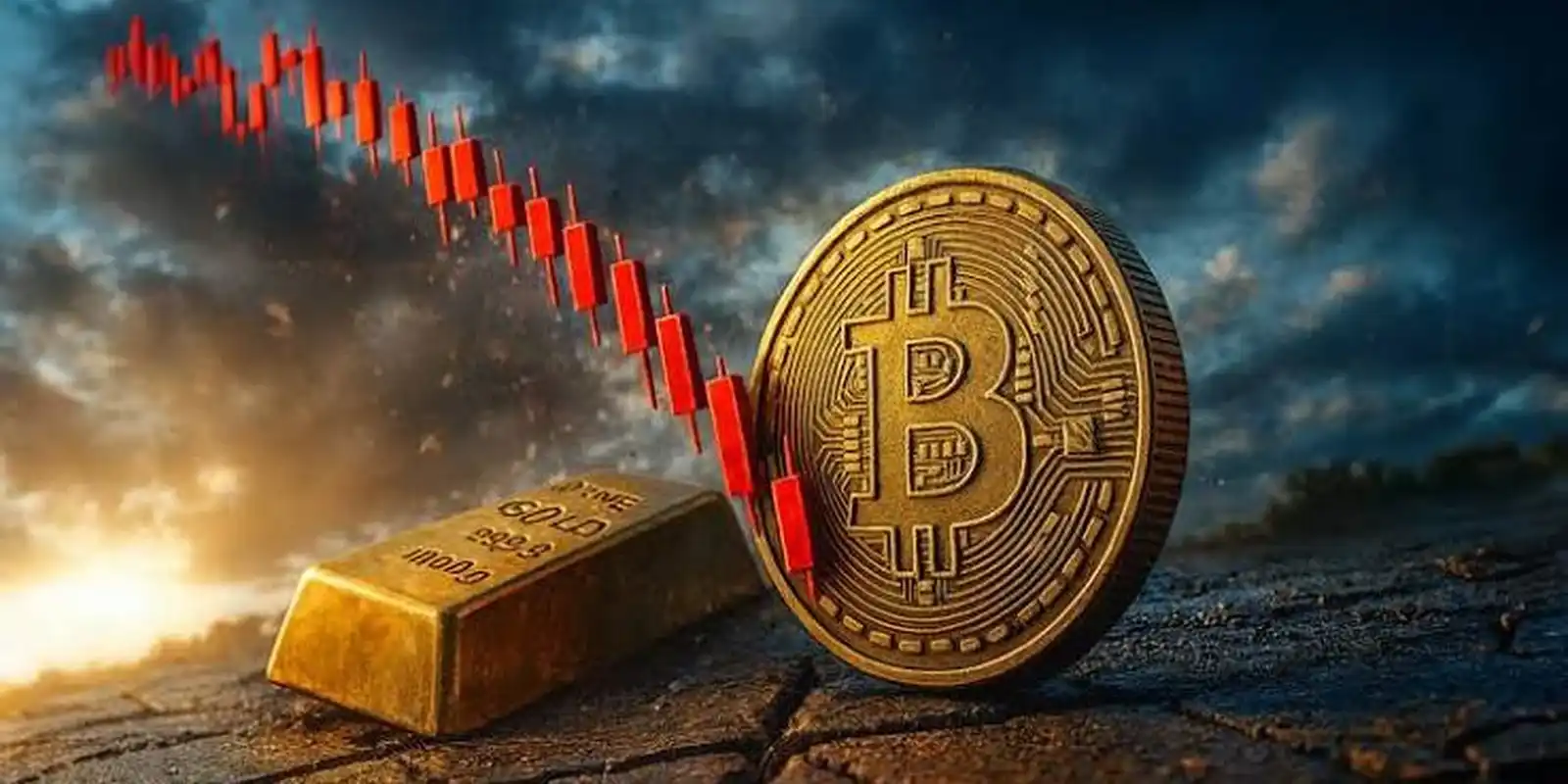
Bitcoin fell from $74,000 to $61,900 in five days, triggering over $300,000 liquidations and wiping more than $100 billion from total crypto market value. The fear index hit 10, a level last seen in June. The selloff was triggered by October CPI at 0.4% month-over-month versus 0.3% expected, pushing December rate-hike odds to nearly 90%. Bad news piled up: BlackRock's IBIT saw its longest outflow streak, MSCI announced removing Strategy from US indexes (potentially $2.8 billion in passive selling), Nvidia's CEO resigned, and Middle East tensions escalated. The Fed's September rate cut cycle has reversed into tightening, with officials warning of further hikes, while the Bank of Japan may raise rates again in December, risking yen carry-trade unwinds. All four major cost baselines are broken: ETF average cost ~$81,500, market average ~$77,500, short-term holder cost ~$75,600, and Strategy's ~$75,400. About 4 million BTC bought between $85,000 and $118,000 are underwater. MVRV fell to ~1.2, still above the below-1.0 level historically seen at bear-market bottoms. Both 2018 and 2022 saw lower second bottoms. Galaxy's base case targets $40,000–46,000. However, mid-sized wallets and Strategy keep accumulating, spot volume rose 24.5%, and some argue leverage has cleared with most macro bad news priced in. December brings the Fed meeting, BOJ meeting, and Deribit options expiry; ETF flows, stablecoin supply, and MVRV will determine direction.

marsbit1h ago

All Four Lines of Defense Broken: How Many Cards Does Bitcoin Have Left to Play?

marsbit1h ago

Trading

Spot

Hot Articles

How to Buy SUN

Welcome to HTX.com! We've made purchasing SUN (SUN) simple and convenient. Follow our step-by-step guide to embark on your crypto journey.Step 1: Create Your HTX AccountUse your email or phone number to sign up for a free account on HTX. Experience a hassle-free registration journey and unlock all features.Get My AccountStep 2: Go to Buy Crypto and Choose Your Payment MethodCredit/Debit Card: Use your Visa or Mastercard to buy SUN (SUN) instantly.Balance: Use funds from your HTX account balance to trade seamlessly.Third Parties: We've added popular payment methods such as Google Pay and Apple Pay to enhance convenience.P2P: Trade directly with other users on HTX.Over-the-Counter (OTC): We offer tailor-made services and competitive exchange rates for traders.Step 3: Store Your SUN (SUN)After purchasing your SUN (SUN), store it in your HTX account. Alternatively, you can send it elsewhere via blockchain transfer or use it to trade other cryptocurrencies.Step 4: Trade SUN (SUN)Easily trade SUN (SUN) on HTX's spot market. Simply access your account, select your trading pair, execute your trades, and monitor in real-time. We offer a user-friendly experience for both beginners and seasoned traders.

11.3k Total ViewsPublished 2024.03.29Updated 2026.06.02

How to Buy SUN

Discussions

Welcome to the HTX Community. Here, you can stay informed about the latest platform developments and gain access to professional market insights. Users' opinions on the price of SUN (SUN) are presented below.

活动图片