How Cryptocurrency Owners Lose Fortunes Due to a Single Blockchain Mistake

cryptonews.ruPublished on 2026-09-14Last updated on 2026-09-14

Abstract

Crypto investors can lose fortunes not only due to hacks, but also from simple user errors in blockchain operations. This article details how mistakes like incorrect swap routes, address poisoning, wrong network selection, or granting excessive smart contract permissions can lead to irreversible losses worth millions of dollars from a single signed transaction. Key failure scenarios include: major swaps executed through pools with insufficient liquidity, causing extreme price slippage and massive losses (examples on Solana, Aave, and Cardano); sending funds to incorrect or poisoned addresses, turning transfers into non-recoverable losses (e.g., a $71M WBTC loss); and granting long-lasting smart contract approvals that can later be exploited (e.g., a $13.4M loss via SwapNet). The core issue is that blockchain networks execute transactions exactly as signed, without evaluating user intent. Unlike traditional finance, where intermediaries can intervene, crypto transfers are final once confirmed. Therefore, full control over assets also means full responsibility. The article concludes with critical safety practices: fully verifying addresses, checking networks, assessing swap liquidity and output, revoking unused approvals, using hardware wallets, and understanding common phishing tactics. Ultimately, the power of self-custody carries the risk of losing everything with one erroneous signature.

Cryptocurrency owners lose fortunes not only after hacks: sometimes an incorrect swap route, an error in an address, choosing the wrong network, or granting one extra permission to a smart contract is enough for million-dollar investments to virtually disappear after a single signature.
Cryptocurrency gives users direct control over their money, but along with it transfers almost all responsibility to the owner. The blockchain does not evaluate a person's intentions. If the parameters are confirmed, the network executes the command as it was signed: it sends tokens to the specified address, conducts an exchange based on available liquidity, or allows a contract to use assets.

This is why an error in a wallet interface or on a DeFi platform can cost more than ordinary market volatility. Even if the asset remains valuable on the books, after an incorrectly signed transaction, it is often already impossible to recover.

Most often, such losses result from several scenarios: phishing, address poisoning, incorrect network selection, improper permissions to smart contracts, errors in swap routing, and social engineering. The scale can be enormous: one signature or one copied address in such situations has led to losses of millions and tens of millions of dollars.

The price of crypto assets can fall not only due to normal volatility. Pressure on the market is intensified by hacks, regulatory bans, technical failures, mass liquidations, and liquidity shortages—therefore, a technical error sometimes turns into a personal portfolio crash for the owner.

A Large Swap Can Destroy the Price on Its Own

One recent case occurred on the Solana network. A user attempted to exchange about 7.8 million STONKS tokens, which were valued at approximately $1.8 million. But the deal went through a Raydium route with extremely weak liquidity. As a result, the user received only about 26.8 RAY, or roughly $25.
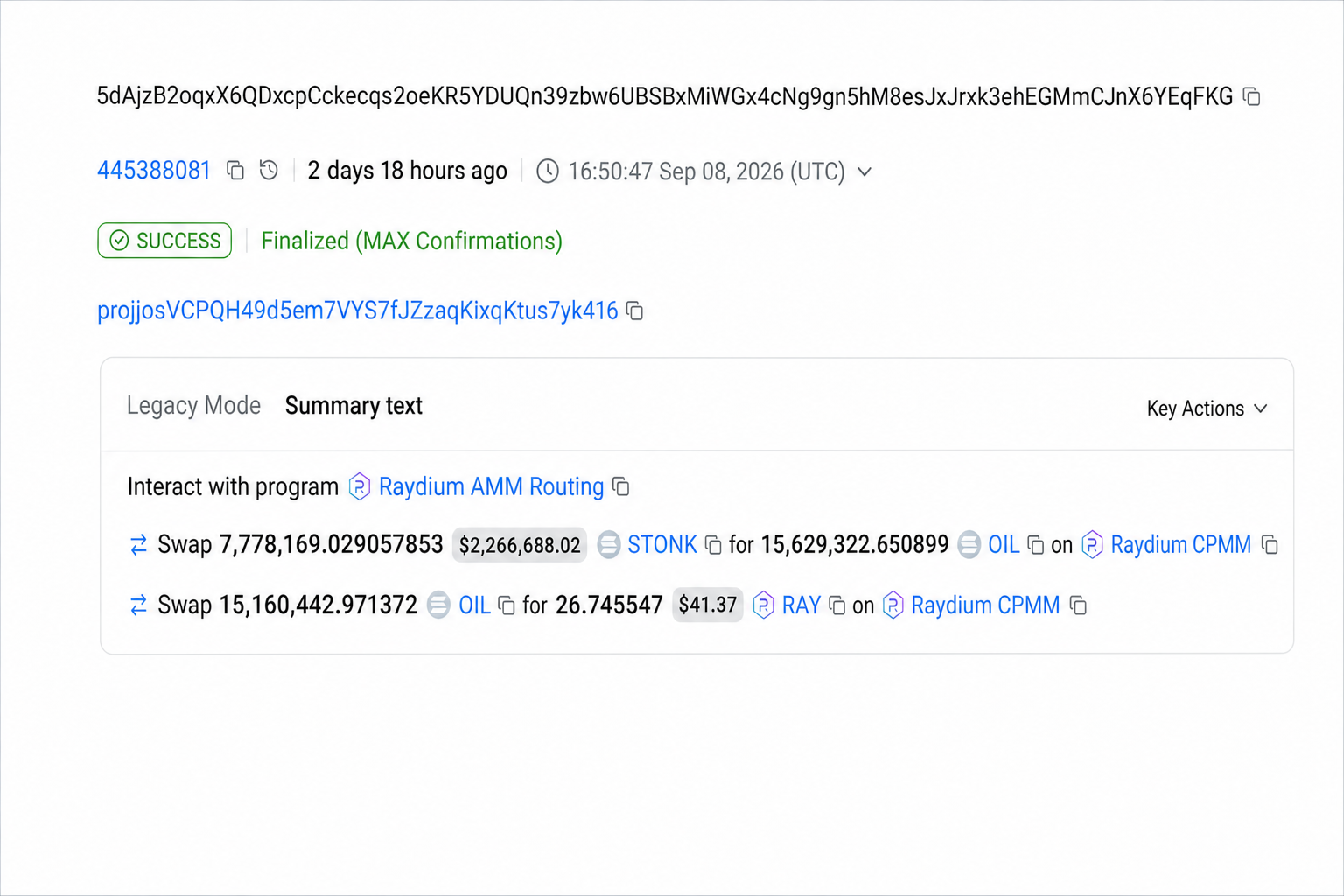
From a technical standpoint, everything was correct: the tokens were debited, the exchange took place, and the result was recorded on the blockchain. The error was not in the network's operation but in the execution price. The liquidity pool simply could not handle such a volume without a sharp skew.

When a trade passes through pools, a large order changes the balance of assets within them. If the exchange volume is much larger than the available liquidity, the user's own order begins to move the price against itself. Consequently, the final amount may be incomparable to the estimated position value.

A similar story became particularly noticeable in March 2026. A user attempted to exchange USDT worth about $50 million for $AAVE via the Aave interface. After completing the transaction, he was left with only 324 $AAVE worth about $36,000.

The Aave interface did not hide the risk. The project's founder, Stani Kulechov, explained that the system warned the user of extreme slippage due to the unusually large order and required separate confirmation of consent to the risk. The user checked the appropriate box on the mobile device and proceeded with the operation.

Later, Aave developer Martin Grabina clarified that the key reason for the losses was the trade's own impact on the price: the order was too large relative to the available liquidity.

CoW Swap stated that it found no signs of hacking or malicious activity. The trade was executed according to the parameters of the signed order. Later, Aave decided to try to return about $600,000 in fees that were received as a result of this transaction to the user.

In November 2025, a similar error occurred with a Cardano holder. He exchanged 14.4 million ADA worth about $6.9 million for only 847,695 USDA, losing approximately $6.05 million due to a lack of liquidity. Before this, the wallet conducted a small test transaction, but it did not show what would happen when exchanging the entire amount.

A Wrong Address Turns a Transfer into an Irrecoverable Loss

Even more dangerous is a situation where the blockchain executes an operation correctly, but the money goes to the wrong recipient. In May 2024, the owner of 1155 WBTC worth about $68 million fell victim to address poisoning. This is an attack where a malicious actor slips an address that visually resembles the real one into the wallet's transaction history.

The scheme does not require stealing the private key. The attacker creates a similar address and sends a small amount from it to the victim's wallet. Then the owner, checking only the beginning and end of the string, copies the fake address from the transaction history and sends funds to it himself. In this case, 1155 WBTC were sent to the erroneous address, and later the value of these assets was estimated at approximately $71 million.

The transaction history, which many use as protection against typos, becomes a tool of deception in such an attack. It is enough not to check the entire sequence of characters, and the network will unquestioningly send the assets to where the signer specified.

Sometimes a catastrophe does not even require a malicious actor. In 2024, a Renzo user, while copying, confused his own wallet address with the address of a related technical smart contract and sent assets worth about $25 million there. After unsuccessful attempts to recover the funds, he offered $2.5 million to anyone who could help regain access to them.

Not only private users make mistakes. Wintermute provided Ethereum multisig wallet addresses to the Optimism developers but did not check if it could control the same address on the Optimism network. Before the main operation, there were test transfers, but the problem only became apparent after sending 20 million OP.

The Danger May Lie Not in a Transfer, but in a Permission

Not all losses begin with the direct sending of tokens. In DeFi, users often sign permissions allowing smart contracts to work with their assets. Such consent can remain active long after a specific operation is completed.

A brief summary of this case: January 2026; exploitation of a vulnerability in the DEX aggregator SwapNet, integrated with Matcha Meta; about $13.4 million in losses; cause—protocol vulnerability and direct permissions instead of One-Time Approval; almost the entire amount, about $13.34 million, came from a single wallet.

This is the main risk of approvals. A signature may not debit funds immediately but can grant an external contract access to assets for weeks or months. When the contract gains the ability to use this permission, the wallet owner may have long forgotten that they ever granted it.

Why Blockchain Doesn't Save from Human Errors

All these cases share one thing: in most episodes, the network did exactly what it was instructed to do. The swap proceeded based on available liquidity, WBTC were sent to the specified address, and the smart contract used a previously granted permission.

In traditional finance, there is usually an intermediary between a person and the final execution of a payment. A bank can limit the amount, stop a suspicious transfer, or request additional confirmation. In cryptocurrencies, the owner of a private key can move millions independently. But along with the intermediary, part of the protection from one's own actions also disappears.

Even a test transaction does not guarantee safety. Wintermute conducted test transfers, the victim of address poisoning trusted the wallet history, and the Aave user confirmed the warning about critical slippage. Bitcoin, DeFi tokens, or stablecoins in this sense obey the same logic: the owner's signature is decisive.

Major operations require several independent checks.

  • Verify the address in its entirety, not just the first and last characters.
  • Choose the correct network before sending funds.
  • Assess the expected output amount before confirming a swap.
  • Check liquidity, especially for large exchanges.
  • Regularly revoke unnecessary smart contract permissions.
  • Use hardware wallets for large amounts.
  • Enable two-factor authentication where available.
  • Understand basic phishing and social engineering schemes to not automatically trust an interface.

Before signing, it's worth checking not only the amount but also the address, network, exchange route, liquidity, and permissions: in the blockchain, it is these parameters that become the final command for the network.

The main advantage of self-custody simultaneously remains its main risk. No one can manage assets without the owner's consent. But if the owner himself signed an incorrect transaction, often there is no one to stop it.

Full control over cryptocurrency means not only freedom from intermediaries. It also means the possibility of losing money without intermediaries—with a single mistaken signature.

end-content

Related Questions

QWhat is one of the most common scenarios leading to irreversible financial losses for cryptocurrency owners, according to the article?

AThe article lists several common scenarios, including phishing, address poisoning, wrong network selection, incorrect smart contract approvals, swap route errors, and social engineering.

QWhat specific error caused a user to lose most of the value when swapping approximately $1.8 million worth of STONKS tokens on Solana?

AThe swap was routed through a Raydium liquidity pool with extremely low liquidity, so the large order drastically shifted the price against the user, resulting in receiving only about $25 worth of RAY tokens.

QHow does an 'address poisoning' attack work to cause a loss of funds?

AA malicious actor sends a small amount from a wallet address that visually resembles the victim's legitimate transaction history address. The victim, only checking the beginning and end of the address string, later copies this poisoned address and sends a large sum to it.

QWhat significant risk do broad 'approvals' for smart contracts pose in DeFi, as highlighted by the SwapNet/Matcha Meta incident?

AApprovals can grant a smart contract access to a user's assets for an extended period. If a vulnerability is later discovered in that contract, attackers can exploit these lingering permissions to drain funds long after the user's initial interaction.

QWhy doesn't the blockchain itself protect users from these types of costly mistakes?

AThe blockchain is neutral and executes exactly what is signed by the user's private key. Unlike traditional finance, there is no intermediary (like a bank) to question, block, or reverse a transaction based on its parameters or potential error.

Related Reads

Coinbase and PNC Bank Launch USDC Collection: Can Stablecoins Become the New Gateway for Enterprise Payments?

Coinbase and PNC Bank have expanded their partnership to launch a USDC collection service for enterprise and institutional clients. Eligible customers can receive USDC via the Ethereum network, which is then converted 1:1 into USD and deposited into their designated PNC bank account. The service uses Coinbase's Payment APIs integrated with PNC's existing treasury management systems, embedding the stablecoin collection process within the traditional banking framework. The collaboration highlights a complementary relationship between stablecoins and banks rather than pure competition. Banks provide client relationships, compliance, and deposit accounts, while blockchain offers round-the-clock value transfer. Coinbase supplies the stablecoin infrastructure and payment APIs, while PNC handles account and traditional financial services. For businesses, the appeal is gaining a new payment channel without overhauling their existing financial systems or managing wallets and private keys themselves. The partnership builds on earlier collaboration announced in July 2025, when the two firms began integrating crypto trading capabilities into PNC's services, followed by Bitcoin spot trading for eligible private banking clients in December. The USDC service extends the focus from wealth management into enterprise payments and treasury management. Coinbase has pursued similar integrations with Citigroup and payment technology firm Moov, signaling a strategic shift from a trading platform toward payment infrastructure. However, questions remain about fees, settlement times, compliance requirements, and actual adoption scale. The service is still in a pilot phase with limited eligibility, and full fee structures and processing times have not been disclosed. The key question is whether enterprises will adopt stablecoin collection in daily operations and whether the funds can be reliably converted, deposited, and used without adding excessive operational cost. The real competitive frontier may be integrating digital dollars into everyday corporate cash flows rather than simply accumulating on-chain assets.

marsbit7m ago

Coinbase and PNC Bank Launch USDC Collection: Can Stablecoins Become the New Gateway for Enterprise Payments?

marsbit7m ago

Crypto Stocks Weekly丨Strategy Adds 1,036 BTC but Holdings Fall Below Cost Basis; Bitmine Holds 4.97% of ETH Supply (November 10)

The article begins by noting that Democrats swept both chambers of Congress, ushering in a divided-government phase, after which markets shifted focus to AI regulation and capex payback cycles, with Anthropic's IPO seen as a bellwether for AI stocks. US equities fell sharply (Nasdaq -5.52% and Philadelphia Semiconductor Index -12.24% on Nov 5) before a Monday rebound driven by falling oil prices and oversold buying—characterized as a repair, not a new high. Macro data showed October nonfarm payrolls +165k and unemployment at 4.1%, keeping 10-year Treasury yields near 4.86% and rate-hike expectations alive. Citi cut US equities and global tech to neutral while upgrading Europe ex-UK, citing unstable AI sentiment; Goldman noted AI stocks are ~40% of the S&P 500 versus ~15% of STOXX 600. Crypto diverged from the equity rebound: US spot Bitcoin ETFs saw $1.282B in weekly net outflows (BlackRock's IBIT -$12.09B... actually $1.209B), Ethereum ETFs -$365M for a sixth straight weekly outflow, with continued outflows on Nov 9. NYSE-affiliated tokenized securities platform chose Avalanche for settlement infrastructure. Corporate treasury updates: Strategy bought 1,036 BTC at ~$79,012 (total 850,364 BTC, average cost ~$75,456, now above spot), funded partly by ATM share sales, with most proceeds used to repurchase STRC preferred shares. Strive added 29 BTC (total 43,153). Listed companies now hold over 6% of Bitcoin's supply (1.2664M BTC across 199 firms). Bitmine added 9,587 ETH, holding 6,070,092 ETH (~4.97% of supply, ~99% of its 5% goal). DeFi Development Corp's SOL rose to 2,609,829. Hyperliquid Strategies raised $911M in Q3, bought ~9.1M HYPE (holdings up to 38.5M, ~16% of circulating supply), and repurchased ~2.7M PURR shares.

marsbit28m ago

Crypto Stocks Weekly丨Strategy Adds 1,036 BTC but Holdings Fall Below Cost Basis; Bitmine Holds 4.97% of ETH Supply (November 10)

marsbit28m ago

When Will the Chip Stock 'Capitulation-Style Selling' End? BofA: Perhaps in Early 2027, Stock Price Pullbacks Typically Lead Fundamental Inflection Points by 6-9 Months

The SOX semiconductor index has fallen 38% (from 14,634 to 9,011) since its June 22, 2026 peak, over 136 days—exceeding the average historical peak-to-trough decline of 32% but less than half the average 253-day duration of past downturns (2011, 2015, 2018, 2022). BofA analyst Vivek Arya expects this "indiscriminate selling," driven by AI capex slowdown fears, to end around early 2027. Historically, SOX declines lead actual semiconductor sales declines by 6–9 months, implying real EPS cuts may emerge from Q1 2027, with capex reductions reflected in H2 2027—though stocks may already price in much of the bad news. SOX currently trades at 13.7x forward P/E versus 17.7x for the S&P 500 (a 22% discount, down from a 15% premium at the AI peak), leaving roughly 12% downside to the historical trough valuation of ~12x. US cloud capex runs at ~$300B/quarter (~$1.2T annualized) versus $1.555T consensus for 2027—about 23% below expectations if spending holds steady, equating to ~30 GW of compute deployment versus BofA's 40+ GW base case. A 20% capex cut would pressure AI semiconductor revenue by 20%+ and EPS by 35–40%. BofA outlines three scenarios: base case ( ~10% downside, bottoming Q1 2027, favor segment leaders), bear case (pressure into mid-2027, favor EDA, high-FCF analog, low-AI-exposure names), and bull case (favor memory, optics, quantum, CPUs). Potential stabilizers include policy clarity in Q1 2027, buybacks (Lam $25B, Nvidia, Micron starting Dec 9), and slower capex extending the upcycle.

marsbit47m ago

When Will the Chip Stock 'Capitulation-Style Selling' End? BofA: Perhaps in Early 2027, Stock Price Pullbacks Typically Lead Fundamental Inflection Points by 6-9 Months

marsbit47m ago

Trading

Spot
活动图片