H-JEPA: LeCun's World Model Startup Delivers, Code and Weights Fully Open-Sourced

marsbitPublished on 2026-10-10Last updated on 2026-10-10

Abstract

Yann LeCun's AI startup, AMI (Advanced Machine Intelligence), along with researchers from NYU, INRIA Paris, and Brown University, has introduced H-JEPA, a hierarchical world model for visual planning. The model stacks multiple Joint-Embedding Predictive Architectures (JEPAs) in layers, each predicting future states over different time horizons in its own representational space. For planning, a high-level layer first formulates a coarse plan, then passes predicted intermediate states as sub-goals to lower layers, which refine them step-by-step into executable actions. This hierarchical approach allows the model to manage both long-term goals and immediate actions. In the Visual AntMaze navigation task, a three-layer H-JEPA achieved a 73% success rate, significantly outperforming a single-layer model at 18%. It also demonstrated better performance with less computational cost in other simulated tasks. The work embodies LeCun's long-held view that intelligent systems require hierarchical planning across different levels of abstraction and timescales. To address the issue of representational collapse in world model training, H-JEPA employs the SIGReg method from prior work. The team has open-sourced the code and pre-trained model weights, enabling researchers to reproduce the planning experiments. This release follows AMI's commitment to open research, announced when the company launched with $1.03 billion in funding at a $3.5 billion pre-money valuation earlier this year. The ...

LeCun's world model startup, AMI (Advanced Machine Intelligence), has just quietly delivered its answer.

In the latest paper, H-JEPA, researchers from AMI, New York University, INRIA Paris, and Brown University introduced a hierarchical world model for visual planning.
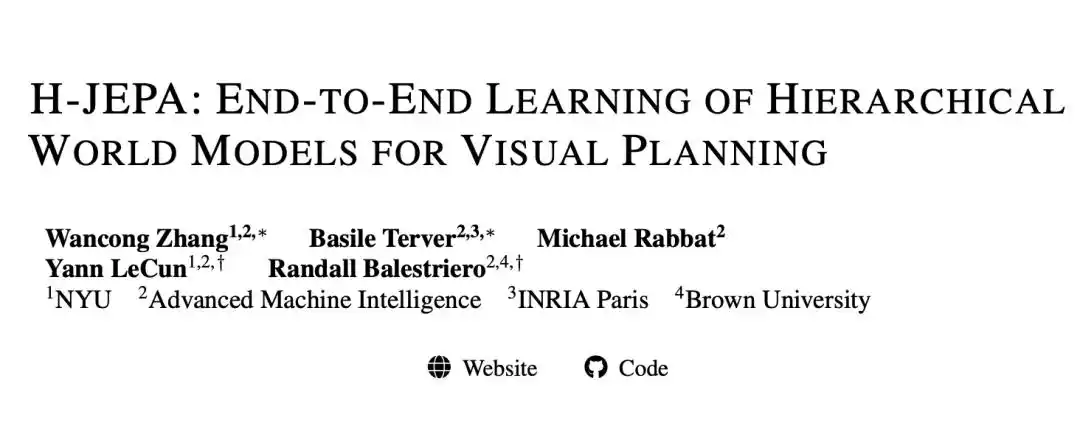
H-JEPA stacks multiple JEPAs (Joint Embedding Predictive Architectures) layer by layer, allowing each layer to predict the state after different time spans within its own representation space.

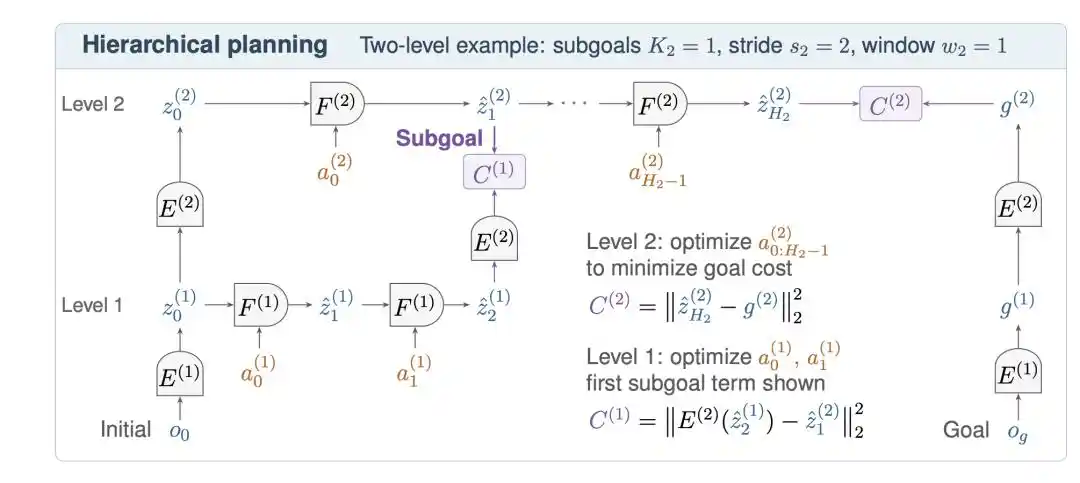
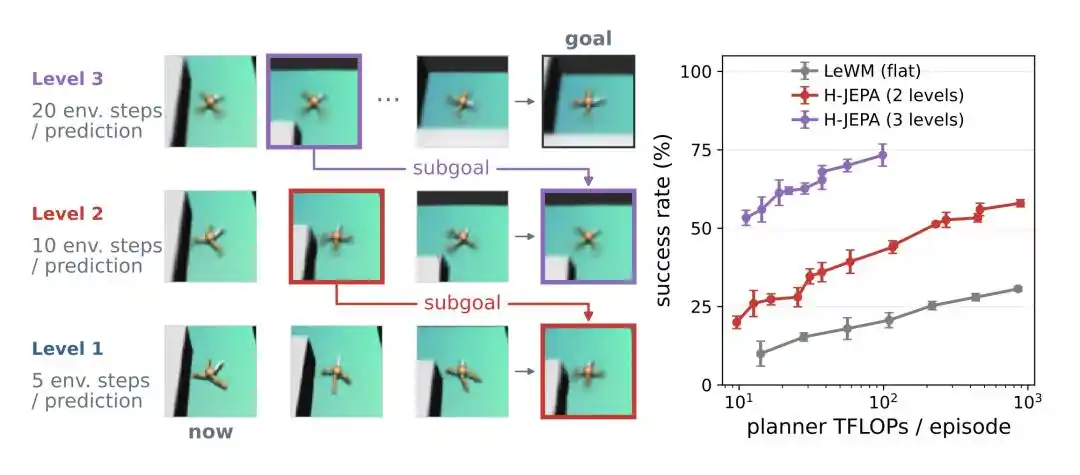
During planning, the high-level layer first formulates a rough plan, then passes the predicted intermediate states as subgoals to the low-level layer. The low-level layer takes over and refines the plan step by step, ultimately generating executable actions.

Through this division of labor, the world model can both plan for long-term goals and handle immediate actions.

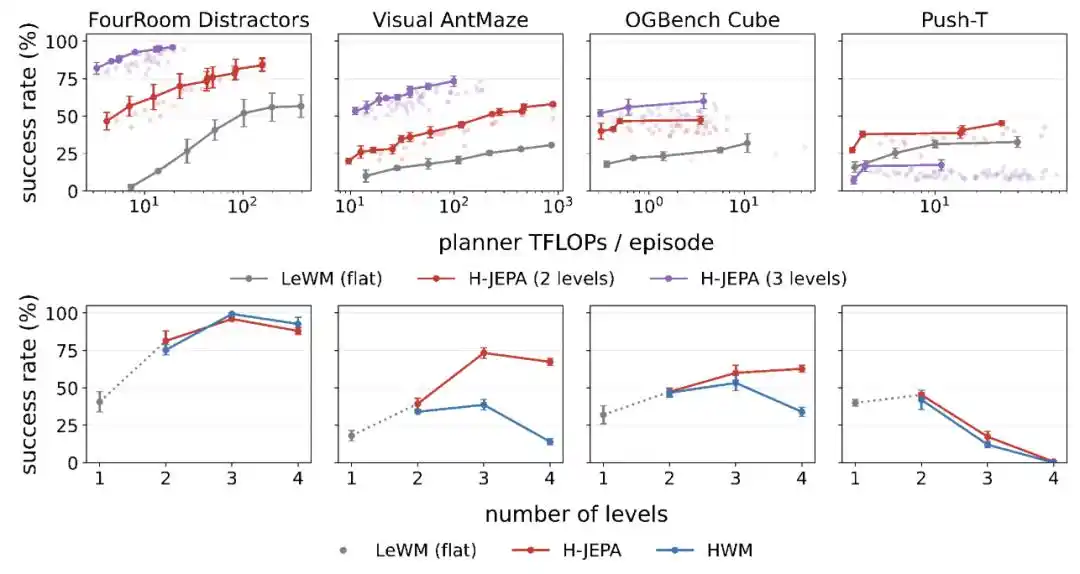
In the Visual AntMaze simulated maze task, the three-layer H-JEPA achieved a success rate of 73%, compared to 18% for the single-layer model.

Simultaneously, in several simulation tasks, the hierarchical model achieved better performance with less computational cost for planning.
Besides delivering tangible test results, H-JEPA also continues the open-source path that LeCun emphasized from the startup's inception.

The team has simultaneously open-sourced the code and pre-trained model weights, allowing researchers to directly load the model and replicate planning experiments.
Why Does a World Model Need Hierarchical Planning?

LeCun has actually been talking about this for a long time.

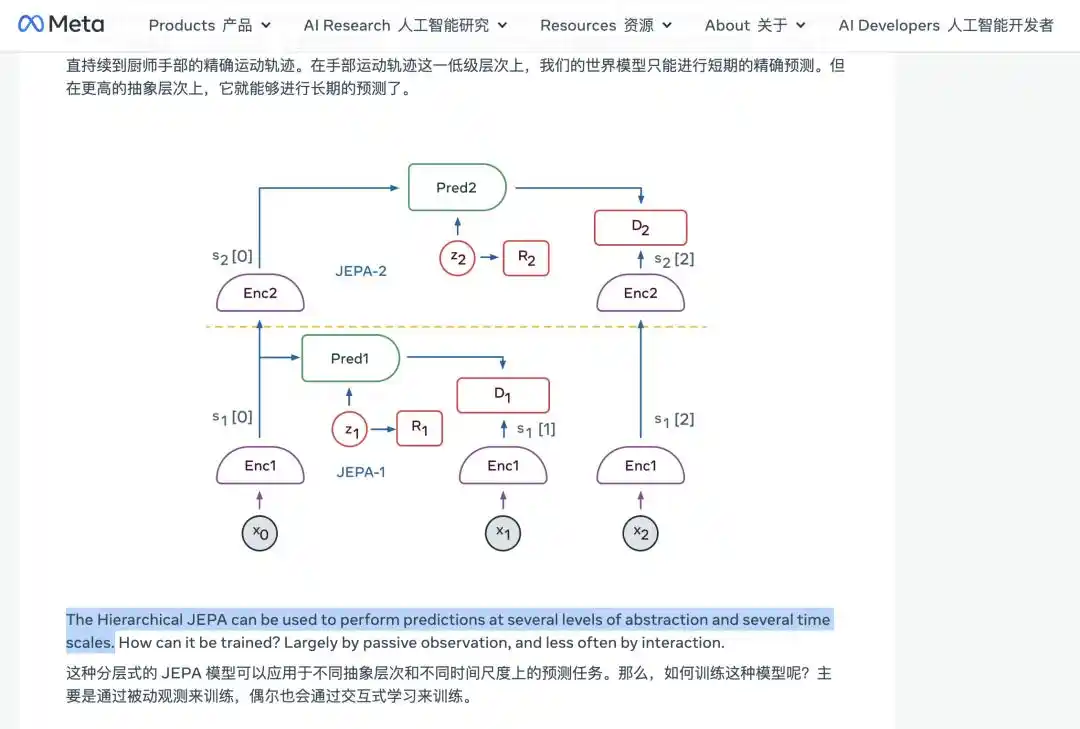
Back in 2022, while still serving as Chief AI Scientist at Meta, he proposed the concept of hierarchical JEPA:

Let the model predict at different levels of abstraction and time scales, and then implement complex goals as actions through hierarchical planning.
This might sound a bit abstract at first, but it's easy to understand using an example LeCun often cites.

Suppose you are sitting in your office at New York University, planning to go to Paris. When planning the entire trip, you focus on the destination, flights, and schedule.

After deciding on the itinerary, you start planning further: how to leave the office, go downstairs, and take a taxi to the airport.

When you actually walk out of the office, the information you focus on becomes the ground in front of you, the stairs, and where to place your next step, which foot to move first.

△

These planning levels cover different time spans and require different information. When planning the flight, the height of a specific step on a staircase is not important; when walking down the stairs, this detail directly determines how you should step.

This is not a characteristic unique to human planning. For robots, the high level needs to understand task objectives, environmental relationships, and future directions, while the low level needs to master specific actions and body control details.

For example, a quadruped robot may have already reached the target location, but if its leg posture differs from the target image, the model might still consider itself far from the goal due to these differences.
So, the question becomes:

How to let different levels learn information representations suitable for themselves, and then gradually implement high-level plans into low-level actions?

How Exactly Does H-JEPA Work?

Specifically, to solve the above problem, H-JEPA configures three components in each layer to handle state, action, and prediction respectively.
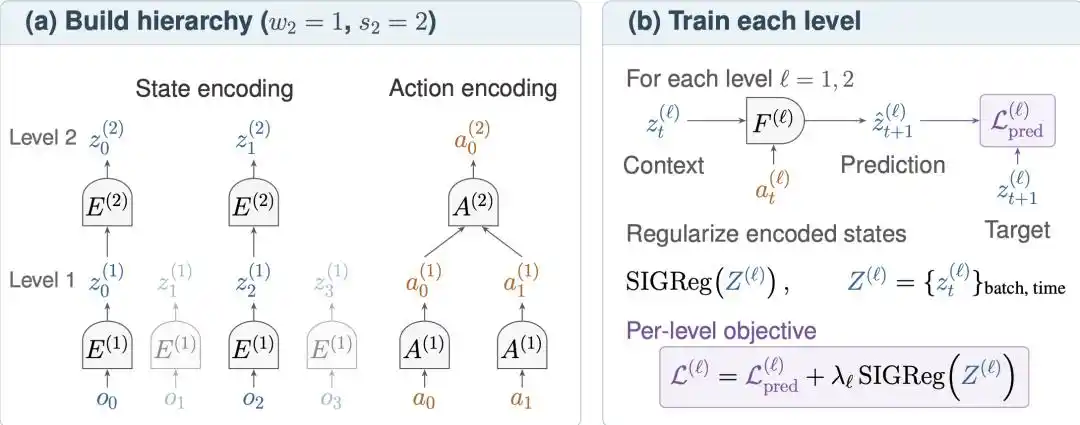
Among them, the state encoder is responsible for extracting the representation of the current environment. The lowest layer directly reads images, while higher layers further abstract based on lower-layer representations, retaining information more important at that time scale.

The action encoder is responsible for describing the changes brought about by actions. The low layer represents specific actions, while the high layer compresses a sequence of continuous actions into more coarse-grained changes.

The predictor combines the current state and action to predict future states. Different levels cover different time spans. In the paper's experiments, one step at a higher adjacent layer corresponds to two-step predictions at the lower layer.

Regarding model training, the layers above are learned jointly through end-to-end training, with different levels connected via subgoals.

The intermediate states predicted by the high level become subgoals for the low level. The low level transforms its predicted states into the high-level representation space, compares them with the subgoals specified by the high level, and then adjusts its actions accordingly.

However, when training the world model, there is a classic problem that needs to be addressed: representation collapse.

If the encoder compresses all inputs into the same vector, and the predictor only outputs this vector, it can achieve very low prediction error, but the model hasn't actually learned any useful information.

To address this, H-JEPA adopts the SIGReg proposed by LeCun's team in their previous LeJEPA work, constraining the representation distribution to prevent different states from being compressed into the same vector.
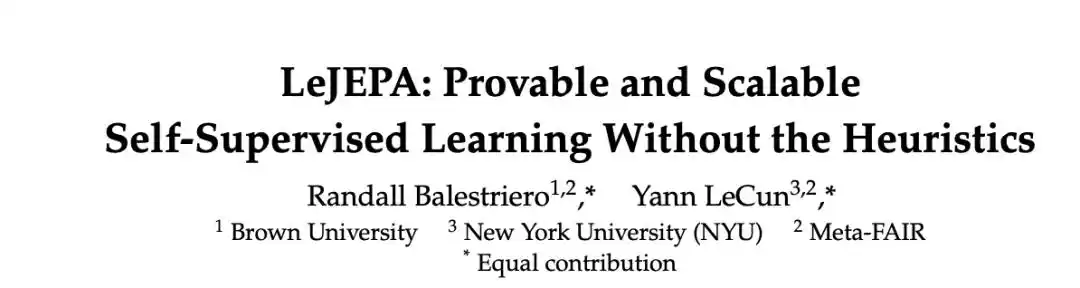
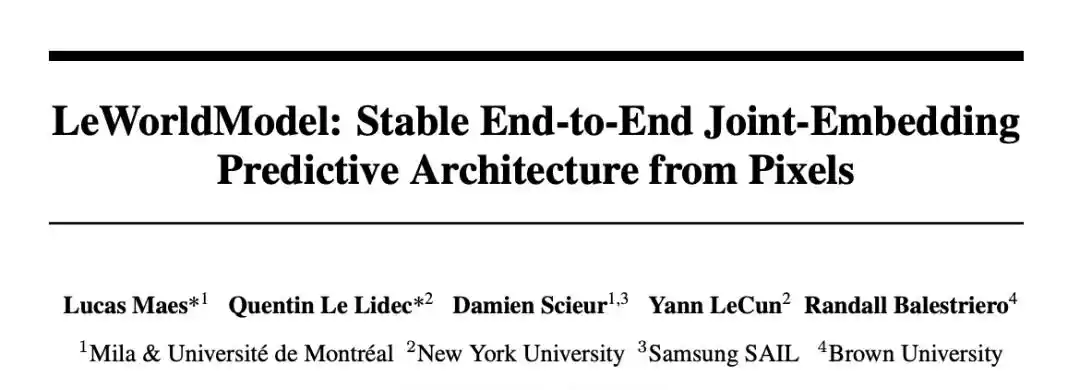
This year's LeWorldModel applied this method to world model training. H-JEPA builds upon it as the lowest layer, adding more JEPAs on top to form a structure trained jointly and planning from top to bottom.
In experiments, the researchers further observed information trade-offs at different levels. In the maze task, the high level gradually weakened the leg posture but still retained the robot's position information.
However, hierarchy also has its applicable conditions. The two-layer model performed well in the Push-T task, but adding a third and fourth layer led to decreased performance.

The paper suggests that shorter task trajectories might limit the training data available to higher layers.

LeCun, Still the Same LeCun

Overall, these designs of H-JEPA continue a fundamental proposition of JEPA: performing prediction in the representation space.

JEPA stands for "Joint Embedding Predictive Architecture." LLMs typically learn to generate content by predicting the next token; visual JEPA first encodes images or videos into internal representations, then predicts the representations of target parts, without needing to generate image pixels one by one.
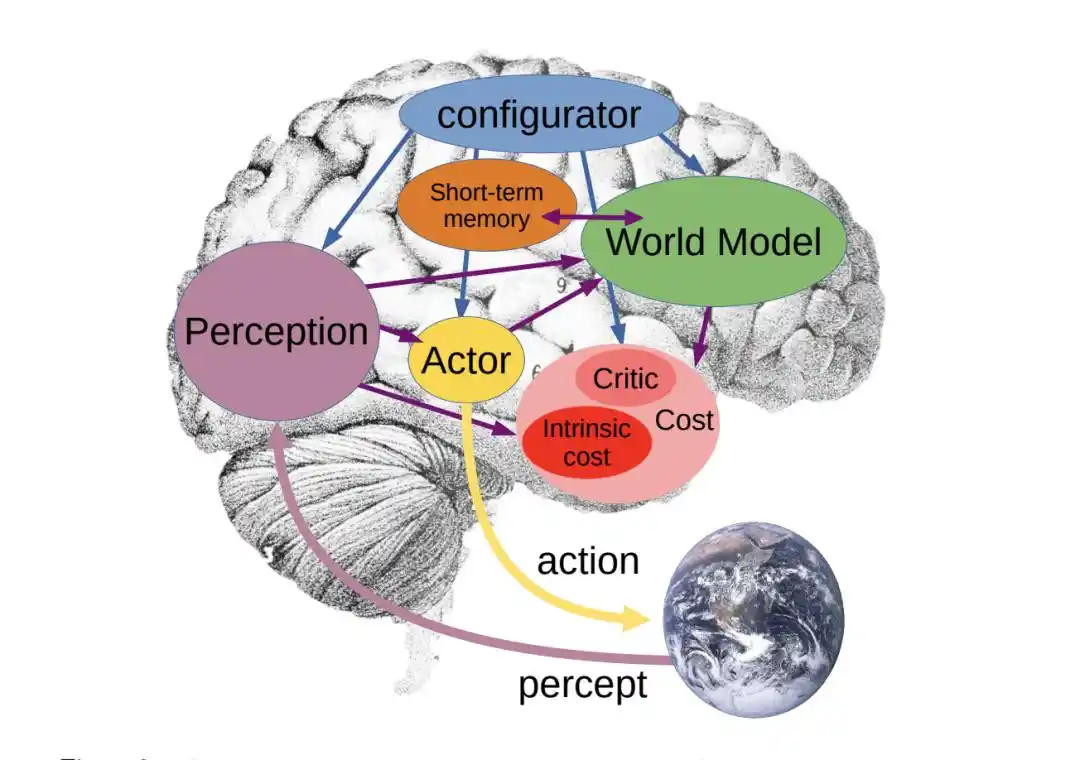
In world models like H-JEPA, the model also incorporates actions to predict the representations of future states. The planner then compares the consequences of different actions to find a path towards the goal.

LeCun has always believed that understanding the world, predicting the consequences of actions, and planning are essential capabilities for achieving human-level intelligence. His assessment of LLMs has always revolved around this point.

In September this year, at the EC CV conference in Malmö, Sweden, his presentation slides once again featured that familiar piece of advice:

If you are interested in human-level AI, don't work on LLMs.
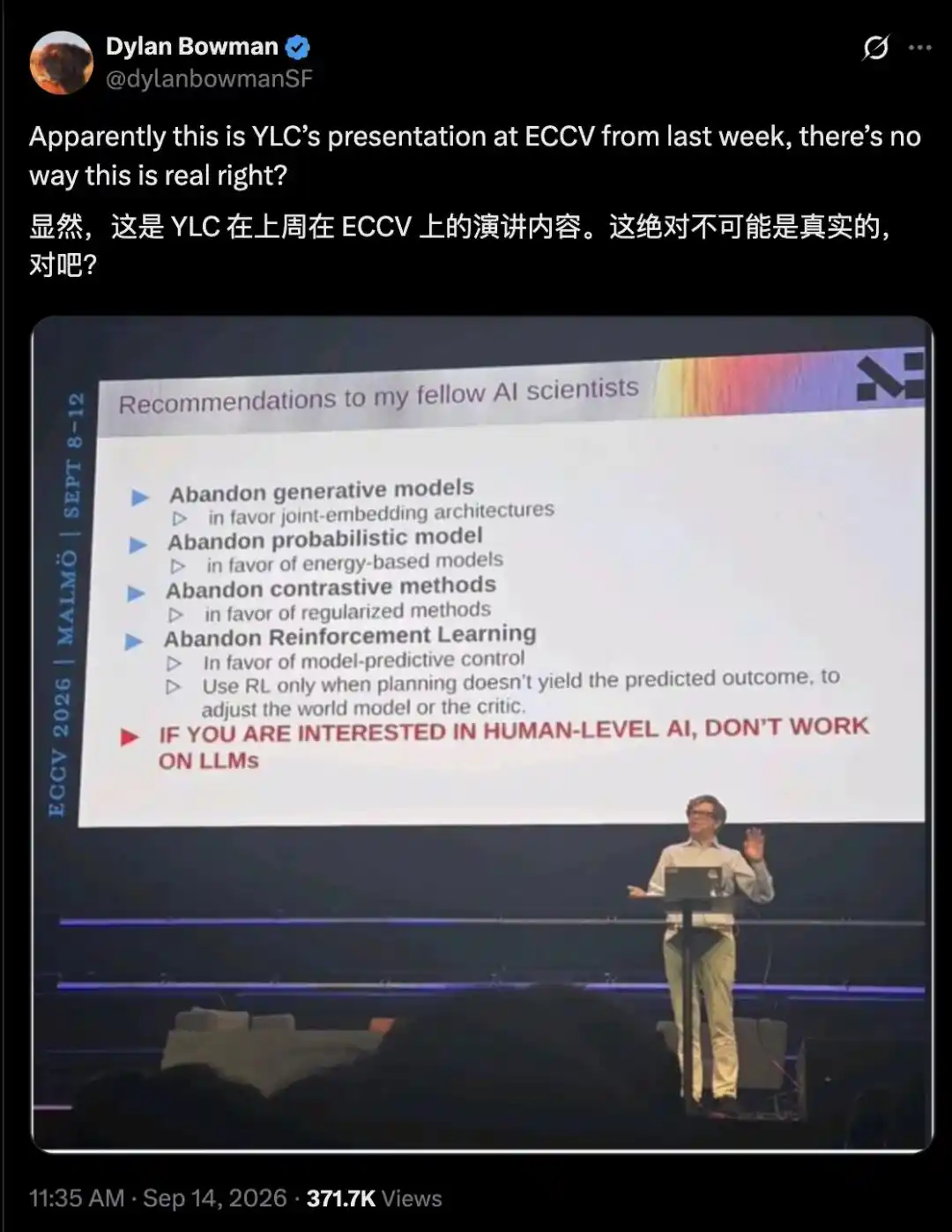
After this slide spread on social media, some doubted if it was fake. LeCun replied:

Guaranteed real.

He later added that LLM-based AI tools are very useful and everyone is using them. But he believes that LLMs alone cannot lead to human-level intelligence.

Now, this research philosophy has also become AMI's entrepreneurial direction.

In March this year, AMI announced the completion of a $1.03 billion funding round, with a pre-money valuation of $3.5 billion.

The company is chaired by LeCun, with Alexandre LeBrun as CEO, Saining Xie as Chief Scientist, Pascale Fung responsible for Research and Innovation, and Michael Rabbat responsible for World Models. Rabbat is also one of the authors of this H-JEPA paper.

However, it must be said that while research results are research results, another expectation for AMI from the outside world remains its products.

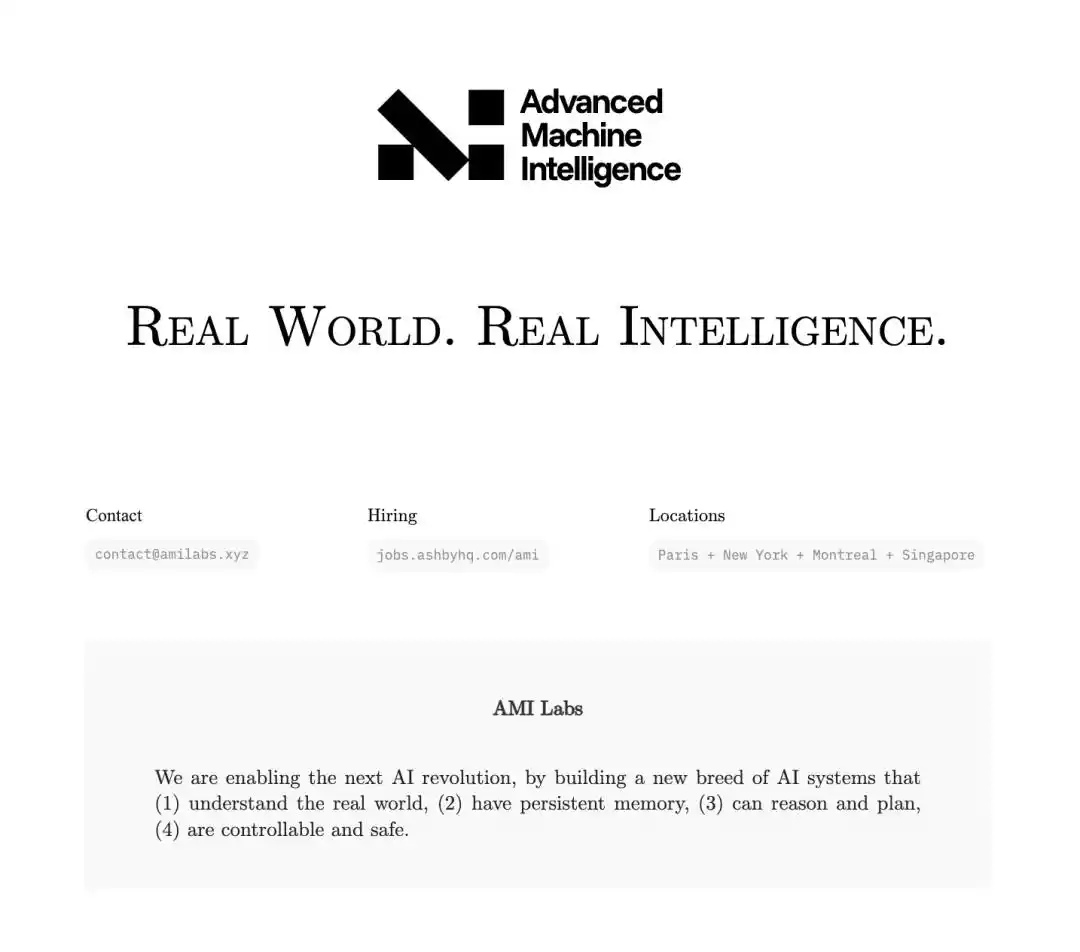
At least from the current official website, the company primarily showcases its technical direction, team, and recruitment information, with no public-facing product portal visible yet.
On the other hand, World Labs, which also bets on world models, has reached a new turning point.

On September 28th, AMD announced an all-stock acquisition agreement with World Labs, founded by Fei-Fei Li, worth approximately $8.2 billion.

It can be said that one side is moving towards integration with chip companies, while the other continues to advance along its own research path.

But with Fei-Fei Li's world model startup achieving a milestone, is Yann LeCun's major result also just a matter of time...?

References

[1]https://venturebeat.com/technology/h-jepa-teaches-world-models-to-plan-at-multiple-levels-of-abstraction

[2]https://arxiv.org/pdf/2610.06805

This article is from the WeChat public account "QbitAI", author: henry

Related Questions

QWhat is H-JEPA, and how does it differ from single-layer world models?

AH-JEPA is a Hierarchical Joint Embedding Predictive Architecture proposed by AMI (Advanced Machine Intelligence). It stacks multiple JEPA layers to enable planning at different levels of abstraction and temporal scales. In the Visual AntMaze task, its success rate was 73%, compared to 18% for a single-layer model, showcasing its superior ability to handle long-term goals and immediate actions through layered, hierarchical planning.

QWhy does LeCun advocate for a hierarchical approach in world models like H-JEPA?

ALeCun advocates for a hierarchical approach because he believes complex tasks, like a human planning a trip, require reasoning at different abstraction levels and time horizons. High levels handle overarching goals (e.g., booking a flight), while lower levels manage immediate actions (e.g., walking down stairs). This division allows models to both plan for the future and execute detailed, context-specific actions, which he considers essential for achieving human-level AI.

QHow does H-JEPA's training prevent the issue of representation collapse?

AH-JEPA prevents representation collapse by using a method called SIGReg (Sparse Information Gap Regularization), which was introduced in LeCun's prior work, LeJEPA. SIGReg constrains the distribution of representations, preventing the encoder from mapping different input states to the same vector. This ensures the model learns meaningful and distinct representations necessary for accurate prediction and planning.

QWhat significant business developments are mentioned regarding AMI and World Labs?

ATwo significant developments are mentioned: AMI, LeCun's startup, completed a $10.3 billion funding round with a pre-money valuation of $35 billion. Separately, AMD announced an all-stock acquisition agreement with World Labs, a company founded by Fei-Fei Li, valued at approximately $8.2 billion. This highlights the growing investment and strategic moves in the world model AI sector.

QWhat is LeCun's stance on large language models (LLMs) in relation to achieving human-level AI?

ALeCun believes LLMs alone are insufficient for achieving human-level AI. He has publicly stated, 'If you are interested in human-level AI, don't work on LLMs.' He acknowledges that LLM-based tools are useful, but argues that true intelligence requires capabilities like understanding the world, predicting action consequences, and hierarchical planning—areas where models like H-JEPA are focused.

Related Reads

Monad's $909 Million Credit Economics: How a High-Performance Public Chain Breaks Through via Lending

Monad, developed by former Jump Trading quant engineers, has seen its on-chain revenue model shift dramatically from high-frequency trading to lending interest. Over the ten months to September 2026, global DeFi TVL fell from $111.4B to $95.5B, yet Monad's market share rose from 0.14% to 1.09%—an nearly eightfold increase—ranking tenth among all chains by DeFi TVL. Lending now dominates fee revenue: in September, lending apps contributed 71% of application fees versus just 16% from trading, with borrowers paying roughly 6.2% annualized interest on an average $903M loan book. Monad's capital efficiency is notably high, with every $1 of TVL generating $0.89 in borrowings versus 42% on Ethereum and 45% on Base. Institutional credit vaults hold $287M in uncollateralized loans—second only to Ethereum mainnet—with Accountable at 33% and Aave at 29% of lending balances. Aave's Monad market became its third-largest fee-generating deployment globally within 46 days. Spot trading fees fell to 1.2 basis points as monthly volume surged to $4B. MON trades at just 0.25x its DeFi TVL versus 7–12x for peers like AVAX, SUI, SOL, and SEI, and has outperformed competitors since its first full trading day. Annualized interest income stands at about $56.5M at current levels, with each additional $100M in loans adding $6.2M yearly—upside supported by upcoming Aave V4, infiniFi Prime, StraitsX stablecoins, and Category Labs' institutional clearing domain.

marsbit22m ago

Monad's $909 Million Credit Economics: How a High-Performance Public Chain Breaks Through via Lending

marsbit22m ago

BTC Short-Term Bottoming and Gathering Momentum, HYPE Triple Support Faces Critical Test | Guest Analysis

Last week, the crypto market was driven by news. On Nov 4, midterm election news sparked a 3.92% Bitcoin rally above $80K, but a day later, US stock declines triggered a 5.48% drop to ~$75,222, a new low since Sept 21, with fear index near 25. HYPE also fell 15.19% weekly, erasing prior gains and returning to ~$75. Key points: Bitcoin has held above the 52-week MA for eight weeks, satisfying the "price breakout principle," but the pullback confirmation signal is not yet issued and the 52-week MA (~$76,110) remains downward-sloping. The rebound from the July 1 low of $57,820 is still classified as an oversold bounce, not a confirmed bull market. On the daily chart, price remains in a descending channel, has broken below the key MA crossover (~$77,200), but holds above the 0.382 Fibonacci level ($76,130). The correction (wave i) has run 48 trading days with a max drawdown of 15.9%; a wave ii rebound is expected but not yet started. The "Shijie Ribbon" model still signals a long market. Strategy: mid-term stay in cash; short-term use 30% position for range trading, favoring buying dips near $72,500–73,500 with strict stops. HYPE: the weekly bearish engulfing candle was driven by external shocks, not fundamentals. Three support layers: the ribbon upper band (~$74.05, lower ~$71), the box lower edge (~$75, which triggered a 20% bounce on Oct 24), and the long-term uptrend line (~$68). Key support zones: $74–75 (ribbon upper + box bottom), $71 (ribbon lower), $68 (long-term trendline). Strategy: if price stabilizes at $74–75 or $68–71, consider light long positions (≤30%) with strict stops. Special rules: set initial stop at entry; move to breakeven at +1% profit; trail stop 1% per 1% gain. All analysis is personal technical opinion, not investment advice; markets carry risk.

Odaily星球日报37m ago

BTC Short-Term Bottoming and Gathering Momentum, HYPE Triple Support Faces Critical Test | Guest Analysis

Odaily星球日报37m ago

Canton Foundation Launches Official Daml 3 Certification, Expanding Developer Access and Establishing Institutional Finance Standards

Canton Foundation has launched the Canton Developer Certification, an official certification program for Daml 3, the smart contract language of the Canton Network. Combining a self-paced course with a certification exam, it offers developers worldwide a structured path to building applications for regulated financial markets. Canton Network is a public, permissionless blockchain designed for regulated finance, with over $6 trillion in on-chain assets processed by its supported applications. Daml is built to manage who may act on a contract and who may access its terms; the certification validates practical mastery of these authorization and privacy principles, establishing a recognized standard intended to strengthen institutional confidence in applications built on the network. The program is based on Daml 3 and Canton 3.x, the current technology underlying the network, letting newcomers start on the latest stack, helping production engineers deepen expertise, enabling institutional architects to design and integrate Canton deployments, and allowing existing Daml 2 developers to migrate their skills and codebases to Daml 3, unifying the community on a single, current platform. For ecosystem partners—financial institutions, application providers, system integrators, and validators—the certification provides a common technical foundation and a consistent way to assess developers' understanding of authorization and privacy requirements. Canton Foundation COO Amanda Martin said financial institutions need confidence that the applications they rely on are built by developers who understand regulated market requirements, and that the program both opens opportunities for developers globally and establishes a shared professional standard, building a stronger foundation for Canton's future growth by bringing the community together on Daml 3. The certification is now live at certification.canton.foundation; the course is self-paced and free to all developers, and the exam costs $150 per attempt. Canton Foundation is an independent nonprofit responsible for the governance and long-term development of Canton Network's shared infrastructure, supporting transparent and decentralized governance, ecosystem coordination, and broad participation by Global Synchronizer operators and network stakeholders, while working with financial institutions, technology providers, developers, and other participants to support the network's continued global growth and adoption.

marsbit48m ago

Canton Foundation Launches Official Daml 3 Certification, Expanding Developer Access and Establishing Institutional Finance Standards

marsbit48m ago

Nvidia Faces Independent Investigation, Bernstein Maintains $400 Target Price

Nvidia's board has launched an independent investigation following reports about CEO Jensen Huang's contacts with Megaspeed executive Alice Huang, though it says there is no reason to believe U.S. national security or company secrets were compromised. Three Republican House committee chairs have requested Huang attend a closed-door briefing on November 18 to explain the contacts and Nvidia's internal procedures for countering foreign intelligence activities, and Democratic Senator Chris Coons said Congress will investigate. Some reports suggested Alice Huang may have influenced Huang's lobbying to ease chip export restrictions to China, a claim Bernstein doubts, noting Huang has long publicly pushed to expand sales in China and that revenue from mainland China and Hong Kong has fallen sharply since export controls. Only H20 and limited H200 chips were approved for China sales, well behind Nvidia's most advanced products, and Bernstein sees limited room for recovery as Chinese customers prioritize domestic alternatives. Regulatory pressure may persist, with hawkish lawmakers potentially revisiting export limits. Bernstein maintains an Outperform rating and a $400 target price, about 114% above the November 6 close of $186.64, citing data center demand and earnings growth. It projects adjusted EPS of $4.77 for FY2026, $9.20 for FY2027 and $15.80 for FY2028. The target is based on average FY2028-2029 non-GAAP EPS of $19.04 at about 21x. Bernstein also flags Huang's succession as a key risk, given his central role and roughly 60 direct reports.

marsbit58m ago

Nvidia Faces Independent Investigation, Bernstein Maintains $400 Target Price

marsbit58m ago

Trading

Spot
活动图片