Author: Rita
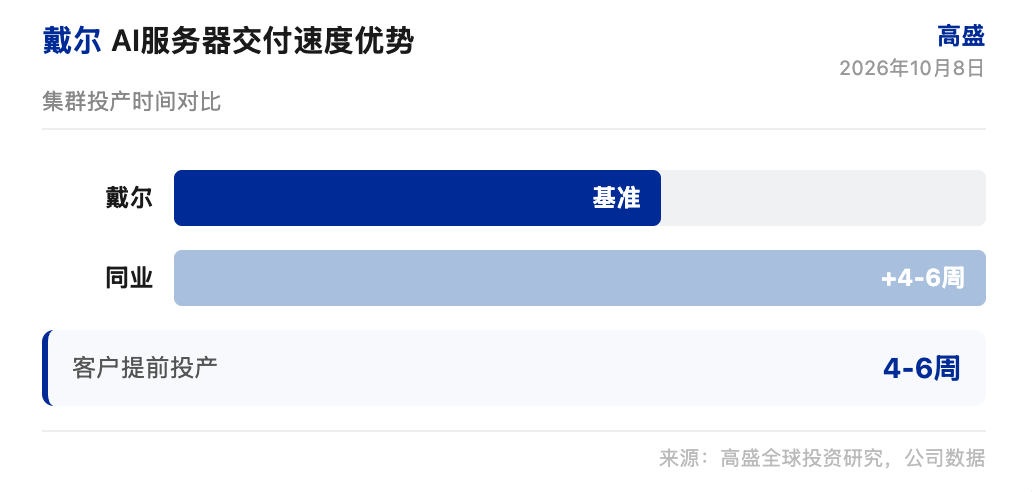
Dell's AI server delivery is approximately 4 to 6 weeks faster than competitors, allowing customers to monetize their infrastructure earlier. Goldman Sachs Group noted in a report dated October 8, 2026, that this speed advantage supports Dell's premium pricing relative to OEM and ODM peers.
Goldman Sachs maintains a Buy rating with a target price of $570; the current stock price is $574.55. The report is based on an investor site visit to Dell's headquarters in Round Rock, with management including CFO David Kennedy and President of Infrastructure Solutions Group Arthur Lewis. The core of the report is whether Dell's competitive moat, extending from component sourcing to design, supply chain, manufacturing, and deployment, can support the sustainability of AI server demand.
Moat Extends Beyond Components
Dell management refuted the view that AI infrastructure is becoming commoditized. Goldman Sachs points out that AI deployment often involves dozens of design iterations, and Dell possesses differentiated capabilities in four areas: system design, supply chain procurement, manufacturing, and deployment.
Dell emphasizes leveraging scale to secure components, completing L11 and L12 integration testing before systems leave the factory, and deploying large clusters more efficiently than peers. Goldman Sachs believes customers using Dell's solutions can go live and generate revenue about 4 to 6 weeks earlier, which supports premium pricing.
Dell also described a rigorous order validation process. For new cloud customers, Dell reviews end-customer contracts and financing arrangements. Dell Financial Services primarily serves as a short-term bridge between shipment and deployment and is not used to provide long-term financing to new cloud customers.
Memory is the Key Bottleneck for 2027
Goldman Sachs notes that supply remains the main constraint on AI infrastructure growth, with Dell expecting tight memory market conditions to persist into next year. Dell believes memory supply will increase through yield improvements, but demand growth continues to outpace supply growth, leading to a tighter environment in 2027.
Dell mentioned two company-level advantages. The direct sales team provides early visibility into changes in customer demand, helping Dell shift memory allocation from weaker end markets like PCs toward AI and server opportunities. Dell's scale and forecast accuracy make it a priority partner for component suppliers.
Goldman Sachs points out that the long-term agreements Dell recently announced focus on securing supply and do not lock in component prices. Pricing continues to reset quarterly. The AI supply chain faces widespread constraints across memory, storage, CPUs, and other components, further elevating the importance of procurement scale.
Storage and Operating Leverage Drive Margins
Goldman Sachs indicates that the primary drivers for Dell's future margin expansion are storage and operating leverage. AI server margins remain in the mid-single-digit range, which Dell views as a reasonable balance between profitability and competitive positioning.
Dell is not aggressively expanding server margins, continuing to pass through component cost fluctuations, especially memory pricing, to avoid impacting demand elasticity. A more notable margin opportunity comes from increasing attach rates for Dell's own IP storage. Management highlighted strong momentum in unstructured data storage, including PowerScale, object storage, and Project Lightning, as well as data platform capabilities.
Goldman Sachs believes the incremental operating expenses required for AI server revenue are relatively low, and the scale benefits across the entire ISG continue to drive profit growth.
Enterprise AI Adoption in Early Stages
Goldman Sachs notes that enterprise AI adoption is still in its early stages, with infrastructure being only one part of the overall transformation. Dell believes successful AI deployment requires not just computing infrastructure but also data preparation and business process redesign.
Dell expects most enterprise environments to evolve towards hybrid architectures, combining cutting-edge models in the cloud with open-source weight models deployed on-premises. Customers can achieve lower total cost of ownership while maintaining data and security control. Adoption remains concentrated among technologically sophisticated users like financial institutions. Dell believes broader enterprise adoption will accelerate as organizations complete the necessary transformation work.
Dell positions itself as Customer 0, using agent AI in ISG software development and internal operations as practical experience that can be shared with customers.
Whether Dell's moat can sustain premium pricing, with 2027 memory supply being the first observation point. For Goldman Sachs' Buy thesis to hold, delivery speed, order quality, and storage attach rates must all materialize simultaneously.
Disclaimer
This article is Tideway Research's compilation and interpretation of a third-party brokerage research report (Goldman Sachs Group, October 8, 2026), combined with publicly available market information. The ratings, target prices, earnings forecasts, and related judgments cited in the article are the views of the brokerage's analysts, representing only the position of their institution, and do not represent the views of Tideway Research, nor do they constitute any investment advice.
The market involves risks, and decisions should be made independently. This article should not be used as a basis for buying or selling any securities.