Donald Trump Allocates $215 Million to Quantum Computing, Posing a Threat to Bitcoin

cryptonews.ruPublished on 2026-10-09Last updated on 2026-10-09

Abstract

The Trump administration has launched the Quantum Genesis Q competition, allocating up to $215 million in funding via the U.S. Department of Energy for companies developing fault-tolerant quantum computers. The program's goal is to create a machine with at least 100 logical qubits capable of performing hundreds of millions of reliable operations by 2028. This initiative is part of a broader $6 billion science package, which includes $2.4 billion in commitments from technology firms like Nvidia, AMD, OpenAI, and Anthropic for AI research tools and resources. This advancement has direct implications for the cryptocurrency industry, particularly Bitcoin, which relies on elliptic-curve cryptography. A sufficiently powerful quantum computer running Shor's algorithm could theoretically derive a private key from a public one. Researchers estimate breaking Bitcoin's 256-bit encryption might require 1,200 to 1,450 logical qubits. While the current target of 100 qubits does not pose an immediate threat, reaching this milestone is a significant step toward practical quantum computing. In anticipation, companies are already preparing; for instance, StarkWare completed the first quantum-resistant Bitcoin transaction in block 964,199 in late August 2026.

  • The Donald Trump administration has announced the launch of the Quantum Genesis Q competition, with a fund of up to $215 million for companies developing fault-tolerant quantum computers.
  • The U.S. Department of Energy aims to create a machine with at least 100 logical qubits by 2028.

The Donald Trump administration has announced the launch of the Quantum Genesis Q competition. The U.S. Department of Energy is offering up to $215 million to companies that develop a fault-tolerant quantum computer with at least 100 logical qubits.
Source: X

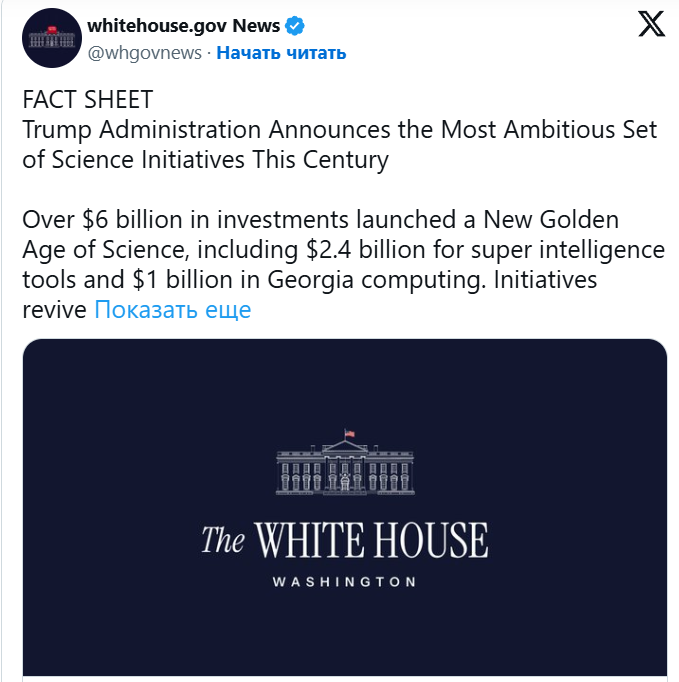
The Trump administration has just announced the next bold step to bring quantum computing into the mainstream, stated the White House Office of Science and Technology Policy.

The U.S. Department of Energy has defined eight research tasks for the Quantum Genesis Q competition, and companies such as Nvidia, AMD, OpenAI, and Anthropic have allocated resources for artificial intelligence research.

The goal of the program is to create a machine capable of performing hundreds of millions of reliable operations by 2028. The initiative is part of a larger $6 billion scientific package, which also includes $2.4 billion in commitments from technology companies for AI tools and computing resources.

This news has direct implications for the crypto industry. Bitcoin uses elliptic curve cryptography to confirm the right to spend coins. A sufficiently powerful quantum computer, by executing Shor's algorithm, could theoretically recover a private key from a public one. Google researchers estimate that breaking Bitcoin's 256-bit cryptography might require between 1,200 and 1,450 logical qubits. The Department of Energy is currently targeting only 100 qubits; however, achieving even this milestone will be an important step towards the practical application of quantum computing.

While quantum computers do not pose an immediate threat, companies are already preparing for the potential risk. As reported by the Happy Coin News editorial team, at the end of August 2026, StarkWare completed the first quantum-resistant Bitcoin transaction in block 964,199.

Risk Warning:

The information on the website is for informational and educational purposes only and does not constitute investment advice or financial recommendations. Cryptocurrencies and digital assets involve a high level of risk, including the potential loss of capital. The editorial team is not responsible for decisions made based on published materials. It is recommended to conduct your own research (DYOR) before making investment decisions. Review the editorial policy at https://happycoin.news/about/


Related Questions

QWhat is the Quantum Genesis Q competition, and how much funding is allocated for it?

AThe Quantum Genesis Q competition is an initiative launched by the Donald Trump administration through the U.S. Department of Energy. It aims to fund companies developing fault-tolerant quantum computers. The funding allocated for this competition is up to $215 million.

QWhat is the specific technical goal of the Department of Energy's quantum computing initiative by 2028?

AThe specific goal of the Department of Energy's initiative, part of the Quantum Genesis Q competition, is to create a quantum machine with at least 100 logical qubits capable of performing hundreds of millions of reliable operations by 2028.

QWhy does the article suggest quantum computing could be a threat to Bitcoin?

AThe article suggests quantum computing could threaten Bitcoin because Bitcoin uses elliptic curve cryptography to secure transactions. A sufficiently powerful quantum computer running Shor's algorithm could theoretically derive a private key from a public key, potentially compromising the security of Bitcoin wallets.

QHow many logical qubits do Google researchers estimate are needed to break Bitcoin's 256-bit cryptography?

AGoogle researchers estimate that breaking Bitcoin's 256-bit cryptography would require a quantum computer with between 1,200 and 1,450 logical qubits.

QWhat is mentioned as an early industry preparation against the potential quantum threat to Bitcoin?

AAs mentioned in the article, an early industry preparation is that StarkWare successfully completed the first quantum-resistant Bitcoin transaction in block 964,199 at the end of August 2026.

Related Reads

Tech Veteran: Anthropic IPO Will Be the Peak of the US AI Rally, Will "Go Big on China AI" If Conditions Allow

Veteran tech investor Jack Selby, head of Copper Sky and managing partner of Peter Thiel's family office, warns that Anthropic's planned IPO—aiming to raise up to $100 billion—could mark the peak of the AI market rally. He cautions that if the highly anticipated IPO prices well below expectations, the expiry of lock-up periods could trigger significant selling pressure and a large-scale AI market correction. Selby names SoftBank and Oracle as "canaries in the coal mine," flagging Oracle's higher debt ratio as a bigger risk, and suggests investors needing AI exposure consider Google instead. Selby also questions Anthropic's fundamentals: over 80% of its revenue is non-recurring and vulnerable to competitors closing the technology gap within six to nine months. He notes the business is extremely capital-intensive—requiring costly data, energy, data centers, and chips—and that with interest rates no longer near zero, calling it a trillion-dollar company seems far-fetched. He further highlights Chinese competition, saying DeepSeek and other Chinese AI models trail Anthropic by only about six months, posing a direct threat. Selby says he would "aggressively go long on Chinese AI" if conditions allow, arguing that Anthropic cannot claim all its business must rely on U.S. models, since most AI use cases resemble basic tool applications, leaving room for Chinese alternatives.

marsbit8h ago

Tech Veteran: Anthropic IPO Will Be the Peak of the US AI Rally, Will "Go Big on China AI" If Conditions Allow

marsbit8h ago

Trading

Spot
活动图片