DarkSword learned to hunt for cryptocurrency on iOS, Chrome was hacked in six days with GPT-5.6 Sol and other cybersecurity events

cryptonews.ruPublished on 2026-10-17Last updated on 2026-10-17

Abstract

Cybersecurity weekly roundup: US authorities dismantled a crypto scam infrastructure targeting Brighton Beach's Russian-speaking community, seizing 241 domains and 112 servers used in "pig butchering" schemes with tens of millions in estimated losses. A GTA VI leaker known as CyberLeek promised to release the full game build if his Solana memecoin CYBERLEEK reached $30 million market cap, but the token dropped over 40% the next day, prompting him to pause and threaten a "dead man's switch" revealing plot spoilers. A new DarkSword iOS exploit variant called P7 now targets crypto wallets, stealing data from imToken and iCloud Keychain on iPhones running iOS 18.4–18.7, delivered via a re-registered analytics domain. Microsoft and TRM Labs disrupted Chinese phishing operations CoGUI, Haozi, and Iron Man System, which sent over a billion emails targeting 75,000+ organizations since early 2026, with operators earning tens of millions. XBOW researchers used GPT-5.6 Sol AI agents to chain three zero-day Chrome bugs (V8, WebP decoder, Crashpad) in six days, earning a $250,000 maximum Google bounty. Texas authorities charged 14 people over North Korean "laptop farm" schemes, raiding 40+ locations and seizing 187 computers; over 70 US companies were affected since 2019.

We have gathered the most important news from the world of cybersecurity for the week.

  • In the US, the infrastructure of a crypto scam targeting Brighton Beach was dismantled.
  • A GTA VI leaker promised to release the game if his memecoin rises to $30 million.
  • The iOS exploit DarkSword learned to hunt for cryptocurrency.
  • Microsoft and TRM Labs struck at the Chinese phishing market.

In the US, the infrastructure of a crypto scam targeting Brighton Beach was dismantled

On October 14, Brooklyn District Attorney Eric Gonzalez announced the dismantling of an international fraud network whose main targets were Russian-speaking residents of New York.

According to the department, law enforcement seized or disabled 241 domains and 112 servers. The machines were hosted with hosting providers in Eastern Europe and the US.

The scammers operated using the "pig butchering" scheme. Victims were lured through Russian-language investment ads placed on Facebook. Those who responded were called by "financial consultants" and helped open an account on a fake crypto platform. A few weeks later, the attackers contacted the victims again and promised to return what was lost for a fee.

The investigation began three years ago after appeals from the Russian-speaking community of Brooklyn. Over two years, the department blocked about 400 domains linked to investment crypto fraud, but new ones quickly appeared in their place.

This time, law enforcement targeted the technical infrastructure — the servers: they stored information about victims and working software.

The prosecutor's office estimated the damage at tens of millions of dollars. So far, about $300,000 has been seized.

Steal the key, not the money: how the economy of vibe hacking works

GTA VI leaker promised to release the game if his memecoin rises to $30 million

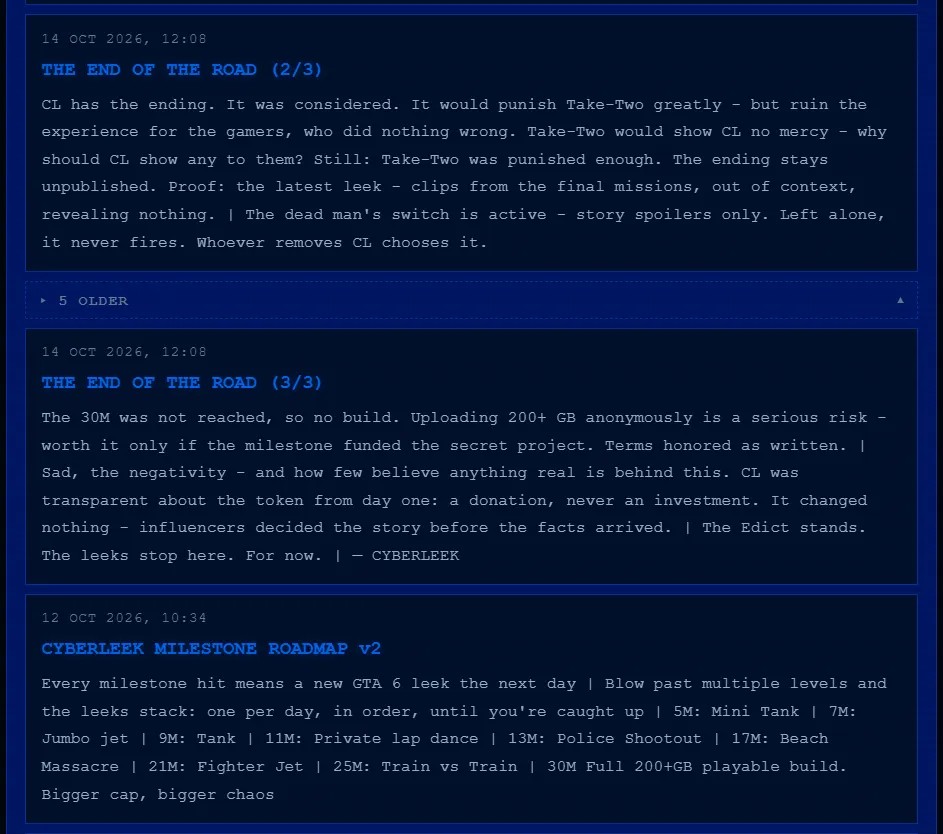
Leaker CyberLeek set a condition: the full build of GTA VI with the story "through the final credits" will appear online when the market capitalization of his memecoin CYBERLEEK on Solana reaches $30 million. Starting in August, he has been publishing stolen videos demonstrating, among other things, gameplay from the new installment of the cult franchise.

From Take-Two Interactive, the blackmailer demanded the release of the game on physical media and a public apology for the decision to distribute the product only via an activation code instead of the usual disc.

According to CoinGecko, on the day the ultimatum was announced, October 13, the capitalization of CYBERLEEK was about $3.8 million after a daily peak of $5.7 million. Already the next day, the token fell by more than 40%.
Source: CyberLeek.

After that, CyberLeek announced a pause and refused to release the build, which was over 200 GB. Instead, he threatened a "dead man's switch": spoilers for the story ending would allegedly be posted online if he is caught. Later, a debug version of the game nevertheless appeared on the leaker's website for $40 per download. Its authenticity has not been confirmed.

At the end of August, CyberLeek had already dumped the price of the token of the same name, earning about $286,000 from sell-offs.

iOS exploit DarkSword learned to hunt for cryptocurrency

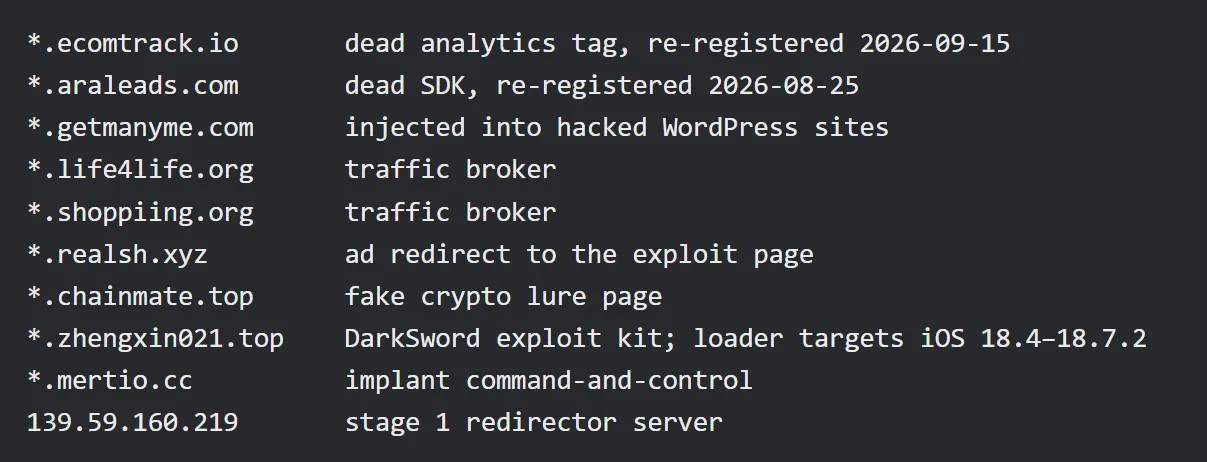
A new version of the DarkSword exploit kit for iPhone steals crypto wallet data and the keychain directly on the device, iVerify reported. The variant was called P7 after the prefix p7_, which the attackers added to the source code.

DarkSword itself was identified back in March. The vulnerability chain allows an attacker to escape the browser sandbox through a malicious website, gain kernel privileges, and inject into the system process SpringBoard. iPhones on iOS 18.4–18.7 are at risk. Initially it was a commercial tool, but after a leak, financially motivated groups began using it.

According to iVerify, P7 requests commands from the command-and-control server every 15 seconds. The implant searches for installed wallets, exfiltrates the contents of imToken, photos, notes, and iCloud Keychain records.

Report URI researcher Scott Helme discovered a new delivery channel. On September 15, the attackers re-registered the domain of a closed analytics service. Its trackers are still present on online store websites, and some visitors now end up on a fake crypto exchange that infects the iPhone. This build targets files from more than 25 coin storage applications.
Source: Report URI.

Censys experts found a panel of a Chinese-language EaaS service with its own network of agents and resellers. A copy of the working server contains 11 seed phrases of victims and other data from 179 devices.

Zero-day vulnerability market: discover, sell, and stay silent

Microsoft and TRM Labs struck at the Chinese phishing market

Since the beginning of 2026, using three phishing kits, CoGUI, Haozi, and Iron Man System, scammers have sent more than a billion emails and SMS messages. Their targets included over 75,000 organizations worldwide. On October 14, the software was disabled, Microsoft reported.

The investigation began at the end of 2025, when Japan's National Police Agency warned the American corporation about malicious campaigns against residents of the country. According to Health-ISAC, the operators earned tens of millions of dollars.

The tools were sold through the underground marketplace YAM Store. In addition to templates, it offered access to Microsoft and Google cloud environments that had been hacked or registered with false data. The hackers intercepted abandoned corporate Microsoft 365 accounts and turned their SharePoint and OneDrive storage into hosting for fake pages.

Sellers accepted payment in cryptocurrency, including USDT and ETH. TRM Labs analysts helped trace and freeze the group's assets.
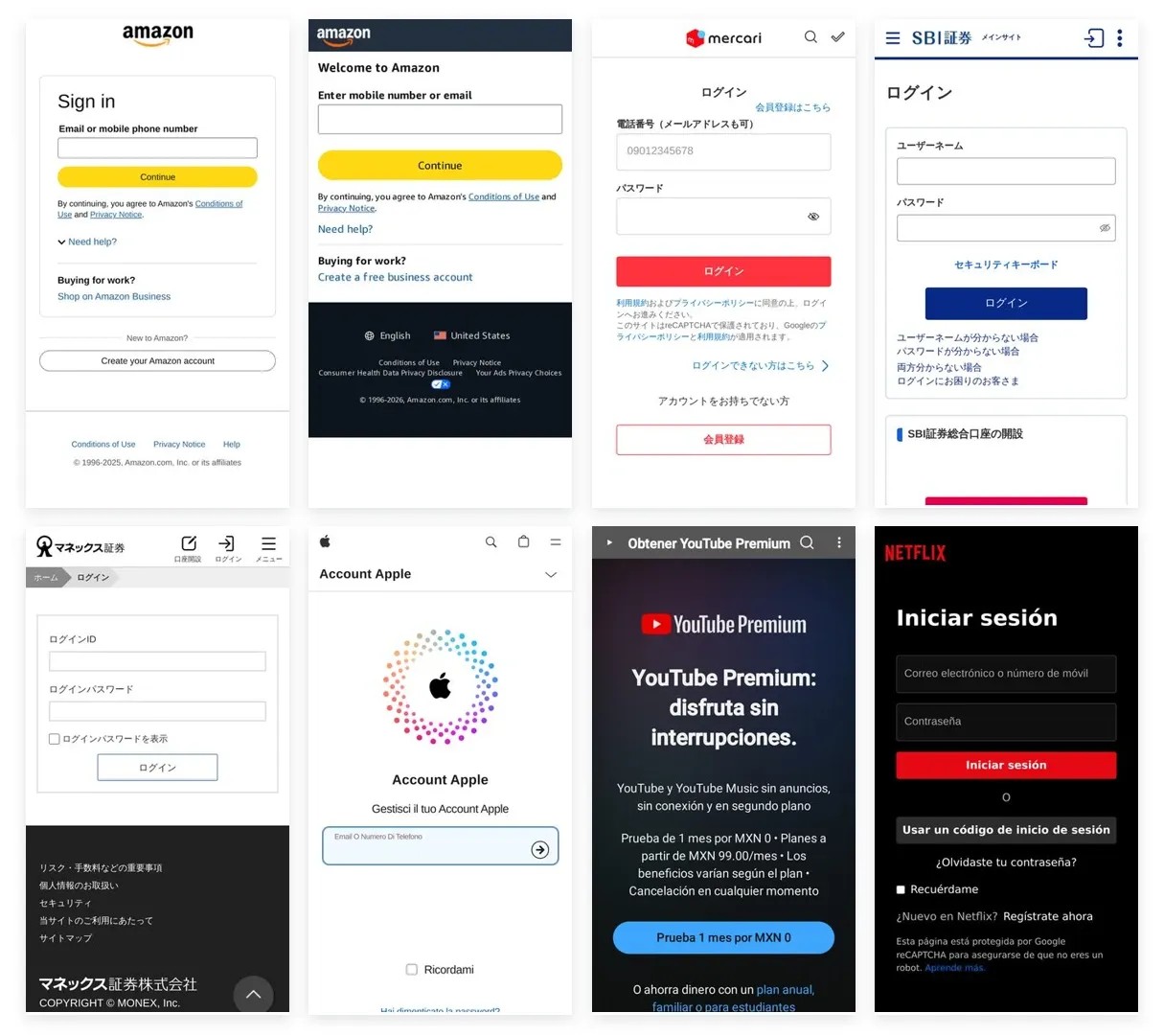
Examples of malicious interfaces. Source: Microsoft.

Resecurity specialists purchased Iron Man and studied the kit in an isolated environment. In the catalog, they found 2,360 lures impersonating postal, tax, banking, and telecom brands from 130 countries and regions. The program regularly checks in with the developer's licensing server, and if this node is disabled, all deployed copies will suffer.
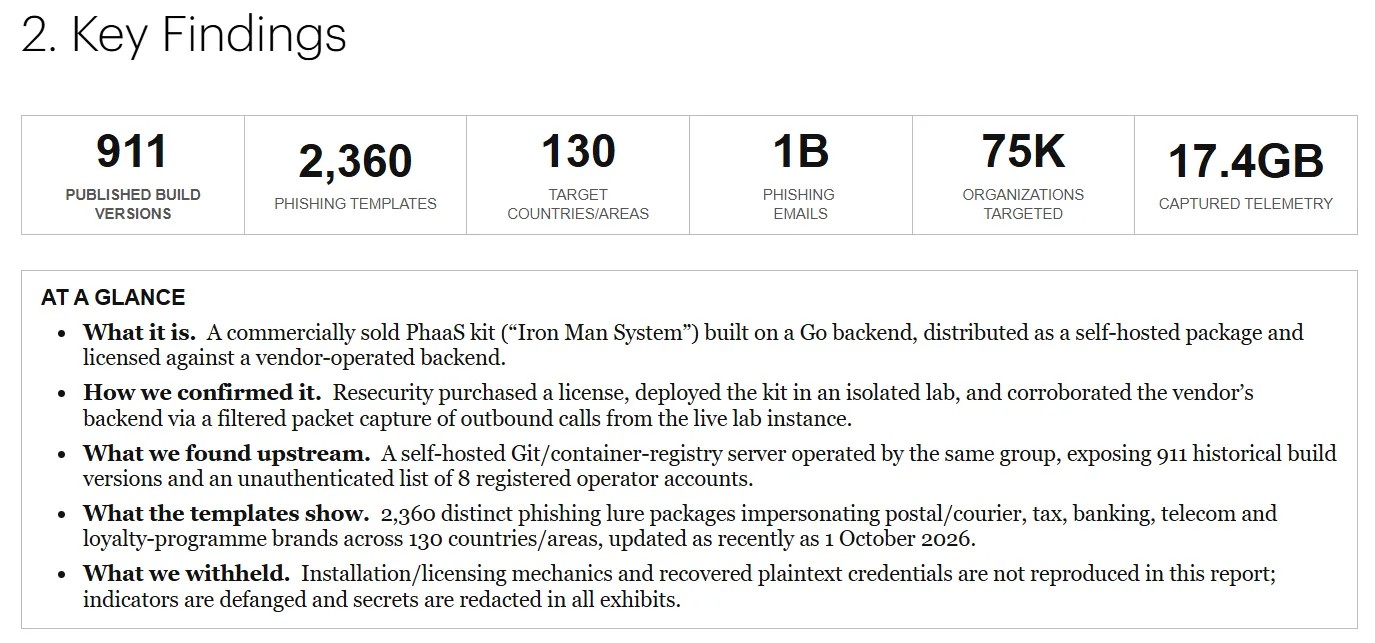
Source: Resecurity.

AI agents helped hack Chrome in six days

On October 13, XBOW disclosed details of an exploit chain for Google Chrome that researchers assembled using AI agents based on GPT-5.6 Sol. Google paid $250,000 for the find — the maximum provided by the corporation's reward program for such a report.

The chain combined three previously unknown bugs: in the V8 engine, in the animated WebP decoder, and in the Crashpad crash handler. Together they broke through both browser sandboxes. For an attacker to execute code on a Windows computer, the victim only needed to open a page.

The work was carried out from August 2 to 7 during the Black Hat and DEF CON conferences. According to XBOW's estimates, the computations cost about $40,000. The agents searched for errors in the source code, tested hypotheses, and wrote draft attack code, while humans selected targets and decided which fragments to connect.

Google closed the vulnerabilities in Chrome 152 in late August and early September. No attacks using them have been recorded.

Before the advent of LLMs, such work took a team of four people from six to nine months, noted XBOW employee Brendan Dolan-Gavitt. The company prepared its first submission in two months, while the chain for which Google paid was assembled in six days.

In Texas, more than 40 DPRK "laptop farms" were shut down

Fourteen participants in a scheme whose creators helped IT specialists from the DPRK get jobs at American companies under false names were charged. The US Department of Justice reported this.

Among the defendants are citizens of China and the US. Two Americans were arrested: 31-year-old Michael Bostell from Philadelphia and 37-year-old Juan Cecilio Pena Carrillo from San Juan, Texas. The rest are at large, and the names of two are not disclosed. The charges include conspiracy to commit fraud, money laundering, and identity theft.

During Operation Lonestar Roundup, the FBI searched more than 40 homes in Texas where "laptop farms" were allegedly located and seized about 187 computers and special devices. At such locations, accomplices store work equipment, and North Koreans connect to it remotely, posing as US residents.

According to the investigation, the scheme operated from about 2019 to July 2025. More than 70 companies in healthcare, communications, retail, and manufacturing were affected, and the fake employees received about $3 million in income.

CrowdStrike added that to obtain laptops, the attackers file false police reports about the theft of work devices. In this way, they get replacements sent to the desired address.

At the same time, the FBI warned about new tactics. North Koreans are increasingly subcontracting received tasks to freelancers from Pakistan, India, and Nigeria in exchange for a share of the salary. Threats of physical reprisal against former managers and their families have also been recorded.

Also on ForkLog:

  • In South Korea, 130 financial companies reported cybersecurity problems.
  • Hinton, Bengio, and another 450 scientists called for disconnecting AI models from the internet.
  • Experts criticized Drake's call to transfer bitcoins to new addresses because of the AI threat.
  • An attack on South Korea's financial sector affected cryptocurrency exchanges.
  • An OpenAI engineer was arrested for installing a wiretap.
  • CryptoQuant: the Ledger incident accelerated the movement of old bitcoins.
  • Anthropic allowed for the emergence of self-propagating AI on IoT devices in the coming months.
  • Coinbase called for preparing bitcoin in advance for post-quantum migration.
  • Ledger: an implant in CryptoBilis wallets transmitted seed phrases over LTE.
  • Hackers unfroze refrigerators in hundreds of supermarkets in France.
  • Aptos launched an encrypted mempool to protect against sandwich attacks.
  • Bitquery estimated the damage from the attack on Ledger users at $93.2 million.
  • A critical decade-old vulnerability was closed in the XRP Ledger.
  • Anthropic deprived Claude of internet access in internal tests.
  • Ledger began investigating the possible compromise of wallets sold by reseller CryptoBilis.

What to read on the weekend

An annual license for Pegasus cost up to $6.8 million, a contract with Candiru — from €16 million with monitoring of ten devices simultaneously, and one Graphite target costs about €20,000. ForkLog figured out who sells spyware to governments and why its victims repeatedly turn out to be journalists and human rights defenders rather than terrorists.

Surveillance as a service

Trending Cryptos

Related Questions

QWhat was the DarkSword P7 exploit designed to steal on iOS devices?

AThe P7 variant of the DarkSword exploit kit was designed to steal cryptocurrency wallet data and keychain credentials directly on the device. It queried a command server every 15 seconds, searched for installed wallets, and exfiltrated contents from imToken, photos, notes, and iCloud Keychain records, targeting files from over 25 crypto storage apps on iOS 18.4–18.7.

QHow did AI agents help XBOW exploit Google Chrome, and how much did it cost?

AXBOW used AI agents based on GPT-5.6 Sol to find and chain three previously unknown bugs—in the V8 engine, the animated WebP decoder, and the Crashpad handler—that together bypassed both browser sandboxes. The work was done August 2–7 during Black Hat and DEF CON, cost about $40,000 in compute, and Google paid $250,000 for the report, the maximum under its reward program. Google patched the flaws in Chrome 152 in late August and early September.

QWhat was the 'pig butchering' crypto scam network dismantled in the US, and what infrastructure was seized?

AThe network targeted Russian-speaking residents of New York, especially around Brighton Beach. Victims were lured via Russian-language Facebook investment ads, then contacted by fake 'financial consultants' who helped them open accounts on fraudulent crypto platforms; scammers later re-contacted victims promising to recover losses for a fee. Brooklyn prosecutors seized or disabled 241 domains and 112 servers hosted in Eastern Europe and the US, estimated damages in the tens of millions of dollars, and recovered about $300,000.

QWhat is CyberLeek demanding in exchange for releasing the GTA VI build, and how did his meme coin perform?

ACyberLeek said the full GTA VI build with the story 'through the final credits' would be released only when the market cap of his Solana meme coin CYBERLEEK reached $30 million. He also demanded Take-Two Interactive release the game on physical media and publicly apologize for distributing it only via activation codes. On October 13, CYBERLEEK's market cap was about $3.8 million after a daily peak of $5.7 million, and the token fell over 40% the next day. He later paused and refused to release the 200+ GB build, threatened a 'dead man's switch' to leak story spoilers if caught, and eventually posted a $40 debug version of unconfirmed authenticity.

QHow did Microsoft and TRM Labs disrupt the Chinese phishing market, and what tools were involved?

AThree phishing kits—CoGUI, Haozi, and Iron Man System—were used since early 2026 to send over a billion emails and SMS messages targeting more than 75,000 organizations worldwide. Microsoft disabled the software on October 14 after an investigation that began in late 2025 when Japan's National Police Agency warned of malicious campaigns. The tools were sold via the underground YAM Store, which also offered access to compromised or fraudulently registered Microsoft and Google cloud environments; hackers hijacked abandoned Microsoft 365 accounts and used SharePoint and OneDrive as hosting for fake pages. Payment was accepted in crypto including USDT and ETH, and TRM Labs helped trace and freeze the group's assets.

Related Reads

Vitalik "Exposes the Shortcomings" of Burn Efficacy, ETH Value Narrative Shifts

Vitalik Buterin argues that Ethereum should focus more on ETH's store-of-value property rather than relying on fee burning to support its valuation. He explains that fee-burning-based valuation rests on a net present value logic—market cap equals annual burned fees divided by discount rate—but this has never provided a truly solid floor. Much of the past burning came from activity within the crypto ecosystem itself, so if ETH's price fell sharply, that revenue would fall too. Only demand from outside crypto can make such a valuation floor convincing, and while RWA growth may help, mature businesses are unlikely to recreate the massive fee consumption seen during speculative frenzies. He also warns of the costs of pursuing fee burning: to justify ETH's ~$270bn market cap through burning, Ethereum would need to operate like a world-class corporation such as L'Oréal—requiring sustained R&D spending (potentially ~700k ETH per year, cutting validator income by roughly two-thirds), active governance, and higher gas prices that could exclude users most in need of privacy and security. Maximizing "price × usage" conflicts with letting as many people as possible use the network within safe resource limits. As a store-of-value asset, the most important metric is survival. Users value decentralization and CROPS (censorship and capture resistance, open source, privacy, security), which also matter to institutions. Ethereum should make prudent security tradeoffs, address quantum computing and AI risks, stabilize the core protocol, push innovation to layer 2, resist complexity and capture-prone reward mechanisms, and support privacy tools, account abstraction, FOCIL, and reduced infrastructure dependence. Store-of-value and application growth are synergistic: more native RWA and decentralized assets on L1 increase ETH's usefulness. Ethereum's social meaning is broad access to decentralization, privacy, and security—and ETH's value comes from these guarantees.

marsbit18m ago

Vitalik "Exposes the Shortcomings" of Burn Efficacy, ETH Value Narrative Shifts

marsbit18m ago

US Stock Market Trends (November 9): Nasdaq Rebounds 1% on Friday, Nvidia Launches Investigation into Jensen Huang Over the Weekend

US stocks closed mixed on Friday, November 6: the Nasdaq rebounded 1.09% to 24,579.42, the S&P 500 rose 0.31% to 7,376.86, and the Dow fell 237.33 points (-0.46%) to 51,285.73. Chip stocks partly recovered after Thursday's selloff, with Micron up about 5%, Nvidia up nearly 3%, AMD up as much as 9%, and Intel up nearly 7% intraday. For the week, the Nasdaq fell 3.4%, the S&P 500 lost 2.7%, and the Dow dropped 0.9%; the tech sector ETF (XLK) had its worst week since early April 2025, down about 8%. October nonfarm payrolls came in at 165,000, far above the 59,000 expected, while unemployment fell to 4.1%. Markets priced a roughly 76.8% chance of a 25-basis-point rate hike at the December 8-9 meeting. WTI settled at $90.83 a barrel, up 0.34%, but fell about 13% for the week; Brent settled at $98.32 and fell over 16% weekly. The 10-year Treasury yield closed at 4.86%. Over the weekend, Nvidia's board launched an independent investigation into reports that CEO Jensen Huang may have been a target of foreign intelligence activity. The board said there is no reason to believe national security or company secrets were compromised, and Huang will remain CEO. Huang admitted to an extramarital affair and apologized. On Monday in Asia, Japan's Nikkei 225 rose about 2% and Taiwan's weighted index gained over 2%, while US futures were mixed, with Nasdaq 100 futures down about 0.2%. Key upcoming events include US inflation data and Nvidia's Q3 earnings on November 17.

marsbit18m ago

US Stock Market Trends (November 9): Nasdaq Rebounds 1% on Friday, Nvidia Launches Investigation into Jensen Huang Over the Weekend

marsbit18m ago

Vitalik 'Exposes' the Limitations of Burning, ETH Value Narrative Shifts

Vitalik Buterin argues that Ethereum should focus more on ETH's store-of-value property rather than relying on fee burning to support its valuation. He explains that fee-burn-based valuation rests on a net present value logic—market cap equals annual burned fees divided by a discount rate—but notes this never provided a truly solid floor. Much of the burning during 2021–2023 came from within the crypto ecosystem itself, so if ETH's price fell, that revenue would fall too. Only demand from outside crypto can make such a valuation floor more convincing, and while RWA growth may help, mature businesses are unlikely to replicate the massive fee consumption seen during speculative manias. He warns that relying on fee burning to justify ETH's ~$270B market cap would require Ethereum to operate like a world-class corporation (roughly L'Oréal's scale), needing sustained R&D spending—perhaps ~700K ETH annually—and highly interventionist governance, both of which create political problems and undermine decentralization and anti-capture properties. Pursuing burning also implies pursuing higher gas prices, potentially excluding users who most need privacy and security; maximizing "price × usage" differs from maximizing safe access for as many people as possible. As a store-of-value asset, the most important metric is survival. Users most value decentralization and CROPS (censorship and capture resistance, open source, privacy, security), which also matter to institutions for risk management and compliance. Ethereum should make prudent security tradeoffs, address quantum computing and AI risks, stabilize the core protocol while shifting innovation to upper layers, and resist complexity-adding features and capture-prone reward mechanisms. Users should be able to hold assets safely and privately, with confidence transactions won't be blocked. Reducing dependence on infrastructure providers matters—he can run a node on a laptop, syncing in under six hours with about one-eighth of disk space, better than 2019. Store-of-value and application growth are synergistic: more native RWA and decentralized assets on L1 increase what holding ETH enables—trustless swaps or using ETH as collateral—boosting its utility, with tradeoffs smaller than maximizing fees.

Odaily星球日报28m ago

Vitalik 'Exposes' the Limitations of Burning, ETH Value Narrative Shifts

Odaily星球日报28m ago

ICLR 2027 First Round Review: Quite a Few Pain Points

ICLR 2027's first-round reviews have sparked widespread complaints among researchers, with many sharing examples of poor-quality or clearly AI-generated feedback on social media. One reviewer asked an author to explain what "standard deviation" means; another review began with the telltale chatbot opener "Certainly! Here is a review of the paper," while two other reviews appeared to be near-identical copies of the same template. One author received criticism for using AI-assisted writing despite having properly disclosed it, and another reviewer openly admitted lacking the expertise to evaluate the paper—prompting debate over whether the real fault lies with reviewer assignment rather than the reviewer. A recurring concern, raised by Jiaxin Pei of UT Austin, is that AI reviewers cannot distinguish between a paper's ordinary limitations and the critical flaws that actually undermine its core contributions. Large language models can list hundreds of limitations for any paper, including the best ones, but they cannot judge which issues truly matter. As a result, reviews grow longer and demand more experiments while the real determinants of paper quality get buried. ICLR 2027 organizers have acknowledged the strain: rapid growth in submissions, a shortage of qualified reviewers, and AI lowering the barrier to paper production. They introduced measures including submission caps, stricter reciprocal review obligations, and rules permitting limited, disclosed AI use in reviewing—with penalties for low-quality or hallucinated AI-generated reviews. Author-reviewer discussion runs until November 18, with final decisions expected December 16.

marsbit1h ago

ICLR 2027 First Round Review: Quite a Few Pain Points

marsbit1h ago

Without Warning, OpenAI Suddenly Mass-Bans Accounts

OpenAI has abruptly banned a large number of ChatGPT accounts without prior notice or email warnings, deleting accounts outright. Affected users see only an error message stating their account has been deleted or deactivated. The purge heavily targets accounts in the Philippines and Turkey, low-cost Team plans, and accounts using reverse proxy relays, and even long-standing paying users with months of subscription have been hit. Free API accounts, shared team accounts, and $200/month Pro accounts were all affected. Developers report losing years of conversation history and personal data locked in the cloud, with appeals unsuccessful. Some speculate OpenAI is cracking down on account stacking to prevent users from exploiting cheap subscriptions. OpenAI's status page showed elevated error rates for some US commercial Mastercards, though OpenAI characterized the incident as a payment channel issue rather than account bans. Users are advised to appeal via OpenAI's official form with account details and Request ID. This move follows earlier steps: OpenAI previously merged ChatGPT and Codex into a single token pool and, five days ago, imposed device and payment card limits, preventing multiple paid subscriptions on one card or device. Starting November 20, new usage policies require third-party API gateways to obtain official written authorization, and from December, Plus, Pro, and Business plans will share a single quota calculated by token consumption. Users are advised to regularly back up cloud conversations and sync Codex projects locally, as the era of freely exploiting AI compute appears to be over.

marsbit1h ago

Without Warning, OpenAI Suddenly Mass-Bans Accounts

marsbit1h ago

Trading

Spot

Hot Articles

Discussions

Welcome to the HTX Community. Here, you can stay informed about the latest platform developments and gain access to professional market insights. Users' opinions on the price of SOL (SOL) are presented below.

活动图片