Dalio Warns: The U.S. Treasury Bear Market Is "Far From Over," Supply-Demand Imbalance Risks Continue to Accumulate

marsbitPublished on 2026-10-14Last updated on 2026-10-14

Abstract

Ray Dalio, founder of Bridgewater Associates, warns that the bear market for U.S. Treasuries is "far from over," with a structural supply-demand imbalance pushing the market toward a historic debt crisis. He argues the U.S. is in a vicious cycle where rising rates increase borrowing costs and debt levels, a spiral that will continue until the economy and markets are under sufficient stress to restore balance. This contrasts with more bullish views from firms like BlackRock and Morgan Stanley Investment Management. Dalio cites data showing U.S. government debt relative to revenue is at its highest since WWII and worsening. With approximately $32 trillion in marketable debt outstanding, net issuance is projected to hit $2.1 trillion this year, alongside rolling over about $10 trillion in maturing debt. The Treasury is increasingly relying on short-term bills (now ~50% of issuance vs. a typical 20%), raising rollover risks and future interest costs as rates rise. A critical pressure point is weakening foreign demand. Overseas investors hold about $3.2 trillion of Treasuries, but purchases are slowing as supply climbs. Japan and China are key: Japanese policymakers may incentivize domestic institutions to repatriate funds to support the yen and JGBs, while China's substantial holdings (estimated by Dalio at ~$4 trillion in total U.S. financial assets) face motivation to reduce exposure due to potential yuan strength and FX losses. Competition for capital is intensifying. Total...

Original Author: Li Dan

Original Source: Wall Street News

Hedge fund giant Ray Dalio, co-founder of Bridgewater Associates, has once again issued a warning on U.S. Treasuries: The sell-off in U.S. government bonds is far from hitting bottom, and a structural supply-demand imbalance is pushing Treasuries toward a historic debt crisis.

Dalio stated in a post on the social media platform LinkedIn on Tuesday, October 13th (U.S. Eastern Time), that the United States is entering a vicious cycle where debt expansion and shrinking demand reinforce each other. Rising interest rates push up borrowing costs, which in turn increases the scale of debt. This spiraling upward trend will continue until "the economy and financial markets are sufficiently pressured and supply and demand rebalance." He wrote: "(The) bear market in bonds probably still has a long way to go."

Dalio's remarks stand in sharp contrast to the positions of institutions such as BlackRock and Morgan Stanley Investment Management. The latter have turned bullish after the 10-year Treasury yield surged to its highest level since 2002 earlier this month, nearing 5.4%. According to reports, the Bloomberg index tracking Treasuries has fallen by about 2.4% year-to-date, with Treasury prices set to record their first annual decline since 2022.

U.S. Government Debt Rises to Its Highest Level Since WWII

Dalio supported his judgment with extensive data in his post. He estimated that, measured by the ratio of total borrowing size and debt servicing costs relative to government revenue, U.S. government liabilities have now risen to their highest level since World War II and are expected to continue deteriorating in the coming years.

As of the end of September 2026, the total marketable Treasury securities outstanding in the U.S. are approximately $32 trillion, an increase of 8% from a year ago. The U.S. Treasury has net issued about $1.5 trillion in new debt so far this year and is expected to net issue about $2.1 trillion for the full year. At the same time, the Treasury also needs to roll over approximately $10 trillion in maturing debt.
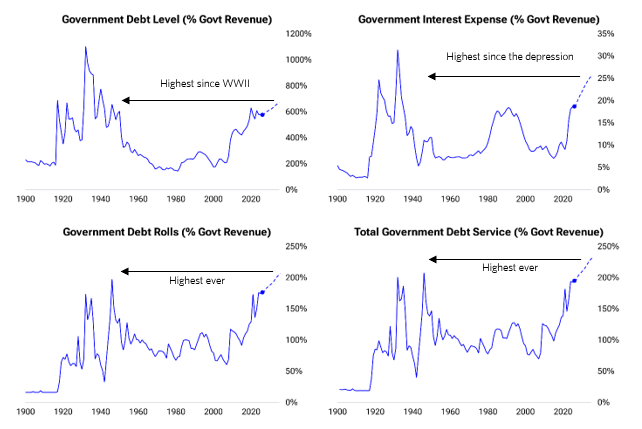
Dalio warned that even if investors only slightly reduce their reinvestment willingness, it could create a huge funding gap.

In terms of debt structure, the U.S. Treasury is increasingly turning to short-term bill issuance to alleviate the pressure from long-end bond supply-demand imbalances. Short-term bill issuance currently accounts for about 50% of total issuance, far above the historical norm of around 20%, a level typically seen only during economic recessions.

Dalio pointed out that while shortening the maturity profile helps temporarily reduce interest expenses, it also significantly increases rollover risk and makes debt servicing costs even more burdensome during a rising interest rate cycle.

Shift in Overseas Demand for U.S. Treasuries, with Japan and China Particularly Critical

Dalio identified shrinking external demand as one of the core factors pressuring the U.S. Treasury market. He noted that foreign investors currently hold about $9.3 trillion in U.S. Treasuries, making them the single largest holder group, accounting for roughly 32% of the total. However, their pace of purchases is slowing, while supply continues to climb.
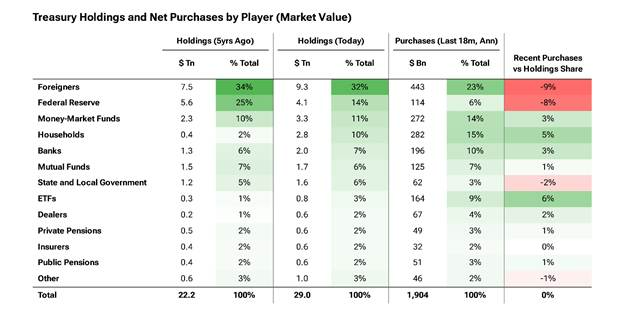
Among major overseas holders of U.S. Treasuries, Japan and China's moves are most noteworthy. Dalio stated that Japan holds approximately $1.1 trillion in U.S. Treasuries, with about $600 billion held as government reserves and around $230 billion held by the Government Pension Investment Fund (GPIF).

He believes Japanese policymakers have strong incentives to guide domestic institutions to reduce U.S. Treasury holdings and repatriate funds to support the yen and stabilize the Japanese Government Bond (JGB) market. Rising JGB yields will further reinforce this trend, and the unwinding of related yen carry trades could also cause sharp market shocks.

Regarding China, Dalio stated that official U.S. statistics significantly underestimate China's actual holdings. He roughly estimates that Chinese companies and individuals hold about $1 trillion in U.S. Treasuries, with China's reserves holding another approximately $2 trillion. China's total financial assets in the U.S. could amount to $4 trillion. As the yuan appreciates, Chinese holdings of dollar-denominated assets face exchange rate losses, increasing the motivation to reduce holdings.

He warned that if just 10% of private dollar holdings were hedged or converted, it would trigger about $400 billion in dollar selling, enough to have a significant impact on currency and credit markets.

Dalio wrote: "Combined, changes in expected supply and demand for new debt have made it easier over a long period of time — and still do — to be short rather than long Treasuries."

Corporate Debt and AI Financing Wave Intensify Competition for Funds

Dalio pointed out that the Treasury is not raising funds in the market in isolation but is competing with all other borrowers and asset issuers. In addition to the roughly $2.1 trillion in net new federal borrowing, corporate debt is expected to increase by about $1.4 trillion. Combined with household and local government borrowing, the total net fixed-income financing demand for 2027 will be approximately $4.4 trillion, excluding maturing debt that needs to be rolled over.
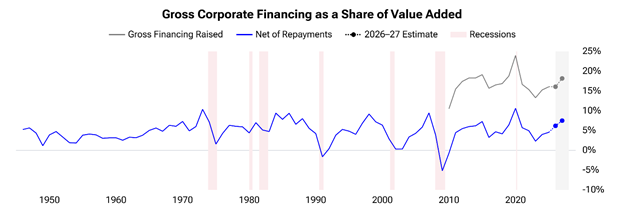
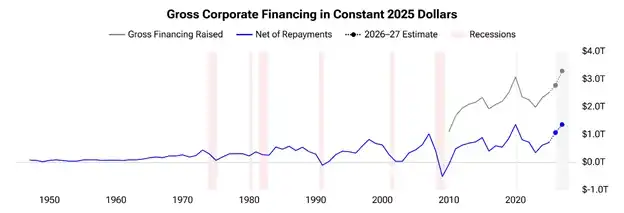
The structural changes in the corporate bond market are particularly noteworthy. Dalio noted that the total size of the U.S. corporate bond market is about $15.7 trillion. Driven by the artificial intelligence (AI) capital expenditure boom, total corporate bond issuance this year has increased nearly 30% year-over-year. Among this, bond issuance by AI hyperscaler companies reached about $220 billion in the first half of 2026, compared to only about $108 billion for the entirety of 2025.

More alarmingly, high capital expenditures are compressing corporate free cash flow, credit spreads have begun to widen, and investors are demanding higher "concessions" to absorb new supply.

Dalio likened the corporate credit market to "the canary in the coal mine," believing it is an early signal that broader financial market stress will become more apparent.

Debt Servicing Costs Erode Fiscal Space

Beyond the supply-demand imbalance, Dalio also focused on analyzing the crowding-out effect of debt servicing costs on fiscal space.

He pointed out that given the approximately $32 trillion in marketable Treasury securities, if overall interest rate levels eventually rise by 1 percentage point, the annual increase in interest expense alone would be about $310 billion. Over 10 years, this would add about $3 trillion to government debt.
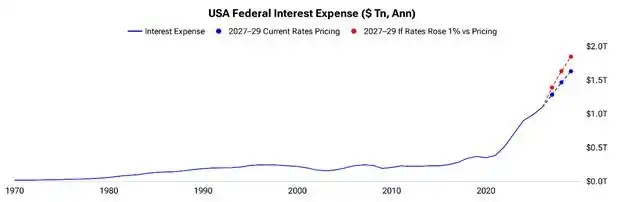
Currently, the average interest rate on existing U.S. debt is about 3.5%, while market rates are in the 4% to 5.5% range.

Dalio noted that even if interest rates do not rise further, interest expenses will continue to climb as older debt matures and is refinanced at higher rates. Treasury data shows that net interest expense for the first three quarters of the 2026 fiscal year increased by $78 billion year-over-year, a rise of 10%.

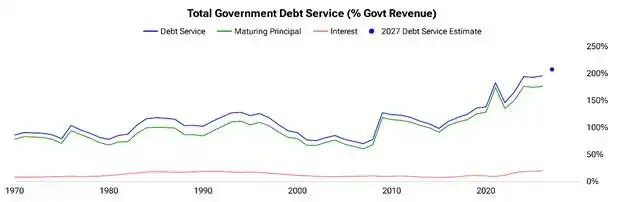
He further pointed out that the size of debt principal rollovers has risen to about 185% of federal tax receipts. The total debt servicing cost as a proportion of government tax revenue is about 200% and still rising, making the risk of a "death spiral" no longer negligible.
Global Debt Competition Intensifies, Stock Market Unlikely to Remain Unscathed

Dalio extended his analysis to a global dimension.

Citing data, he noted that the total borrowing of OECD member governments reached a record $17 trillion in 2025 and is expected to rise further to about $18 trillion in 2026, a 17% increase from 2024 and roughly double the level a decade ago. European countries are stepping up sovereign bond issuance to finance defense and infrastructure. Germany's total issuance in 2027 is expected to reach about €576 billion, while the European Central Bank is concurrently reducing, not expanding, its government bond holdings.

Regarding the stock market, Dalio also issued a warning. He pointed out that over the past year, companies have shifted from being net buyers to net sellers (financers) in the equity market. The annualized equity issuance scale reached $1.8 trillion in the first half of 2026, primarily driven by the AI construction wave. He expects continued pressure on equity financing through IPOs, secondary offerings, and private placements in the future.
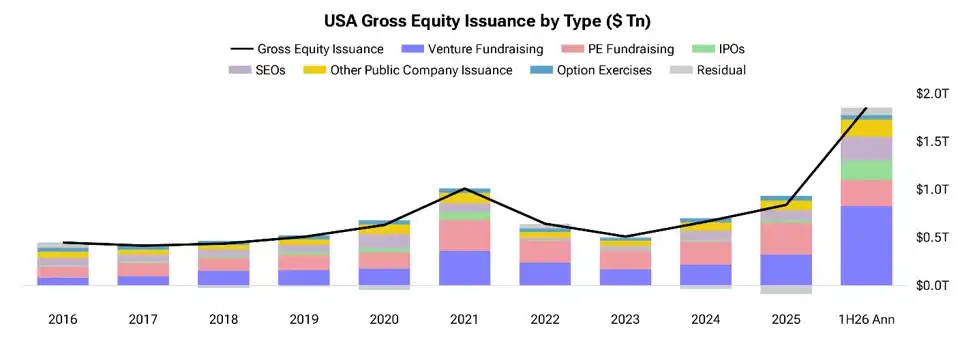
Dalio concluded that "the supply of financial assets (both debt and equity) appears to far exceed what demand can digest."

He stated that the current market is in the middle phase of a cycle where interest rates have risen significantly but have not yet led to a pronounced decline in stocks and risk assets. Interest rates will continue to rise until the supply-demand imbalance begins to narrow, at which point interest-rate-sensitive markets and economic sectors will bear the brunt first.


Related Questions

QAccording to Ray Dalio, why does he believe the bear market in US Treasuries is far from over?

ARay Dalio believes the bear market in US Treasuries is far from over due to a structural imbalance between supply and demand, where increasing debt levels and rising interest costs create a self-reinforcing spiral. He warns that this will continue until the pressure on the economy and financial markets forces a rebalancing of supply and demand.

QWhat are the key factors contributing to the decline in foreign demand for US Treasuries as highlighted by Dalio?

AThe key factors contributing to the decline in foreign demand are the actions of major holders like Japan and China. Japan may guide domestic institutions to sell Treasuries to support the yen and stabilize its own bond market, while China faces incentives to reduce its dollar holdings due to potential forex losses if the yuan appreciates. A slowdown in their purchasing pace against rising US debt supply exacerbates the imbalance.

QHow is the US Treasury's shift towards issuing more short-term bills creating risks, according to Dalio's analysis?

AThe shift towards issuing more short-term bills, which now constitute about 50% of issuance compared to a historical norm of 20%, creates significant rollover risk. While it temporarily lowers interest expenses, it makes the government's debt servicing costs more susceptible to and higher during a period of rising interest rates.

QWhat role does corporate debt, particularly from the AI sector, play in the overall fixed-income supply pressure?

ACorporate debt, especially surging issuance from AI hyperscaler companies, significantly adds to the overall fixed-income supply pressure. With total corporate bond issuance up nearly 30% year-over-year driven by AI capital expenditure, it competes with government debt for investor capital. This increased supply, alongside tightening credit spreads, acts as an early warning signal ('canary in the coal mine') for broader financial market stress.

QWhat is the 'death spiral' risk that Dalio associates with the US government's debt situation?

AThe 'death spiral' risk refers to the dangerous cycle where rising interest rates increase debt servicing costs, which in turn expands the debt burden (as more borrowing is needed to cover costs). This leads to even higher interest expenses as debt rolls over at higher rates. Dalio notes that debt servicing costs are already around 200% of federal tax revenues and rising, creating an unsustainable fiscal path that could lead to a crisis.

Related Reads

ENS DAO Proposes Transferring Treasury Management Authority to Foundation Board, Community Retains Ultimate Veto Power

ENS DAO has initiated an on-chain vote on Social Proposal 7.5, which seeks to restructure governance of its core treasury by transferring authority over the Investment Policy Statement (IPS) to the ENS Foundation Board. Under the plan, policy amendment rights currently held by all token holders through on-chain voting would move to the Foundation Board, which would also take over the MetaGov working group's oversight of professional funds and fund managers. The proposal addresses long-standing pain points in decentralized treasury management, including slow token-voting response cycles and the high threshold for financial parameter review. As the protocol delegates management of scaled funds to Karpatkey, requiring full network governance for minor adjustments to asset allocation or risk exposure has caused voter fatigue and risked missing market windows. The shift aims to remove administrative bottlenecks in professional treasury operations. To ensure rigor, the new rules require the Board to solicit community input on the ENS governance forum at least 7 days before proposing amendments. Formal resolutions must receive at least 4 director votes in favor, with conflicted directors recused and remaining eligible directors deciding unanimously. Each amendment must include written rationale and be published within 14 days of passage. ENS DAO has built in checks and balances: the minimum treasury reserve duration and major withdrawals still require full token-holder approval, as does any change to IPS Section 3 governing amendment authority and Board duties. Crucially, ENS DAO retains a permanent override power to overturn any Board amendment via a social proposal, and external fund manager Karpatkey must continue monthly public financial reporting. The proposal reflects mature Web3 infrastructure exploring a balance between modern legal-entity governance and on-chain native democracy, offering a model for compliant, efficient decentralized treasury operations. As of the latest Snapshot data, Proposal 7.5 has 179,900 votes in favor with 100% support and no opposition or abstentions. The vote closes on November 22; if passed, the ENS Foundation will publish IPS v2.1 incorporating the revisions.

marsbit9m ago

ENS DAO Proposes Transferring Treasury Management Authority to Foundation Board, Community Retains Ultimate Veto Power

marsbit9m ago

Ethereum Upgrade Testing Exposes Hidden Risks: Transactions Show Success, but Payments May Fail

Ethereum's proposed Glamsterdam upgrade has exposed compatibility risks in smart contracts during testing on the Sepolia testnet. Simulations of Juicebox payment contracts showed that some transactions confirm successfully at the outer level while internal payments silently fail, causing fund distributions or fee payments to be skipped. The issue stems from changes to the underlying execution gas accounting logic, which affects existing contracts that rely on traditional exception handling. In NFT purchase tests, buyers received NFTs even when the internal payment failed due to gas exhaustion, leaving funds stranded in the payment project. In token distribution tests, cross-project payments were interrupted, so beneficiaries received the project's original tokens instead of the intended cross-project settlement. Cash redemption tests revealed that within a gas range of 679,622 to 817,622, users could redeem funds while the internal 2.5% protocol fee was not charged, effectively waiving the fee. Juicebox developer mejango linked the problem to tiered changes in opcode gas costs and contract error-handling mechanisms, specifically EIP-8037, which sharply raises the gas cost of state creation and new storage writes. Because internal payment subcalls exhaust gas before outer logic, and developers commonly use try/catch structures that isolate errors, the failed payments do not trigger a transaction rollback. On mainnet simulations, the same gas range produced only full transaction failures or complete payments, never silent internal skips. This contrast highlights the impact of gas pricing changes on already-deployed, non-upgradeable contracts, where gas reserves and error catching designed under the old model can turn into fund-leakage risks. The Ethereum Foundation has added the Juicebox report and PoC materials to its agenda and scheduled a special meeting on November 19 to discuss the scope of impact and possible responses. No final decision on adjusting proposal parameters has been made yet.

marsbit10m ago

Ethereum Upgrade Testing Exposes Hidden Risks: Transactions Show Success, but Payments May Fail

marsbit10m ago

Trading

Spot
活动图片