Crypto lending rises again… but have they solved the risks?

cointelegraphPublished on 2026-10-08Last updated on 2026-10-08

Abstract

Crypto lending is recovering, with total value locked surging over 55% since July to around $56 billion. However, this growth amplifies existing risks, as highlighted by the April Kelp DAO hack. This exploit created unbacked rsETH tokens, many used as collateral on Aave, causing significant deposit outflows despite Aave's contracts not being directly breached. Industry leaders emphasize that security must extend beyond smart contracts to include underlying bridges, oracles, and issuer operations. Protocols like Aave are adopting more holistic reviews, phasing out risky assets, and implementing quarterly reassessments. Experts warn that human error, operational security, and the pressure to deploy capital for yield remain critical vulnerabilities. While AI-assisted tools are being used for security testing and can improve breadth and speed, they generate many false positives, necessitating expert oversight. Furthermore, the rise of AI agents introduces new attack surfaces. The consensus is that security involves not only prevention but also robust containment and response plans for when breaches occur.

As the charts flip from red to green, crypto lending has seen a resurgence of interest after a particularly dismal second quarter.

Figures from Galaxy show that $11.33 billion left the sector in Q2 — partly due to the crisis of confidence in lenders caused by the Kelp DAO hack in April that left users of the most trusted protocol, Aave, unable to access their ETH.

Since the beginning of July, however, total lending value locked has gained more than 55% to sit around $56 billion today.

But that also means the honeypot has grown larger. Can users trust interlinked DeFi lending protocols in the age of AI-assisted hacks, when an exploit from any one protocol can have a series of devastating effects for other protocols connected to it?

Stani Kulechov, founder and chief executive of Aave Labs, tells Magazine the problem is now top of mind.

“When a protocol accepts a token as collateral, it is also accepting that token’s bridge, its verifier configuration, its oracle and its issuer’s operational security.”

And that’s exactly what landed Aave in trouble.

An expanding attack surface

When hackers exploited a Kelp DAO cross-chain route in April, they created 116,500 unbacked rsETH (worth about $290 million at the time), and many of those tokens were posted as collateral to borrow other assets on Aave markets.

Even though Aave’s own contracts were not breached, the protocol still saw deposits fall by around $15 billion in the days after the exploit, and it had to freeze its rsETH and wrsETH markets.
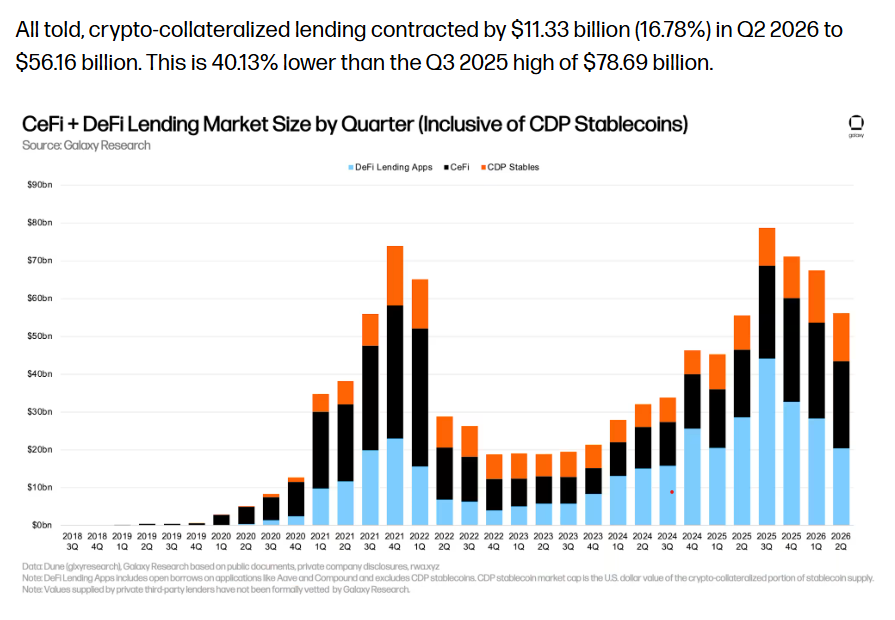
The lending market contracted by 16.78% in Q2. Source: Galaxy

Kulechov says that Aave now takes a more holistic approach to security.

“We rebuilt our approach around that wider view,” he says. “Our starting point is that security can’t stop at the smart contract.” He adds that traditional reviews “missed the risk sitting in the bridges, verifier networks and other infrastructure an asset depends on.”

Related: MiCA is coming for DeFi vaults, but regulation will be difficult

Users of lending protocols will similarly need to judge how exposed a protocol is to external and internal risks.

“Every wrapper, bridge and oracle between the lender and the underlying asset is another place a loan can go wrong,” says Thomas Wu, chief financial officer of Bitcoin-backed lender Ledn.

Sid Powell, co-founder and chief executive of crypto credit platform Maple, tells Magazine that “serious lenders” should assume a borrower can fail at any time and work backward from there.

“What am I holding, where is it, can I see it in real time, and how quickly can I get to it if something breaks?”

When security fails, containment matters

DeFi lender Spark chief executive Sam MacPherson says that beyond smart contracts, the team also reviews governance design, operational security, collateral quality, liquidity management and dependencies across the wider ecosystem.

Spark began phasing out rsETH on SparkLend in January, before the April Kelp exploit, after assessing that “its low usage and revenue” did not justify the “additional risk” created by supporting it.

Kulechov says Aave has introduced similar mechanisms, and every asset is re-reviewed quarterly and “again after any material change.” He says the protocol has already started “an orderly wind-down” on six networks that didn’t meet the chain-level standards.
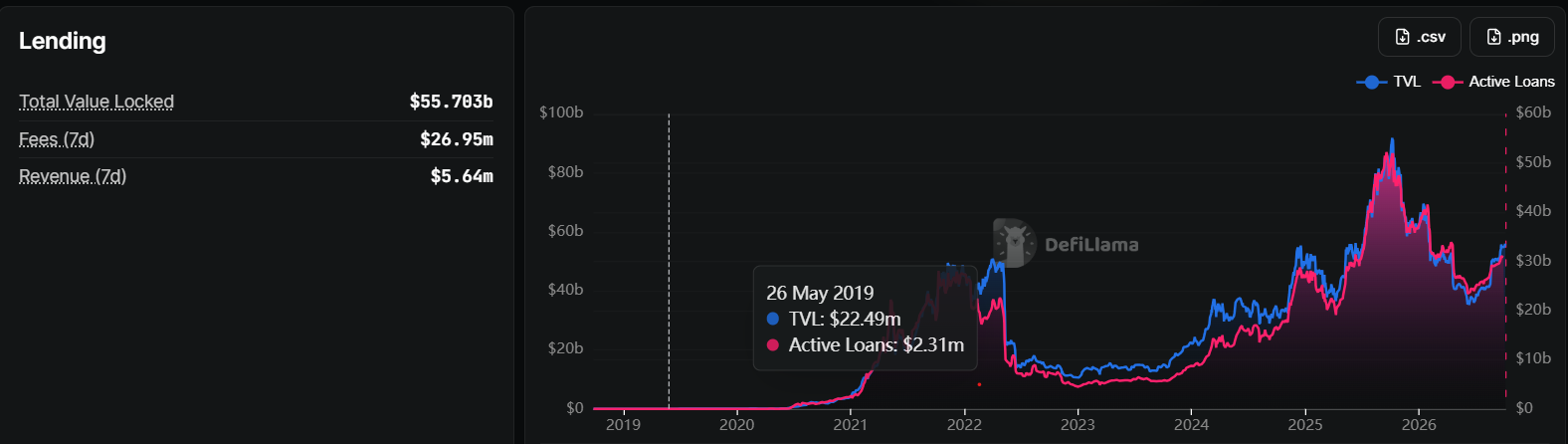
Lending (TVL) is up over 55% from the end of Q2. Source: DeFiLlama

“No protocol can control the entire ecosystem, but it can control how much of that risk it takes on and how quickly it responds,” Kulechov says.

While preventing failures is the aim, protocols also need procedures in place to respond if something happens, says MacPherson.

“Preventing losses is only part of the challenge. Protocols also need to demonstrate how a loss would be contained if something does go wrong.”

The margin for human error

Shawn Owen, founder and chief executive of SALT Lending, says that human error remains one of the biggest vulnerabilities — and it’s the easiest to overlook.

“A lot of the biggest losses have come down to key management, access controls or someone getting socially engineered, and a smart contract audit won’t catch any of that,” Owen says.

Additional risks materialize when assets are deployed elsewhere to generate interest. Crypto lenders learned that lesson the hard way during 2022’s brutal market unwind, when lenders like Celsius, Voyager and BlockFi all imploded after taking on risks customers either didn’t understand or weren’t expecting.

To minimize the attack surface, Ledn keeps client Bitcoin with qualified custodians rather than lending it out to generate additional yield.

Related: S&P Global brings risk assessments to growing crypto lending vault sector

Wu says every transaction is an additional point where something can go wrong, “so the fewer there are, the lower the risk of a breach.”

“The only way to take those risks off the table is to keep client Bitcoin in segregated custody, with tight controls and as few movements as possible.”

Powell warns that when deposits start coming in faster than a manager can find good places to lend, the pressure to maintain yields can lead to bad choices.

“So they take on a little more risk to get there. Maybe the collateral standards get looser, or they lend to a borrower they’d have turned down a year ago. [...] The managers who hold up in a downturn are usually the ones who were willing to say no to capital when they didn’t have a good place to put it.”

Can AI make lending safer?

For all the recent headlines about AI hacks and exploits and agents escaping human control, AI may actually be able to assist in making crypto lending safer.

Aave is already using AI-assisted testing alongside its conventional security processes. It used mutation testing to deliberately introduce bugs into V4 contracts, and its test suites caught 271 of 304 injected vulnerabilities.

In a recent review of its V3 and V4 codebases, three AI security tools generated 71 findings, of which, after manual review, 20 were considered valid. The other 51 showed why human security experts will likely remain employed for some time to come.
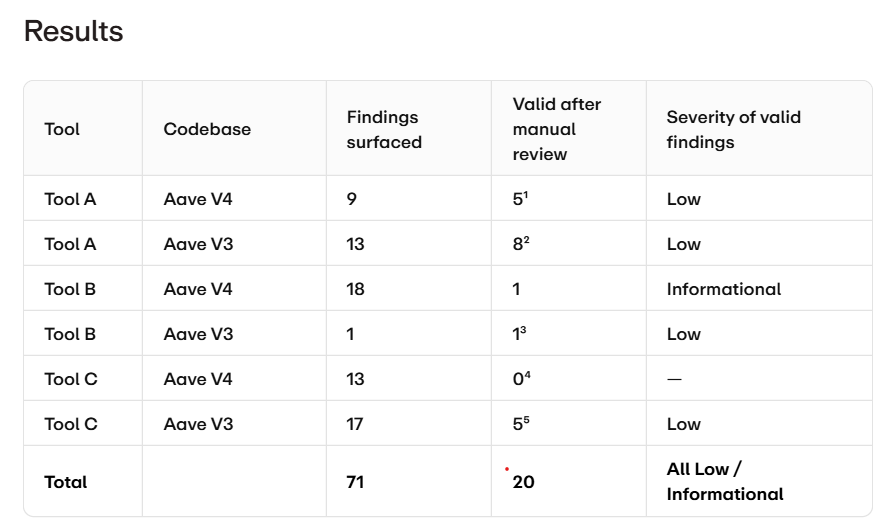
AI-Assisted Security Review of Aave V3 & V4. Source Aave

“AI is very good at breadth and speed,” Kulechov says, “but around 70% of the raw findings were false positives, so expert judgment stays essential.”

AI is something of a double-edged sword as its permissions, protocol knowledge and decision-making processes become another potential attack surface.

“As AI agents start managing capital onchain,” Kulechov says, “their permissions, inputs and decision logic become things that need to be secured just like a contract.”

So, as crypto lending grows again, the challenge isn’t just keeping the code secure, but making sure every new part of the puzzle is understood, monitored and contained when something goes wrong.

Magazine: Stablecoins can drain from banks and nations at lightning speed

Related Questions

QWhat was the main cause of the crisis of confidence in crypto lending in Q2, as mentioned in the article?

AThe main cause was the Kelp DAO hack in April, which led to the creation of unbacked rsETH tokens. These tokens were used as collateral on Aave, causing users of the trusted Aave protocol to be unable to access their ETH and resulting in a significant outflow of funds from the sector.

QAccording to Aave Labs' founder Stani Kulechov, what broader factors does a protocol accept when it accepts a token as collateral?

AWhen a protocol accepts a token as collateral, it is also accepting that token's bridge, its verifier configuration, its oracle, and its issuer's operational security. This highlights that security cannot stop at the smart contract level.

QHow did the Spark protocol mitigate risk related to rsETH before the April Kelp exploit?

ASpark began phasing out rsETH on its SparkLend platform in January, before the April exploit. They made this decision after assessing that the token's low usage and revenue did not justify the additional risk created by supporting it.

QWhat is one of the biggest vulnerabilities in crypto lending that is easy to overlook, according to SALT Lending's CEO Shawn Owen?

AHuman error is one of the biggest and easiest-to-overlook vulnerabilities. This includes issues with key management, access controls, and social engineering, none of which are caught by smart contract audits.

QHow is Aave using AI to improve security, and what is a key limitation of this approach?

AAave is using AI-assisted testing, such as mutation testing to deliberately introduce bugs, and AI security tools to review codebases. A key limitation is that AI generates a high rate of false positives (around 70% of raw findings in one review), making expert human judgment essential for validation.

Related Reads

Mercado Bitcoin begins post-hack reopening without a timeline for withdrawals

Mercado Bitcoin, one of Brazil's largest crypto exchanges, began restoring read-only access to customer accounts in phases on Monday, a week after attackers drained an estimated $49 million from the platform. Access started at 19:00 UTC, with all accounts expected to be viewable by 21:00 UTC, showing holdings as they stood on Nov. 2, the day of the hack. The exchange has yet to say when customers will be able to withdraw funds. Fabricio Tota, vice president of new business, said the exchange hoped read-only access would reassure customers that their assets were still recorded on the platform. He explained that the company opted for "a more conservative approach" to reactivating accounts "to ensure our return happens with the utmost security." The caution follows concerns from blockchain security analysts that attackers were able to access addresses, draining funds through standard transfers rather than a smart contract exploit. Blockchain analysts traced some of the stolen funds to customer deposit addresses, but Mercado Bitcoin says customers won't bear the losses. Tota said the vast majority of assets were never even touched by anyone and were not involved in the incident. On Nov. 4, Mercado Bitcoin pledged to cover all losses with company funds, bolstered by a $20 million investment from stablecoin issuer Tether in July. Tota highlighted that a portion of the stolen funds were also frozen in the hours after the company announced the attack. The next phase of recovery will require users to confirm their registration details before they can move funds. The exchange plans to restore withdrawals via Pix, Brazil's instant payment system, initially allowing customers to withdraw only to accounts in their own name. Tota gave no date for either step. Mercado Bitcoin has yet to explain how the attackers gained access to its wallets. Blockchain data company Bitquery found that as of Nov. 4, wallets linked to the attacker held most of the stolen funds that had escaped freezes, including 106.07 BTC.

cointelegraph5h ago

Mercado Bitcoin begins post-hack reopening without a timeline for withdrawals

cointelegraph5h ago

Avalanche’s AVAX leads crypto gains following NYSE tokenization deal

Avalanche's AVAX token rose as much as 10% on Monday, becoming the top gainer among the 100 largest cryptocurrencies, after the New York Stock Exchange announced plans to use Avalanche's blockchain to settle trades on a new platform for trading tokenized stocks around the clock. AVAX later eased to $8.86, still up over 8% on the day, with a market cap of around $3.95 billion and $439.7 million traded in the past 24 hours. Avalanche's total value locked stands at $633 million, up 4% over the past day. NYSE's head of digital issuance, Dennis Lee, said the exchange is examining how blockchain technology can expand its equities offerings and is picking the right technology for each job. The deal underscores Wall Street's growing effort to use blockchain to make stock trading faster and enable trading outside regular market hours; traditional US markets are open 9:30 am to 4:00 pm EST on weekdays, with trades often taking at least one business day to settle. The NYSE first announced plans for the platform in January, and Ava Labs revealed in September that the exchange had spent about a year testing Avalanche, though the final selection was not confirmed until Monday. Avalanche will record stock trades and help complete transactions on the platform, which will let investors buy and sell digital versions of stocks across different blockchains. Lee said the settlement ledger needs to be fast, reliable, permissioned, cost-predictable, and backed by a large developer community—all of which Avalanche meets. The platform could launch before the end of 2026 pending regulatory approval. Ava Labs chief business officer John Nahas said first conversations with the NYSE began nearly a year ago and called it an important step toward blockchain becoming foundational financial infrastructure. The news comes as other major firms invest in blockchain for faster, round-the-clock trading: Nasdaq plans to invest $100 million in Kraken's parent Payward to launch tokenized stocks by Q2 2027, and the DTCC launched a service in October allowing firms to turn traditional securities into digital tokens. The NYSE deal follows other efforts to bring traditional assets onto Avalanche, including Progmat moving over 452 billion yen in digital securities onto a dedicated Avalanche blockchain in July and Aave Labs' plans for a lending service using tokenized assets as collateral.

cointelegraph6h ago

Avalanche’s AVAX leads crypto gains following NYSE tokenization deal

cointelegraph6h ago

Trading

Spot
活动图片