Claude Code Desktop Version Drastically Upgraded: One Person Commands an AI Army to Speed-Code

marsbitPublished on 2026-10-15Last updated on 2026-10-15

Abstract

Anthropic's Claude Code Desktop receives a major "v2-like" overhaul, transforming it into a multi-agent collaboration workspace. Its standout feature is automated nested sessions: users can define multiple coding tasks in a main chat, and Claude automatically spawns parallel sub-sessions to execute them concurrently. Each sub-session works independently, preventing intermediate logs and errors from cluttering the main thread. Upon completion, results are neatly summarized back to the primary session. Other key enhancements include a redesigned session sidebar for monitoring agent status, one-click environment reuse for complex project setups, and Git Worktree isolation to prevent code conflicts during parallel work. A new `/btw` command allows users to ask contextual side questions in a separate tab without interrupting the main workflow. Claude Code also proactively recommends follow-up tasks and features "idle compaction" to optimize token usage. This update marks a shift from AI as a single coding assistant to a platform for managing a coordinated "AI engineering corps," where developers oversee multiple parallel agents, streamlining complex project development.

Claude Code has evolved overnight!

Just today, Anthropic officially released an epic-level update for the Claude Code desktop version!

It can now launch multiple conversations simultaneously, running tasks multi-threaded, and whoever finishes first throws the result back to the main session.

Furthermore, the new interface has completely revamped session management.

It not only supports environment reuse and one-click launching of subsequent tasks but also allows you to type /btw to instantly switch to a new tab and start running tasks separately.

Almost instantly, the global developer community was flooded with the same news.

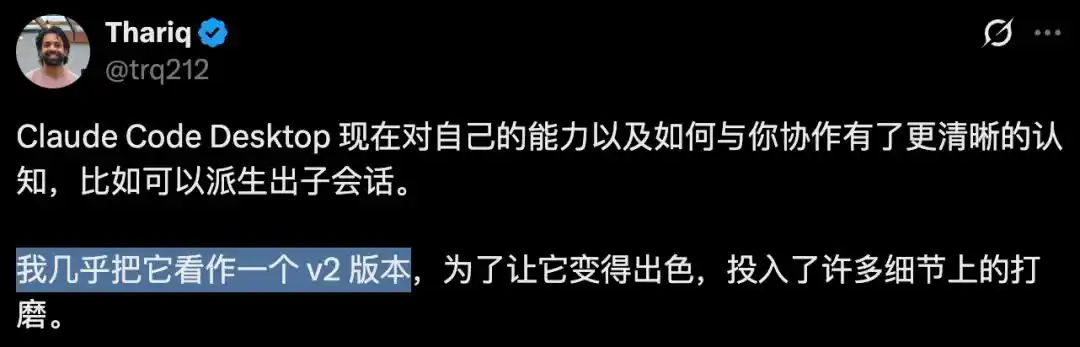
Anthropic engineer Thariq could hardly contain his excitement, exclaiming, "This is almost a v2 version"!
Claude Auto-Splits Itself, Multiple Sessions Work Simultaneously

First, let's look at the most eye-catching feature this time: automatic creation of nested sessions.

Previously, if you wanted the AI to do three things at once, you had to manually open three windows and then check the results one by one yourself.

Worse, with too many tasks, the main thread would turn into a disaster zone: front-end code mixed with back-end error messages, and to trace back a specific modification step, you had to frantically scroll your mouse in front of the screen.

Now, this logic has completely changed.

In the new Claude Code desktop version, you only need to hand over all tasks at once in the main dialog.

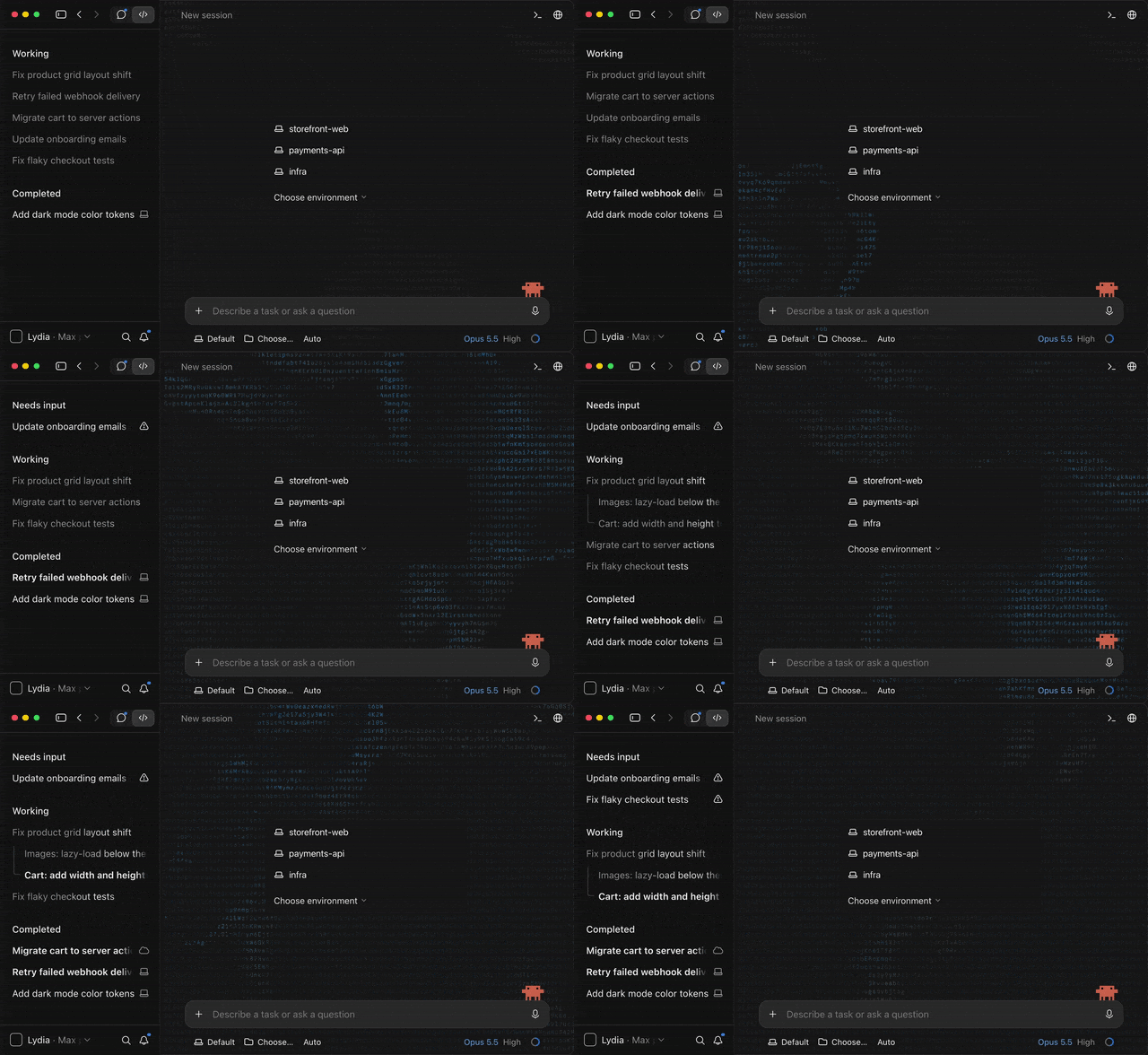
When Claude recognizes that these tasks can be processed in parallel, it instantly performs a "Shadow Clone Jutsu"—automatically creating an independent nested session for each subtask!
Even better is its information flow mechanism:

Underlying Concurrent Execution: Several sub-sessions start working simultaneously in the background, each reading context, modifying code, running tests, without interfering with each other.

Extremely Clean Main Thread: Their tedious intermediate trial-and-error and hundreds of lines of terminal output won't pollute the main conversation interface at all.

Automatic Summary and Reporting: When each sub-session finishes its work, it automatically reports the final execution results back to the main session neatly, just like a subordinate reporting to a director.

This way, the main thread maintains extremely high readability from start to finish.

Humans don't need to worry about the process of debugging those hundreds of lines of error messages in between. They can just sit in the main session, reviewing the final answers submitted by each AI like approving official documents.

If a Claude clone gets stuck or you want to see the details, you can click through to the underlying session at any time.

This round of upgrades makes it easier for the AI to work separately. But engineering acceptance still requires human oversight.

How Can a Person Keep Track of a Pile of AI Conversations?

When several Clauses start working together, you immediately run into another problem: who should you look at?

One is still analyzing code, one is running commands, and another might have stopped waiting for your decision. If you can only click into each one to check the records, the waiting time you saved gets eaten up by switching windows.

The new version moves these statuses to more visible positions.

The sidebar allows users to clearly see which sessions are working and which require personal intervention.

After entering a session, a real-time to-do list follows Claude's plan as it progresses; when it needs a user response, a review card will summarize the situation of this round.
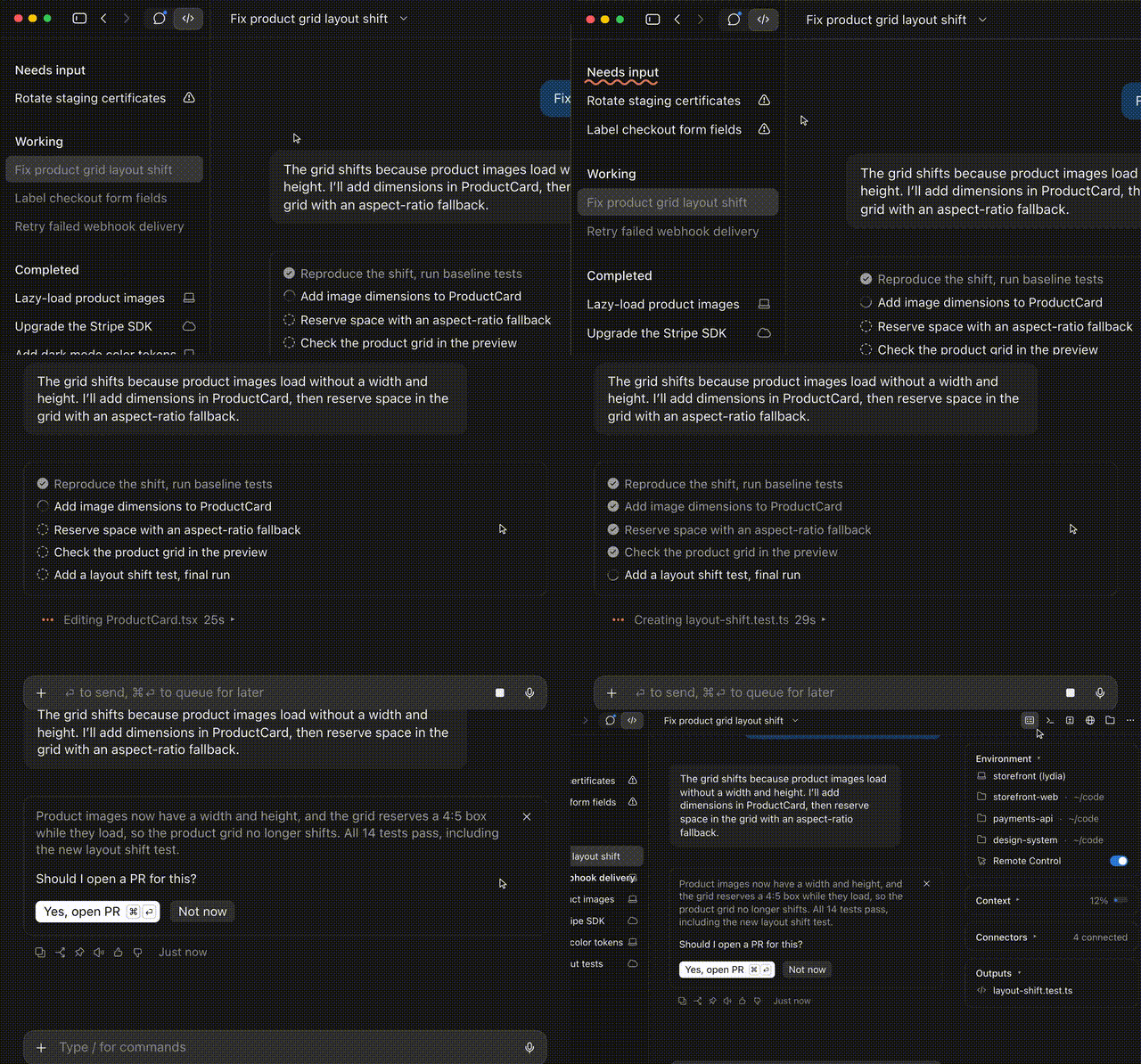
The side information bar displays the task's running location, context, and code changes.

Second-Level Entry into the "Battlefield," One-Click Environment Reuse

Besides concurrency during task execution, Anthropic has also taken "pre-work preparation" to the extreme this time.

Many full-stack architects' daily development environments are very complex: the front-end is in one folder, backend microservices are in another, and some long-running tasks even need to be run in the cloud.

Every time you restart the software or switch projects, it takes a long time just to configure these directories and connections properly.

The new Claude Code has drastically restructured the "new session interface."

The core goal is four words: seamless continuation.

One-Click Access to Commonly Used Directories

When you open the interface, "Recently used folders" are directly placed in the most prominent position. No need to search through the system directory tree—just one click and you can start working right away.

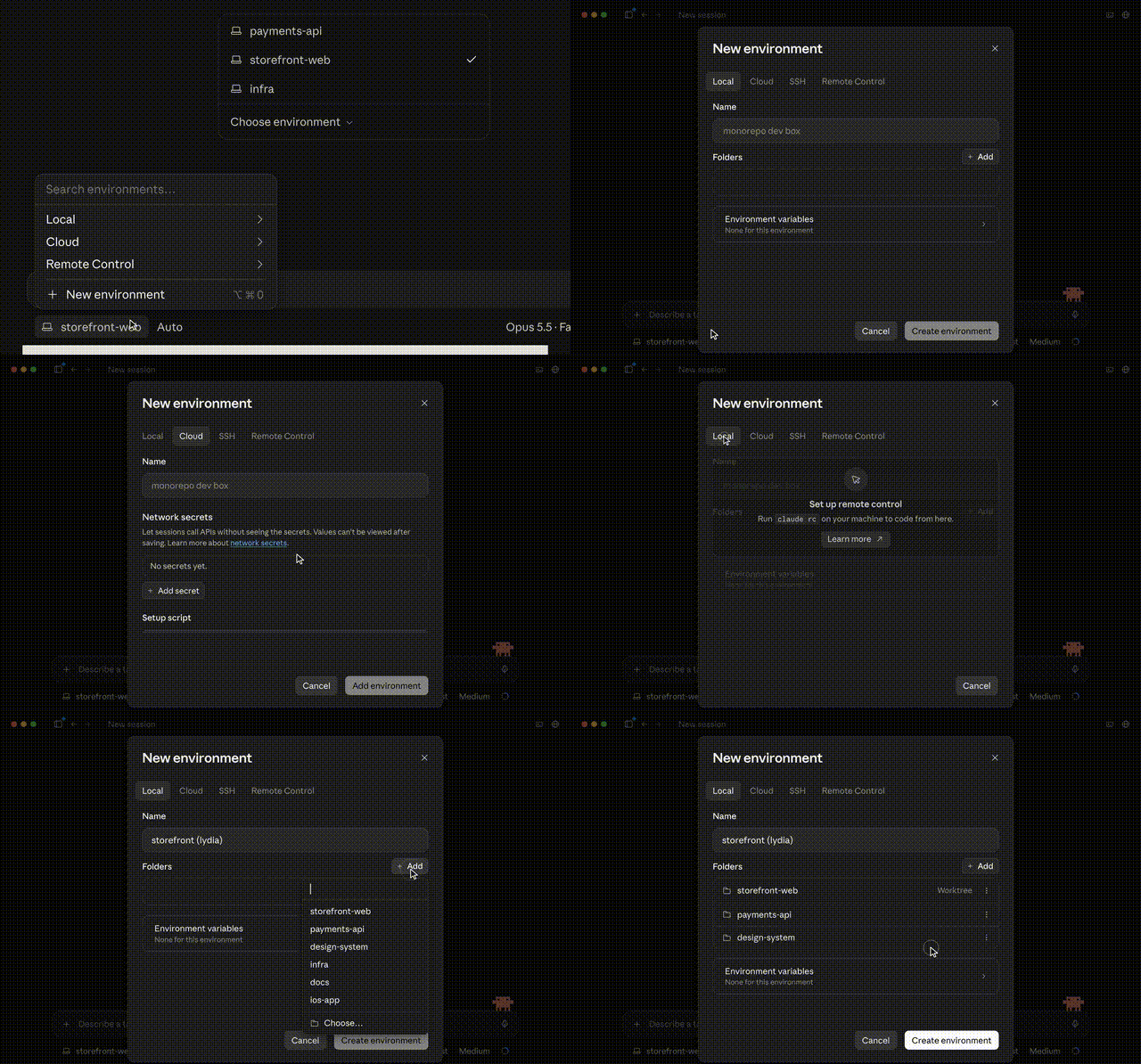
Custom "Environment" Packaged and Saved

Now, you can package and save an entire complex development configuration directly as a named "Environment."

For example, a combination of several local folders, a specific SSH remote host, or a cloud runtime environment. The next time you need to use it, you can instantly launch the entire multi-directory, cross-end workbench with one click.
Native-Level Git Worktree Isolation

Since there are multiple concurrent sessions, wouldn't it be a problem if two AIs modify code in the same local folder simultaneously?

Anthropic has already thought of this for you!

When launching multiple sessions, the new CC directly provides the option for "Independent Worktree for each folder."

Just tick the box, and Claude will automatically use Git Worktree to pull up independent worktree branches for different parallel sessions.

Session A refactors the underlying architecture, Session B fixes an urgent online bug—both are physically isolated at the file level. No more worrying about code overwriting each other or the local environment crashing.

Detail-Obsessed, /btw to Chime in Anytime, Actively Recommends Follow-up Tasks

Why did Thariq marvel that the new Claude Code desktop version has "an extremely strong sense of self-awareness of its own capabilities"?

The answer lies in two clever interactive details: proactive recommendations and the /btw side conversation.

Previous AI tools were like "abacus beads"—you had to push them to move.

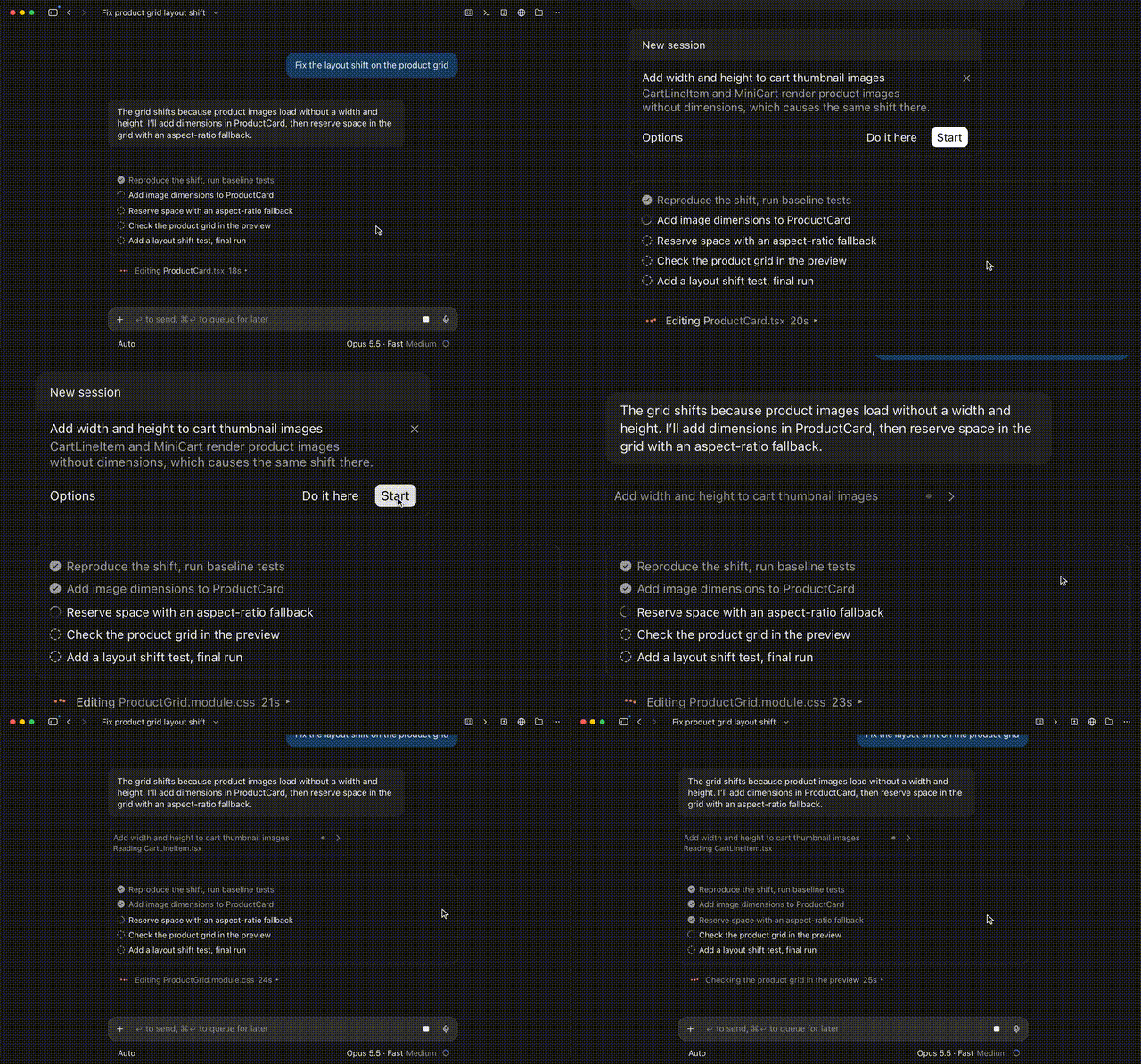
The new CC, while working, actively recommends the next steps based on the current changes.

No need to type for confirmation; just click once, and the follow-up suggestions will directly start running in the background as independent sessions! Additionally, the empty input box will intelligently display grey prompt suggestions, which can be instantly adopted by pressing the Tab key.
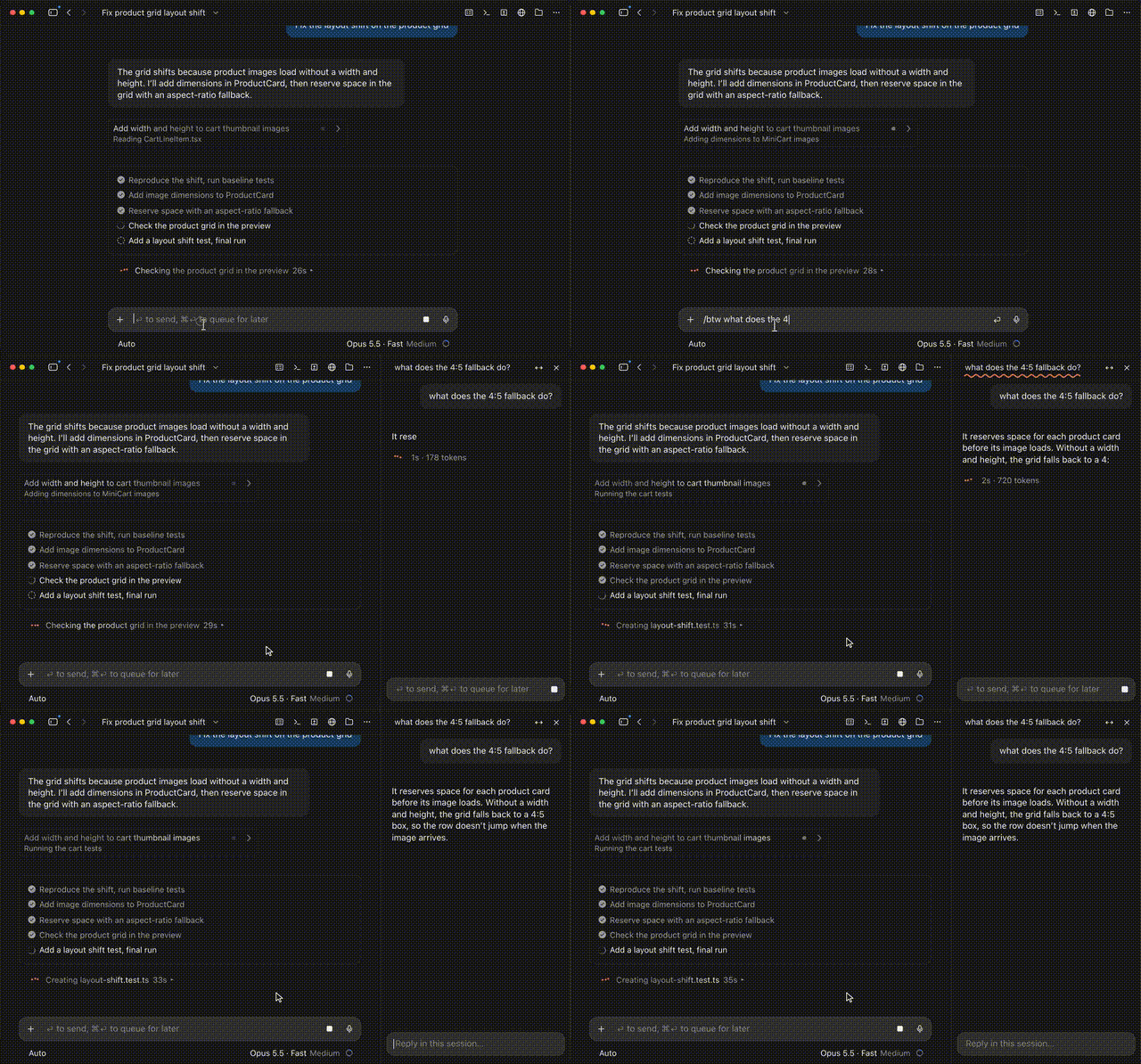
Another design that makes programmers applaud is the newly added /btw command (by the way).

During the main task progression, you inevitably have temporary questions, like "By the way, what's the default expiration time for this authentication token?"

Now, in CC, just type /btw (or use the shortcut Cmd + ; / Ctrl + ;):

The system immediately opens a side conversation in an independent tab, fully inheriting all the context from the main session up to that point, with no need to re-explain the background.

The main session continues at full speed, completely undisturbed! The side question will never pollute the main thread record. Once you resolve your doubt and close the tab, the main work remains clean.

This feature seems simple, but it solves a very fundamental pain point: The "flow state" should not be interrupted.

Programmers fear the "context-switching tax" the most. Every time they are interrupted and try to return to a state of deep work, it might take over ten minutes.

/btw allows people to resolve temporary questions without interrupting the main workflow. Often, efficiency is saved bit by bit in this way.
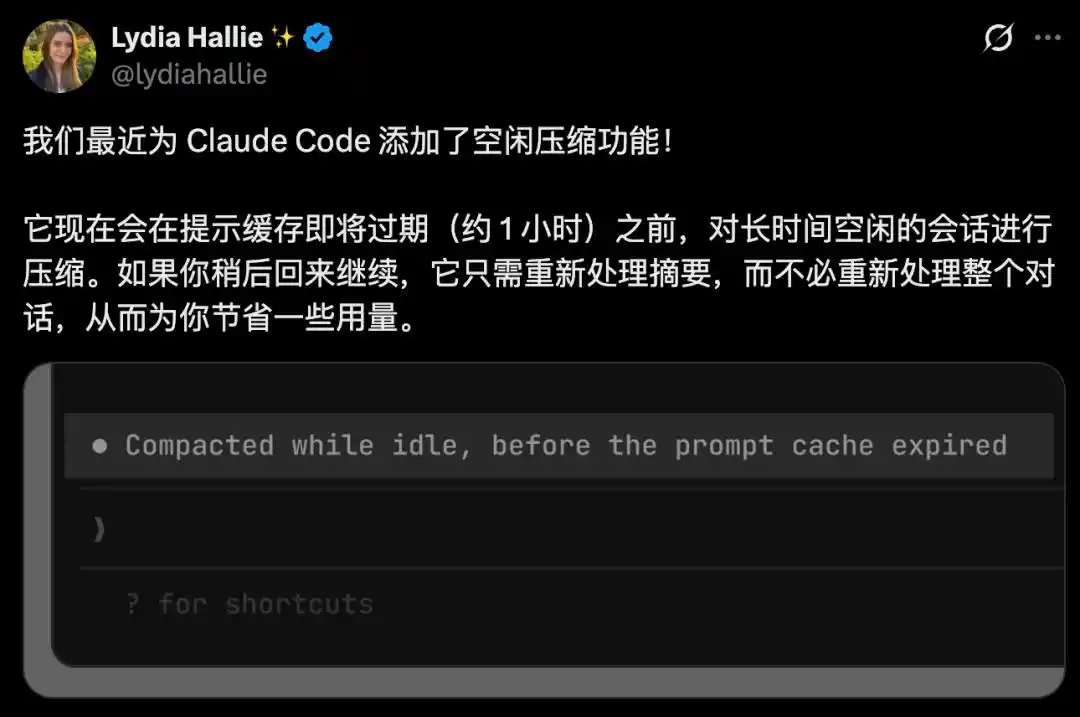
Moreover, Claude Code has added an "Idle Compaction" feature.

When a session remains idle for a long time, CC will automatically compress the session context before the prompt cache is about to expire (around 1 hour).

This retains critical context while reducing token consumption, saving on usage quotas.
The Second Half of AI Programming: Competing on "Team Leadership"

To put it bluntly, this major overhaul of the Claude Code desktop version directly pushes AI programming into its second half.

It's evolving from a single "AI Programming Assistant" into a full-fledged "Multi-Agent Collaboration Workbench."

Over the past two years, the AI coding competition focused on single-point capabilities—code completion, single-generation accuracy, scores on benchmarks like SWE-bench.

But today, the bottleneck has become "How can the AI simultaneously advance the development of ten modules without messing up the engineering?"

As Thariq said, Claude Code is highly aware of its capabilities and knows how to cooperate with humans by spawning sub-sessions.

Most importantly, under this new paradigm, the role of human developers has fundamentally shifted.

The era of single-threaded work is ending. The "Multi-Agent Parallel Engineering Army" for each individual is officially launched today.

References:

https://x.com/ClaudeDevs/status/2110445849516101743

https://code.claude.com/docs/en/desktop-quickstart

https://x.com/trq212/status/2110463962877989276

This article is from the WeChat public account "Xin Zhiyuan," author: Peach (Taozi).

Trending Cryptos

Related Questions

QWhat is the most significant new feature of the updated Claude Code desktop version?

AThe most significant new feature is the ability to automatically create nested sessions for parallel task execution, allowing multiple AI agents to work on different tasks concurrently and report results back to the main session without cluttering it.

QHow does the new Claude Code handle multiple sessions to prevent human oversight from becoming overwhelming?

AIt provides a side navigation bar showing the status of all sessions (e.g., working, waiting for input). It also uses real-time task lists and review cards within sessions to clearly summarize progress and indicate when human intervention is needed.

QWhat problem does the '/btw' command in Claude Code solve for developers?

AThe '/btw' command (meaning 'by the way') solves the problem of context-switching and broken 'flow state'. It allows developers to ask a follow-up or clarifying question in a separate tab with full context inheritance, without interrupting or polluting the main session's progress and conversation history.

QWhat is the purpose of the 'Idle Compaction' feature mentioned in the article?

AThe 'Idle Compaction' feature automatically compresses the context of a session that has been idle for a long time (around an hour) before the prompt cache expires. This preserves key context while reducing token consumption and saving on usage limits.

QAccording to the article, how is Claude Code's role evolving with this major update?

AClaude Code is evolving from a single 'AI programming assistant' into a 'multi-Agent collaboration workstation'. The competition is shifting from single-point capabilities (like code completion) to managing and coordinating multiple AI agents to handle complex, parallel engineering tasks effectively.

Related Reads

Crypto Stocks Weekly丨Strategy Adds 1,036 BTC but Holdings Fall Below Cost Basis; Bitmine Holds 4.97% of ETH Supply (November 10)

The article begins by noting that Democrats swept both chambers of Congress, ushering in a divided-government phase, after which markets shifted focus to AI regulation and capex payback cycles, with Anthropic's IPO seen as a bellwether for AI stocks. US equities fell sharply (Nasdaq -5.52% and Philadelphia Semiconductor Index -12.24% on Nov 5) before a Monday rebound driven by falling oil prices and oversold buying—characterized as a repair, not a new high. Macro data showed October nonfarm payrolls +165k and unemployment at 4.1%, keeping 10-year Treasury yields near 4.86% and rate-hike expectations alive. Citi cut US equities and global tech to neutral while upgrading Europe ex-UK, citing unstable AI sentiment; Goldman noted AI stocks are ~40% of the S&P 500 versus ~15% of STOXX 600. Crypto diverged from the equity rebound: US spot Bitcoin ETFs saw $1.282B in weekly net outflows (BlackRock's IBIT -$12.09B... actually $1.209B), Ethereum ETFs -$365M for a sixth straight weekly outflow, with continued outflows on Nov 9. NYSE-affiliated tokenized securities platform chose Avalanche for settlement infrastructure. Corporate treasury updates: Strategy bought 1,036 BTC at ~$79,012 (total 850,364 BTC, average cost ~$75,456, now above spot), funded partly by ATM share sales, with most proceeds used to repurchase STRC preferred shares. Strive added 29 BTC (total 43,153). Listed companies now hold over 6% of Bitcoin's supply (1.2664M BTC across 199 firms). Bitmine added 9,587 ETH, holding 6,070,092 ETH (~4.97% of supply, ~99% of its 5% goal). DeFi Development Corp's SOL rose to 2,609,829. Hyperliquid Strategies raised $911M in Q3, bought ~9.1M HYPE (holdings up to 38.5M, ~16% of circulating supply), and repurchased ~2.7M PURR shares.

marsbit20m ago

Crypto Stocks Weekly丨Strategy Adds 1,036 BTC but Holdings Fall Below Cost Basis; Bitmine Holds 4.97% of ETH Supply (November 10)

marsbit20m ago

When Will the Chip Stock 'Capitulation-Style Selling' End? BofA: Perhaps in Early 2027, Stock Price Pullbacks Typically Lead Fundamental Inflection Points by 6-9 Months

The SOX semiconductor index has fallen 38% (from 14,634 to 9,011) since its June 22, 2026 peak, over 136 days—exceeding the average historical peak-to-trough decline of 32% but less than half the average 253-day duration of past downturns (2011, 2015, 2018, 2022). BofA analyst Vivek Arya expects this "indiscriminate selling," driven by AI capex slowdown fears, to end around early 2027. Historically, SOX declines lead actual semiconductor sales declines by 6–9 months, implying real EPS cuts may emerge from Q1 2027, with capex reductions reflected in H2 2027—though stocks may already price in much of the bad news. SOX currently trades at 13.7x forward P/E versus 17.7x for the S&P 500 (a 22% discount, down from a 15% premium at the AI peak), leaving roughly 12% downside to the historical trough valuation of ~12x. US cloud capex runs at ~$300B/quarter (~$1.2T annualized) versus $1.555T consensus for 2027—about 23% below expectations if spending holds steady, equating to ~30 GW of compute deployment versus BofA's 40+ GW base case. A 20% capex cut would pressure AI semiconductor revenue by 20%+ and EPS by 35–40%. BofA outlines three scenarios: base case ( ~10% downside, bottoming Q1 2027, favor segment leaders), bear case (pressure into mid-2027, favor EDA, high-FCF analog, low-AI-exposure names), and bull case (favor memory, optics, quantum, CPUs). Potential stabilizers include policy clarity in Q1 2027, buybacks (Lam $25B, Nvidia, Micron starting Dec 9), and slower capex extending the upcycle.

marsbit39m ago

When Will the Chip Stock 'Capitulation-Style Selling' End? BofA: Perhaps in Early 2027, Stock Price Pullbacks Typically Lead Fundamental Inflection Points by 6-9 Months

marsbit39m ago

TSMC: October Revenue Up 60%, with Month-over-Month Growth Still Accelerating

TSMC reported October consolidated revenue of NT$586.89 billion, up 59.7% year-over-year and 14.7% month-over-month, signaling accelerating momentum. Converted to RMB, that is about RMB 119.4 billion, with cumulative revenue for the first ten months reaching NT$4.49 trillion, up 43.3% year-over-year. The near-60% growth came on top of an already high base, while the sequential acceleration confirms strengthening demand rather than a slowdown. The report arrived at a delicate moment. The Philadelphia Semiconductor Index had plunged 12.25% over two sessions, its worst single-day drop since March 2020, as political changes in the U.S. prompted new governors in Texas and Ohio to pause approvals for new data center projects. Markets pessimistically priced in a halt across the AI data center supply chain. Sentiment rebounded sharply on November 9, with the semiconductor index jumping 6.86%, and Taiwan's weighted index surging 1,960.06 points, its second-largest single-day gain on record, supported by government stabilization funds and short-selling restrictions. TSMC stands apart from other AI assets. As the only foundry capable of mass-producing 3nm and 2nm chips, it holds about 90% of the global AI chip foundry market, with advanced-node capacity booked through 2028. Its diversified revenue mix—68% high-performance computing, 21% smartphones, 4% automotive and 4% IoT—provides a buffer, allowing it to reallocate capacity to flagship phone chips, automotive computing, and edge AI if data center approvals slow. October's results validate management's guidance of roughly 44% full-year dollar revenue growth and capital spending of US$60-64 billion. Expansion continues, with 2nm ramping and Arizona's second fab moved up to Q3 2027; Goldman Sachs raised its 12-month target price to NT$3,300. Google's expanded eighth-generation TPU lineup adds further demand, with TSMC and other Taiwanese suppliers in the ecosystem. TSMC's ADR trades at about 24x trailing earnings, low relative to its growth. Risks include a prolonged U.S. data center approval freeze and geopolitical or oil-price shocks. In A-shares, domestic substitution names such as SMIC and NAURA remain driven by rising localization rather than Texas approvals.

marsbit40m ago

TSMC: October Revenue Up 60%, with Month-over-Month Growth Still Accelerating

marsbit40m ago

Trading

Spot

Hot Articles

How to Buy ONE

Welcome to HTX.com! We've made purchasing Harmony (ONE) simple and convenient. Follow our step-by-step guide to embark on your crypto journey.Step 1: Create Your HTX AccountUse your email or phone number to sign up for a free account on HTX. Experience a hassle-free registration journey and unlock all features.Get My AccountStep 2: Go to Buy Crypto and Choose Your Payment MethodCredit/Debit Card: Use your Visa or Mastercard to buy Harmony (ONE) instantly.Balance: Use funds from your HTX account balance to trade seamlessly.Third Parties: We've added popular payment methods such as Google Pay and Apple Pay to enhance convenience.P2P: Trade directly with other users on HTX.Over-the-Counter (OTC): We offer tailor-made services and competitive exchange rates for traders.Step 3: Store Your Harmony (ONE)After purchasing your Harmony (ONE), store it in your HTX account. Alternatively, you can send it elsewhere via blockchain transfer or use it to trade other cryptocurrencies.Step 4: Trade Harmony (ONE)Easily trade Harmony (ONE) on HTX's spot market. Simply access your account, select your trading pair, execute your trades, and monitor in real-time. We offer a user-friendly experience for both beginners and seasoned traders.

7.8k Total ViewsPublished 2024.03.29Updated 2026.09.28

How to Buy ONE

Discussions

Welcome to the HTX Community. Here, you can stay informed about the latest platform developments and gain access to professional market insights. Users' opinions on the price of ONE (ONE) are presented below.

活动图片