August's Collective Surge: Capital is Paying 'Extra Premiums' for Leading Crypto Treasury Companies

marsbitPublished on 2026-09-06Last updated on 2026-09-06

Abstract

In August, the cryptocurrency market, led by Bitcoin breaking $82,000, saw its strongest rally since October 2025. While Bitcoin gained about 25%, the Digital Asset Treasury (DAT) sector experienced a dramatic collective surge. Ten major DAT stocks rose an average of 106% for the month, significantly outperforming their underlying treasury assets, which gained about 45% on average. This indicates that the market is paying an "additional premium" for these companies. The rally highlighted a "Beta + leverage" characteristic, where smaller, more narratively driven DATs like CYPH (ZEC) and USDE (ENA) posted extreme excess returns over their treasury assets. While industry giant MicroStrategy (MSTR), representing ~68% of the sector's市值, showed more moderate gains, it exemplifies the core DAT capital flywheel: rising asset prices improve the balance sheet, enabling equity raises to buy more assets, amplifying per-share exposure. The DAT model is evolving beyond simple Bitcoin holdings. Newer entrants like Bitmine (ETH) and Forward Industries (SOL) incorporate staking, adding a yield component to the price-driven model and transforming treasuries into productive assets. Furthermore, capital is flowing into higher-beta, smaller-cap DATs focused on altcoins like HYPE (PURR) and ZEC (CYPH). These companies bundle asset price exposure with narratives around ecosystem growth, mining operations, or broader platform utilities, offering greater elasticity. The sector's recent outperform...

Author: Jae, PANews

On the early morning of September 4th, Bitcoin briefly broke through $82,000. Although it subsequently fell back to around $80,000, the crypto market has actually experienced its strongest rebound since October 2025 starting from mid-August. Bitcoin recorded a gain of about 25% in the past month, while U.S. spot Bitcoin ETFs saw net inflows of $3.52 billion in a single month, setting a new yearly record.

However, what has been more dramatic than the spot market action is the collective explosion of the Digital Asset Treasury (DAT) sector. According to PANews statistics, all 10 leading DAT stocks closed higher in August, with an average monthly gain of about 106%, while the average increase in their treasury assets was only about 45%. Even excluding extreme outliers, the excess returns of DAT stocks relative to their underlying assets remain remarkably significant.

It can be said that capital is assigning an additional capital market premium to certain DATs. This premium is composed of the beta from rising coin prices, the amplification from financing leverage, the boost from staking yields, and the imagination fueled by ecosystem narratives.

All Green in August, Doubling Returns Unfolded

According to PANews observations, the total market cap of the 10 leading DAT stocks included in the statistics currently exceeds $82 billion, up 46% month-on-month; August trading volume was about 2.5 billion shares, a month-on-month increase of 33%, indicating that capital's attention has returned to the DAT track.
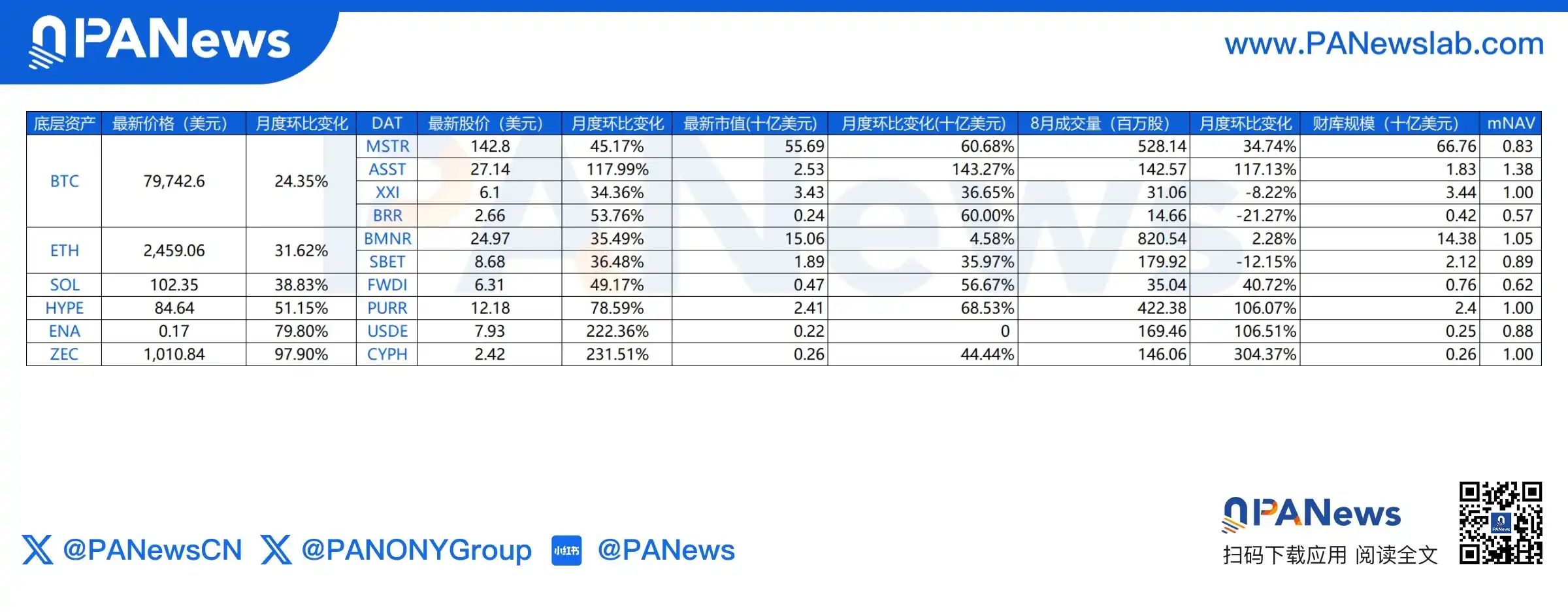
The most interesting phenomenon in this round of market action is that DAT stock gains have generally outperformed their treasury assets, exhibiting a strong "Beta+Leverage" characteristic. In terms of price performance, all 10 leading DAT stocks achieved excess returns relative to their treasury assets. Among them, three DAT stocks are particularly noteworthy:

  • ASST: Treasury asset BTC rose 24.35% during the same period, while the stock surged 117.99%, achieving an excess return of about 94 percentage points.

  • CYPH: Treasury asset ZEC rose 97.9% during the same period, while the stock surged 231.51%, achieving an excess return of about 134 percentage points;

  • USDE: Treasury asset ENA rose 79.8% during the same period, while the stock surged 222.36%, achieving an excess return of about 143 percentage points;

In contrast, the sector leader MSTR showed relative restraint, rising 45.17% in the past month with an excess return of only about 21 percentage points.

A pattern has emerged: the smaller the DAT's market cap, the lower the stock liquidity, and the newer the narrative, the greater the price elasticity relative to its treasury assets often is. This is the most obvious difference between this round of DAT action and the era of "Strategy's dominance": as DAT holdings expand from Bitcoin to more assets, mid-to-small cap stocks, with their smaller float and more diversified narratives, have shown more aggressive price action than the leading stock.

MSTR Holds Nearly 70% of Top DAT Market Cap, Treasury Leverage Creates Bidirectional Elasticity

However, Strategy remains the most mature example of the DAT model, with MSTR's market cap accounting for about 68% of the cumulative market cap of the 10 leading DAT stocks.

The fundamental business logic of a DAT is not a linear mapping of "coin up → stock up", but rather a leveraged tool that amplifies the return on treasury assets.

On August 23rd, BTC surged over 20% within a week. Strategy held 840,447 BTC at the time, with a net BTC asset value of approximately $49.68 billion. On August 31st, Strategy announced the purchase of approximately 4,603 BTC for about $370 million, at an average price of about $80,318, bringing its total holdings to 845,050 BTC.

This is precisely the capital cycle of the DAT model: BTC rises → balance sheet improves → equity financing capability strengthens → obtains more funds to buy BTC → per-share BTC exposure further increases.

This positive feedback mechanism endows DAT stocks with stronger elasticity than their treasury assets. When treasury asset prices rise, the compounded return rate of DAT stocks naturally far exceeds the simple coin price increase. This characteristic also makes DAT stocks a "return amplifier" during rebound phases.

The most attractive aspect of a DAT is leverage, and the most dangerous aspect is also leverage. The flywheel works both ways; the stronger the upward momentum, the more violent the downward move can be.

The total treasury asset size of the 10 DAT stocks is approximately $92.62 billion, while their combined stock market cap is only 88.8% of their treasury size. This means that the DAT sector does not universally trade at high premiums; in fact, some stocks are already trading below the value of their treasury assets.

It is important to note that an mNAV (market-to-net asset value) below 1 does not equate to "risk-free arbitrage." In addition to treasury assets, companies have liabilities, preferred shares, dilution risks, management fees, financing costs, asset staking, regulatory risks, operational losses, and a series of other deductions.

According to a Bloomberg report, Nakamoto, a Bitcoin DAT backed by crypto entrepreneur David Bailey, who helped turn U.S. President Trump towards supporting BTC, has seen its stock price plummet about 99% from its peak, wiping out its market premium.

The volatility of DATs stems both from the underlying coin price and from the expansion and contraction of valuation premiums, with the amplitude of the latter often being greater than the former.

From BTC to ETH/SOL, DATs Add a Layer of Staking Yield

Strategy represents the playbook of the first-generation "hodling" DAT. Another clear change is that the DAT model is expanding to more crypto assets, and its mechanics are also evolving, giving DATs the attributes of "productive assets."

Ethereum treasuries are a classic example of this evolution. Take Bitmine, for example. As of now, it holds over 5.9 million ETH, accounting for about 5% of ETH's total supply, along with 211 BTC and over $500 million in cash and tradable securities, with the combined value of crypto assets and cash reaching $15.6 billion. Among these, about 5.07 million ETH have been staked to earn on-chain yields.

SharpLink adopts a similar approach, holding over 890,000 ETH, which it consistently deploys into staking and on-chain yield strategies.

Solana treasuries followed suit. Forward Industries holds approximately 7.807 million SOL and its equivalent assets, accounting for about 1.3% of Solana's circulating supply, with almost all of it staked.

Compared to BTC treasuries, which are highly dependent on price fluctuations, ETH/SOL treasuries add a layer of value support through staking yields.

This means the valuation model for DATs is undergoing a second-order evolution:

  • Stage One: Treasury Value ≈ Asset Price × Holdings, price-driven;

  • Stage Two: Treasury Value ≈ Asset Price × Holdings + Staking/On-Chain Yields, supported by cash flow;

This model may become the main battleground for competition in the next phase of the DAT sector.

Sector Divergence Emerges, Risk Appetite Spills into Altcoin DATs

Capital is flowing from BTC and ETH treasuries into higher-Beta altcoin treasuries, with market interest in DAT stocks like HYPE and ZEC significantly increasing. This is also a signal that the market is entering its second phase: after mainstream assets attract incremental capital, funds spill over into mid-to-small cap targets, and risk appetite cascades down the hierarchy.

Altcoin DATs are smaller in scale and more prone to extreme price movements.

PURR is a prime example. As of now, it holds approximately 30.1 million HYPE, with a holding value as high as $2.54 billion. Simultaneously, the company has repurchased about 5.8 million shares of PURR, tightening the float.

More importantly, PURR's value anchor points are not just the HYPE price, but a whole suite of combined narratives: HYPE price volatility + HYPE holdings growth + Hyperliquid ecosystem growth + HYPE buyback and burn + DAT financing capability.

Among these, Hyperliquid's ecosystem revenue and token economics provide the primary value support. Over the past 12 months, the Hyperliquid ecosystem generated approximately $712 million in retained earnings, with a staggering 99% of that value flowing to HYPE holders through a buyback mechanism. Investors buying PURR are essentially betting on the growth of the Hyperliquid ecosystem.

CYPH, which holds ZEC, also possesses significant potential. As of now, it holds 323,394 ZEC, accounting for about 1.91% of Zcash's circulating supply. Subsequently, the company also entered the Zcash mining field through a related transaction with Winklevoss Capital, controlling about 18% of the network's total hashrate. CYPH's valuation incorporates ZEC treasury value, mining operations, and the privacy asset narrative.

USDE is a newcomer among DATs, listed on Nasdaq at the end of June, with ENA as its treasury asset. USDE holds approximately 3.029 billion ENA, valued at about $510 million, representing 20% of ENA's total supply. USDE's business model simultaneously covers six major segments: Ethena ecosystem infrastructure, validation nodes, LayerZero DVN, stablecoin Harness, USDe distribution, and the ENA treasury.

In other words, USDE is attempting to build a complete flywheel: Ethena ecosystem growth → infrastructure revenue increases → ENA value appreciates → capital market financing → further expands ENA treasury and its ecosystem footprint.

Ecosystem narrative + low market cap + scarce newly listed float collectively catalyzed a single-month gain of over 200%, but it appears more like a special case of a "small-cap, high-volatility, strong-narrative DAT."

Currently, divergence in the DAT market is already evident. Capital and attention are concentrating towards the top, while elasticity and imaginative potential lie with mid-to-small cap targets.

The collective outperformance of DATs relative to coin prices in the recent period sends a signal: DATs are becoming a high-beta instrument connecting traditional stock markets and crypto assets.

More worthy of in-depth investigation than the percentage gains is the source of the excess returns. If it primarily stems from genuine growth in assets per share, cash flows from staking and ecosystem businesses, then DATs are evolving into a brand-new mode of crypto asset management.

From "comparing who holds more coins" to "comparing who creates more value per share," competition in the DAT sector is entering a higher dimension. And ultimately, all leverage and premiums must be tested by the cycle.


Related Questions

QAccording to the article, what was the average monthly increase of the top 10 DAT stocks and their treasury assets in August?

AThe top 10 head DAT stocks saw an average monthly increase of about 106%, while their treasury assets only rose by about 45% on average.

QWhat is the basic business logic of DAT (Digital Asset Treasury) companies, and how does it create leverage according to the article?

AThe basic business logic of DAT companies is a leveraged mechanism to amplify the return rate of treasury assets. The model creates a positive feedback loop: crypto asset price rises -> balance sheet improves -> ability to raise capital via stock issuance increases -> more funds are used to buy crypto assets -> the crypto exposure per share further increases.

QHow are Ethereum and Solana-based DAT models evolving beyond the original Bitcoin-centric model?

ADAT models for Ethereum and Solana are evolving by incorporating staking. Companies like Bitmine and SharpLink for ETH, and Forward Industries for SOL, stake a significant portion of their holdings. This adds a layer of staking yield or on-chain revenue, giving these treasuries a value support based on cash flow, not just price appreciation.

QWhat factors contribute to the 'premium' or 'excess returns' observed in some smaller or newer DAT stocks, as exemplified by PURR, CYPH, and USDE?

AThe excess returns for smaller/newer DAT stocks like PURR, CYPH, and USDE come from a combination of factors: high-beta treasury assets (e.g., HYPE, ZEC, ENA), small market cap and low stock liquidity, and strong ecosystem narratives. Their valuations incorporate not just the underlying token price but also growth from associated ecosystems, business operations (like mining for CYPH), and economic mechanisms like token buybacks.

QWhat key risk does the article associate with the leverage inherent in the DAT model?

AThe key risk is that the leverage in the DAT model works both ways. While it can amplify gains during market upturns, it can also lead to severe losses during downturns. The article warns that the valuation premium can expand and contract, and this volatility in the premium itself is often greater than the volatility of the underlying crypto assets.

Related Reads

"Strictest Ever" Wet-Lab Prediction Benchmark Released: Maxed-Out Reasoning and 5x Compute Still Won't Cut It

UniPat AI has launched Science Prediction Universe (SPU), a new benchmark that evaluates whether AI models can predict the outcomes of real wet-lab experiments before they are conducted. The benchmark covers 116 tasks and 4,207 wet-lab experiments across chemistry, materials science, biology, and medicine, drawing on recent papers and unpublished collaborations with institutions such as Stanford, Cornell, and Harvard. Models are given eight hours, an H20 GPU, internet access, and scientific software, and must submit a ranked prediction of experimental results, which is then scored against hidden ground-truth data using the Spearman correlation coefficient. To prevent memorization, evaluation runs in isolated, offline containers and screens outputs for paper identifiers. Results show that even leading models like Opus 5.5 and GPT-6 Astra remain far from reliable prediction: the best average score was 0.486, and only about half of tasks exceeded the random baseline. The study also found that increasing reasoning effort fivefold barely improved accuracy, since models often settled on an answer early and spent the rest of the time on minor adjustments. Likewise, more tool use and GPU calls did not reliably help. Performance varied sharply by measurement target, and API costs ranged 300-fold across configurations. SPU aims to give researchers and model developers a unified way to measure and improve AI's scientific judgment before investing in costly experiments.

marsbit2h ago

"Strictest Ever" Wet-Lab Prediction Benchmark Released: Maxed-Out Reasoning and 5x Compute Still Won't Cut It

marsbit2h ago

From Harshly Criticizing Stablecoins to Building an L1: Airwallex's Jack Zhang Isn't "Converting" — the Battle for the Settlement Layer Has Begun

In June 2025, Airwallex CEO Jack Zhang publicly questioned stablecoins, arguing that fiat conversion costs outweighed their cross-border payment benefits and that crypto had failed to solve real-world problems for 15 years. Yet just 17 months later, in November 2026, Zhang emerged as co-founder of Alta, a blockchain project that raised $80 million (a $47.5 million Series A led by Index Ventures plus a $32.5 million seed round). Rather than a change of heart, the move reflects commercial necessity: a battle over the stablecoin settlement layer is underway, and payment giants that stay out risk becoming mere interfaces atop someone else's chain. Alta is not a general-purpose public chain but a compliant Layer 1 built for banks and licensed payment institutions. Co-founder Loong Wang, previously of Ren Protocol, says existing chains like Ethereum and Solana cannot simultaneously meet institutional demands for privacy, compliance, integration with local financial systems, and liquidity. Alta uses recursive zero-knowledge proofs to enable on-chain compliance checks without exposing identities or transaction amounts, and builds in programmable compliance modules, native identity authorization, and anti-airdrop protections. Co-founder Catherine Porter previously led Meta's Libra (Diem) partnerships. Airwallex itself is Alta's key advantage: with $287 billion in annualized volume, $1.3 billion in revenue, 200 countries, and 90 currencies, it will channel enterprise clients onto the new chain. Zhang's apparent reversal is consistent: he criticized stablecoins as cheap remittance tools, but now bets on tokenized fiat settlement infrastructure. Competitive pressure comes from Stripe, which acquired Bridge for $1.1 billion, bought Privy, and incubated the Tempo chain (raising $500 million at a $50 billion valuation, with OpenAI, Shopify, Deutsche Bank, and Visa as partners). Circle's Arc, Fireblocks, and Canton Network are also competing. With stablecoin market cap exceeding $320 billion and 2025 on-chain volume surpassing $33 trillion, the real contest is over who controls minting, clearing, and fiat redemption. Success will depend less on technology than on three factors: genuine adoption by traditional financial institutions, compliance adaptation across jurisdictions, and efficient on- and off-ramps to real banking systems. The paradigm has shifted: instead of disrupting banks, fintech giants now aim to build infrastructure that lets traditional finance voluntarily move on-chain. Pragmatism, not ideology, now dominates the race.

marsbit5h ago

From Harshly Criticizing Stablecoins to Building an L1: Airwallex's Jack Zhang Isn't "Converting" — the Battle for the Settlement Layer Has Begun

marsbit5h ago

"Everyone is too conservative with AI!" Head of Claude Code: My approach is more ambitious

Felix Rieseberg, who leads Claude Code's desktop app, argues that most people use AI too conservatively and should set more ambitious goals. His central trick: set unreasonably aggressive targets and insist they're achievable—for example, instead of cutting website load time from 10 seconds to 5, aim for 0.2 seconds, and when the model protests, keep telling it the problem is solvable and to try again. He organizes ambition into four categories: speed (doing the same work faster), height (raising the abstraction level to focus on desired outcomes rather than individual tasks), depth (working like top experts, using their real tools, data, and methods), and breadth (drawing on ideas from other fields). For height, he suggests asking what you ultimately want to happen and what the goal behind the goal is—e.g., instead of fixing single crashes, require the app to never crash. For a quarterly business review, move from filling in a template to understanding what changed and why, identifying the most urgent decisions, and redesigning the review process itself. For depth, he advises insisting on the tools top professionals actually use (databases and statistical models rather than Markdown tables), setting "unreasonable" targets, challenging your own assumptions against raw data, hunting for new knowledge, and using external validation rather than letting the model grade itself. A useful prompt asks the model what top experts would do that you haven't requested, what raw materials and tools they'd use, and what besides the model and you could prove the result correct. For breadth, he recommends replacing nouns with verbs (not "make a PPT" but "in 30 minutes, convince busy people of an explanation and drive a decision under uncertainty"), assembling cross-disciplinary teams, and using multi-agent setups—while avoiding mere role-play in favor of adopting other fields' actual methods. He closes with self-efficacy research: people given clear, challenging goals outperform those told to do their best, and believing difficult things are possible—as with the four-minute mile—unlocks achievement. In an era of rapid capability gains, updating our beliefs about what's possible matters more than ever.

marsbit5h ago

"Everyone is too conservative with AI!" Head of Claude Code: My approach is more ambitious

marsbit5h ago

Trading

Spot
活动图片