The volume of tokenized real-world assets (RWA) on the blockchain has exceeded 38 billion dollars, yet this figure is less significant than what awaits us in the future. In a report published on Monday, September 14, 2026, Castle Labs argued that the industry's future depends not on the number of listings, but on whether tokenized assets can move between exchanges, serve as loan collateral, and be traded with high liquidity.
This distinction is of paramount importance for institutions exploring tokenization, as well as DeFi protocols seeking profitable collateral. It will determine whether tokenized assets can bring meaningful benefit or remain merely digital shells within traditional financial systems.
Treasury Bonds Form the Foundation of the 38 Billion Dollar Base
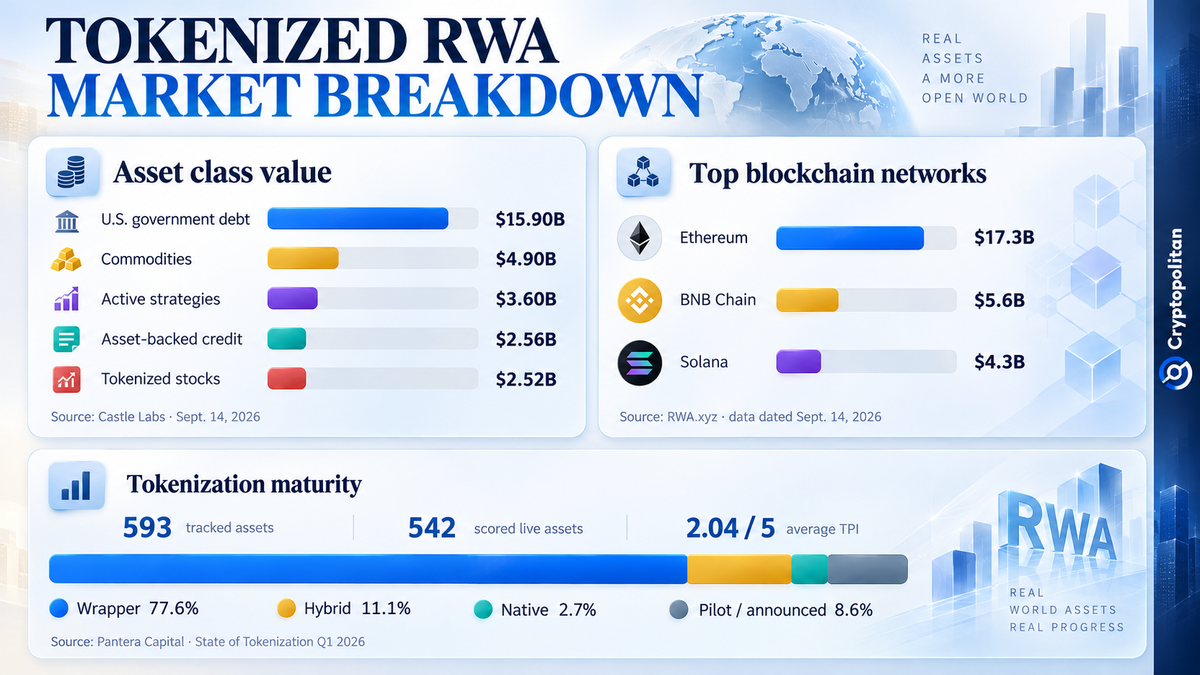
As of September 15, 2026, RWA.xyz reported a distributed asset value of $38.86 billion, up 1.00% over 30 days, and approximately 4.24 million holders. According to Castle Labs, U.S. government debt accounts for over $15.9 billion. Other asset types include: commodities worth $4.9 billion, active strategies worth $3.6 billion, asset-backed loans worth $2.56 billion, and tokenized equities worth $2.52 billion.
The market is also segmented by the blockchains where transactions occur. According to RWA.xyz's ranking as of September 14, the top three networks are Ethereum with $17.3 billion, BNB Chain with $5.6 billion, and Solana with $4.3 billion. The provided information indicates a persistent issue of tokenized assets being distributed across various blockchains, leading to liquidity problems.
According to a 2026 CoinGecko report, the volume of risk-weighted tokenized assets (RWA) exceeded $19.3 billion by the end of the first quarter, more than tripling since January 2025.
Listing Assets Has Now Become a Simple Task
Castle Labs claims the supply-side problem is no longer relevant. Companies such as Kraken, Robinhood, Ondo, Securitize, Franklin Templeton, and BlackRock can already provide tokenized access in one way or another.
A more important question is what asset holders can actually do with their assets. Castle Labs divides utility into two categories: accessibility and composability. Tokenization has expanded access to trading venues, but assets become useful only when they can move between different venues, be traded with high liquidity, be used as collateral, and efficiently interact with blockchain transactions.
This has become especially relevant with the extension of trading venue operating hours, which, fortunately, deprives traditional markets of the 24/7 access advantage they have held for the past few years.
Regulation and Institutions Take Action
The sector has found favorable state policies that support its long-term growth. According to TRM Labs, stablecoin regulation had advanced in over 70% of 30 jurisdictions by 2025, and approximately 80% of financial institutions made statements about their digital asset initiatives.
The implications for the banking sector are manifesting at a structural level. In a note published by the IMF in April 2026, economist Tobias Adrian noted that tokenization could enable atomic settlement, continuous liquidity management, and the implementation of regulatory requirements. However, without a proper legal framework and secure settlement assets, tokenization could increase instability by accelerating banking runs and increasing concentration and fragmentation.
A May report from BCG stated that today, risk-weighted digital assets (RWA) are small in scale; however, in the coming decade, digital RWAs are likely to have the greatest structural significance in the banking sector.
Why Does Liquidity Still Lag Behind?
In its Q1 report, Pantera Capital recorded a total of 593 assets, of which 542 were active. The average tokenization progress index for the quarter was only 2.04 out of 5. According to Pantera, of the tracked assets, 77.6% were classified as 'Wrapper', 11.1% as Hybrid, and only 2.7% as Native.
Pantera compared the RWA market to the early phase of the internet when "newspapers were placed on websites": meaning known products moved to another technological platform, though most have yet to fully leverage their potential. In practice, many tokenized assets still behave much like their traditional counterparts, which partly explains why liquidity and market infrastructure are struggling to keep pace with developments.
The Organisation for Economic Co-operation and Development (OECD) reached the same conclusion, identifying insufficient liquidity, a lack of payment networks, gaps in securities custody, legal uncertainty, and lack of interoperability as factors hindering wider adoption.
Cryptopolitan also noted that tokenization alone is insufficient to ensure liquidity, and that market makers, two-way order flow, and a reliable price discovery process will still be necessary.
The future of tokenization will no longer be solely about how much value is tokenized, but whether that value can truly move and be utilized within the financial context.