Bitmine Nears Mastery of the '5% Alchemy', Who Will Step Up After ETH Loses Its Biggest Buyer?

marsbitPublished on 2026-10-14Last updated on 2026-10-14

Abstract

Ethereum's largest corporate holder, Bitmine, is nearing its goal of holding 5% of all ETH supply, potentially within the next 6-7 weeks. This target, originally a five-year plan, is set to be achieved in just about 16 months since the strategy began in June 2025. The company currently holds approximately 4.9% of ETH supply. Upon reaching this 5% "hard cap," Bitmine plans to pause its aggressive accumulation, shifting focus toward shareholder returns and stock price recovery. This includes a large ongoing stock buyback program. Bitmine's sustained buying has been a major support for ETH, absorbing a significant portion of new supply. Its potential exit as a constant buyer raises questions about future market demand. Currently, U.S. spot Ethereum ETFs have seen net outflows, and other digital asset treasury (DAT) companies hold far smaller reserves, suggesting no immediate, comparable buyer is ready to fill the gap. Despite a large unrealized loss on its ETH holdings, Bitmine remains optimistic. Chairman Tom Lee stated the company's substantial staking rewards could cover financial obligations like dividends, reducing the need to sell core holdings. He predicts ETH could reach $5,000 by year-end and potentially $7,500 if Bitcoin surpasses $100,000. Long-term bullish drivers include asset tokenization, generational wealth transfer, and AI industry growth. While Bitmine's buying halt may test short-term market absorption, new institutional demand and Ethereum's ecosystem devel...

Author: Nancy, PANews

Bitmine, the largest buyer of Ethereum, is about to hit the brakes on accumulation. In just over a year, Bitmine is within reach of its 5% of Ethereum supply target, a goal originally set as a five-year plan.

Despite continuous expansion of unrealized losses on paper, this Ethereum treasury company never ceased its hoarding, becoming one of the crucial supporting buy-side forces for ETH. Once Bitmine stops persistently sweeping up coins, who will take over as the next buy-side force for ETH?

Achieving the '5% Alchemy' in Just 16 Months

Ethereum's biggest bull, Bitmine, is about to complete the '5% Alchemy'.

Since initiating its ETH reserve strategy in June 2025, Bitmine has been consistently buying ETH almost every week, rapidly growing into the world's largest Ethereum treasury company. Now, this originally five-year deployment plan has entered its final stage ahead of schedule.

Bitmine's official announcement shows that as of October 11th, the company holds 6,028,946 ETH, accounting for approximately 4.9% of the total ETH supply (122.1 million), achieving about 99% of its 5% holdings target.

In other words, Bitmine is only short by about 77,000 ETH from its goal. Based on the acquisition scale of over 12,000 ETH in the most recent week, the company could reach its target in as fast as six to seven weeks. This means Bitmine is poised to fulfill its promised goal approximately 16 months after initiation.

Looking at the accumulation pace, Bitmine has significantly slowed its coin purchases in recent months. Since June this year, its weekly accumulation scale has gradually shrunk from previous levels of hundreds of thousands or even two hundred thousand ETH to tens of thousands or lower. Although the direction of continuous buying remains unchanged, it's evident that Bitmine is actively adjusting its accumulation rhythm.

The aggressive accumulation strategy has also put considerable pressure on Bitmine's balance sheet. Calculated at an average ETH holding price of $3,334, Bitmine's current unrealized loss is approximately $5 billion. Regarding this, Bitmine Chairman Tom Lee remains optimistic. He stated that most of the company's ETH holdings were accumulated during the crypto market bear phase, placing Bitmine in a relatively favorable position before the next crypto bull run he anticipates arrives.

"We will not continue accumulating beyond 5%, nor will we hold more than 5% of Ethereum's total supply," Tom Lee clearly stated at the Token2049 conference in Singapore, setting 5% as Bitmine's hard cap for holdings.
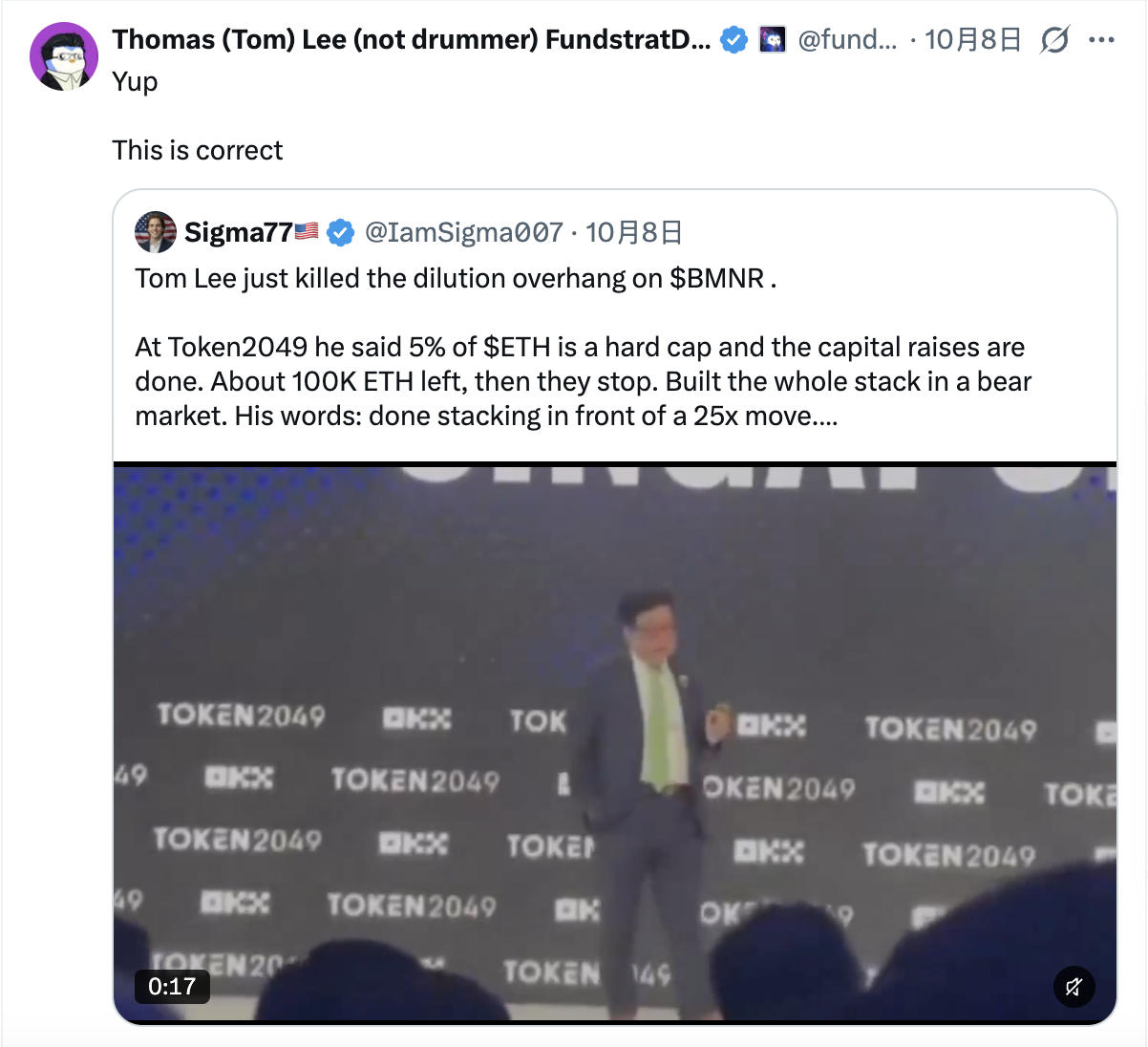
It's worth noting that several months ago, Tom Lee mentioned in an interview with Bankless that as more enterprises begin to view ETH as a long-term reserve asset similar to real estate, it might become reasonable for Bitmine to hold more than 5% of ETH's total supply. He also revealed that the company might reassess this holdings target in 2027, primarily based on Ethereum's adoption rate and ecosystem development.

Perhaps 5% is not the absolute upper limit for Bitmine's long-term holdings. Whether to continue accumulating in the future will still depend on the development of the Ethereum ecosystem and the company's own capital operation strategy.

Strategic Focus May Shift to Valuation Recovery, Covering Financial Expenses by Selling Staking Rewards

At present, Bitmine's choice to press pause upon nearing its holdings target likely considers both the healthy development of the Ethereum ecosystem and its own stock price performance.

From an ecosystem development perspective, Tom Lee has publicly explained multiple times that Bitmine set the ETH holdings target at 5% to hold a sufficiently large scale of ETH to exert positive influence while avoiding causing disturbances to the ecosystem. In his view, 5% is a holdings ratio that can generate substantial impact, also providing important long-term support for the Ethereum ecosystem, acting as a 'ballast stone' for network development.

On the other hand, Bitmine itself faces stock price pressure. Over the past year, BMNR's stock price has fallen over 55.6%. For Bitmine, continuous financing for buying coins is an important means to expand its ETH reserves, but the pressure from equity dilution brought by financing could also drag down the market's valuation of the company's stock.
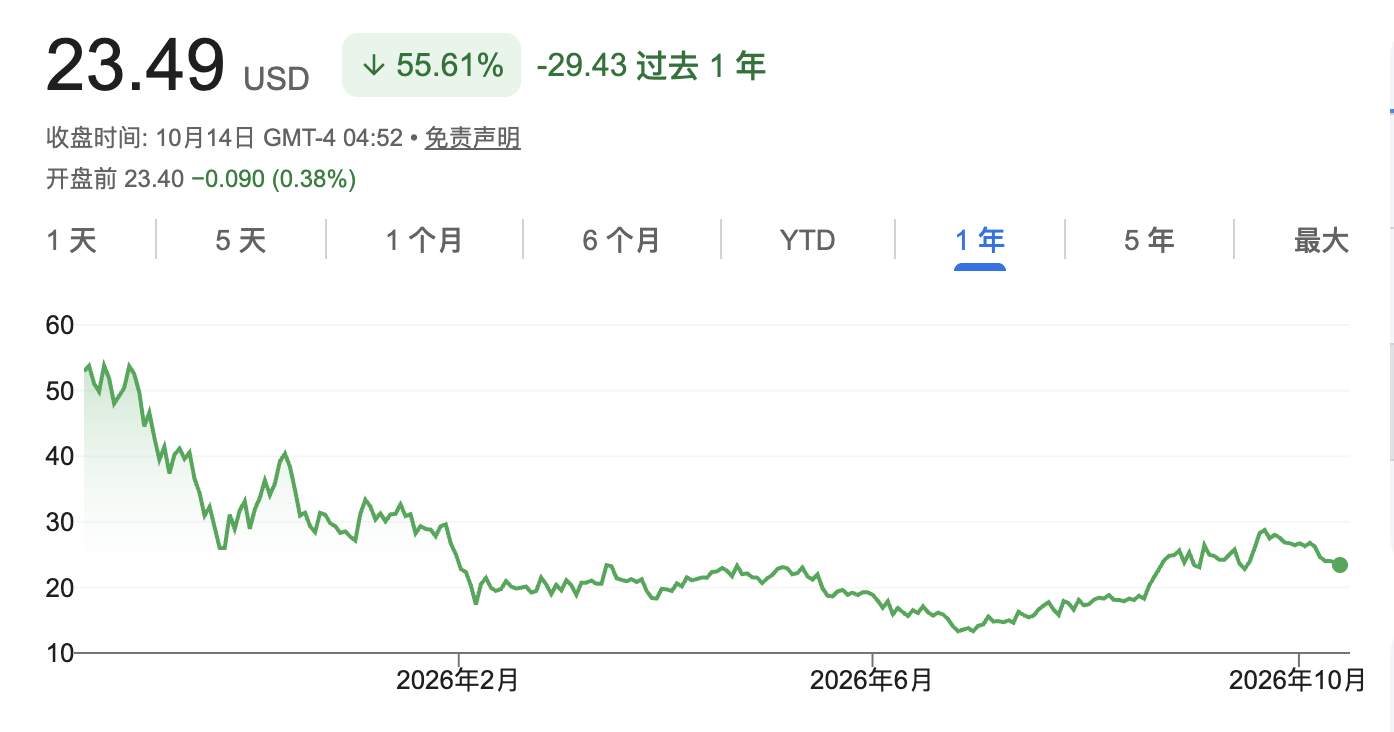
To boost the stock price, Bitmine has slowed its ETH buying pace while initiating a stock repurchase plan. According to official disclosures, between July 14th and August 17th, the company repurchased 21 million shares, costing $350 million. Tom Lee called this the largest stock repurchase in crypto industry history.

Now, as the accumulation scale approaches the set holdings target, Bitmine's strategic focus may shift towards shareholder returns and valuation recovery. Tom Lee pointed out during his recent Token2049 Singapore speech that after reaching the set holdings target, BMNR is expected to outperform ETH, because the company will no longer need continuous financing for buying coins, and market concerns about its equity dilution are also expected to ease.

However, completing the accumulation target does not mean Bitmine will sell its core ETH holdings for financial needs. Tom Lee recently stated that most DAT companies holding substantial assets may eventually need to sell part of their assets to cover operating expenses, repay debt, or distribute returns to shareholders. But Bitmine's situation is different; ETH can continuously generate income through staking, and the existing staking income is already sufficient to cover preferred stock dividend payments, thereby reducing the necessity for the company to sell core ETH holdings to meet financial obligations.

It is reported that Bitmine currently stakes 5,067,309 ETH, with annualized staking income of $336 million; if all holdings were staked, calculated at a 7-day staking yield of 2.61%, annualized income is estimated to reach $400 million.

Nevertheless, Tom Lee also clearly revealed that Bitmine will sell the staking rewards it receives. In his view, selling core ETH holdings might imply changing the existing strategy, whereas selling rewards generated from staking is a way to manage the holdings scale.

But even calculating based on the $400 million annualized income if all holdings were staked, the daily selling amount would only be about $1.1 million, having limited direct impact on ETH's price.

After the Biggest Buyer Stops Buying, Who Will Fill the Market Gap?

Undeniably, over the past year or more, Bitmine has not only been a significant buy-side force in the ETH market but also an important participant supporting market confidence.

According to SoSoValue data, as of October 13th, the total net asset value of U.S. spot Ethereum ETFs is approximately $15.83 billion, with a net asset ratio (ETF-held asset market value as a percentage of ETH's total market value) reaching 5.16%. In comparison, the ETH holdings scale of Bitmine, a single DAT company, is already on par with the overall holdings scale of U.S. spot Ethereum ETFs.

More importantly, Bitmine's buying scale can, to some extent, absorb ETH's new supply. Taking the past 30 days as an example, ultrasound.money data shows that ETH's new issuance is approximately 86,000 coins, while Bitmine bought about 72,000 ETH during the same period, equivalent to 75.2% of the new issuance.

However, if Bitmine no longer persistently sweeps up coins, who can take over as the new buy-side force for ETH has become a topic of market concern.

Currently, spot ETFs have not demonstrated sufficiently strong absorption capacity. Data shows that U.S. spot Ethereum ETFs have experienced net outflows for two consecutive weeks, with $542 million leaving just last week, marking the largest single-week net outflow since January this year. If the fund outflow trend continues, ETFs will not only struggle to fill the buy-side gap possibly left by Bitmine but may also further increase selling pressure in the market.

The buying capacity of other digital asset treasury companies is also limited. Currently, the second-largest ETH treasury company, SharpLink, holds ETH accounting for about 0.73% of the total supply, far from Bitmine's approximately 4.9% holdings ratio. Whether in terms of asset reserve scale or continuous accumulation capability, other DAT companies currently find it difficult to compare with Bitmine.

However, changes in buy-side forces do not necessarily mean ETH's price will continue to face downward pressure. Market demand still depends on ETF fund flows, other institutions' allocation intentions, and the overall risk appetite of the crypto market.

Regarding medium-to-long-term trends, Tom Lee remains optimistic. He believes the next crypto bull run could become the largest in history, driven by multiple factors including asset tokenization, generational wealth transfer, digital asset treasury companies continuously absorbing market supply, and the crypto industry benefiting from AI development as a downstream segment of the AI industry chain.
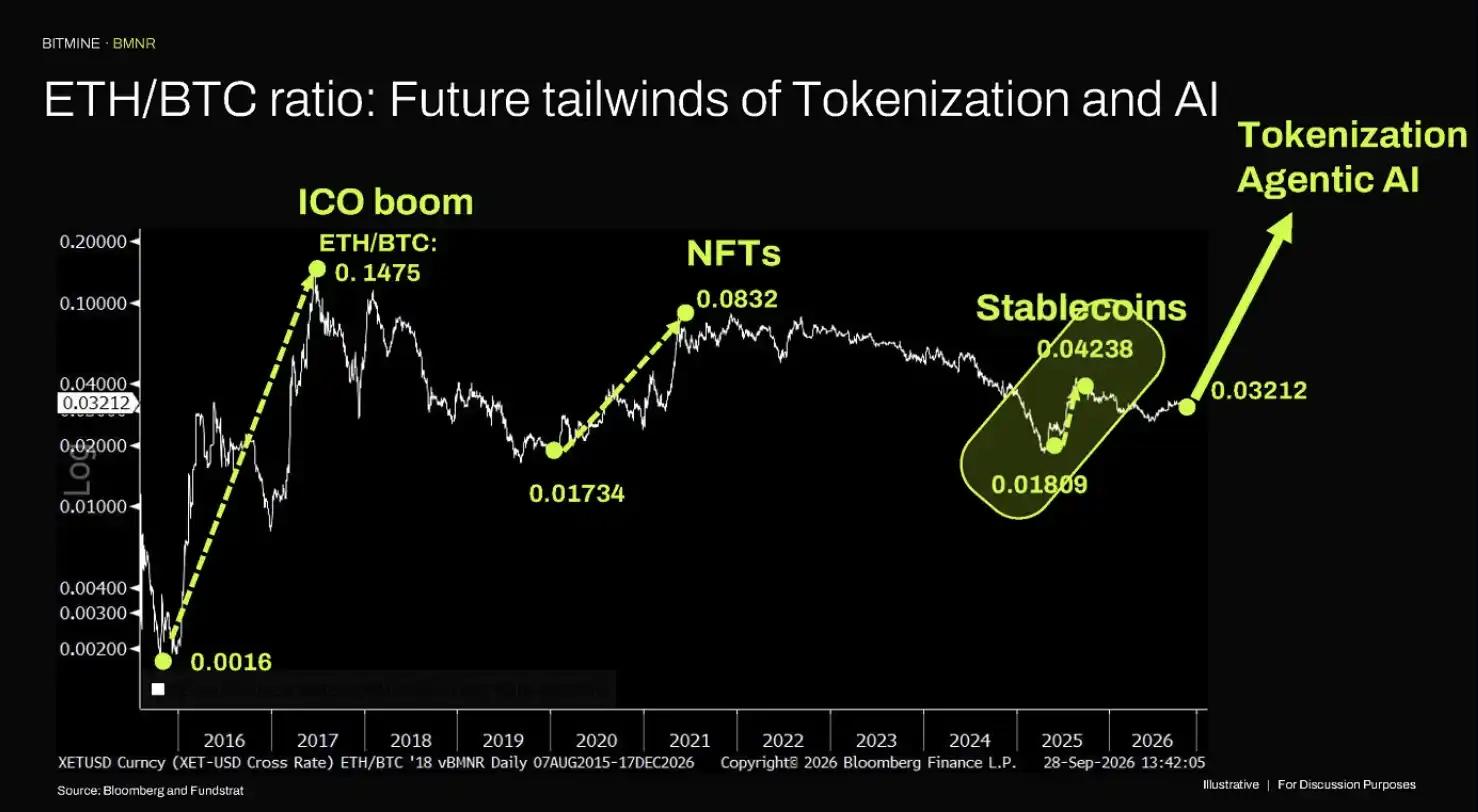
In Tom Lee's view, the ongoing wealth transfer could also bring new incremental funds to the crypto market. As the generation inheriting wealth is relatively younger and may have a higher risk appetite for crypto assets and stocks, this trend's impact in this cycle might surpass that of the 2019-2021 bull run.

Regarding ETH's price prospects, Tom Lee gives an even more aggressive forecast. He predicts ETH could break through $5,000 before the end of this year; if Bitcoin's price surpasses $100,000, ETH could further rise to about $7,500. His long-term bullish logic lies in Ethereum potentially experiencing a larger price breakout after years of consolidation.

In summary, after Ethereum's largest buyer stops accumulating, the absorption capacity of the ETH market may face a test. But the buying rhythm of a single treasury company cannot determine ETH's long-term trend. With the acceleration of asset tokenization, growing institutional allocation demand, and the continuous development of the Ethereum ecosystem, the market is still expected to welcome new incremental funds, providing new demand support for ETH.

Related Questions

QWhat is Bitmine's current ETH holding target, and how close are they to achieving it?

ABitmine's ETH holding target is 5% of the total ETH supply. As of the article, they hold approximately 4.9% (6,028,946 ETH), which is about 99% complete towards their goal.

QAccording to Tom Lee, what will Bitmine do after reaching its 5% ETH holding target?

ATom Lee stated that Bitmine will stop increasing its ETH holdings once it reaches the 5% target, setting it as a hard cap. The company will not hold more than 5% of the total ETH supply.

QHow does Bitmine plan to manage its financial obligations, such as operating expenses and dividends, without selling its core ETH holdings?

ABitmine plans to cover its financial obligations, like preferred stock dividends, using the staking rewards generated from its ETH holdings. The company intends to sell the staking rewards it receives rather than its core ETH holdings.

QWhat potential market concern arises if Bitmine stops its consistent buying of ETH?

AThe concern is that there may not be sufficient new buying pressure to absorb ETH's new supply and support its price, especially since U.S. spot Ethereum ETFs have recently seen net outflows and other Digital Asset Treasury (DAT) companies hold significantly smaller amounts of ETH compared to Bitmine.

QWhat are Tom Lee's price predictions for ETH, and what factors does he cite for his bullish long-term outlook?

ATom Lee predicts ETH could surpass $5,000 by the end of the year and potentially reach around $7,500 if Bitcoin breaks $100,000. His long-term bullish outlook is based on factors like asset tokenization, generational wealth transfer, DAT companies absorbing supply, the crypto industry benefiting from AI development, and Ethereum potentially experiencing a significant price breakout after years of consolidation.

Related Reads

Vitalik "Exposes the Shortcomings" of Burn Efficacy, ETH Value Narrative Shifts

Vitalik Buterin argues that Ethereum should focus more on ETH's store-of-value property rather than relying on fee burning to support its valuation. He explains that fee-burning-based valuation rests on a net present value logic—market cap equals annual burned fees divided by discount rate—but this has never provided a truly solid floor. Much of the past burning came from activity within the crypto ecosystem itself, so if ETH's price fell sharply, that revenue would fall too. Only demand from outside crypto can make such a valuation floor convincing, and while RWA growth may help, mature businesses are unlikely to recreate the massive fee consumption seen during speculative frenzies. He also warns of the costs of pursuing fee burning: to justify ETH's ~$270bn market cap through burning, Ethereum would need to operate like a world-class corporation such as L'Oréal—requiring sustained R&D spending (potentially ~700k ETH per year, cutting validator income by roughly two-thirds), active governance, and higher gas prices that could exclude users most in need of privacy and security. Maximizing "price × usage" conflicts with letting as many people as possible use the network within safe resource limits. As a store-of-value asset, the most important metric is survival. Users value decentralization and CROPS (censorship and capture resistance, open source, privacy, security), which also matter to institutions. Ethereum should make prudent security tradeoffs, address quantum computing and AI risks, stabilize the core protocol, push innovation to layer 2, resist complexity and capture-prone reward mechanisms, and support privacy tools, account abstraction, FOCIL, and reduced infrastructure dependence. Store-of-value and application growth are synergistic: more native RWA and decentralized assets on L1 increase ETH's usefulness. Ethereum's social meaning is broad access to decentralization, privacy, and security—and ETH's value comes from these guarantees.

marsbit35m ago

Vitalik "Exposes the Shortcomings" of Burn Efficacy, ETH Value Narrative Shifts

marsbit35m ago

US Stock Market Trends (November 9): Nasdaq Rebounds 1% on Friday, Nvidia Launches Investigation into Jensen Huang Over the Weekend

US stocks closed mixed on Friday, November 6: the Nasdaq rebounded 1.09% to 24,579.42, the S&P 500 rose 0.31% to 7,376.86, and the Dow fell 237.33 points (-0.46%) to 51,285.73. Chip stocks partly recovered after Thursday's selloff, with Micron up about 5%, Nvidia up nearly 3%, AMD up as much as 9%, and Intel up nearly 7% intraday. For the week, the Nasdaq fell 3.4%, the S&P 500 lost 2.7%, and the Dow dropped 0.9%; the tech sector ETF (XLK) had its worst week since early April 2025, down about 8%. October nonfarm payrolls came in at 165,000, far above the 59,000 expected, while unemployment fell to 4.1%. Markets priced a roughly 76.8% chance of a 25-basis-point rate hike at the December 8-9 meeting. WTI settled at $90.83 a barrel, up 0.34%, but fell about 13% for the week; Brent settled at $98.32 and fell over 16% weekly. The 10-year Treasury yield closed at 4.86%. Over the weekend, Nvidia's board launched an independent investigation into reports that CEO Jensen Huang may have been a target of foreign intelligence activity. The board said there is no reason to believe national security or company secrets were compromised, and Huang will remain CEO. Huang admitted to an extramarital affair and apologized. On Monday in Asia, Japan's Nikkei 225 rose about 2% and Taiwan's weighted index gained over 2%, while US futures were mixed, with Nasdaq 100 futures down about 0.2%. Key upcoming events include US inflation data and Nvidia's Q3 earnings on November 17.

marsbit35m ago

US Stock Market Trends (November 9): Nasdaq Rebounds 1% on Friday, Nvidia Launches Investigation into Jensen Huang Over the Weekend

marsbit35m ago

Vitalik 'Exposes' the Limitations of Burning, ETH Value Narrative Shifts

Vitalik Buterin argues that Ethereum should focus more on ETH's store-of-value property rather than relying on fee burning to support its valuation. He explains that fee-burn-based valuation rests on a net present value logic—market cap equals annual burned fees divided by a discount rate—but notes this never provided a truly solid floor. Much of the burning during 2021–2023 came from within the crypto ecosystem itself, so if ETH's price fell, that revenue would fall too. Only demand from outside crypto can make such a valuation floor more convincing, and while RWA growth may help, mature businesses are unlikely to replicate the massive fee consumption seen during speculative manias. He warns that relying on fee burning to justify ETH's ~$270B market cap would require Ethereum to operate like a world-class corporation (roughly L'Oréal's scale), needing sustained R&D spending—perhaps ~700K ETH annually—and highly interventionist governance, both of which create political problems and undermine decentralization and anti-capture properties. Pursuing burning also implies pursuing higher gas prices, potentially excluding users who most need privacy and security; maximizing "price × usage" differs from maximizing safe access for as many people as possible. As a store-of-value asset, the most important metric is survival. Users most value decentralization and CROPS (censorship and capture resistance, open source, privacy, security), which also matter to institutions for risk management and compliance. Ethereum should make prudent security tradeoffs, address quantum computing and AI risks, stabilize the core protocol while shifting innovation to upper layers, and resist complexity-adding features and capture-prone reward mechanisms. Users should be able to hold assets safely and privately, with confidence transactions won't be blocked. Reducing dependence on infrastructure providers matters—he can run a node on a laptop, syncing in under six hours with about one-eighth of disk space, better than 2019. Store-of-value and application growth are synergistic: more native RWA and decentralized assets on L1 increase what holding ETH enables—trustless swaps or using ETH as collateral—boosting its utility, with tradeoffs smaller than maximizing fees.

Odaily星球日报46m ago

Vitalik 'Exposes' the Limitations of Burning, ETH Value Narrative Shifts

Odaily星球日报46m ago

ICLR 2027 First Round Review: Quite a Few Pain Points

ICLR 2027's first-round reviews have sparked widespread complaints among researchers, with many sharing examples of poor-quality or clearly AI-generated feedback on social media. One reviewer asked an author to explain what "standard deviation" means; another review began with the telltale chatbot opener "Certainly! Here is a review of the paper," while two other reviews appeared to be near-identical copies of the same template. One author received criticism for using AI-assisted writing despite having properly disclosed it, and another reviewer openly admitted lacking the expertise to evaluate the paper—prompting debate over whether the real fault lies with reviewer assignment rather than the reviewer. A recurring concern, raised by Jiaxin Pei of UT Austin, is that AI reviewers cannot distinguish between a paper's ordinary limitations and the critical flaws that actually undermine its core contributions. Large language models can list hundreds of limitations for any paper, including the best ones, but they cannot judge which issues truly matter. As a result, reviews grow longer and demand more experiments while the real determinants of paper quality get buried. ICLR 2027 organizers have acknowledged the strain: rapid growth in submissions, a shortage of qualified reviewers, and AI lowering the barrier to paper production. They introduced measures including submission caps, stricter reciprocal review obligations, and rules permitting limited, disclosed AI use in reviewing—with penalties for low-quality or hallucinated AI-generated reviews. Author-reviewer discussion runs until November 18, with final decisions expected December 16.

marsbit1h ago

ICLR 2027 First Round Review: Quite a Few Pain Points

marsbit1h ago

Without Warning, OpenAI Suddenly Mass-Bans Accounts

OpenAI has abruptly banned a large number of ChatGPT accounts without prior notice or email warnings, deleting accounts outright. Affected users see only an error message stating their account has been deleted or deactivated. The purge heavily targets accounts in the Philippines and Turkey, low-cost Team plans, and accounts using reverse proxy relays, and even long-standing paying users with months of subscription have been hit. Free API accounts, shared team accounts, and $200/month Pro accounts were all affected. Developers report losing years of conversation history and personal data locked in the cloud, with appeals unsuccessful. Some speculate OpenAI is cracking down on account stacking to prevent users from exploiting cheap subscriptions. OpenAI's status page showed elevated error rates for some US commercial Mastercards, though OpenAI characterized the incident as a payment channel issue rather than account bans. Users are advised to appeal via OpenAI's official form with account details and Request ID. This move follows earlier steps: OpenAI previously merged ChatGPT and Codex into a single token pool and, five days ago, imposed device and payment card limits, preventing multiple paid subscriptions on one card or device. Starting November 20, new usage policies require third-party API gateways to obtain official written authorization, and from December, Plus, Pro, and Business plans will share a single quota calculated by token consumption. Users are advised to regularly back up cloud conversations and sync Codex projects locally, as the era of freely exploiting AI compute appears to be over.

marsbit1h ago

Without Warning, OpenAI Suddenly Mass-Bans Accounts

marsbit1h ago

Trading

Spot
活动图片