U.S. Treasury's $5 Billion+ Buyback of 10-Year Bonds Failed to Stop Their Sell-Off

cryptonews.ruPublished on 2026-09-12Last updated on 2026-09-12

Abstract

On September 10th, the U.S. Treasury, led by Scott Bessent, conducted a significantly larger-than-usual buyback of long-term government bonds, purchasing $5.2 billion worth. However, this intervention failed to halt a continued sell-off, with the yield on the benchmark 10-year Treasury note rising above 4.85% for the first time since 2023 and hitting nearly 4.98% the next day. Investors viewed the scale of the operation as insufficient for the massive $32 trillion U.S. debt market. They cited persistent pressures including rising oil prices, inflation risks, a large budget deficit, and expectations of further Federal Reserve rate hikes as reasons the buyback couldn't reverse the trend. The Treasury had announced it was prepared to buy up to $6 billion in long-term debt, triple its standard $2 billion operation. Yet, it only accepted $5.2 billion of the over $10 billion in investor offers. Market participants, including strategists from Bank of America and Amundi, criticized the move as too timid and potentially counterproductive, signaling government "nervousness" without addressing core issues. Key factors driving yields higher include the U.S. national debt exceeding $40 trillion, soaring debt servicing costs, strong new borrowing needs, and inflationary pressures from high energy prices. Additional concerns were raised by proposals for large new government spending. Analysts concluded the market is effectively "fighting the U.S. Treasury," with the intervention unable t...

The U.S. Treasury Department, led by Scott Bessent, conducted the first enlarged buyback of long-term government bonds amounting to $5.2 billion on September 10, but the operation failed to halt the rise in yields, writes the FT.

Following the announcement of the results, the yield on 10-year bonds climbed above 4.85% for the first time since 2023, and on September 11, it reached nearly 4.98%—the highest level in almost three years. At the time of writing, the indicator was at 4.93%.
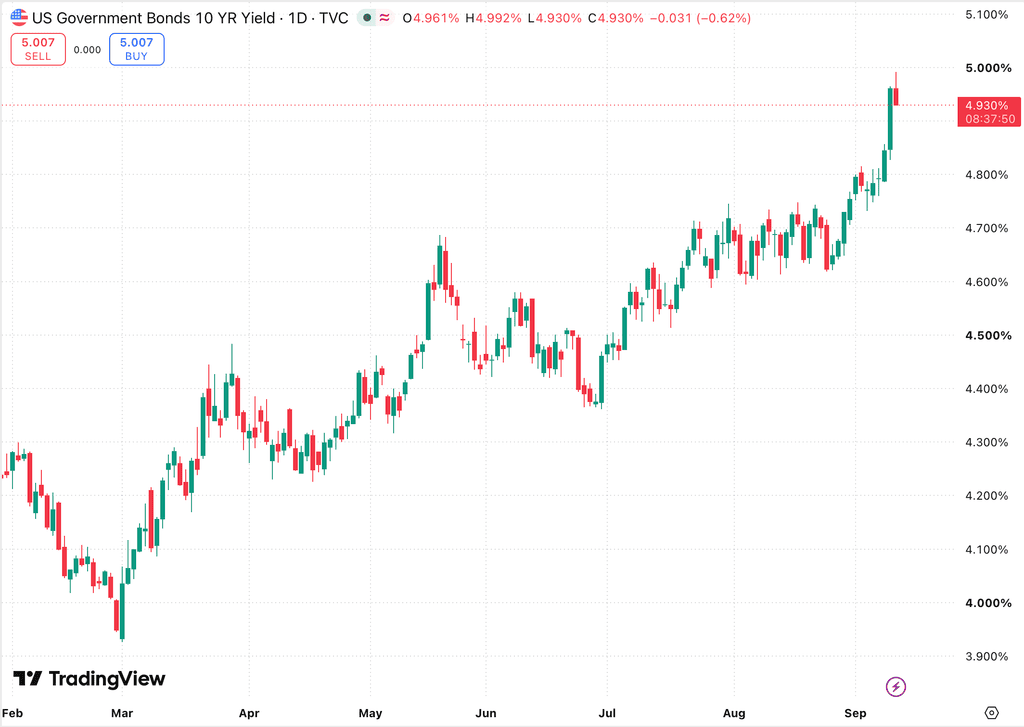
Yield on 10-year U.S. Treasury bonds. Source: TradingView.

Investors believe the scale of intervention was insufficient for the U.S. government debt market, which is worth about $32 trillion, while rising oil prices, inflation risks, budget deficits, and expectations of a Fed rate hike continue to weigh on bonds.

Buyback of up to $6 Billion Failed to Calm the Market

Ahead of the operation, the U.S. Treasury announced it was prepared to buy back up to $6 billion of long-term debt with maturities of 10 to 20 years. This is three times the standard volume of $2 billion and exceeds the previous promise from August to increase operations to at least $4 billion.

However, in reality, the Treasury accepted offers for only $5.2 billion out of more than $10 billion in bids from investors. Meanwhile, the yield on 10-year bonds rose to 4.98%, and for 30-year bonds, the indicator also set a new multi-year high of over 5.4%.

For the market, this signaled that even direct intervention by the Treasury is currently unable to reverse the main factors pushing rates higher.

Amundi's Chief Investment Officer, Vincent Mortier, stated that the small scale of the operation "does not solve the broader problem" of rising U.S. bond yields. According to him, the signal the Treasury sends to the market through the buyback could prove counterproductive, as it demonstrates a "certain nervousness" on the part of the U.S. government.

Morgan Stanley also warned about the unusual nature of such intervention. Morgan Stanley Wealth Management's Chief Economic Strategist, Ellen Zentner, noted:

"We cannot ignore the fact that some actions by the U.S. carry risks typical of emerging markets. Usually, we have not seen interventionist policy from the U.S. And when we have, it was a formal, institutionalized process."

Why Yields Continue to Rise

One of the main factors pressuring U.S. bonds this week was the sharp rise in oil prices amid escalating war between the U.S. and Iran and supply issues through the Strait of Hormuz. The price of Brent rose to nearly $110 per barrel, and on September 11, it reduced its gains and traded around $104.

More expensive energy increases inflationary risks and raises the likelihood that the Fed will have to keep rates high for longer or even raise them again. According to the CME FedWatch Tool, the market estimates the probability of a Fed rate hike this month at approximately 84.7%.

Bond yields are also pressured by:

  • the record volume of U.S. government debt, which has exceeded $40 trillion;
  • massive budget deficit;
  • high debt servicing costs;
  • rising inflation expectations;
  • significant volume of new borrowing;
  • bond sales by technology companies to finance AI investments;
  • expectations of strong economic growth due to the development of artificial intelligence.

An additional factor was statements by U.S. President Donald Trump about the possibility of paying $5,000 to every adult American if Republicans win the midterm elections. Such a program could cost the budget over $1 trillion and heighten concerns about future government spending.

Investors Consider Bessent's First Move Insufficiently Large

Disappointment with the scale of the operation was noticeable even before it took place. Mark Cabana, head of U.S. rates strategy at Bank of America, stated that the Treasury was effectively "saving" on intervention, which contradicts an "at any cost" approach.

"If you're going to intervene, your priority should be steering the market in a certain direction or reaching a certain level, not the price you're willing to pay for it. You can't have both."

DoubleLine portfolio manager Bill Campbell also believes Bessent should have acted on a larger scale:

"I thought Bessent would understand: in any intervention, your first shot is your best, and you need to go in big right away."

A similar reaction was shown by market participants on X. Analysts at The Kobeissi Letter wrote, after the announcement of the increased buyback, that even tripling the volume to $6 billion did not stop the rise in 10-year bond yields. They noted that the market is effectively "fighting the U.S. Treasury."

Separately, The Kobeissi Letter emphasized that the Treasury faces a fundamental problem: the U.S. has a deficit of over $2 trillion, spends over $1.2 trillion per year on interest payments, and oil prices have nearly doubled since the start of the war.

A user on platform X under the pseudonym Hedgie pointed out the contrast between Bessent's statement "I'm the boss now" and the market's reaction. According to him, the Treasury increased the buyback from $2 billion to $4 billion, then to $6 billion, but after that, the market continued to sell bonds, and 10-year yields only rose.

At the same time, crypto-skeptic Peter Schiff stated that even tripling the buyback of long-term bonds did not stop the rise in yields, and such a situation could support demand for gold.

Recall that Morgan Stanley estimated the maximum possible buyback amount at around $10 billion.

Related Questions

QWhat was the result of the US Treasury's first expanded buyback of long-term bonds on September 10th, despite its scale?

AThe US Treasury's buyback of $5.2 billion in long-term bonds failed to stop the rise in yields. The yield on 10-year bonds climbed above 4.85% for the first time since 2023, reaching nearly 4.98% on September 11th.

QWhy did the market view the Treasury's $5.2 billion bond buyback operation as insufficient?

AInvestors considered the scale of intervention too small for the approximately $32 trillion US government debt market. Additionally, factors like rising oil prices, inflation risks, budget deficits, and expectations of a Fed rate hike continued to pressure bond prices, pushing yields higher.

QAccording to the article, what are the key factors currently putting upward pressure on US bond yields?

AKey factors include: sharply rising oil prices boosting inflation risks; a record-high US national debt exceeding $40 trillion; a massive budget deficit; high debt servicing costs; rising inflation expectations; significant new government borrowing; bond sales by tech companies to fund AI investments; and expectations of strong economic growth from AI development.

QHow did some investors and analysts criticize the strategy of Treasury Secretary Scott Bessent regarding the bond buyback?

ACritics like Mark Cabana from Bank of America said the Treasury was 'saving money' on the intervention, contradicting an 'at any cost' approach. Bill Campbell from DoubleLine argued Bessent should have acted on a much larger scale from the start, as the 'first shot is the best shot'. Analysts on X noted the market was essentially 'fighting the US Treasury'.

QWhat potential future policy was mentioned that could further concern investors about US fiscal sustainability?

AStatements from US President Donald Trump about potentially paying $5,000 to every adult American if Republicans win the midterm elections were mentioned. Such a program could cost the budget over $1 trillion, heightening concerns about future government spending and fiscal health.

Related Reads

Luxor CEO warns of AI ‘dark forest’ following Bitcoin miner hijack

Luxor, a Bitcoin mining services provider, suffered a cyberattack over the weekend in which attackers compromised its Commander mining-management platform and redirected customers' computing power to another mining pool. CEO Nick Hansen said the attack came through a "sophisticated AI-enabled vector" and warned that AI-enabled attacks on businesses, especially in crypto, are becoming more frequent and harder to defend against as models improve and more attackers enter the arena. He said Luxor paused most feature work to harden its cybersecurity and acquired GPUs to run unrestricted open-weight AI models, urging similar services to do the same, calling it "your only defense in this new AI-powered dark forest." Initial reports suggested about 64,000 mining machines representing 13 exahashes per second were redirected to the OCEAN mining pool on Saturday, though Luxor did not confirm those figures, saying just over a dozen customer accounts using Commander were affected. Luxor said it patched Commander within two hours, began restoring affected machines to their original pool settings, and pledged to fully compensate customers and publish a post-mortem. The issue was isolated to Commander, with other services including Luxor Pool and LuxOS unaffected. Initial reports suggested attackers received no mining rewards, but a Bitcoin address identified by CoreX as linked to the incident later received two OCEAN payouts totaling about 0.162 BTC, worth roughly $10,500. Hansen's warning follows other reported AI-assisted intrusions targeting crypto businesses, including India's cybersecurity agency warning that a group called Crafty Falcon used AI-powered tools to attack financial companies and crypto exchanges, Chainalysis disclosing an attacker used "offensive agentic techniques" to access its systems, and Anthropic reporting that multiple groups had developed "automated exploit foundries" with AI to accelerate vulnerability research and exploit design.

cointelegraph27m ago

Luxor CEO warns of AI ‘dark forest’ following Bitcoin miner hijack

cointelegraph27m ago

Systemic Risk Breaks Through Multiple Supports, BTC and HYPE Temporarily Flat and Observing | Guest Analyst

BTC closed the week around $74,900, effectively breaking below its 52-week moving average (~$76,100) with a 13.98% weekly loss, ending the bull-bear transition and returning the market to bearish territory. A systemic risk event drove a high-volume selloff through multiple supports, including the rising trendline (~$72,000), the 0.5 Fibonacci retracement ($72,610), and the proprietary "Trend Ribbon" zone ($72,510–73,120). On the weekly chart, a five-leg corrective structure (0-1 through 4-5) has formed since the October 2025 high of $126,200, with a descending central zone between roughly $82,850 and $60,000. Two paths are outlined: either the decline ends near $57,820–60,000 and the market ranges, or a new low forms—though momentum models suggest limited downside due to large-scale bottom divergence. On the daily chart, the proprietary "Reversal Monitoring System" has issued its fourth signal (yellow background, depth index -18 to -18.8), with the prior three signals showing roughly a 70% success rate. Key BTC support levels are $60,000–62,000, $57,820, and $54,500; resistance sits at $67,300–69,000, $72,500–73,000, and $75,500–76,000. Both mid-term and short-term strategies remain in cash. HYPE fell 8.61% weekly with 27.92% amplitude, touching $60 before closing at $68.11, just above its long-term rising trendline—the last line of defense. A long lower shadow signals buying support but does not confirm stabilization; a retest of $60 is possible. HYPE resistance is $71, $74–75, and $82.5; support is $68, $60, and $50–52. The key focus is whether the long-term trendline holds; the short-term stance is to stay in cash.

marsbit50m ago

Systemic Risk Breaks Through Multiple Supports, BTC and HYPE Temporarily Flat and Observing | Guest Analyst

marsbit50m ago

Systemic Risk Breaks Through Multiple Supports, BTC and HYPE Temporarily in Cash and Observing | Guest Analyst

Bitcoin's weekly close near $74,900 fell just below the 52-week moving average (~$76,100), ending an eight-week run above it. A systemic risk event drove a high-volume bearish candle through multiple supports (ascending trendline ~$72,000, 0.5 Fibonacci retracement at $72,610, and the "Trend Ribbon" zone of $72,510–73,120), followed by three days of sharp decline. The weekly candle dropped 13.98%, invalidating the bull-bear transition and returning the market to a bear phase. HYPE fell 8.61% for the week with 27.92% volatility, touching $60 before closing at $68.11, holding just above its long-term ascending trendline. On the weekly chart, a five-leg corrective structure (0-1 through 4-5) has formed since the October 2025 high of $126,200, with a descending central zone between ~$82,850 and ~$60,000. Two scenarios are outlined: either the decline ends near $57,820–60,000 (failed breakout, range-bound), or a new low forms with significant bottom divergence, limiting downside. The proprietary "Daily Turning Point Monitoring System" has issued its fourth signal (yellow background, depth index -18 to -18.8) near $62,000, after three prior validated turning points with roughly 70% success. Key levels: resistance at $67,300–69,000, $72,500–73,000, and $75,500–76,000; support at $60,000–62,000, $57,820, and $54,500. The recommended strategy is to stay in cash for both medium- and short-term positions until direction is confirmed. For HYPE, the long-term trendline near $68 is the last defense; a weekly close below it would end the rally from the January low of $20.14. Resistance sits at $71, $74–75, and $82.5; support at $68, $60, and $50–52. The stance is also to remain flat and watch whether the trendline holds.

Odaily星球日报1h ago

Systemic Risk Breaks Through Multiple Supports, BTC and HYPE Temporarily in Cash and Observing | Guest Analyst

Odaily星球日报1h ago

Trading

Spot
活动图片