Bitcoin Bull Turn Hinges On US Debt Wall, Real Vision Says

bitcoinistОпубликовано 2026-06-09Обновлено 2026-06-09

Введение

Real Vision crypto analyst Jamie Coutts says Bitcoin's long-term technical setup is approaching attractive, accumulation-zone levels, suggesting a potential cycle bottom in Q2/Q3. However, he cautions that a major macroeconomic obstacle could delay a sustained bullish reversal: a looming US Treasury refinancing wall. In 2027, $3.67 trillion of government debt matures and must be refinanced at significantly higher interest rates. Coutts argues current market liquidity is insufficient to absorb this issuance smoothly, especially as capital continues rotating out of crypto and into AI-related equities and commodities since late 2025. This liquidity constraint, combined with a potential contraction of the Federal Reserve's balance sheet, poses a risk to all risk assets, including Bitcoin. While Bitcoin may be the first to detect a future shift toward increased Fed liquidity, Coutts believes such a shift may only come after stress emerges in the Treasury market. Therefore, despite a positive technical structure, Bitcoin's next durable bull phase may hinge on navigating this significant macro refinancing challenge.

Real Vision Chief Crypto Analyst Jamie Coutts says Bitcoin is moving into a more attractive long-term setup, but a major US Treasury refinancing wall may still stand between the market and a durable bullish reversal.

In a post on X, Coutts said Bitcoin’s long-term technical backdrop is beginning to resemble the kind of structure that can precede a cycle bottom. “I’ll be the first to turn bullish on Bitcoin when the long-term technicals hit exhaustion and the trend turns,” he wrote. “I’ve argued Q2/Q3 would mark the bottom based on historical bear-market structures. Its playing out that way. The relative setup is approaching very attractive levels. The asset is in the long-term accumulation zone, imo.”

US Debt Refinancing Wall May Pressure Bitcoin

The issue, in Coutts’ view, is not simply Bitcoin’s chart. It is the macro plumbing around it.

He pointed to 2027, when the US faces $3.67 trillion in coupon maturities, a figure he said is 36% above the 2020–2025 average. The refinancing burden reflects the repricing of Covid-era debt issued when rates were near zero into a market where rates are now in the 4% to 5% range.
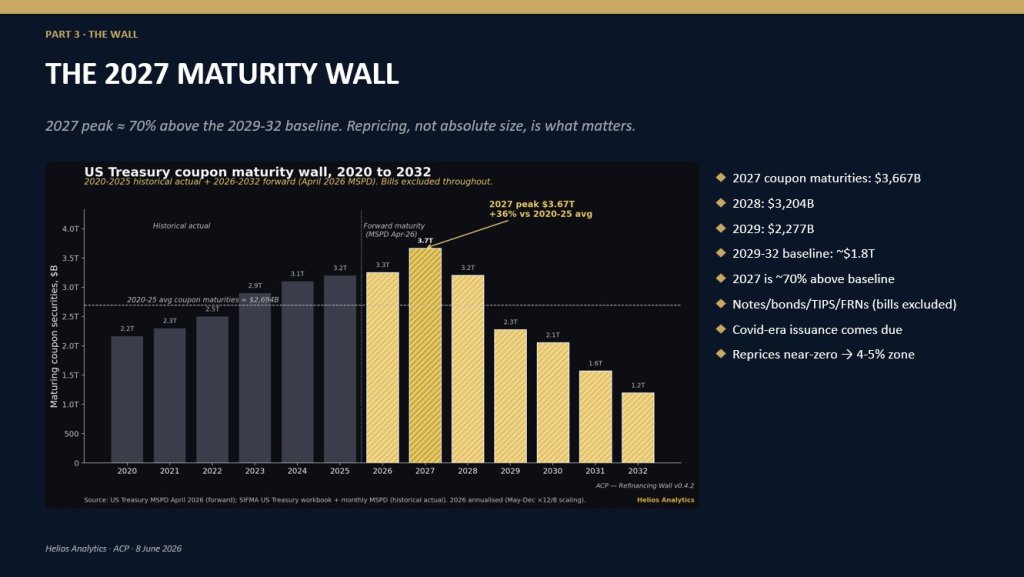
Source: X @Jamie1Coutts

For Bitcoin and other risk assets, the concern is whether current liquidity conditions can absorb that level of issuance without stress in the Treasury market. Coutts argued that liquidity remains a constraint, particularly as capital has continued to rotate away from crypto since late 2025.

“Retail and insto flows have been rotating out of Bitcoin and crypto since Q4 2025,” he said. “Every marginal unit of liquidity has flowed into AI buildout assets. That makes sense. Capital flows to where it’s treated best. Right now, the capital allocation argument sits with AI equities and commodities. On-chain activity is back at multi-year lows.”

That rotation matters because Bitcoin’s bull phases have historically depended not only on internal crypto positioning, but also on broader liquidity expansion and risk appetite. Coutts’ point is that Bitcoin may be entering a structurally attractive zone at the same time liquidity remains scarce and competing asset classes are absorbing the available capital.

He also pushed back against the market’s focus on IPO issuance, arguing that the larger issue is the government refinancing burden and the ability of the financial system to intermediate it. “While the market fixates on IPO issuance,” he wrote, “what concerns me about all risk assets is that markets ex-crypto don’t seem bothered by the fact that current liquidity levels can’t easily absorb this refi supply.”

The complication is the Fed’s balance sheet. Coutts noted that Kevin Warsh wants a smaller balance sheet, adding another potential constraint if policymakers try to roll a large maturity wall through a system with reduced central bank liquidity.

“Yes, they will continue to stuff the short end and monetise through the banks,” Coutts said, adding that stablecoins are likely to play an “increasingly important role.” But he warned that rolling $3.67 trillion of maturities through a contracting Fed balance sheet “without a bond market accident would be among the most impressive acts of fiscal/monetary policy management in a generation.”

The implication for Bitcoin is nuanced. Coutts is not dismissing the bottoming case. He is arguing that the market may still need a macro trigger before the next sustained advance can take hold. In his framework, Bitcoin is likely to sense a shift in Fed-side liquidity before other assets, but that shift may not arrive until stress appears in Treasuries.

“I don’t see how they do it without far more Fed-side liquidity,” he wrote. “Bitcoin will detect it first. But there’s still an uncomfortable distance to travel. Treasuries will need to start misbehaving before the policy needle moves. That’s the tricky part.”

At press time, BTC traded at $63,196.
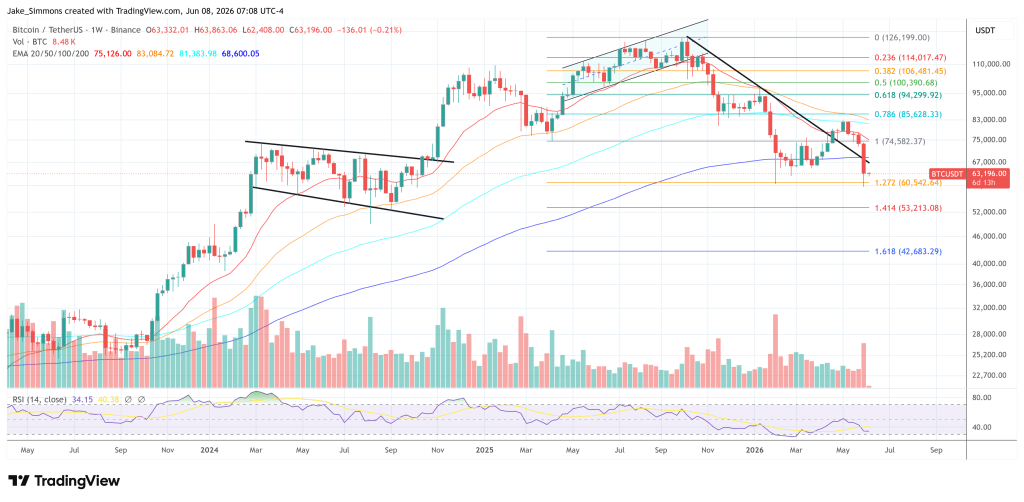
Bitcoin trades below the 200-week EMA, 1-week chart | Source: BTCUSDT on TradingView.com

Связанные с этим вопросы

QAccording to Jamie Coutts, what is the key macroeconomic event that could prevent a sustained Bitcoin bull run?

AThe key macroeconomic event is the US Treasury's massive refinancing wall in 2027, involving $3.67 trillion in coupon maturities. The concern is whether current liquidity can absorb this issuance without stress in the Treasury market, potentially constraining capital flow to risk assets like Bitcoin.

QWhat does Jamie Coutts mean when he says Bitcoin is in a 'long-term accumulation zone'?

AHe means that Bitcoin's long-term technical setup is approaching very attractive levels, resembling structures that have historically preceded a cycle bottom. This suggests the asset is at a price level where long-term investors might consider accumulating positions.

QWhere has capital been rotating since Q4 2025, according to the article?

ACapital has been rotating away from Bitcoin and crypto and flowing into AI buildout assets (AI equities and commodities), as capital flows to where it is 'treated best' based on the current capital allocation argument.

QWhy does Jamie Coutts believe Bitcoin might sense a macro shift before other assets?

AHe believes Bitcoin is likely to detect a shift in Fed-side liquidity (potentially increased liquidity in response to Treasury market stress) before other assets, given its sensitivity to such monetary and liquidity conditions.

QWhat potential role does Coutts see for stablecoins in the context of the US debt refinancing challenge?

AHe suggests that stablecoins are likely to play an 'increasingly important role' as the financial system intermediates the large refinancing burden, potentially as part of the mechanisms to manage liquidity.

Похожее

WeChat Agent Issues a 'Heroic Summons,' Half of the Internet Responds

WeChat AI Agent is on the horizon. The WeChat Open Platform has issued a guide for developers, offering them ways to integrate into the WeChat AI ecosystem. This will enable mini-programs to be discovered and invoked by the AI. Meituan has already announced its integration, allowing users to access services like food delivery through WeChat AI. Other platforms like Ctrip and Tongcheng have followed suit. Furthermore, WeChat is collaborating with major smartphone manufacturers to enable their native AI assistants to perform actions within WeChat, such as initiating calls or sending messages, through a controlled protocol called Agent-to-Agent (A2A). Reports indicate the WeChat AI Agent will be accessible by swiping right on the main interface. It aims to understand user intent within the rich context of chats, groups, and past interactions, then automatically call upon relevant mini-programs to complete tasks like ordering coffee or booking restaurants. This positions it as a potential "super app" with direct access to WeChat's vast ecosystem of services, social connections, and payment systems. Technically, this is a complex endeavor. It requires advanced natural language understanding, a "world model" to predict interactions within mini-programs (UI-Oceanus), multi-model orchestration for cost efficiency, and careful coordination with millions of third-party service providers. Tencent's development follows a "Co-Design" approach, where product teams and the Hunyuan model team collaborate closely, allowing capabilities honed in other AI products (like Yuanbao for chat, ima for search, WorkBuddy for office tasks) to be transferred to the WeChat Agent. Tencent is strategically opting for the A2A protocol over GUI-based automation (which it has blocked in the past), maintaining control over its ecosystem. To manage the immense scale and cost of serving 1.4 billion monthly active users, Tencent is deepening its ties with DeepSeek, known for its cost-effective training, to secure a low-cost inference backbone. The ultimate goal is to solve practical, everyday problems for users within the WeChat ecosystem, moving beyond technical benchmarks to deliver real utility, which Tencent sees as the key to winning in the long-term AI game.

marsbit11 мин. назад

WeChat Agent Issues a 'Heroic Summons,' Half of the Internet Responds

marsbit11 мин. назад

Humanity Loses $31 Million in Attack, Token Price Plummets 90% Due to a Single Private Key

On June 9th, the digital identity project Humanity Protocol suffered a major security breach resulting in over $31 million in losses. According to on-chain analyst Specter, hundreds of wallets holding the project's H token were drained. The attack was confirmed by founder Terence Kwok to be caused by the compromise of a foundation member's private key. As a precaution, users are advised to avoid interacting with Humanity's cross-chain bridge or liquidity pools. The incident caused the H token price to crash over 90%, from around $0.70 to a low of $0.052, wiping its market cap from $2 billion to approximately $35.7 million. The attacker allegedly minted 100 million new H tokens and is selling them for BNB. This breach adds to existing controversies surrounding Humanity Protocol. Founded in 2024, it aimed to verify human users via palm-print biometrics and zero-knowledge proofs. However, a leaked conversation in 2025 revealed that only about 1 million of its 9 million claimed Human IDs had completed biometric verification, suggesting 88% might be bots. Furthermore, the project has faced allegations of being a repackaged product from a Chinese access control vendor, raising privacy and authenticity concerns. Founder Terence Kwok's previous venture, Tink Labs, a hotel smartphone startup that raised $170 million, failed and entered bankruptcy in 2020 after burning through its funding. The current attack highlights the persistent critical issue of private key management in crypto. Unlike smart contract exploits, a private key compromise bypasses all on-chain security mechanisms. With no user compensation plan announced yet, this $31 million breach may be a final blow to the project's credibility, already weakened by previous controversies and a heavily depreciated token.

marsbit45 мин. назад

Humanity Loses $31 Million in Attack, Token Price Plummets 90% Due to a Single Private Key

marsbit45 мин. назад

MicroStrategy Will Not Die in This Downturn: Reflexivity, STRC Anchoring Back to Par, and the Self-Rescue Logic of "Sell Stock, Not Bitcoin"

This article analyzes the recent sharp decline in Bitcoin and MicroStrategy (MSTR), framing it as a targeted "reflexivity" attack. The trigger was MSTR using its cash reserves to buy back convertible notes, raising market concerns about a liquidity crisis. The playbook follows George Soros's principle: market expectations can shape reality. Fears that MSTR might be forced to sell BTC caused panic selling, lowering BTC's price and worsening MSTR's financial ratios, thus reinforcing the negative narrative. The author argues that MSTR's Structured Convertible (STRC), while falling in price, is a floating-rate security that will eventually return to par value (100). The price drop reflects the market demanding a higher yield due to perceived risk, but as a floating-rate instrument, its coupon can adjust, naturally pulling the price back to par over time. This is crucial for MSTR's continued ability to raise funds. The core thesis is that MSTR's best move to counter the attack is to **issue new equity (sell shares)**, not sell its Bitcoin holdings. While selling BTC would solve the immediate cash crunch, it would destroy the company's core investment thesis and premium. It would dilute the BTC per share, likely erase the market premium over its net asset value (mNAV > 1), and worsen its debt-to-asset ratio. Issuing shares while mNAV is high (e.g., 1.25x) allows MSTR to raise cash for reserves without harming shareholder value or the "perpetual accumulation" narrative. It improves the debt ratio and reassures STRC holders, breaking the negative reflexivity cycle. In conclusion, while MSTR could survive this episode even by selling BTC, doing so would fundamentally alter its investment proposition and weaken it for future cycles. The optimal, value-preserving strategy is to sell equity to rebuild reserves and maintain the long-term growth flywheel.

marsbit46 мин. назад

MicroStrategy Will Not Die in This Downturn: Reflexivity, STRC Anchoring Back to Par, and the Self-Rescue Logic of "Sell Stock, Not Bitcoin"

marsbit46 мин. назад

Humanity Loses $31 Million, a Private Key Causes Token Price to Plunge 90%

On June 9th, the digital identity project Humanity Protocol suffered a major security breach resulting in over $31 million stolen from hundreds of wallets holding its H token. The attack was caused by the compromise of a private key belonging to a foundation member, leading the team to advise users against interacting with its bridge or liquidity pools. Following the incident, the price of the H token plummeted by over 90%, from around $0.70 to a low of $0.052, wiping out a significant portion of its market capitalization. The attacker allegedly minted 100 million new H tokens and began selling them for BNB. Humanity Protocol, founded in 2024, aimed to verify human users through palm-print biometrics and zero-knowledge proofs on Polygon CDK. Despite raising $50 million across two funding rounds and achieving a unicorn valuation, the project faced prior controversies. Shortly after its June 2025 token launch, reports emerged that only about 1 million of its 9 million registered IDs had completed biometric verification, suggesting 88% might be bots. Furthermore, allegations surfaced that the project might be a rebranded "shell" of a Chinese access control company, raising concerns about data privacy and authenticity. The project's founder, Terence Kwok, has a controversial business history. His previous venture, Tink Labs, burned through $170 million in funding before collapsing in 2020. The breach highlights the persistent critical risk of private key management in crypto. With no user compensation plan detailed in the initial response, the incident deals a severe blow to trust in a project already struggling with credibility issues.

Foresight News1 ч. назад

Humanity Loses $31 Million, a Private Key Causes Token Price to Plunge 90%

Foresight News1 ч. назад

Торговля

Спот
Фьючерсы

Популярные статьи

Тест по Bitcoin Биткоина

HTX Learn: Изучите Bitcoin halving и Заработаете Токены USDT

3.1k просмотров всегоОпубликовано 2024.04.16Обновлено 2024.04.16

Тест по Bitcoin  Биткоина

Что такое $BITCOIN

ЦИФРОВОЕ ЗОЛОТО ($BITCOIN): Комплексный анализ Введение в ЦИФРОВОЕ ЗОЛОТО ($BITCOIN) ЦИФРОВОЕ ЗОЛОТО ($BITCOIN) — это проект на основе блокчейна, работающий в сети Solana, который стремится объединить характеристики традиционных драгоценных металлов с инновациями децентрализованных технологий. Хотя он носит имя Биткойн, часто называемого “цифровым золотом” из-за его восприятия как средства хранения ценности, ЦИФРОВОЕ ЗОЛОТО является отдельным токеном, предназначенным для создания уникальной экосистемы в ландшафте Web3. Его цель — позиционировать себя как жизнеспособный альтернативный цифровой актив, хотя детали его применения и функциональности все еще развиваются. Что такое ЦИФРОВОЕ ЗОЛОТО ($BITCOIN)? ЦИФРОВОЕ ЗОЛОТО ($BITCOIN) — это токен криптовалюты, специально разработанный для использования в блокчейне Solana. В отличие от Биткойна, который выполняет широко признанную роль хранения ценности, этот токен, похоже, сосредоточен на более широких приложениях и характеристиках. Примечательные аспекты включают: Инфраструктура блокчейна: Токен построен на блокчейне Solana, известном своей способностью обрабатывать высокоскоростные и недорогие транзакции. Динамика предложения: ЦИФРОВОЕ ЗОЛОТО имеет максимальное предложение, ограниченное 100 квадриллионами токенов (100P $BITCOIN), хотя детали о его обращающемся предложении в настоящее время не раскрыты. Утилита: Хотя точные функциональные возможности не описаны, есть указания на то, что токен может быть использован для различных приложений, потенциально связанных с децентрализованными приложениями (dApps) или стратегиями токенизации активов. Кто создатель ЦИФРОВОГО ЗОЛОТА ($BITCOIN)? На данный момент личность создателей и команды разработчиков, стоящих за ЦИФРОВЫМ ЗОЛОТОМ ($BITCOIN), остается неизвестной. Эта ситуация типична для многих инновационных проектов в области блокчейна, особенно тех, которые связаны с децентрализованными финансами и феноменом мем-криптовалют. Хотя такая анонимность может способствовать культуре, ориентированной на сообщество, она усиливает опасения по поводу управления и ответственности. Кто инвесторы ЦИФРОВОГО ЗОЛОТА ($BITCOIN)? Доступная информация указывает на то, что у ЦИФРОВОГО ЗОЛОТА ($BITCOIN) нет известных институциональных спонсоров или значительных венчурных капиталовложений. Проект, похоже, функционирует по модели пирингового взаимодействия, сосредоточенной на поддержке и принятии сообществом, а не на традиционных путях финансирования. Его активность и ликвидность в основном сосредоточены на децентрализованных биржах (DEX), таких как PumpSwap, а не на устоявшихся централизованных торговых платформах, что еще больше подчеркивает его подход, ориентированный на grassroots. Как работает ЦИФРОВОЕ ЗОЛОТО ($BITCOIN) Операционные механизмы ЦИФРОВОГО ЗОЛОТА ($BITCOIN) можно подробно описать на основе его дизайна блокчейна и характеристик сети: Механизм консенсуса: Используя уникальный механизм доказательства истории (PoH) Solana в сочетании с моделью доказательства доли (PoS), проект обеспечивает эффективную валидацию транзакций, что способствует высокой производительности сети. Токеномика: Хотя конкретные дефляционные механизмы не были подробно описаны, большое максимальное предложение токенов подразумевает, что оно может быть предназначено для микротранзакций или нишевых случаев использования, которые еще предстоит определить. Интероперабельность: Существует потенциал для интеграции с более широкой экосистемой Solana, включая различные платформы децентрализованных финансов (DeFi). Однако детали относительно конкретных интеграций остаются неуточненными. Хронология ключевых событий Вот хронология, которая подчеркивает значимые вехи, касающиеся ЦИФРОВОГО ЗОЛОТА ($BITCOIN): 2023: Первоначальное развертывание токена происходит в блокчейне Solana, отмеченное его адресом контракта. 2024: ЦИФРОВОЕ ЗОЛОТО приобретает видимость, когда оно становится доступным для торговли на децентрализованных биржах, таких как PumpSwap, позволяя пользователям обменивать его на SOL. 2025: Проект наблюдает спорадическую торговую активность и потенциальный интерес к инициативам, возглавляемым сообществом, хотя на данный момент не зафиксировано никаких значительных партнерств или технических достижений. Критический анализ Сильные стороны Масштабируемость: Основная инфраструктура Solana поддерживает высокие объемы транзакций, что может повысить полезность $BITCOIN в различных сценариях транзакций. Доступность: Потенциально низкая цена торговли за токен может привлечь розничных инвесторов, способствуя более широкому участию благодаря возможностям дробного владения. Риски Отсутствие прозрачности: Отсутствие публично известных спонсоров, разработчиков или процесса аудита может вызвать скептицизм относительно устойчивости и надежности проекта. Волатильность рынка: Торговая активность сильно зависит от спекулятивного поведения, что может привести к значительной волатильности цен и неопределенности для инвесторов. Заключение ЦИФРОВОЕ ЗОЛОТО ($BITCOIN) является интригующим, но неоднозначным проектом в быстро развивающейся экосистеме Solana. Хотя он пытается использовать нарратив “цифрового золота”, его отход от установленной роли Биткойна как средства хранения ценности подчеркивает необходимость более четкого различения его предполагаемой утилиты и структуры управления. Будущее принятие и усвоение, вероятно, будут зависеть от решения текущей непрозрачности и более четкого определения его операционных и экономических стратегий. Примечание: Этот отчет охватывает синтезированную информацию, доступную на октябрь 2023 года, и с тех пор могут произойти события.

99 просмотров всегоОпубликовано 2025.05.13Обновлено 2025.05.13

Что такое $BITCOIN

Fractal Bitcoin: масштабирование Биткоина с помощью рекурсивной системы

Fractal Bitcoin — масштабное Layer-1-решнение, созданное на базе кода Биткоина, позволяющего достигать бесконечного масштабирования с помощью рекурсивного подхода.

2.3k просмотров всегоОпубликовано 2025.06.30Обновлено 2025.06.30

Fractal Bitcoin: масштабирование Биткоина с помощью рекурсивной системы

Обсуждения

Добро пожаловать в Сообщество HTX. Здесь вы сможете быть в курсе последних новостей о развитии платформы и получить доступ к профессиональной аналитической информации о рынке. Мнения пользователей о цене на BTC (BTC) представлены ниже.

活动图片