To C, To B, and the Next Big Thing Called To A

marsbitОпубликовано 2026-06-09Обновлено 2026-06-09

Введение

After To C and To B, the Next Wave is To A: Serving AI Agents In a recent quarterly earnings call, Meituan's Wang Xing introduced a new concept: To A (To Agent), signifying that future business services will increasingly target AI Agents as primary clients, not just consumers or merchants. This shift implies that internet giants must now consider how to make their services more appealing for AI Agents to recommend, fundamentally altering traditional distribution logic. This "To A era" is prompting an unusual trend of alliances among major tech companies. Unlike previous competitive battles, firms like Meituan, Tencent, JD.com, Huawei, OPPO, and OpenAI are rapidly forming partnerships. The reason is strategic: as AI Agents become the primary user interface, handling tasks from a single command (e.g., "Book a Japanese restaurant for tomorrow"), the risk for platforms is being bypassed entirely. Companies are positioning themselves within this new value chain. Three primary strategies are emerging: 1. **Super-Entry Points + Service Providers:** Platforms like Tencent's Yuanbao, WeChat, and ChatGPT aim to be the first-stop Agent, integrating various services (food delivery, shopping, travel) from partners like Meituan and JD.com. 2. **Apps as Callable Services:** Companies like Meituan, JD.com, and Uber are ensuring their core services remain accessible and callable by external Agents, shifting from front-end apps to back-end capabilities. 3. **System-Level Agent Entry Poin...

Text | World Model Workshop

A week ago, Wang Xing said something at Meituan's Q1 2026 earnings call that many people might not have fully grasped.

He said that in the future, Meituan's service targets will no longer just be consumers (To C) and merchants (To B); serving AI Agents (To A) is becoming increasingly important.

To C and To B have been the fundamental business models for the internet over the past two decades.

But now, Wang Xing has proposed a new term: To A.

The truly radical part of this statement is that he is not treating Agents as tools, but redefining them as customers.

If Agents are customers, Meituan must consider how to make Agents more willing to recommend Meituan, not just make users more willing to open the Meituan app.

Behind this lies the quiet replacement of the internet's distribution logic.

And the pace of this replacement is faster than imagined.

The To A Era Business War

In the same week Wang Xing put forward his "To A theory," three other things happened simultaneously.

At Meituan's earnings call, Wang Xing announced that the XiaoMei AI Agent would deeply integrate with Tencent's Yuanbao.

When users say "I want to order takeout" in Yuanbao, Meituan takes over the subsequent steps of choosing a restaurant, placing the order, and delivery.

Just recently, JD.com was also revealed to be in talks with Tencent regarding AI Agent cooperation, and is already connecting with terminal manufacturers like Huawei, OPPO, and Honor.

Across the Pacific, OpenAI announced that ChatGPT will transform into a super-app, integrating external applications like Booking, Spotify, Expedia, etc., focusing on Agents that can autonomously help users complete various tasks.

Without any coordination, it seems like a collective action triggered by the same signal—tech giants are beginning to ally.

This is unusual.

In previous business wars, TikTok links were directly blocked by WeChat, Alibaba and Tencent mutually blocked links for nearly a decade, and Meituan and Ele.me fought a fierce subsidy battle.

The culture of internet business warfare has always been open confrontation, a fight to the death.

But this time, they are allying, and allying quickly. Why?

The reason lies in Wang Xing's statement.

Today, the user's path is: wanting to order takeout, open Meituan; wanting to buy plane tickets, open Ctrip; wanting to shop, open Taobao or JD.com.

Each app guards its own entry point, with traffic circulating within its own pool.

But when Agents enter the picture in the future, users only need to say one phrase: "Help me book Japanese food for tomorrow night." The Agent understands the intent, calls the service, completes the order, without needing to open a single app.

This is the real danger that the big players sense.

If users in the future only talk to Agents, will they still be part of the chain?

Looking again at the intensive alliances between the giants this week, the logic becomes clear.

XiaoMei integrating with Tencent Yuanbao, JD.com partnering with Tencent and bringing in Huawei, OPPO, Honor—these are essentially moves to "To A," to secure recommendation slots within Agents.

So this is not an ordinary business war. With the arrival of the To A era, the internet is undergoing a re-division of labor, and all players want to defend their territory.

Different Paths to To A

Notably, different companies are approaching To A differently. Currently, this wave of alliances is taking three paths:

First type: Super entry point + Service providers.

Tencent Yuanbao, WeChat, ChatGPT are all doing this.

Tencent Yuanbao integrating Meituan, Tencent's traffic entry point integrating JD.com, OpenAI bringing Booking, Spotify, Expedia, Canva, etc., into ChatGPT—essentially, these are packaging services like takeout, shopping, travel, content, design, payment into a single Agent entry point.

They are competing for the user's first stop when making a request.

Second type: Apps packaging themselves into callable services.

Meituan XiaoMei, JD.com AI Agent, Taobao, Uber, Expedia, OpenTable belong to this category.

Their logic is pragmatic: if users no longer open us directly in the future, then I must at least ensure that when the Agent makes decisions for users, I can still be called.

Better to retreat from the front-end entry point to a back-end capability layer than to be completely bypassed.

Third type: Smartphone manufacturers building system-level Agent entry points.

Huawei's Xiaoyi, Honor's YOYO, OPPO, Xiaomi are taking a more fundamental route.

They may not necessarily build their own takeout, shopping, or social apps, but they control the smartphone system's entry point.

The user's first spoken request might be heard first by the phone's AI assistant, then distributed to WeChat, JD.com, Meituan.

This is an opportunity for smartphone manufacturers, who lost the entry point in the App era, to re-position themselves using Agents.

However, some companies have taken a completely different path.

For example, Alibaba has chosen to first integrate internally.

Qianwen, Taobao AI shopping guide, Alipay AI wallet, DingTalk AI travel all connect Alibaba's own services. Fliggy, Amap, Taobao Quick Buy—all are within the integration scope.

Alibaba is choosing to first turn itself into a complete closed loop, so when it exports externally, it's already a packaged Alibaba service layer.

Regardless of the path, what everyone is competing for is an irreplaceable position in the new To A chain.

Where Will To A Lead?

Alliance is the first step in this business war, but not the end.

The current landscape seems like a win-win:

Tencent Yuanbao gains Meituan and JD.com's service capabilities; Meituan and JD.com gain WeChat's entry point traffic; Huawei, OPPO, and other smartphone manufacturers get on board, each getting what they want.

But there is a natural crack in these collaborations: the interests of the entry point holder and the service provider have never been completely aligned.

Could Yuanbao, which calls Meituan today, directly allow restaurants to register on its own platform tomorrow, skipping the Meituan layer?

Could ChatGPT, which integrates Booking today, connect directly to hotel inventory tomorrow, no longer needing the OTA as a middleman?

This is not a conspiracy theory; it's a commercial temptation any platform that controls a sufficiently large entry point would face.

When WeChat launched Mini Programs, countless lightweight apps were absorbed; when Google Maps went online, local navigation apps collectively disappeared.

This time, if a super-app could truly enable suppliers to be directly dispatched by its own Agent—restaurants, hotels, ride-hailing, shopping, all bypassing existing aggregation platforms—then the existence of apps like Meituan and Ctrip would be in danger.

Although this path is difficult, it's not entirely impossible.

Therefore, today's alliances among giants are essentially service providers securing their spot before the window closes, preferring to be called than to be bypassed.

They are betting that their service capabilities are solid and hard to replace, making the Agent entry point dependent on them.

Beyond this, there are other questions in this To A battle.

For example, could Agent service recommendations eventually evolve into a new form of paid placement advertising?

If so, Meituan and JD.com would have to pay for the user traffic they originally owned, adding an extra layer of toll.

Another example: if the Agent's recommendation results have problems, who is responsible? The entry point holder or the service provider?

No one knows the answers, but everyone has already started running.

After all, in this To A reconstruction, the greatest danger is not losing the race, but not hearing the starting gun.


Связанные с этим вопросы

QWhat is the new business model proposed by Wang Xing in the article?

AThe new business model proposed by Wang Xing, co-founder of Meituan, is 'To A', which means treating AI Agents as clients rather than just tools. This represents a shift beyond the traditional To C (consumer) and To B (business) models.

QWhy are tech giants forming alliances in the To A era according to the article?

ATech giants are forming alliances because the rise of AI Agents threatens to replace traditional app-based distribution channels. By allying, they aim to secure their position in the new service chain, ensuring their services are still accessible and recommended by Agents, thus preventing being bypassed or marginalized.

QWhat are the three main strategies or routes that companies are adopting in the To A landscape?

AThe three main strategies are: 1) Super-entry + Service Providers (e.g., Tencent Yuanbao, ChatGPT integrating various services). 2) Apps turning themselves into callable services (e.g., Meituan Xiaomei, JD's AI Agent). 3) Smartphone manufacturers creating system-level Agent entries (e.g., Huawei Xiaoyi, Honor YOYO).

QWhat potential conflict of interest is highlighted in the alliances between entry platforms and service providers?

AA potential conflict is that entry platforms (like Tencent Yuanbao or ChatGPT) might eventually try to connect directly with end suppliers (like restaurants, hotels), bypassing the service platforms (like Meituan, Booking.com). This could make the middleman service providers obsolete if the entry platform can provide the same services without them.

QWhat are two key challenges or questions raised about the future development of the To A model?

ATwo key challenges are: 1) Whether Agent recommendations might evolve into a new form of paid advertising or bidding for rankings, forcing service providers to pay for traffic they previously owned. 2) Determining liability when an Agent's recommended service fails or causes a problem - whether the entry platform or the service provider is responsible.

Похожее

AI Agent Completely Transforms Web3 Gaming: From the Rugpull Bakery Bot Controversy to the New 2026 Agent Paradigm

This article explores how the AI Agent paradigm is fundamentally transforming Web3 gaming, moving from a disruptive force to a core, legitimized element. It begins with the controversy in the competitive baking game Rugpull Bakery, where automated scripts caused fairness issues. Instead of banning them, the developers integrated AI Agents into the official gameplay by providing technical documentation (skill.md, agent.json), marking a shift towards "Agentic Gaming." The piece outlines three primary implementation models for AI Agents in Web3 games by 2026: 1. **Autonomous Competitors & Economic Entities:** AI Agents act as independent players with unique strategies. Examples include TEN Protocol's poker agents, AI Arena's trainable NFT fighters, and Satoshi Strike Force's "Digital Athletes" trained on player data. The Somnia blockchain is highlighted as a dedicated "Agentic L1" infrastructure supporting this model at scale. 2. **Modular Infrastructure & Programmable Environments:** This model, exemplified by EVE Frontier, allows AI Agents to program game world logic itself. Using "Smart Assemblies" (e.g., Smart Turrets, Smart Gates), Agents can modify shared economic and physical rules on-chain, creating dynamic, player/AI-built worlds. The ERC-8183 standard further enables these automated entities to hire other AI services for complex tasks. 3. **Hybrid Companions & Dynamic Adaptation:** Here, AI serves as a collaborative partner. In Parallel Colony, highly autonomous AI Avatars work alongside human players who provide high-level guidance. Illuvium plans to use AI to make NPCs dynamic and responsive, creating personalized, emergent narratives for each player. The conclusion posits that Web3 gaming has reached a "post-human" inflection point. Blockchains' transparency and programmability, combined with new standards and infrastructure like Somnia, make integrating and governing AI Agents not just viable but essential. The future lies in a symbiotic digital order where players transition from manual laborers to commanders and partners of algorithmic intelligence.

marsbit34 мин. назад

AI Agent Completely Transforms Web3 Gaming: From the Rugpull Bakery Bot Controversy to the New 2026 Agent Paradigm

marsbit34 мин. назад

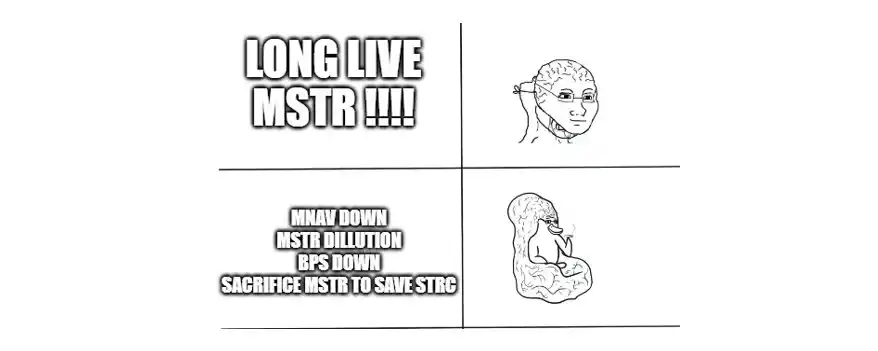
Saylor's Purchase of 1550 Bitcoin Is a Bad Trade

**Title: Saylor's Purchase of 1,550 Bitcoins Was a Bad Trade** The article critically analyzes Strategy's recent move of selling 32 bitcoins followed by a much larger purchase of 1,550 bitcoins. While appearing bullish, the author argues this trade is detrimental to MSTR shareholders. The core argument revolves around the concept of "breakeven modified Net Asset Value (mNAV)," a key metric for Strategy. To increase Bitcoin per share (BPS) for MSTR holders, Strategy must issue new shares at a premium high enough that the funds raised can buy more bitcoin than the bitcoin backing each existing share. Currently, this breakeven mNAV is estimated at 1.30. The recent trade failed on two counts: 1. The shares for the $181 million raise were issued at an mNAV *below* the 1.30 breakeven point. Selling "cheap" shares to buy bitcoin actually *reduces* BPS. 2. Only $101.3 million of the raised funds were used to buy bitcoin; the rest went to boost the company's dollar reserves. The breakeven mNAV calculation assumes *100%* of proceeds are used for bitcoin purchases. Diverting funds, even if mNAV were high, dilutes BPS. The result is an estimated 0.19% decrease in Bitcoin per share for MSTR holders. In exchange, Strategy merely extended its operational runway for its dollar reserves from ~6.3 months to 7 months. The author interprets this as Strategy prioritizing the survival and development of its STRC business over its stated core goal of increasing MSTR's BPS. This constitutes a gamble: if sacrificing MSTR value leads to improved market sentiment and a recovery in STRC's price (and thus mNAV), the whole system could work. If not, Strategy may be forced into a cycle of further diluting MSTR to stay afloat, potentially leading to deferred STRC dividends or corporate decline. The article concludes with a hope for price recovery for Bitcoin, MSTR, and STRC.

Foresight News45 мин. назад

Saylor's Purchase of 1550 Bitcoin Is a Bad Trade

Foresight News45 мин. назад

The AI Bear Market Lasting Two Days Is Over; Why Did Funds Buy Back Storage Stocks First?

After a severe two-day selloff in early June that erased over $1 trillion from U.S. chip stock market value, capital is flowing back first to the memory sector. The correction was not driven by a collapse in AI demand but rather a market reassessment of high expectations. Stocks like Broadcom faced selling pressure despite strong AI revenue guidance, signaling a shift in focus from who has an "AI story" to who can most rapidly translate AI demand into verifiable profits and earnings per share (EPS). Memory companies, such as Micron and SK Hynix, are leading the recovery because their EPS growth is more immediately verifiable. The AI server boom directly increases demand for high-bandwidth memory (HBM) and high-capacity server DRAM, tightening supply and driving up contract prices for conventional DRAM and NAND Flash. This price increase, coupled with a shift to higher-margin products, flows directly into near-term revenue and profitability, as evidenced in recent earnings reports. In contrast, other AI semiconductor segments like GPUs, ASICs, and optical modules, while central to the long-term AI infrastructure story, face longer and less certain paths to EPS validation. Their growth depends more on future product cycles, customer adoption timelines, and capital expenditure plans. The rebound in memory stocks highlights a market preference for assets with shorter, more transparent EPS conversion cycles following the recent de-risking phase. However, this does not negate the potential of other AI hardware segments should they provide clearer near-term order visibility. The episode has raised the validation bar for all AI-related investments.

marsbit45 мин. назад

The AI Bear Market Lasting Two Days Is Over; Why Did Funds Buy Back Storage Stocks First?

marsbit45 мин. назад

Торговля

Спот
Фьючерсы

Популярные статьи

Как купить S

Добро пожаловать на HTX.com! Мы сделали приобретение Sonic (S) простым и удобным. Следуйте нашему пошаговому руководству и отправляйтесь в свое крипто-путешествие.Шаг 1: Создайте аккаунт на HTXИспользуйте свой адрес электронной почты или номер телефона, чтобы зарегистрироваться и бесплатно создать аккаунт на HTX. Пройдите удобную регистрацию и откройте для себя весь функционал.Создать аккаунтШаг 2: Перейдите в Купить криптовалюту и выберите свой способ оплатыКредитная/Дебетовая Карта: Используйте свою карту Visa или Mastercard для мгновенной покупки Sonic (S).Баланс: Используйте средства с баланса вашего аккаунта HTX для простой торговли.Третьи Лица: Мы добавили популярные способы оплаты, такие как Google Pay и Apple Pay, для повышения удобства.P2P: Торгуйте напрямую с другими пользователями на HTX.Внебиржевая Торговля (OTC): Мы предлагаем индивидуальные услуги и конкурентоспособные обменные курсы для трейдеров.Шаг 3: Хранение Sonic (S)После приобретения вами Sonic (S) храните их в своем аккаунте на HTX. В качестве альтернативы вы можете отправить их куда-либо с помощью перевода в блокчейне или использовать для торговли с другими криптовалютами.Шаг 4: Торговля Sonic (S)С легкостью торгуйте Sonic (S) на спотовом рынке HTX. Просто зайдите в свой аккаунт, выберите торговую пару, совершайте сделки и следите за ними в режиме реального времени. Мы предлагаем удобный интерфейс как для начинающих, так и для опытных трейдеров.

1.4k просмотров всегоОпубликовано 2025.01.15Обновлено 2026.06.02

Как купить S

Sonic: Обновления под руководством Андре Кронье – новая звезда Layer-1 на фоне спада рынка

Он решает проблемы масштабируемости, совместимости между блокчейнами и стимулов для разработчиков с помощью технологических инноваций.

2.3k просмотров всегоОпубликовано 2025.04.09Обновлено 2025.04.09

Sonic: Обновления под руководством Андре Кронье – новая звезда Layer-1 на фоне спада рынка

HTX Learn: Пройдите обучение по "Sonic" и разделите 1000 USDT

HTX Learn — ваш проводник в мир перспективных проектов, и мы запускаем специальное мероприятие "Учитесь и Зарабатывайте", посвящённое этим проектам. Наше новое направление .

1.8k просмотров всегоОпубликовано 2025.04.10Обновлено 2025.04.10

HTX Learn: Пройдите обучение по "Sonic" и разделите 1000 USDT

Обсуждения

Добро пожаловать в Сообщество HTX. Здесь вы сможете быть в курсе последних новостей о развитии платформы и получить доступ к профессиональной аналитической информации о рынке. Мнения пользователей о цене на S (S) представлены ниже.

活动图片