Claude's Latest Model to be Released Tomorrow, Anthropic Turns Model Launches into an IPO Language

marsbitОпубликовано 2026-06-09Обновлено 2026-06-09

Введение

Anthropic is positioning itself for an IPO, transitioning from a "safe AI lab" to a company speaking the language of public markets. Recent signals include a near-trillion-dollar valuation, confidential S-1 filing, high revenue run-rate, and rumors of the upcoming Claude 5 model. The market is eagerly trading on the Claude 5 (or "Fable 5") rumors, seeing the potential release as a key piece of Anthropic's IPO narrative—proof of its continued innovation. However, public investors will look beyond raw model capability to scrutinize sustainable revenue, cost structure, and profitability. A differentiator for Anthropic is its work on advanced, controlled models like Mythos and Project Glasswing, focused on high-value security tasks. This supports a premium enterprise and safety story but also brings heightened regulatory and dual-use risk disclosure pressures for its IPO. Ultimately, the S-1 filing, not model rumors, will reveal the substance. The market will judge Anthropic based on concrete metrics: revenue quality, customer concentration, cost control, and whether it can be framed as a scalable AI software platform versus a capital-intensive infrastructure player.

TL;DR

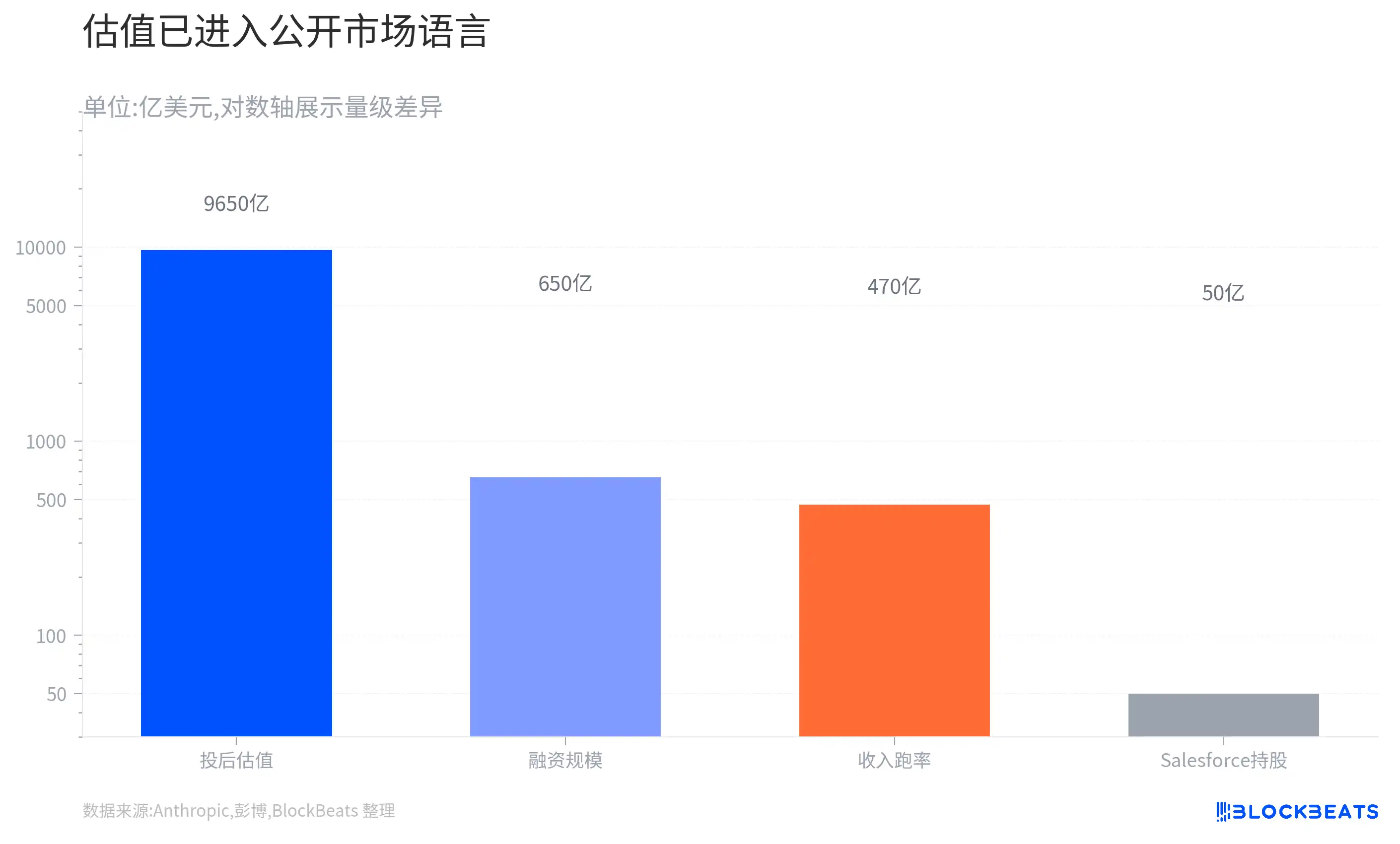
The recent market inclusion of Anthropic in the same trading chart is not an isolated event but a set of signals: a nearly one-trillion-dollar post-money valuation, confidential S-1 filing, rapidly growing revenue run-rate, and rumors surrounding Claude 5.

For investors, the meaning of these signals is straightforward. AI frontier labs are no longer proving themselves solely with papers, model rankings, and product reputation. They are starting to explain how much they are worth in a language the public market can understand. Model capabilities, enterprise adoption, revenue quality, compute costs, and risk disclosure are all being placed into a single pricing framework.

There is currently no official announcement, product page, or model card from Anthropic confirming Claude Fable 5. Statements about it sharing an underlying architecture with Mythos, adding safety guardrails, and improving long-context and complex task capabilities should still be considered rumors or market expectations. What's truly worth discussing is not what Fable 5 has already proven, but why an unconfirmed new model is being incorporated into Anthropic's IPO narrative ahead of time.

Anthropic Enters IPO Preparation Phase

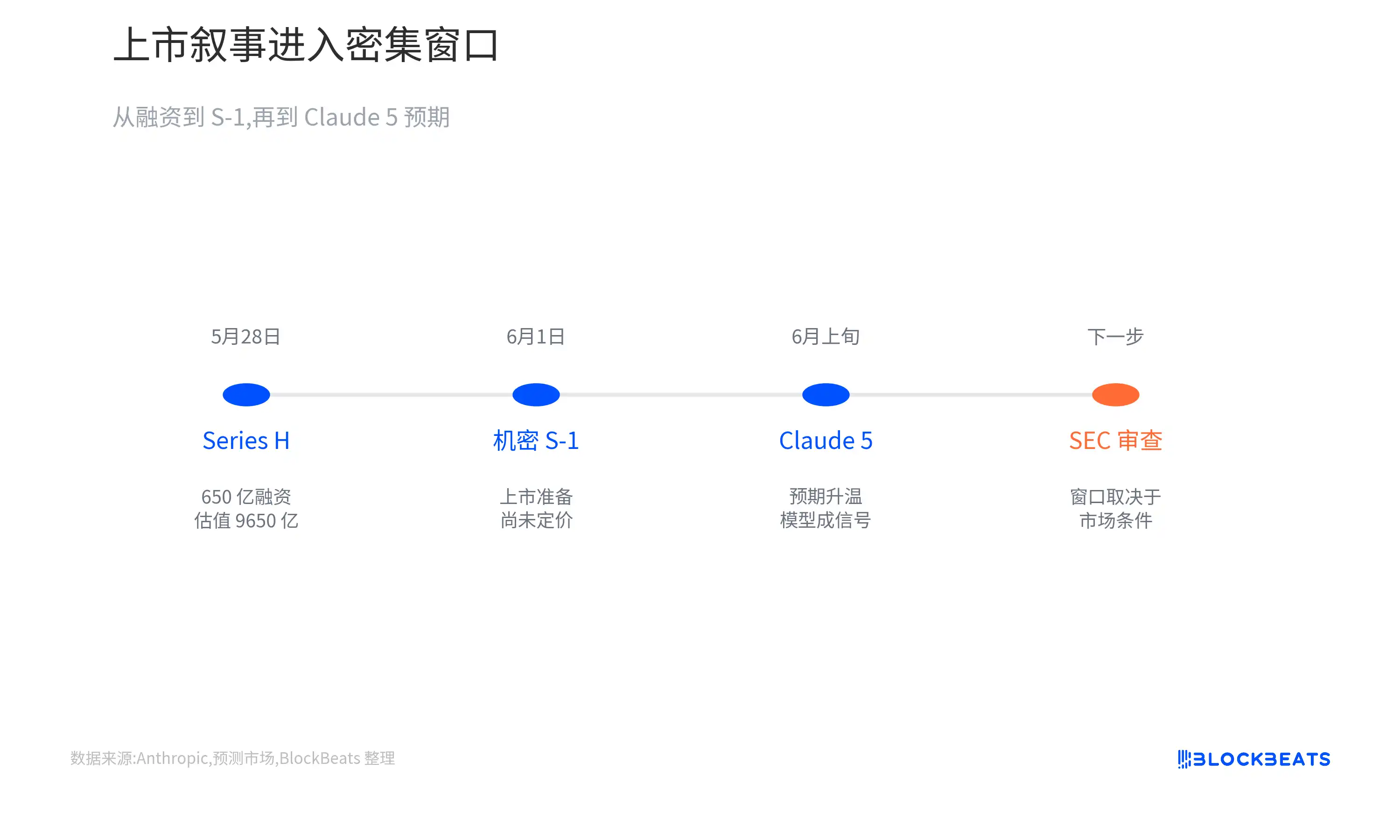
Anthropic's timeline is dense enough. On May 28, the company announced the completion of a $650 billion Series H financing, with a post-money valuation reaching $9.65 trillion, and stated that its run-rate revenue had exceeded $470 billion earlier that month. On June 1, Anthropic further confirmed it had confidentially filed a draft Form S-1 with the SEC for a planned IPO. The number of shares to be offered and the price range have not been determined, and the listing remains subject to SEC review, market conditions, and other factors.
This changes Anthropic's position in the market. It is no longer just the "safe model company" alongside OpenAI but an ultra-large AI platform candidate preparing for the public market. The private market can pay for future imagination, and the public market will also pay for the future, but it demands that companies break down that imagination into more verifiable metrics.

These metrics include whether revenue sources are stable, customers are concentrated, compute costs are controllable, model leadership is sustainable, and regulatory risks are disclosable and manageable. For frontier model companies, this transition is harder than for traditional software companies.

When traditional SaaS companies go public, investors typically look at ARR, net retention rate, gross margin, sales efficiency, and customer structure. Frontier model companies also need to answer these questions but additionally face training and inference costs, model iteration speed, safety incidents, cloud provider dependency, and chip cycles. The stronger the model, the greater the revenue potential, but also the heavier the cost and regulatory variables.

This is also what makes Anthropic special at this moment. Its high valuation cannot be supported solely by "Claude is smarter." It needs a more complete story: sustained progress in model capabilities, enterprise customers willing to pay, a sufficiently large revenue run-rate, a safety positioning that unlocks high-value scenarios, and an available capital market window. The amplification of the Claude 5 rumors is precisely because it appears to be the next piece of the puzzle in this story.
Fable 5 Rumors Being Traded in Advance

If Anthropic were simply releasing a new model in a routine manner, the market likely wouldn't be this excited. The amplification of the Claude 5 rumors is precisely because it coincides with a critical IPO juncture. Financing, valuation, S-1 filing, layered with heavyweight model leaks perfectly form a narrative the capital market loves to hear: the company proves with concrete action just before its IPO that it remains firmly at the forefront of capability iteration.

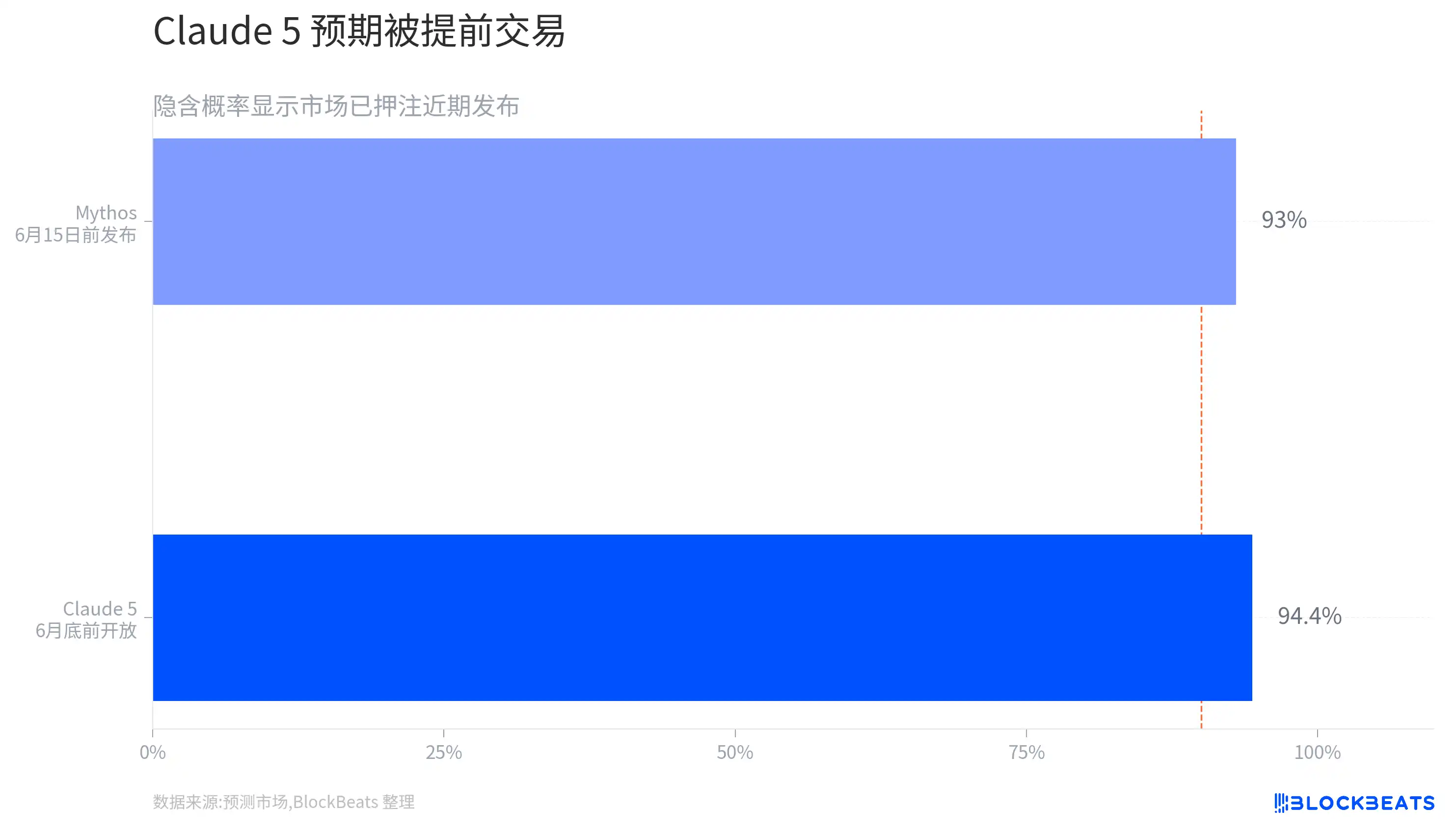
Prediction markets have already opened betting on "whether Claude 5 will be publicly available by June 30, 2026." The current market price reflects the traders' implied probability. While public information cannot yet fully confirm the specific timeline previously circulated, it's clear: the prediction market is already pricing a near-term release of Claude 5, and the price is not low.

This expectation carries inherent information. The market directly translates "product cadence" into "valuation narrative": if Anthropic can indeed consistently roll out stronger models, its nearly trillion-dollar post-money valuation with a high revenue run-rate will be interpreted as a natural outcome of rapid platform capability expansion; conversely, if the model cadence noticeably slows, then the near-trillion valuation would have to rely more heavily on the quality and certainty of existing revenue to sustain itself.

This trading method is not unfamiliar. Consumer internet companies emphasize user growth and retention before IPO, cloud companies highlight large customers and net expansion rates, chip companies talk about orders and capacity. AI model companies don't yet have a fully mature public market template, so model releases themselves become a visible signal. It is both a product update and a capability showcase, impacting developers and enterprise clients while also shaping investor imagination about the next phase of revenue growth.

But the impact of a model release on valuation is not linear. A stronger model can bring higher API call volumes, larger enterprise contracts, and stronger customer stickiness, but also potentially higher inference costs, more complex safety reviews, and heavier infrastructure investment. The public market ultimately won't just ask "Is it the strongest?" but also "How much compute is consumed per dollar earned?" "Can gross margins improve?" "Will safety boundaries limit commercialization speed?"

Mythos Provides Imagination, But Also Brings Disclosure Pressure

The more differentiated part of Anthropic's current narrative is not "another chatbot model," but the controlled frontier capabilities represented by Mythos and Project Glasswing.

According to official Anthropic disclosures, Claude Mythos Preview is a general, unreleased frontier model that will not be made broadly available. Project Glasswing is oriented towards defensive security work, where collaborative partners gain controlled access for use in critical software security, zero-day vulnerability discovery and remediation, among other scenarios. Anthropic also disclosed that the project has already discovered a significant number of zero-day vulnerabilities and committed to up to $1 billion in usage credits and $4 million in open-source security donations.
This provides Anthropic with a valuation story different from that of a regular consumer chatbot. It can position itself as a foundational model supplier entering complex tasks, high-value enterprise workflows, and safety-critical scenarios. For the public market, this is easier to map to large customer budgets than "users like to chat," and it's also easier to explain why enterprises are willing to pay a premium for more reliable, safer models.

If there is indeed a technical link between a future Fable 5 and Mythos, with the former offering stricter guardrails to a broader user base, it would create a narrative path in theory: the most frontier capabilities are first validated in a controlled environment, then partially productized in a safer form. This path aligns with Anthropic's long-emphasized safety positioning and fits the demand of enterprise clients for controlled AI.

But the same dynamic pushes Anthropic towards greater regulatory pressure. Cybersecurity capabilities have a dual-use (civilian-military) nature. Models that can find and fix vulnerabilities could also be misused in attack chains. Mythos's controlled release already indicates such capabilities cannot simply be fully released. If future, more general models are interpreted by the market as "trickled-down Mythos capabilities," the company must more clearly explain safety guardrails, access restrictions, misuse monitoring, and liability boundaries.

These contents will enter the S-1 risk disclosures. Public market investors won't only care about how powerful the model is, but also whether that power brings additional regulatory costs, national security reviews, reputational risks, and potential liabilities. For an AI company with a post-money valuation nearing one trillion dollars, a major safety incident could be more than just a product mishap; it could be a systemic variable affecting the listing timeline and valuation multiples.

What's Next is the S-1, Not New Rumors

For Anthropic, what is most likely overestimated by the market right now is not model capability, but the relationship between model capability and valuation.

Discussions about Fable 5, Claude 5, and even Mythos can indeed boost market sentiment. A stronger model means higher customer attention, stronger developer interest, and means Anthropic can continue to maintain its presence in the frontier model competition. But these factors are essentially growth expectations. They can explain why the market is willing to trade the future in advance, but they are insufficient alone to prove that the nearly trillion-dollar valuation has been validated by reality.

Once truly in the public market, investor concerns will quickly become specific. How much of that over $470 billion revenue run-rate can ultimately convert into sustainable, auditable revenue? Is enterprise customer growth coming from long-term deployments or pilot phases? What proportion of revenue comes from top customers? What roles do strategic partners and cloud channels like Amazon and Alphabet play? More importantly, while model inference volumes grow rapidly, can training and inference costs be continuously reduced to support margin improvement?

These metrics ultimately determine not just the growth rate, but how the market defines Anthropic.
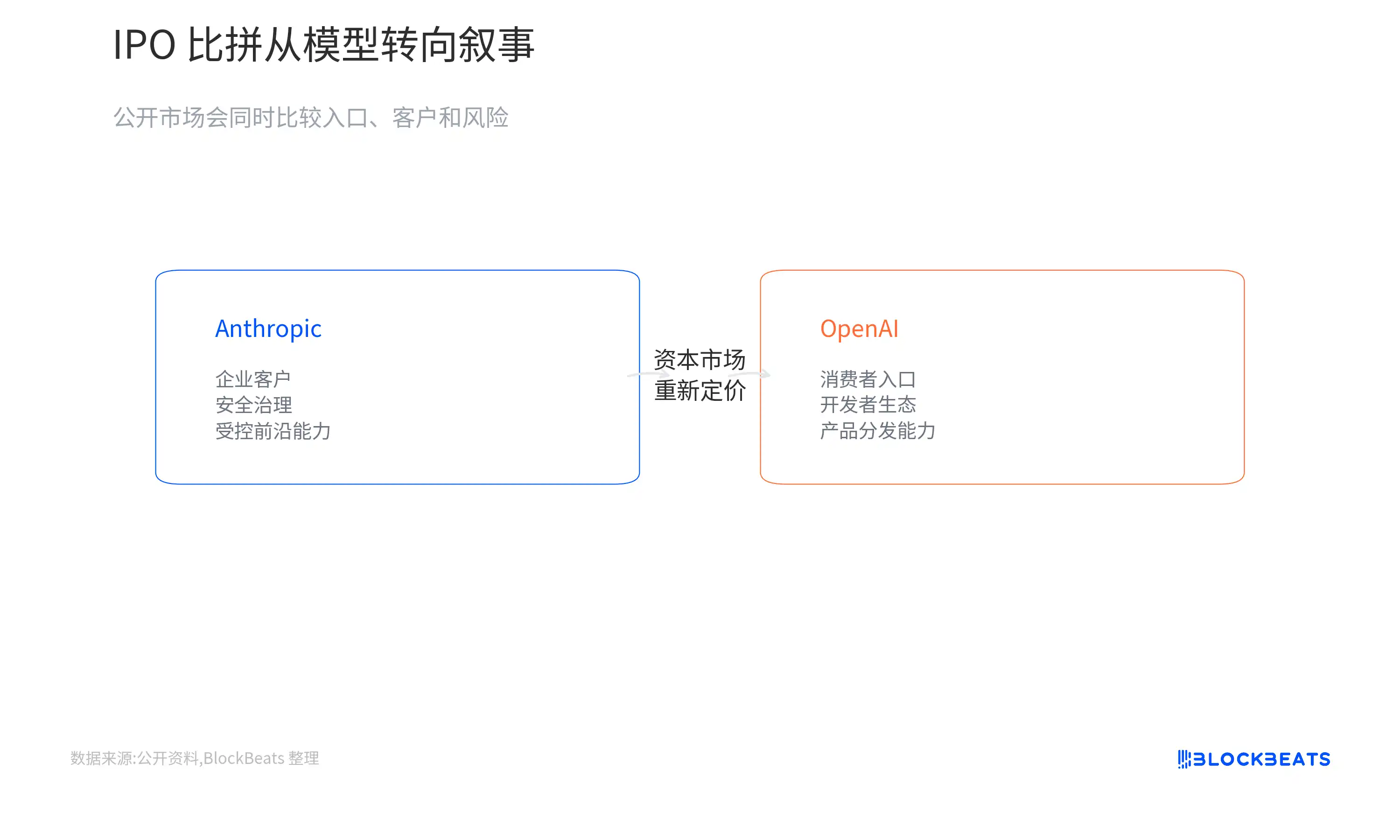
If the company can persistently lower unit costs, increase customer stickiness, and build a broader software ecosystem around its models, then investors are more willing to view it as the next-generation AI software platform. If revenue growth is consistently accompanied by massive compute investment and expanding capital expenditures, then the market is more likely to categorize it as a high-growth, high-consumption AI infrastructure company. Both narratives can support high valuations, but they correspond to different valuation multiples and risk tolerances.

OpenAI's presence will make this comparison more apparent, but the two don't necessarily constitute a simple zero-sum competition. OpenAI possesses stronger consumer touchpoints and ecosystem influence, while Anthropic has built a more distinct enterprise, safety, and governance narrative. What the future public market will truly compare might not be who releases a certain model first, but who can more stably convert model capabilities into revenue growth and explain the future to investors with lower uncertainty.


Связанные с этим вопросы

QAccording to the article, what is the new 'language' that Anthropic is starting to speak when communicating its value?

AThe article states that Anthropic is beginning to communicate its value using the 'language' understood by the public market. This involves framing its worth through measurable financial indicators like model capabilities, enterprise adoption, revenue quality, computing costs, and risk disclosures, moving beyond just research papers and product reputation.

QWhat specific event marked Anthropic's official entry into the IPO preparation stage, as detailed in the text?

AAnthropic officially entered the IPO preparation stage on June 1, when it confirmed it had confidentially submitted a draft Form S-1 to the SEC, with the actual IPO contingent on regulatory review and market conditions.

QWhy does the article suggest the Claude 5 (Fable 5) rumors are being amplified by the market at this specific time?

AThe article suggests the Claude 5 rumors are being amplified because they coincide perfectly with Anthropic's key IPO milestones. The timing creates a compelling narrative for investors: the company is demonstrating it remains at the forefront of AI capability just before going public, thereby validating its high valuation and growth story.

QWhat differentiated valuation story does the 'Mythos' model and Project Glasswing provide for Anthropic, according to the analysis?

AMythos and Project Glasswing provide Anthropic with a differentiated valuation story focused on controlled, high-value enterprise and security-critical applications. This positions Anthropic not just as a consumer chatbot provider, but as a supplier of foundational models for complex tasks, high-value enterprise workflows, and cybersecurity (like zero-day vulnerability discovery), which is easier to map to large enterprise budgets and justifies premium pricing for safer, more reliable models.

QWhat does the article identify as the more critical factor for public market investors to assess about Anthropic's future, beyond just new model releases?

ABeyond new model releases, the article identifies the more critical factor for public market investors as understanding how Anthropic's model capabilities translate into sustainable, verifiable financial performance. Key concerns include the sustainability and auditability of its $47B+ revenue run-rate, customer concentration, the role of strategic partners, and most importantly, whether training and inference costs can decrease to support improved profit margins, which will define the company as either a next-gen AI software platform or a high-growth, high-burn infrastructure company.

Похожее

Apple's Desired On-Device AI Sees a Dark Horse Emerge: The First Cognitive Model is Born, 4B Matches GPT-5.4

A Chinese company, Tomorrow's Journey (Nextie), has introduced what it is calling the industry's first "cognitive model" for edge devices. Named New Journey Alpha, this 4-billion-parameter model reportedly matches the performance of trillion-parameter giants like GPT-5.4 in group intelligence tasks such as debate and collective decision-making. The development follows Andrej Karpathy's vision of stripping vast factual knowledge from large language models to retain only a smaller "cognitive core" capable of reasoning, planning, and knowing its own limits. This approach directly addresses the soaring computational costs and token expenses hindering AI's widespread deployment, as highlighted by incidents like Amazon shutting down an internal AI tool due to prohibitive costs. Trained via reinforcement learning on a corpus of academic papers from 1800-2020 to enhance generalization, the model enables three key advancements: 1) Improved decision quality in multi-agent systems, 2) Drastically reduced compute costs, allowing for cost-effective cloud or on-device (e.g., MacBook) deployment, and 3) The feasibility of "proactive" AI agents that act autonomously without user prompts, unlocking new commercial possibilities beyond today's reactive models. Built by the former Microsoft Xiaoice team—known for creating a 3.6B model that outperformed a 65B Llama model—the company is now focusing on the multi-agent systems sector, a field gaining significant investor interest. The model's economic impact is profound; by achieving high-level performance with minimal parameters, it fundamentally alters the cost structure of AI services, challenging the prevailing model of ever-larger parameter counts.

marsbit11 мин. назад

Apple's Desired On-Device AI Sees a Dark Horse Emerge: The First Cognitive Model is Born, 4B Matches GPT-5.4

marsbit11 мин. назад

OpenAI's 'Blueprint for the Future': Making AI Beneficial for Every Person on the Planet

A new transformative technology emerges every few generations. OpenAI draws a parallel with the advent of electricity in the 1920s, which initially brought convenience but ultimately enabled unprecedented progress in medicine, engineering, and living standards by empowering people to create new possibilities. AI is poised to recreate this phenomenon. Its true significance lies not in the technology itself, but in what people can achieve with it—from understanding a medical bill or starting a business to aiding scientific discovery. OpenAI believes AI should be universally accessible, allowing everyone to use it according to their own needs. This future, however, is not guaranteed. While transformative tech can centralize power, OpenAI's philosophy is that AI must serve humanity, augmenting human capabilities and broadly distributing its benefits. The company's first commitment is to build AI for human service, aiming to empower the many rather than concentrate power in a few. Safety, alignment with human intent, and oversight are paramount. OpenAI is optimistic about AI's potential to expand human welfare but remains clear-eyed about risks. The goal is to help people achieve more, not to replace them. Full automation is not the desired future; human judgment, values, and direction will become even more critical. OpenAI outlines three core goals: 1. Build automated AI researchers to accelerate and increasingly automate the research process itself, maintaining close human collaboration. The internal projection is that by March 2028, a significant portion of their research will be conducted by AI systems working alongside human researchers. 2. Accelerate economic development by advancing science, boosting productivity, and fostering growth, while ensuring the fruits are widely shared. 3. Provide a personal AGI for everyone on Earth, allowing individuals to benefit from this transformative technology in their own way. The company is entering its third phase, moving from foundational AGI research (Phase 1) to product deployment and learning from real-world use (Phase 2). The current challenge is making advanced AI abundant, affordable, safe, practical, and usable for all individuals and organizations. OpenAI concludes that a widely distributed power structure leads to a more resilient, adaptable, and free society. A positive AI future should not be controlled by a handful of entities but built, benefited from, and owned by many. If realized correctly, AI can become a cornerstone for enhancing global productivity, creativity, scientific advancement, and economic opportunity, fulfilling the mission to ensure AGI benefits all of humanity.

marsbit1 ч. назад

OpenAI's 'Blueprint for the Future': Making AI Beneficial for Every Person on the Planet

marsbit1 ч. назад

Arthur Hayes' New Article: AI Bubble Nears Bursting, Crypto Market Faces Short-Term Pressure

In a new essay, Arthur Hayes argues that the AI market bubble is approaching a rupture, which will place significant short-term pressure on crypto assets. He identifies rising oil prices, a trio of massive tech IPOs (SpaceX, Anthropic, OpenAI), and potential anti-AI political rhetoric from Trump as the three key catalysts for a correction. Hayes posits that the prolonged blockage of the Strait of Hormuz will drive energy prices higher, increasing operational costs for data centers and squeezing AI company profits. Simultaneously, the market may struggle to absorb the upcoming wave of multi-trillion dollar tech IPOs. Furthermore, with high inflation hurting his election chances, Trump could pivot to attacking the AI sector with proposals for heavy taxation and regulation to win over voters, spooking the market. Hayes notes that nearly all new dollar liquidity since 2022 has flowed into the AI sector, leaving little for Bitcoin, explaining its recent underperformance. He believes an AI stock crash would trigger a broad risk-off sentiment and credit contraction, dragging down crypto in the near term. Consequently, his fund, Maelstrom, has sold all AI-related stocks and non-core cryptocurrencies, retaining only Bitcoin and Ethereum while building positions in traditional energy stocks. He anticipates Bitcoin will bottom and resume its bull run only after the AI bubble pops and a new monetary easing cycle begins.

marsbit1 ч. назад

Arthur Hayes' New Article: AI Bubble Nears Bursting, Crypto Market Faces Short-Term Pressure

marsbit1 ч. назад

Торговля

Спот
Фьючерсы

Популярные статьи

Как купить S

Добро пожаловать на HTX.com! Мы сделали приобретение Sonic (S) простым и удобным. Следуйте нашему пошаговому руководству и отправляйтесь в свое крипто-путешествие.Шаг 1: Создайте аккаунт на HTXИспользуйте свой адрес электронной почты или номер телефона, чтобы зарегистрироваться и бесплатно создать аккаунт на HTX. Пройдите удобную регистрацию и откройте для себя весь функционал.Создать аккаунтШаг 2: Перейдите в Купить криптовалюту и выберите свой способ оплатыКредитная/Дебетовая Карта: Используйте свою карту Visa или Mastercard для мгновенной покупки Sonic (S).Баланс: Используйте средства с баланса вашего аккаунта HTX для простой торговли.Третьи Лица: Мы добавили популярные способы оплаты, такие как Google Pay и Apple Pay, для повышения удобства.P2P: Торгуйте напрямую с другими пользователями на HTX.Внебиржевая Торговля (OTC): Мы предлагаем индивидуальные услуги и конкурентоспособные обменные курсы для трейдеров.Шаг 3: Хранение Sonic (S)После приобретения вами Sonic (S) храните их в своем аккаунте на HTX. В качестве альтернативы вы можете отправить их куда-либо с помощью перевода в блокчейне или использовать для торговли с другими криптовалютами.Шаг 4: Торговля Sonic (S)С легкостью торгуйте Sonic (S) на спотовом рынке HTX. Просто зайдите в свой аккаунт, выберите торговую пару, совершайте сделки и следите за ними в режиме реального времени. Мы предлагаем удобный интерфейс как для начинающих, так и для опытных трейдеров.

1.4k просмотров всегоОпубликовано 2025.01.15Обновлено 2026.06.02

Как купить S

Sonic: Обновления под руководством Андре Кронье – новая звезда Layer-1 на фоне спада рынка

Он решает проблемы масштабируемости, совместимости между блокчейнами и стимулов для разработчиков с помощью технологических инноваций.

2.3k просмотров всегоОпубликовано 2025.04.09Обновлено 2025.04.09

Sonic: Обновления под руководством Андре Кронье – новая звезда Layer-1 на фоне спада рынка

HTX Learn: Пройдите обучение по "Sonic" и разделите 1000 USDT

HTX Learn — ваш проводник в мир перспективных проектов, и мы запускаем специальное мероприятие "Учитесь и Зарабатывайте", посвящённое этим проектам. Наше новое направление .

1.8k просмотров всегоОпубликовано 2025.04.10Обновлено 2025.04.10

HTX Learn: Пройдите обучение по "Sonic" и разделите 1000 USDT

Обсуждения

Добро пожаловать в Сообщество HTX. Здесь вы сможете быть в курсе последних новостей о развитии платформы и получить доступ к профессиональной аналитической информации о рынке. Мнения пользователей о цене на S (S) представлены ниже.

活动图片