Fed's $400 Billion Liquidity Signal: Bitcoin Under Pressure Awaits a Breakthrough

深潮Опубликовано 2025-12-09Обновлено 2025-12-09

Введение

Bitcoin's price appears stable but is under significant structural pressure, with investors facing nearly $500 million in daily losses and over 6.5 million BTC held at unrealized losses. This coincides with a potential shift in U.S. monetary policy, as the Federal Reserve ends its quantitative tightening program—which reduced its balance sheet by $2.4 trillion—and signals a move toward "Reserve Management Purchases." This could inject over $400 billion annually in liquidity by reinvesting in short-term Treasuries. Market attention is focused on Fed Chair Powell’s upcoming remarks regarding labor market softening and the timing of liquidity expansion. A clear signal toward reserve rebuilding could push Bitcoin above the $92k–$93.5k resistance, while a cautious tone may keep it range-bound between $75k–$82k. Despite miner capitulation and weak short-term holder sentiment, large wallets are accumulating Bitcoin, exchange reserves are declining, and stablecoin inflows suggest latent demand. This combination of pressure and accumulation often precedes a market bottom. Bitcoin’s next major move hinges on the Fed’s liquidity signals and broader macroeconomic conditions.

Written by: Oluwapelumi Adejumo

Compiled by: Saoirse, Foresight News

Bitcoin's price movement is fluctuating alongside the Fed's final policy decision of the year, showing almost no significant surface-level changes, yet the deep market structure presents a completely different picture.

Beneath the seemingly stable price range lies a period of concentrated pressure: on-chain data shows investors are facing daily losses nearing $500 million, leverage in the futures market has significantly decreased, and nearly 6.5 million Bitcoin are currently in an unrealized loss position.
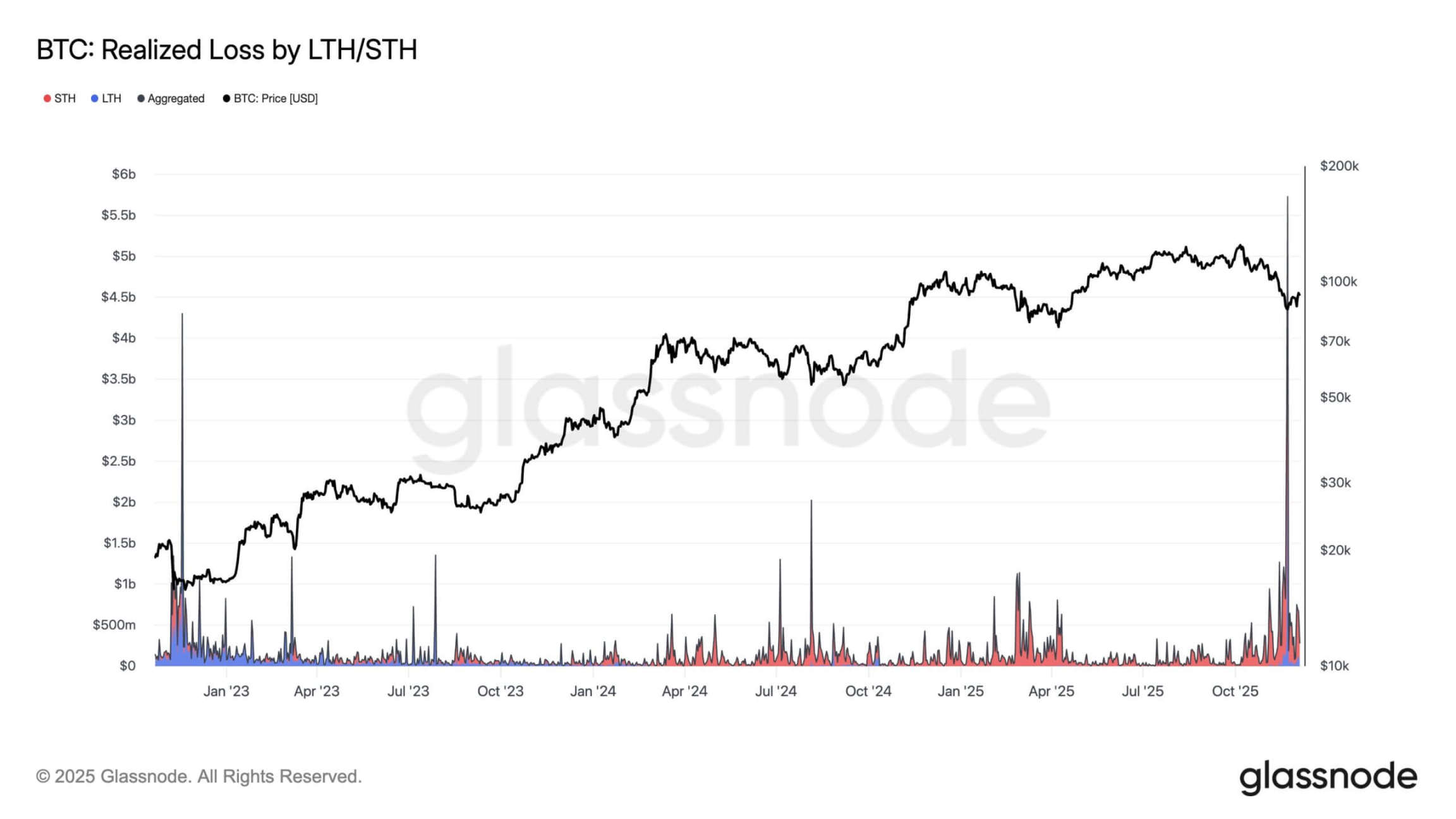
Bitcoin Realized Loss Level, Source: Glassnode

This situation resembles the final stages of past market contractions more than a healthy consolidation phase.

However, structural adjustments occurring beneath a calm surface are not uncommon for Bitcoin, but the timing of this adjustment is noteworthy.

The internal market "capitulation selling"恰好 coincides with an external inflection point in US monetary policy. The Federal Reserve has ended its most aggressive balance sheet reduction phase in over a decade, and the market expects its December meeting to outline a clearer framework for a "turn towards reserve rebuilding."

Given this, the on-chain market pressure and the pending liquidity shift together form the backdrop for this week's macro events.

Liquidity Shift

According to the Financial Times, Quantitative Tightening (QT) officially ended on December 1st. During this period, the Fed reduced its balance sheet by approximately $2.4 trillion.

This move pushed bank reserve levels down into a range historically associated with funding stress, while the Secured Overnight Financing Rate (SOFR) repeatedly tested the upper limit of the policy rate band.

These changes indicate that the market system is no longer flush with liquidity but is gradually entering a phase of "concern triggered by scarce reserves."

Against this backdrop, the most critical signal from the Federal Open Market Committee (FOMC) is not the widely anticipated 25 basis point rate cut, but rather the direction of its balance sheet strategy.

The market expects the Fed to clarify its transition plan to "Reserve Management Purchases (RMP)" through an explicit statement or policy implementation document.

According to analysis by investment research firm Evercore ISI, this plan could launch as early as January 2026, involving monthly around $35 billion in purchases of short-term Treasury bills — funds recouped from maturing mortgage-backed securities will be reallocated into short-term assets.

The details of this mechanism are crucial: although the Fed is unlikely to define RMP as "stimulus policy," continuous reinvestment into short-term Treasury bills will steadily rebuild bank reserves and shorten the asset maturity structure of the System Open Market Account (SOMA).

This operation will gradually increase the scale of reserves, ultimately leading to an annualized balance sheet growth exceeding $400 billion.

Such a shift would mark the first sustained expansionary policy signal from the Fed since the start of quantitative tightening. Historical data suggests Bitcoin's sensitivity to these types of liquidity cycles is far greater than its sensitivity to changes in policy rates.

Meanwhile, broader monetary aggregate data indicates that the liquidity cycle may have already begun to turn.

Notably, the M2 money supply has reached a historical peak of $22.3 trillion, surpassing the high of early 2022 after a prolonged period of contraction.

(Note: M2 is a core measure of money supply, falling under the "broad money" category. It has a wider scope than base money (M0) and narrow money (M1), providing a more comprehensive reflection of the overall liquidity situation in society.)
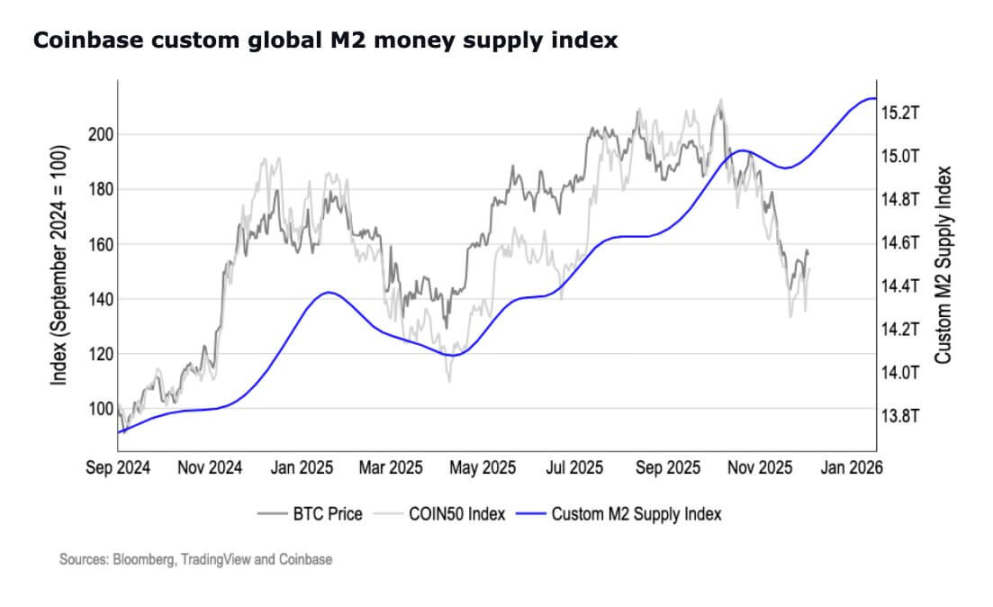
US M2 Money Supply, Source: Coinbase

Therefore, if the Fed confirms the start of "reserve rebuilding," Bitcoin's sensitivity to balance sheet dynamics could quickly rebound.

Macro Trap

The core rationale for this policy shift stems from changes in employment data.

Nonfarm payrolls have declined in 5 out of the past 7 months; simultaneously, job openings, the hiring rate, and the quits rate have all shown signs of slowing, shifting the employment market narrative from "highly resilient" to "fragile and under pressure."

As these indicators cool, the theoretical framework of an "economic soft landing" becomes increasingly difficult to sustain, and the Fed's policy options continue to narrow.

While current inflation has receded, it remains above the policy target; meanwhile, the cost of "maintaining restrictive policy for longer" is rising.

The potential risk is that weakness in the labor market could intensify further before inflation fully returns to target levels. Therefore, the informational value of the Fed press conference this week might exceed that of the rate decision itself.

The market will focus intently on how Fed Chair Powell balances the dual objectives — maintaining labor market stability while ensuring credibility in the inflation path. His remarks on "reserve adequacy," "balance sheet strategy," and the "timing of RMP launch" will dominate market expectations for 2026.

For Bitcoin, this means its price movement won't be a binary outcome of simply rising or falling, but will depend on the specific direction of the policy signals.

If Powell acknowledges labor market weakness and clearly outlines the reserve rebuilding plan, the market might perceive the current range-bound price as disconnected from the policy direction — a break above the $92k - $93.5k range would indicate traders are anticipating liquidity expansion.

Conversely, if Powell emphasizes policy caution or delays clarifying RMP details, Bitcoin could remain within the lower consolidation range of $82k - $75k — a zone that concentrates ETF holding bottoms, corporate treasury reserve thresholds, and historical structural demand areas.

Will Bitcoin See 'Capitulation Selling'?

Meanwhile, Bitcoin's internal market dynamics further corroborate the view that "the asset is undergoing a reset beneath the surface."

Short-term holders continue to sell tokens during market weakness; as mining costs approach $74k, mining economics have significantly deteriorated.

Simultaneously, Bitcoin mining difficulty saw its largest single drop since July 2025, indicating marginal miners are scaling back operations or shutting down rigs entirely.

However, these pressure signals coexist with early signs of "supply tightening."

Research firm BRN Research disclosed to CryptoSlate: large wallets have accumulated approximately 45,000 BTC over the past week; Bitcoin exchange balances continue to decline; stablecoin inflows show that capital is poised to re-enter the market should conditions improve.

Furthermore, supply metrics from asset manager Bitwise show that despite retail sentiment being in "extreme fear," wallets of all types are accumulating Bitcoin. Tokens are moving from high-liquidity platforms to long-term custody accounts, further reducing the proportion of supply available to absorb sell-offs.

This pattern of "forced selling, miner pressure, and selective accumulation" often forms the foundation for a long-term market bottom.

Bitwise further added:

"Bitcoin's capital expansion continues to contract, with the 30-day realized cap growth rate falling to just 0.75% per month. This suggests profit-taking and stop-loss selling in the current environment are roughly balanced, with losses only slightly outweighing profits. This rough balance indicates the market has entered a 'calm period,' with neither bulls nor bears holding clear dominance."

Technical Perspective

From a market structure perspective, Bitcoin remains constrained by two key ranges.

A sustained break above $93.5k would push the asset into a zone where "momentum models are more easily triggered," with subsequent targets at $100k, $103.1k (the short-term holder cost basis), and long-term moving averages.

Conversely, failure to break resistance in the face of cautious Fed signals could see the market retreat to the $82k - $75k range — an area that has repeatedly acted as a "reservoir" for structural demand.

BRN Research notes that cross-asset performance also confirms this sensitivity: ahead of the Fed meeting, gold and Bitcoin showed inverse correlations, reflecting asset rotation driven by changes in liquidity expectations, rather than purely risk sentiment-driven volatility.

Therefore, if Powell's comments reinforce the expectation that "reserve rebuilding is the core of the next policy phase," capital could quickly rotate towards assets that respond positively to "liquidity expansion."

Связанные с этим вопросы

QWhat is the key liquidity signal from the Fed mentioned in the article, and how might it impact Bitcoin?

AThe Fed is expected to transition to a 'Reserve Management Purchases' (RMP) program, potentially starting as early as January 2026, which would involve monthly purchases of around $35 billion in short-term Treasury bills. This would steadily rebuild bank reserves, leading to an annualized expansion of the balance sheet by over $400 billion. Historically, Bitcoin has shown high sensitivity to such liquidity cycles, and this shift could provide a tailwind for its price if the policy direction is confirmed.

QAccording to on-chain data, what are the signs of underlying market stress in Bitcoin despite its seemingly stable price?

AOn-chain data shows that investors are realizing losses of nearly $500 million daily, leverage in the futures market has significantly decreased, and approximately 6.5 million Bitcoin are currently in a state of unrealized loss. This points to a period of concentrated selling pressure and capitulation beneath the surface of the price action.

QWhat are the two key price ranges that are constraining Bitcoin's movement, as per the technical analysis in the article?

ABitcoin is constrained between two key ranges. A sustained break above $93,500 would signal a move into a momentum-driven phase with targets at $100,000 and $103,100. Conversely, a failure to break resistance could see a retracement to the lower consolidation range of $82,000 to $75,000, which has historically acted as a structural demand zone.

QHow does the article characterize the current state of the mining industry and its impact on the market?

AThe mining economics have significantly deteriorated as mining costs approach $74,000. This has been accompanied by the largest single drop in Bitcoin mining difficulty since July 2025, indicating that marginal miners are scaling back operations or shutting down rigs. This represents a source of selling pressure and is a sign of a market under stress.

QWhat conflicting forces are at play in the Bitcoin market that could be forming a long-term bottom?

AThe market is experiencing conflicting forces: forced selling from short-term holders and pressured miners exists alongside selective accumulation by large wallets. There has been a net outflow of Bitcoin from exchanges, and stablecoin inflows suggest capital is ready to re-enter the market. This pattern of distribution to strong hands and a reduction in easily sellable supply is often a foundation for a long-term market bottom.

Похожее

SociFi Dream Shattered? Farcaster Pivots to Bet on Wallet Track

Farcaster, a decentralized social network protocol, has announced a major strategic shift after 4.5 years, abandoning its "social-first" approach to adopt a "wallet-first" growth model. Co-founder Dan Romero acknowledged that despite initial success—such as a surge to 100,000 daily active users (DAU) in early 2024 driven by features like Frames and the DEGEN airdrop—user engagement and revenue sharply declined later that year. By October 2025, monthly revenue had dropped 99% from its peak. The platform will now prioritize building a high-quality wallet within its official app, Warpcast, focusing on the intersection of wallets and social interaction. The new user journey emphasizes wallet funding and utility as key activation points. Farcaster is also enhancing its financial infrastructure through the acquisition of token launch platform Clanker and offering incentives like a 10% reward on USDC deposits. Frames, interactive mini-apps within the social feed, enable "content as transaction" capabilities, allowing users to mint, trade, and pay directly in their feeds. Despite raising $150 million in a 2024 Series A round at a $1 billion valuation, the move has drawn criticism. Some argue it signals the end of the SocialFi dream and a return to a transaction-focused model reminiscent of the 2017 ICO era. Others note challenges in a competitive wallet market and potential feature bloat. Farcaster remains an open protocol, and users can choose alternative clients, but the shift underscores a broader industry reality: pure Web3 social networks may struggle without integrating high-value financial tools to drive user engagement and retention.

marsbit4 мин. назад

SociFi Dream Shattered? Farcaster Pivots to Bet on Wallet Track

marsbit4 мин. назад

12.9 Today's Market: Why the Drop? BTC\SOL\ETH\BNB\RDNT\STABLE\TRUMP\Horse to Success\bibi Trading Advice

The cryptocurrency market experienced significant volatility, with $212 million in liquidations over 24 hours, including a single $2.14 million Bitcoin liquidation on Hyperliquid. Market sentiment remains nervous, with high turnover reflecting short-term bearishness, though long-term holders remain steady. The Federal Reserve's upcoming meeting is a key focus, as interest rate decisions may influence market direction. Bitcoin’s support is near $88,100, with a potential dip to $85,200–85,900 offering a buying opportunity. Resistance is at $93,400. SOL may see support at $125.8 and $124, with potential accumulation near $120. ETH has supports at $2,955, $2,865, and $2,805, with resistance at $3,282. BNB’s key level is $898; holding above may lead to a bounce toward $939. Meme coins are highly risky, with many projects on BSC and SOL facing extreme volatility and potential scams. High-cap tokens like BIBI are relatively safer. Patience and strict stop-losses are advised. Specific tokens: - 马到成功 (Horse to Success): Accumulating near $2M market cap with strong community support. - ZEC: Showing strength, possibly entering a major upward trend if it holds key levels. - RDNT: Avoid chasing pumps—likely a temporary bounce. - TRUMP: Unlikely to rally this cycle due to locked supply; may perform in the next bull market if Trump remains politically relevant. - STABLE: Bearish due to high fully diluted valuation and lack of catalysts; consider shorting. Overall, December is to accumulate during consolidation while preserving capital for larger opportunities in Q1 2026.

金色财经13 мин. назад

12.9 Today's Market: Why the Drop? BTC\SOL\ETH\BNB\RDNT\STABLE\TRUMP\Horse to Success\bibi Trading Advice

金色财经13 мин. назад

Financial On-Chain Transformation: A Blueprint for the Overhaul of the U.S. Capital Market

The article "Financial On-Chaining: A Blueprint for the Transformation of U.S. Capital Markets" explores the potential systemic overhaul if the U.S. financial system migrates to blockchain technology, as suggested by SEC Chair Paul Atkins. It outlines seven key structural shifts: 1. Market Dynamics: Transition to T+0 settlement, enabling 24/7 trading and real-time regulatory oversight by the SEC, increasing capital velocity but eliminating traditional market buffers. 2. Banking Sector: Banks would operate with near-transparent balance sheets, reducing risks like asset-liability mismatches but potentially accelerating bank runs. Programmable collateral could unlock new financing efficiency. 3. Real Economy: Democratization of assets through fractional ownership and "micro-IPOs" for SMEs, injecting liquidity premium into U.S. assets. 4. Geopolitics: Digital reinforcement of dollar dominance via tokenized Treasuries and money market funds, attracting global capital through efficiency and transparency. 5. Risk Evolution: Systemic risks would shift from human-driven panics to technical failures (e.g., smart contract bugs, oracle manipulation), making crises faster and more technical. 6. Winners and Losers: Infrastructure builders, new asset managers, and hybrid talent would thrive; traditional intermediaries and opaque industries would decline. 7. Realistic Timeline: Full adoption in two years is unlikely due to technical, legal, and political hurdles, but gradual implementation (e.g., in Treasuries, repos) is inevitable as efficiency drives change.

比推26 мин. назад

Financial On-Chain Transformation: A Blueprint for the Overhaul of the U.S. Capital Market

比推26 мин. назад

Торговля

Спот
Фьючерсы
活动图片