Bitcoin peeled off exchanges this year in ‘positive long-term sign’

cointelegraphОпубликовано 2025-12-09Обновлено 2025-12-09

Введение

According to Santiment, over 403,000 Bitcoin (BTC) have been moved off exchanges since December 2024, representing a 2% decrease in exchange-held BTC compared to the previous year. This trend is viewed as a positive long-term indicator, as reduced exchange supply historically lowers the risk of major sell-offs and supports price stability. Analysts suggest these outflows are partly due to users moving coins into cold storage for long-term holding. Additionally, institutional accumulation via ETFs is absorbing significant supply—ETFs and public companies now hold more Bitcoin than all exchanges combined. This shift reflects growing institutional ownership, reduced liquid supply, and a strengthening market structure less dependent on trading platforms.

There are at least 400,000 fewer Bitcoin on exchanges compared to the same time last year, in a positive sign for the market, according to the market intelligence platform Santiment.

Over 403,000 Bitcoin (BTC) have moved off exchanges since Dec. 7, 2024, representing roughly 2% of the total supply, Santiment said in an X post on Monday, citing data from its sanbase dashboard.

Users often move their Bitcoin away from exchanges into cold storage wallets, which, in theory, makes it harder to sell and could signal long-term plans to hold.

“In general, this is a positive long-term sign. The less coins exist on exchanges, the less likely we’ve historically seen a major sell-off that causes downside pressure for an asset’s price.”

“As Bitcoin's market value hovers around $90K, crypto’s top market cap continues to see its supply moving away from exchanges,” Santiment added.
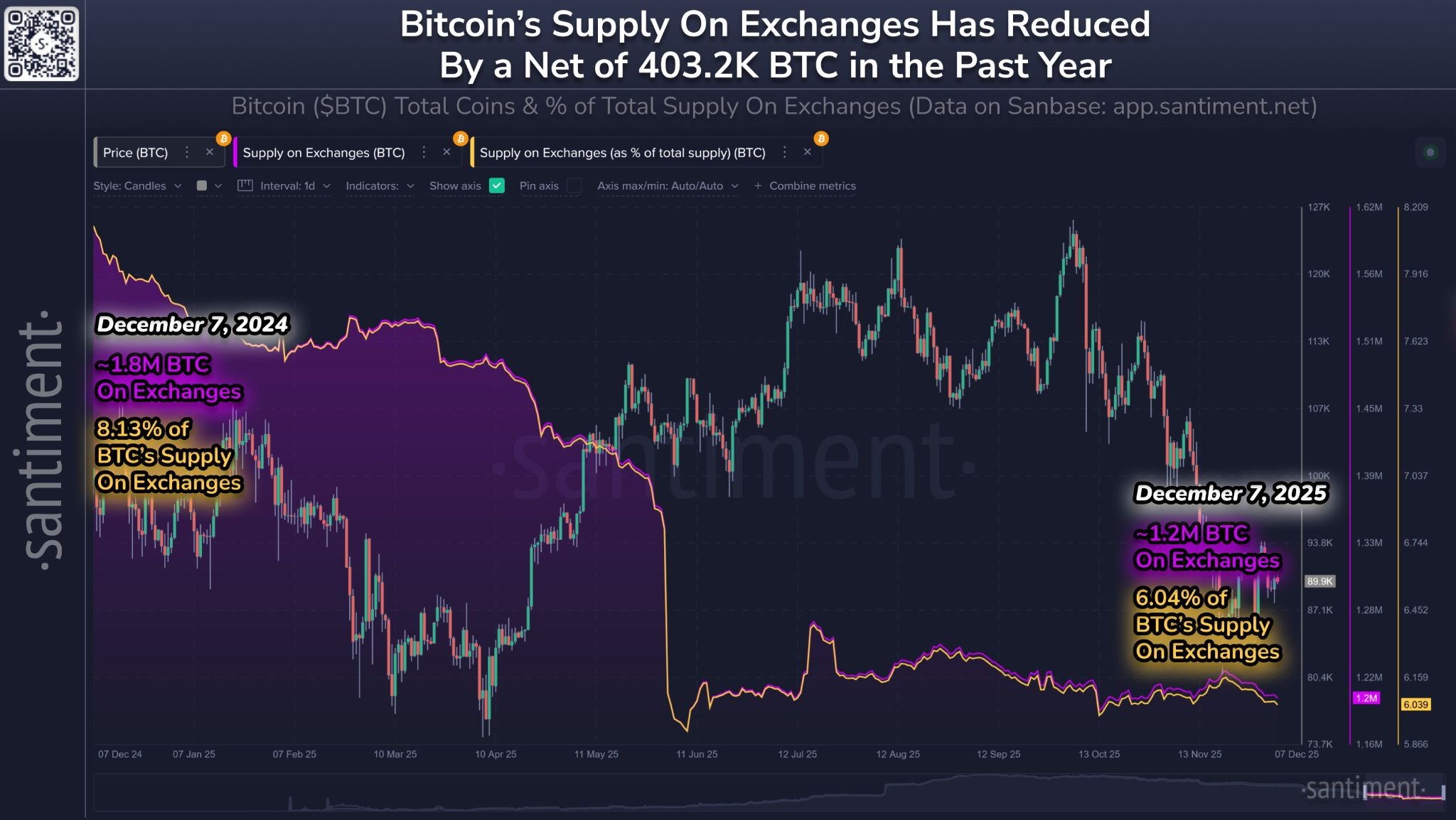
A year ago, there were around 1.8 million Bitcoin on exchanges. Source: Santiment

Bitcoin is also shifting into ETFs

While much of the Bitcoin on exchanges is likely headed back to hodler wallets, Giannis Andreou, the founder and CEO of crypto miner Bitmern Mining, said that exchange-traded funds (ETF) could also be absorbing these coins.

Citing data from BitcoinTresuries.Net, Andreou said ETFs and public companies now hold more Bitcoin than all exchanges combined, after years of outflows and ETFs quietly accumulating in the background.

Related: Strategy’s Bitcoin treasury swells past 660,000 BTC after fresh $962M buy

“Institutional ownership has quietly crossed into a new phase: less liquid supply, more long-term holders, stronger price reflexivity, a market driven by regulated vehicles, not trading platforms,” Andreou said.

“This shift is bigger than people think. Bitcoin isn’t moving to exchanges anymore. It’s moving off them straight into institutions that don’t sell easily. The supply squeeze is building in real time.”

ETFs and private companies hold more Bitcoin than exchanges

Crypto data analytics platform CoinGlass shows the same trend, with Bitcoin held on exchanges sitting at around 2.11 million as of Nov. 22, when Bitcoin was suffering through a correction and trading hands for around $84,600.
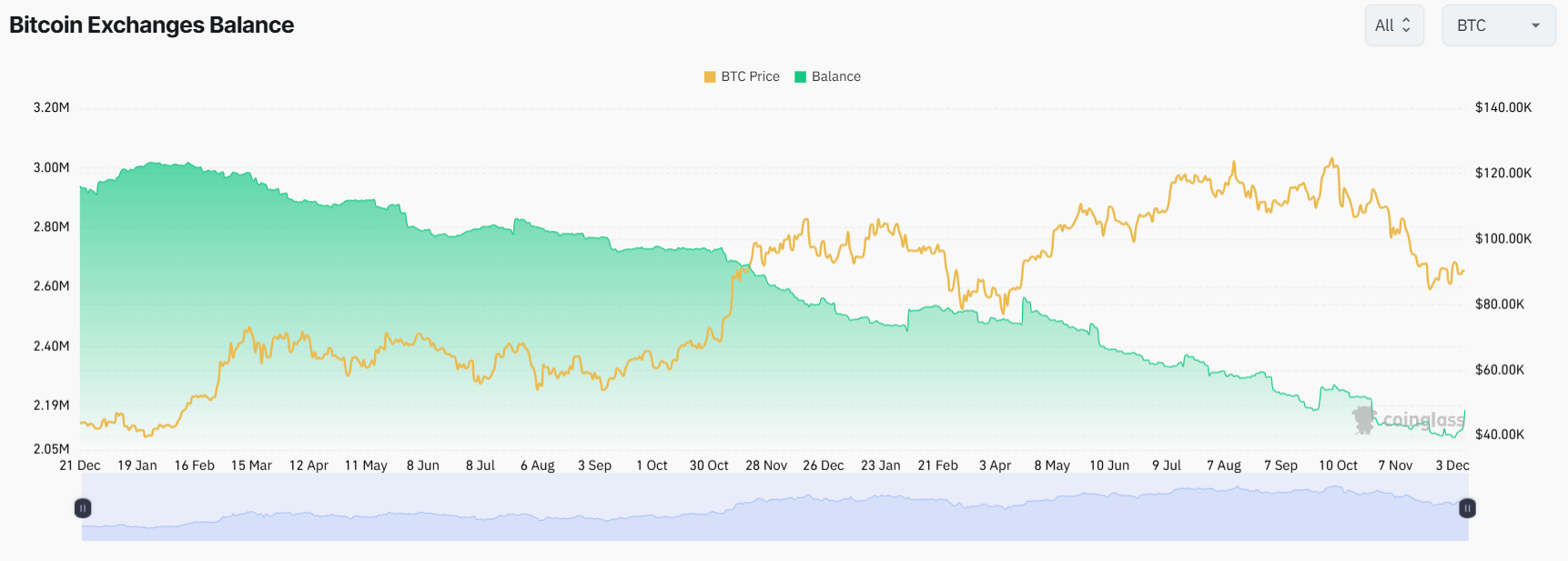
Bitcoin held on exchanges has been steadily falling over the last year. Source: CoinGlass

BitBo lists ETFs as holding over 1.5 million Bitcoin and public companies with over one million, representing nearly 11% of the total supply combined.

Magazine: Koreans ‘pump’ alts after Upbit hack, China BTC mining surge: Asia Express

Похожее

SociFi Dream Shattered? Farcaster Pivots to Bet on Wallet Track

Farcaster, a decentralized social network protocol, has announced a major strategic shift after 4.5 years, abandoning its "social-first" approach to adopt a "wallet-first" growth model. Co-founder Dan Romero acknowledged that despite initial success—such as a surge to 100,000 daily active users (DAU) in early 2024 driven by features like Frames and the DEGEN airdrop—user engagement and revenue sharply declined later that year. By October 2025, monthly revenue had dropped 99% from its peak. The platform will now prioritize building a high-quality wallet within its official app, Warpcast, focusing on the intersection of wallets and social interaction. The new user journey emphasizes wallet funding and utility as key activation points. Farcaster is also enhancing its financial infrastructure through the acquisition of token launch platform Clanker and offering incentives like a 10% reward on USDC deposits. Frames, interactive mini-apps within the social feed, enable "content as transaction" capabilities, allowing users to mint, trade, and pay directly in their feeds. Despite raising $150 million in a 2024 Series A round at a $1 billion valuation, the move has drawn criticism. Some argue it signals the end of the SocialFi dream and a return to a transaction-focused model reminiscent of the 2017 ICO era. Others note challenges in a competitive wallet market and potential feature bloat. Farcaster remains an open protocol, and users can choose alternative clients, but the shift underscores a broader industry reality: pure Web3 social networks may struggle without integrating high-value financial tools to drive user engagement and retention.

marsbitТолько что

SociFi Dream Shattered? Farcaster Pivots to Bet on Wallet Track

marsbitТолько что

12.9 Today's Market: Why the Drop? BTC\SOL\ETH\BNB\RDNT\STABLE\TRUMP\Horse to Success\bibi Trading Advice

The cryptocurrency market experienced significant volatility, with $212 million in liquidations over 24 hours, including a single $2.14 million Bitcoin liquidation on Hyperliquid. Market sentiment remains nervous, with high turnover reflecting short-term bearishness, though long-term holders remain steady. The Federal Reserve's upcoming meeting is a key focus, as interest rate decisions may influence market direction. Bitcoin’s support is near $88,100, with a potential dip to $85,200–85,900 offering a buying opportunity. Resistance is at $93,400. SOL may see support at $125.8 and $124, with potential accumulation near $120. ETH has supports at $2,955, $2,865, and $2,805, with resistance at $3,282. BNB’s key level is $898; holding above may lead to a bounce toward $939. Meme coins are highly risky, with many projects on BSC and SOL facing extreme volatility and potential scams. High-cap tokens like BIBI are relatively safer. Patience and strict stop-losses are advised. Specific tokens: - 马到成功 (Horse to Success): Accumulating near $2M market cap with strong community support. - ZEC: Showing strength, possibly entering a major upward trend if it holds key levels. - RDNT: Avoid chasing pumps—likely a temporary bounce. - TRUMP: Unlikely to rally this cycle due to locked supply; may perform in the next bull market if Trump remains politically relevant. - STABLE: Bearish due to high fully diluted valuation and lack of catalysts; consider shorting. Overall, December is to accumulate during consolidation while preserving capital for larger opportunities in Q1 2026.

金色财经9 мин. назад

12.9 Today's Market: Why the Drop? BTC\SOL\ETH\BNB\RDNT\STABLE\TRUMP\Horse to Success\bibi Trading Advice

金色财经9 мин. назад

Financial On-Chain Transformation: A Blueprint for the Overhaul of the U.S. Capital Market

The article "Financial On-Chaining: A Blueprint for the Transformation of U.S. Capital Markets" explores the potential systemic overhaul if the U.S. financial system migrates to blockchain technology, as suggested by SEC Chair Paul Atkins. It outlines seven key structural shifts: 1. Market Dynamics: Transition to T+0 settlement, enabling 24/7 trading and real-time regulatory oversight by the SEC, increasing capital velocity but eliminating traditional market buffers. 2. Banking Sector: Banks would operate with near-transparent balance sheets, reducing risks like asset-liability mismatches but potentially accelerating bank runs. Programmable collateral could unlock new financing efficiency. 3. Real Economy: Democratization of assets through fractional ownership and "micro-IPOs" for SMEs, injecting liquidity premium into U.S. assets. 4. Geopolitics: Digital reinforcement of dollar dominance via tokenized Treasuries and money market funds, attracting global capital through efficiency and transparency. 5. Risk Evolution: Systemic risks would shift from human-driven panics to technical failures (e.g., smart contract bugs, oracle manipulation), making crises faster and more technical. 6. Winners and Losers: Infrastructure builders, new asset managers, and hybrid talent would thrive; traditional intermediaries and opaque industries would decline. 7. Realistic Timeline: Full adoption in two years is unlikely due to technical, legal, and political hurdles, but gradual implementation (e.g., in Treasuries, repos) is inevitable as efficiency drives change.

比推22 мин. назад

Financial On-Chain Transformation: A Blueprint for the Overhaul of the U.S. Capital Market

比推22 мин. назад

Торговля

Спот
Фьючерсы
活动图片