Justin Sun Takes on the Role of Nobel and Decides to Award for Solving Mathematical Problems

cryptonews.ruPublished on 2026-09-22Last updated on 2026-09-22

Abstract

Justin Sun, a prominent cryptocurrency entrepreneur, has announced the launch of the "Justin Sun Prize." This initiative promises a $1 million reward for solving 66 mathematical problems, with verified solutions to be paid in USDT or USDC stablecoins. In his announcement, Sun drew a comparison to the Nobel Prize, noting its founder's controversial reputation. However, Sun did not provide proof of the existence of the $66 million prize fund required for the rewards. He stated the wallet address would be made public for verification and that he could only add to, not withdraw from, the fund. This announcement comes amidst recent controversies surrounding Sun, including a scandal involving a failed surrogacy arrangement with actress Jing Tian and a lawsuit against the Trump family concerning frozen investments in World Liberty Financial worth $544 million. For observers of Sun's media and crypto ventures, the pattern of announcing high-profile initiatives without immediate substantiation is familiar. The situation currently presents a declared concept with attracted interest, but without a visible fund or tangible rewards.

Recently, Justin Sun recently announced the launch of his new initiative, the "Justin Sun Prize," which offers a $1 million reward to those who can solve 66 mathematical problems and verify the correctness of their solutions.

As usual, Justin Sun did not provide any evidence of the existence of a $66 million fund from which he would pay out the rewards.
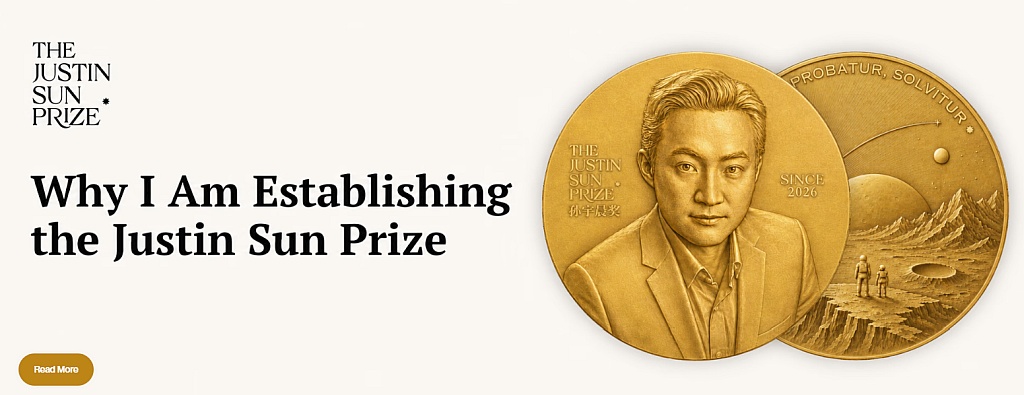
The cryptocurrency entrepreneur wrote about the competition on social media and immediately compared it to the Nobel Prize. At the same time, he reminded that Alfred Nobel established his award after he was dubbed the "merchant of death."

Justin Sun did not explain whether he fears for his own reputation, although he recently found himself at the center of a scandal related to a failed surrogacy involving Chinese actress Jing Tian. Interestingly, in this dispute, the public in mainland China sided with the actress.

In addition, in August, Sun filed a lawsuit against the Trump family over the blocking of personal investments in the World Liberty Financial project. The company explained the freezing of funds as a violation of rules, while their opponent sees no fault on their part. Recall that we are talking about WLFI tokens worth $544 million.

Returning to the competition, according to its terms, winners will receive payments in stablecoins $USDT or $USDC. At the same time, Sun wrote that he can only replenish the prize fund, but not withdraw funds from it. He also promised to make the prize fund wallet address available for verification to anyone interested.

So, what we have is: the initiative has been announced, interest has been attracted, the fund is absent, as is the reward. For those who follow Justin Sun's steps in the media space and crypto sector, the situation does not seem unexpected.

end-content

Trending Cryptos

Related Questions

QWhat is the main announcement made by Justin Sun in the article?

AJustin Sun announced the launch of the 'Justin Sun Prize,' offering a total of $1 million in rewards for solving 66 mathematical problems.

QAccording to the article, what is a major point of skepticism regarding the Justin Sun Prize?

AA major point of skepticism is that Justin Sun did not provide any proof of the existence of a $66 million fund from which the rewards are supposed to be paid.

QHow did Justin Sun compare his new prize initiative?

AHe immediately compared it to the Nobel Prize, while also noting that Alfred Nobel established his award after being labeled a 'merchant of death.'

QWhat recent controversies involving Justin Sun are mentioned in the article?

AThe article mentions two recent controversies: a scandal involving a canceled surrogacy arrangement with Chinese actress Jing Tian, and a lawsuit filed by Sun against the Trump family concerning the blocking of investments in World Liberty Financial and $544 million worth of WLFI tokens.

QIn what form will the prizes for the mathematical competition be paid, and what did Sun promise regarding the prize fund?

AThe prizes will be paid in the stablecoins USDT or USDC. Sun promised to make the prize fund wallet address publicly available for verification by anyone, stating he could only add to the fund, not withdraw from it.

Related Reads

Aave V3.8 Officially Launches: Covering 15 Public Chains, $15.2 Billion Liquidity Pool, Introducing Low-Gas-Cost Reentrancy Protection

Aave has launched V3.8 across 15 active V3 markets, following approval by the Aave DAO and development by Aave Labs. According to DeFiLlama, Aave's total value locked exceeds $16.4 billion, with active V3 markets holding over $15.23 billion. The upgrade was deployed via AIP #541, completing a 22-day governance process that began with a forum proposal on October 21 and a Snapshot vote on October 27. V3.8 covers active instances on Ethereum (Core and Lido), Plasma, Avalanche, BNB Chain, Monad, Base, and Arbitrum, along with Mantle, X Layer, Polygon, Linea, Optimism, Gnosis, MegaETH, and Celo. Legacy markets that were frozen with zero caps were deliberately skipped. The release introduces kernel-level reentrancy protection for external callback operations on liquidity pools. Traditionally, preventing cross-function reentrancy requires writing a lock flag before state changes, but after EIP-3529 capped SSTORE refunds at 20%, maintaining persistent locks in high-frequency lending pools became gas-intensive. V3.8 instead uses EIP-1153 transient storage, where TSTORE and TLOAD cost only 100 gas per read or write and automatically clear at transaction end, providing reentrancy hardening at minimal cost. Aave Labs addressed developer concerns that the lock might block liquidation composability within flash loan callbacks. The flashLoan and flashLoanSimple entry points only check the lock status without setting it, creating asymmetric isolation: users can still compose liquidations, deposits, or repayments inside a flash loan callback, but attempts to initiate a flash loan from within a regular pool operation callback are rejected and reverted. Security verification included Certora formal verification and independent external audits before the AIP vote. The new contract code is published in the official Aave V3 repository under the Business Source License. Developers also noted that downstream integrators reading view functions such as account health factors or reserve data during callbacks should account for intermediate ledger states and ensure peripheral risk controls remain compatible.

marsbitJust now

Aave V3.8 Officially Launches: Covering 15 Public Chains, $15.2 Billion Liquidity Pool, Introducing Low-Gas-Cost Reentrancy Protection

marsbitJust now

The real estate company that went bankrupt and pivoted to chips is now preparing to hand over its hotels to Huazhu?

A bankrupt Chinese property developer that pivoted to semiconductors is quietly returning to the hotel business through a joint venture with Huazhu Group. The new company, Huaying New Hotel Management (Guangzhou), was registered with 5 million yuan in capital, split 70/30 between Huazhu and Yingxin Development, formerly New Hualian Cultural Tourism. Its address matches the building housing the Guangzhou Tianhe Sports Center Mercure and Ji Hotel—both underlying assets of the recently closed Huatai Zijin Huazhu Anzhu REIT. Huazhu's former deputy CFO Ye Fei has also returned as CIO, overseeing asset securitization and real estate investment and operations. New Hualian once invested nearly 30 billion yuan in cultural tourism and operated 16 hotels with 5,339 rooms at its 2022 peak, but excessive diversification and heavy asset exposure led to a liquidity crisis. It entered judicial restructuring in 2022, completed a plan resolving 87.7 billion yuan in debt by June 2025, changed its name to Yingxin Development, shed property assets, and acquired a semiconductor packaging and testing firm. Its hotel management arm was even renamed as a semiconductor technology company in July, dropping "hotel management" from its name entirely. Several hotel assets have since been sold off or closed, including the Yinchuan Ruijing and Shanghai Sofitel, the latter failing twice at auction after its price dropped from 1.8 billion to 798 million yuan. The joint venture likely serves as a light-asset management platform to revitalize Yingxin's remaining hotel and tourism properties using Huazhu's brands, systems, supply chain, and membership channels, while preserving a path to exit via REITs. It echoes Huazhu's 2021 venture with Sunac, which took over management of 22 hotels, though Huazhu now holds a larger 70% stake and is expected to have more say. Huazhu operates 13,539 hotels across 21 countries with over 1.33 million rooms, but lacks well-located, bulk-available quality existing properties. Franchise expansion is slow and new builds are increasingly uneconomical, making aging hotels, idle offices, and scenic-area properties held by developers and local SOEs attractive targets. Huazhu has partnered with several developers and, half a year ago, agreed with Guangzhou state capital to build 300 hotels, covering asset revitalization, cultural tourism, hotel management, and securitization. Its Huazhu Anzhu REIT, the Shenzhen Stock Exchange's first hotel commercial property REIT and China's first sponsored by a private hotel group, raised about 1.1645 billion yuan. In the first half of 2026, Huazhu's management and franchise revenue exceeded 50% of total revenue for the first time, becoming its largest income source, marking its shift from heavy-asset self-operation to an asset-light model. As hotel property REITs scale up—with offerings from Huazhu, Jinjiang, New Century, and Fosun—developers burdened by high debt and low or negative operating cash flow are increasingly turning to established hotel managers. The next competitive frontier will be operating complex existing assets, matching the right operating capability to each asset type, and generating sustainable cash flow that enables exit and value appreciation.

marsbit33m ago

The real estate company that went bankrupt and pivoted to chips is now preparing to hand over its hotels to Huazhu?

marsbit33m ago

Trading

Spot

Hot Articles

How to Buy SUN

Welcome to HTX.com! We've made purchasing SUN (SUN) simple and convenient. Follow our step-by-step guide to embark on your crypto journey.Step 1: Create Your HTX AccountUse your email or phone number to sign up for a free account on HTX. Experience a hassle-free registration journey and unlock all features.Get My AccountStep 2: Go to Buy Crypto and Choose Your Payment MethodCredit/Debit Card: Use your Visa or Mastercard to buy SUN (SUN) instantly.Balance: Use funds from your HTX account balance to trade seamlessly.Third Parties: We've added popular payment methods such as Google Pay and Apple Pay to enhance convenience.P2P: Trade directly with other users on HTX.Over-the-Counter (OTC): We offer tailor-made services and competitive exchange rates for traders.Step 3: Store Your SUN (SUN)After purchasing your SUN (SUN), store it in your HTX account. Alternatively, you can send it elsewhere via blockchain transfer or use it to trade other cryptocurrencies.Step 4: Trade SUN (SUN)Easily trade SUN (SUN) on HTX's spot market. Simply access your account, select your trading pair, execute your trades, and monitor in real-time. We offer a user-friendly experience for both beginners and seasoned traders.

10.9k Total ViewsPublished 2024.03.29Updated 2026.06.02

How to Buy SUN

Discussions

Welcome to the HTX Community. Here, you can stay informed about the latest platform developments and gain access to professional market insights. Users' opinions on the price of SUN (SUN) are presented below.

活动图片