The Commodity Futures Trading Commission’s (CFTC) Market Participants Division has extended a no-action position to providers of passive cryptocurrency trading software, exempting them from registering as brokers, two days after the Senate blocked the CLARITY Act.
The relief measures are outlined in CFTC Staff Letter No. 26-25, signed by Division Director D.J. Hennes. Staff stated they would not recommend enforcement action against eligible software providers for not registering as introducing brokers, nor against their personnel for not registering as associated persons of an introducing broker.
Similar relief was granted in March to a single company, Phantom Technologies. However, that position was specific to Phantom.
Other developers seeking similar protection had to submit their own requests. The latest CFTC Staff Letter No. 26-25 removes this limitation, offering relief on substantially the same terms to any passive software provider meeting the stated conditions.
Where is the Line Between Software and Broker?
The relief applies only to software that passively connects users to regulated markets. The provider can create and provide interfaces allowing users to check market data, view products, and send orders directly to registered platforms. It can also integrate this into a self-custody wallet.
The protection vanishes when brokerage activity enters the picture. Under these conditions, the service provider cannot decide how to route or execute an order. It cannot give explicit buy or sell signals and cannot hold user funds.
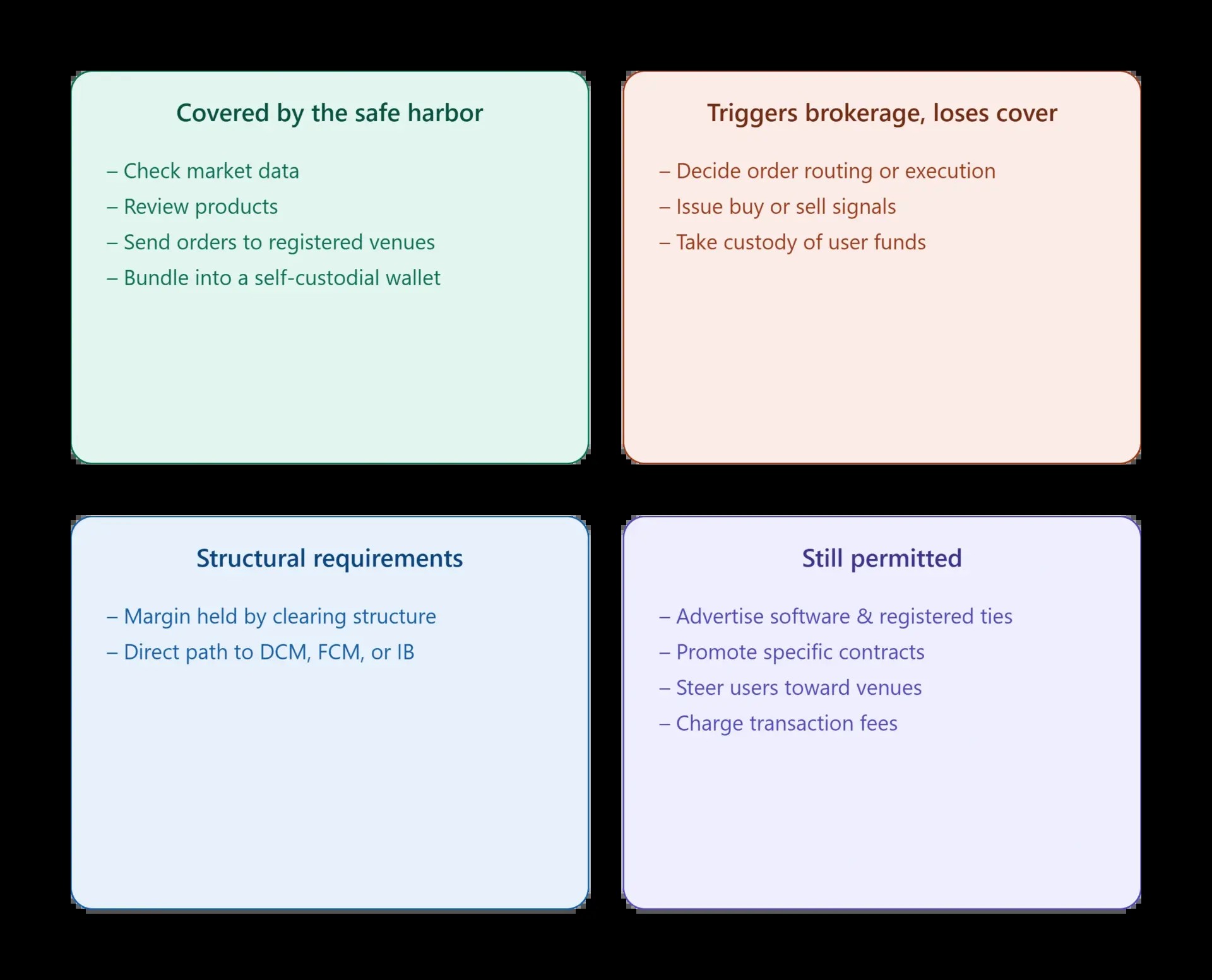
Funding for derivatives positions must be held by a clearing structure, not the software developer. Users must be able to contact the designated marktrac, futures commission merchant, or introducing broker without going through the software.
Authorized providers can advertise their software and its connections to registered firms. They can also promote specific derivative tracs and direct users to specific platforms. They can charge fees to registered counterparties and pay users per transaction.
Ten Conditions and One Caveat
The CFTC staff letter details ten types of permitted activities and their limitations. Among these, the service provider and its primary counterparty must not be disqualified under the law.
Service providers are required to disclose conflicts of interest and fee amounts, and retain proof that users reviewed risk information. Furthermore, they must have written agreements with each registered partner covering joint liability.
Providers are also obligated to notify the CFTC of any insolvency and to file a notice submitting to the agency’s jurisdiction.
However, there is a significant caveat: this position comes from the Market Participants Division. It states that it "does not necessarily reflect the position or view of the Commission or any other division or office of the Commission." Therefore, it is not binding on the CFTC.
The letter noted that the Division retains the discretion to modify, suspend, or terminate the relief. It added that it would become void if the CFTC ever issues formal guidance on how broker registration applies to software developers.
CFTC Chairman Michael Selig stated in May at the Consensus Miami conference that he wanted to formalize the Phantom position into a rule, calling the process "crawl, walk, run." To date, those rules have not been adopted.
An Interim Solution in Case CLARITY Stalls
The staff letter came about two days after the U.S. Senate rejected a cloture motion on the Digital Asset Market CLARITY Act by a vote of 49 to 50, eleven votes short of the required 60.
Among those voting against were four Republicans, and no Democrats voted in favor.
In response to the vote, Selig stated that the outcome was unfortunate. He wrote in his post on X: "Americans deserve regulatory clarity, legal certainty, and consumer protection in crypto asset markets."
He stated that the CFTC is fully committed to helpingdent Trump fulfill his promise of creating a "future-proof framework for crypto asset market regulation," writing: "One way or another, we will help get the job done, using our existing legislative authority."
The Securities and Exchange Commission (SEC) made a move on the same day, issuing a long-awaited exemption for innovation projects. Uniswap founder Hayden Adams pointed to an accompanying statement by SEC Commissioner Hester Peirce, quoting her saying that "Truly decentralized systems governed by autonomous software... do not need an exemption."