Anthropic Introduces Claude Fable 5.1 and Mythos 5.1: System Prompt Already Leaked Online

cryptonews.ruОпубликовано 2026-09-02Обновлено 2026-09-02

Введение

On September 1st, Anthropic released Claude Fable 5.1, an updated version of the Fable 5 model, alongside its counterpart Claude Mythos 5.1, which features a different set of restrictions. Both models share the same architecture but serve different purposes: Fable 5.1 is designed for complex coding, intellectual tasks, and long-running agent processes, while Mythos 5.1 is exclusive to trusted access program participants. According to company data, Fable 5.1 demonstrated significant performance gains on agent and scientific benchmarks compared to its predecessor and the competing GPT-5.6 Sol model. Pricing remains at $10 per million input tokens and $50 per million output tokens, with a reduced cache reading cost. The model's context window is 1M tokens. Anthropic showcased Fable 5.1's scientific capabilities by using it to create a new, more detailed topographic map of Venus from decades-old NASA Magellan mission data, releasing it under a Creative Commons license. Shortly after the release, the model's extensive system prompt (exceeding 270,000 characters) was extracted and published online on GitHub. Fable 5.1 is accessible via the Claude API and major cloud platforms, whereas Mythos 5.1 remains restricted. The release marks the second major update for the Fable and Mythos lines since their launch in June 2026. The article concludes by noting the regulatory context, referencing a temporary U.S. export restriction on these models in June 2026 and pondering whether such s...

On September 1st, Anthropic introduced Claude Fable 5.1 — an updated version of the Fable 5 model — along with a parallel variant, Claude Mythos 5.1, featuring a different set of constraints. Both models are built on the same architecture but are intended for different scenarios: Fable 5.1 is aimed at complex tasks in coding, intellectual work, and extended agentic processes, while Mythos 5.1 is available only to participants in trusted access programs.

Improved Performance on Benchmarks

According to the company, Fable 5.1 demonstrated a noticeable performance improvement on agentic and scientific tests compared to its predecessor and the competing model GPT-5.6 Sol:

  • Terminal-Bench-Science 0.1 — 52.6% vs. 24.7% for Fable 5 and 22.4% for GPT-5.6 Sol

  • Terminal-Bench 4.0 — 55.8% for Fable 5.1 and 60.9% for Mythos 5.1 vs. 42.0% for Fable 5 and 37.3% for GPT-5.6 Sol

  • GDPval-AA v2 — 1853 points vs. 1723 for Fable 5
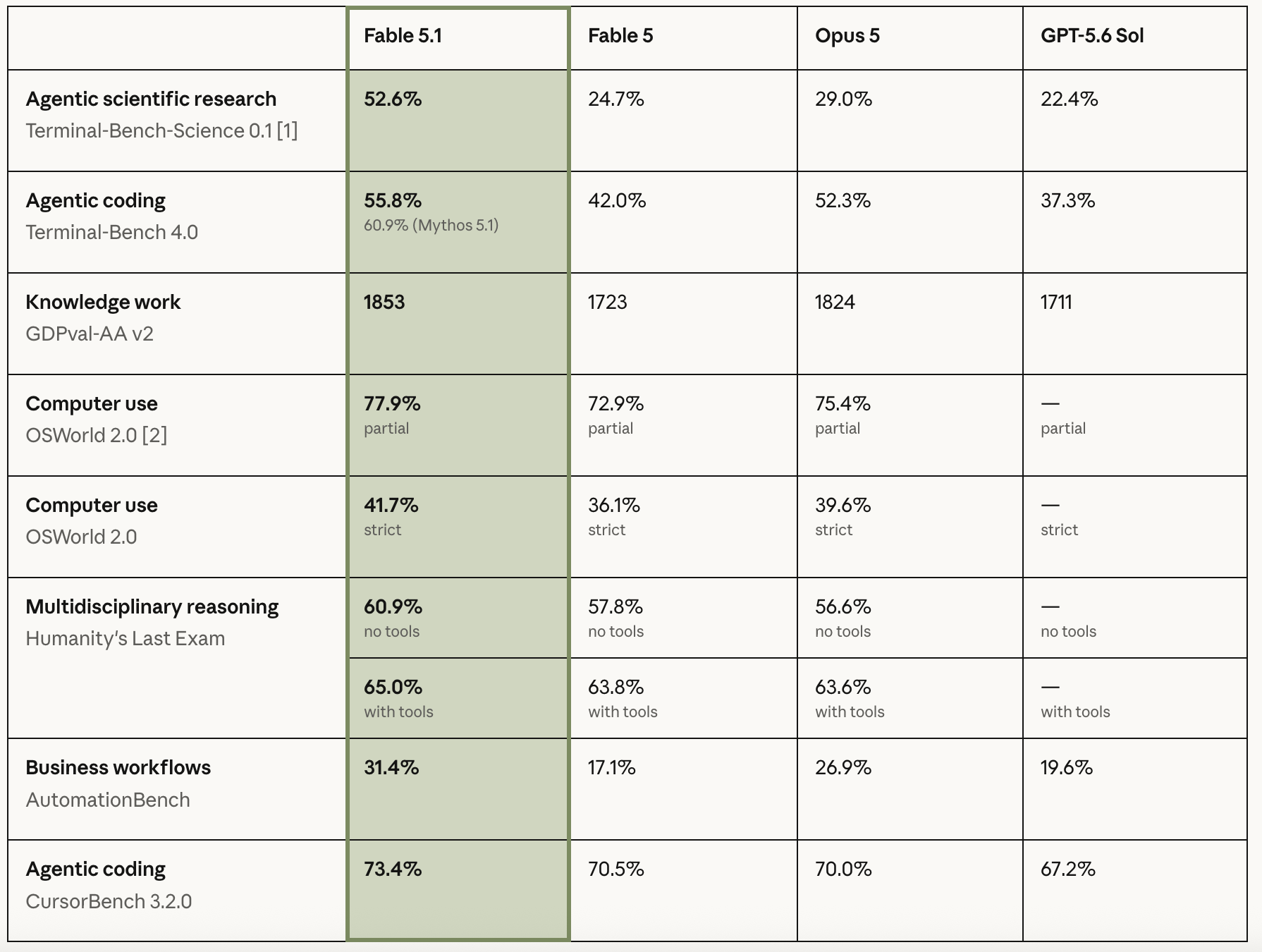
Fable 5.1 testing data

The base cost for using the model remains unchanged — $10 per million input tokens and $50 per million output tokens. However, Anthropic reduced the price for cache reads to $0.25 per million tokens, which, according to the company's estimates, saves about 25% on typical workloads and up to ~45% on agentic scenarios. The model's context window reaches 1M tokens, and the maximum response length is limited to 128K tokens.

Venus Map as a Demonstration of Capabilities

In the announcement, Anthropic provided a telling example of the model's use in science: Fable 5.1 trained a neural network and constructed a new topographic map of approximately one-third of Venus's surface. The work was based on over-30-year-old radar data from NASA's Magellan mission and an existing partial map of the planet. As a result, the resolution improved from 10–20 km to 2–3 km, and the accuracy of elevation measurements increased to 25%. The company released the finished map under a Creative Commons license.

System Prompt Leaked into the Open

Almost immediately after the release, Fable 5.1's system prompt — the document that defines the model's behavior rules, memory handling, tool usage, artifacts, computer use, and request routing — surfaced online. According to September 2nd posts on social media platform X, its size exceeds 270,000 characters. The file was extracted and published in a GitHub repository (Anthropic section, file claude-fable-5.1.md, updated September 1st). One example discussion of the find was posted by a user on X.

Where the Model is Available

Fable 5.1 can be invoked via the Claude API under the identifier claude-fable-5-1, as well as through Amazon Bedrock, Google Cloud, and Microsoft Foundry. Mythos 5.1 remains a restricted version — access is only open to participants in trusted access programs.

This release is the second major update to the Fable and Mythos line since their initial launch in June 2026. The main changes affected pricing, the speed of solving long agentic tasks, and accuracy on scientific benchmarks, while the core model architecture remained the same.

AI Perspective

From a machine data analysis perspective, the story with Fable and Mythos writes the second episode of regulatory risk this year: in June 2026, the U.S. Department of Commerce temporarily restricted access to these models, citing national security risks, and only lifted the ban three weeks later. The technical gains on benchmarks and the almost simultaneous leak of the system prompt exist within the same context: the more powerful and "chatty" a model becomes, the closer the scrutiny from regulators and security researchers on its internal architecture. On a macroeconomic level, this cycle of "ban–lift" adds an element of uncertainty for corporate clients choosing an AI infrastructure provider, comparable to sanction risks in the semiconductor industry. Will such turbulence remain a one-off episode or become a regular practice for the most powerful AI models?

Связанные с этим вопросы

QWhat are the two new AI models released by Anthropic, and what are their primary intended use cases?

AAnthropic released Claude Fable 5.1 and Claude Mythos 5.1. Fable 5.1 is aimed at complex coding, intellectual labor, and long-running agent processes. Mythos 5.1 is only available to members of trusted access programs.

QHow did Claude Fable 5.1 perform on the Terminal-Bench-Science 0.1 benchmark compared to its predecessor and a competing model?

AOn the Terminal-Bench-Science 0.1 benchmark, Claude Fable 5.1 achieved a score of 52.6%, compared to 24.7% for Fable 5 and 22.4% for the competing GPT-5.6 Sol.

QWhat is the pricing and context window specification for Claude Fable 5.1?

AThe base usage cost is $10 per million input tokens and $50 per million output tokens. The context window is 1 million tokens, with a maximum response length of 128K tokens.

QWhat significant scientific project did Anthropic use to demonstrate Fable 5.1's capabilities, and what were the improvements?

AAnthropic used Fable 5.1 to create a new elevation map of about one-third of Venus's surface, improving detail resolution from 10-20 km to 2-3 km and increasing height measurement accuracy to 25%.

QWhat happened to the Claude Fable 5.1 system prompt shortly after release, and where was it published?

AThe system prompt, a document over 270,000 characters long that defines the model's behavior rules, was extracted and published in a GitHub repository in the Anthropic section (file claude-fable-5.1.md).

Похожее

Blockchain.com стремится получить одобрение CFTC для прогнозных рынков: CNBC

Криптовалютная биржа Blockchain.com подала заявку в Комиссию по торговле товарными фьючерсами США (CFTC) на получение двух лицензий: как регулируемая биржа для рынков прогнозов (событийных контрактов) и как брокер для криптодеривативов. Это позволит компании предлагать собственные прогнозные рынки наряду с планами по интеграции партнёра Polymarket. Вопрос регулирования таких платформ, включая Kalshi и Polymarket, сейчас оспаривается в судах штатов, обвиняющих их в нарушениях законов о ставках. Компания также рассматривает возможность IPO с оценкой до $6 млрд. Одновременно председатель CFTC Майкл Селиг обосновал необходимость регулирования крипторынка через ведомственные правила, а не законы Конгресса, ссылаясь на крах биржи FTX. Он заявил, что новые правила призваны защитить средства клиентов. Селиг, остающийся единственным комиссаром агентства, заявляет о своей юрисдикции над рынками прогнозов и намерении реализовать крипто-повестку администрации Трампа.

cointelegraph43 мин. назад

Blockchain.com стремится получить одобрение CFTC для прогнозных рынков: CNBC

cointelegraph43 мин. назад

Zcash нанимает вашингтонского лоббиста для продвижения политики в сфере криптовалют

Ассоциация Pretty Good Policy for Zcash (PGPZ), занимающаяся защитой интересов приватной криптовалюты Zcash, официально зарегистрировала лоббистскую деятельность в Вашингтоне. Цель инициативы — организованное и авторитетное участие в формировании политики США в отношении цифровых активов, чтобы защитить будущее ориентированных на конфиденциальность технологий. Исполнительный директор Divij Pandya зарегистрирован как единственный лоббист. В фокусе внимания PGPZ находятся такие вопросы, как Закон о ясности рынка цифровых активов и предложения по налогообложению криптовалют. Группа, созданная в июне 2024 года, продолжает работу более широкой инициативы Pretty Good Policy for Crypto. В августе сообщество Zcash выделило грант в размере 750 000 долларов для финансирования первого года работы PGPZ. Как заявил основатель Paul Brigner, важно обеспечить, чтобы Zcash был правильно понят, представлен и защищён в дискуссиях, где принимаются решения о законности и полезности приватных цифровых денег.

cointelegraph1 ч. назад

Zcash нанимает вашингтонского лоббиста для продвижения политики в сфере криптовалют

cointelegraph1 ч. назад

Торговля

Спот
活动图片