Just now, Anthropic has launched the new generation models Claude Fable 5.1 and Claude Mythos 5.1.
Anthropic claims that Claude Fable 5.1 is currently one of the most powerful publicly available models, designed for complex reasoning, long-cycle tasks, and Agent workflows. Claude Mythos 5.1, on the other hand, represents the higher boundary of their exploration.
It is important to note that while both share the same foundational model capabilities, they employ different safety measures tailored for different usage scenarios.
Fable 5.1 is open to general users, developers, and enterprises. Mythos 5.1 is available to vetted partners in high-risk fields, maintaining stricter access controls.
In other words, one is tasked with entering the real world to work, while the other is kept in a more strictly controlled environment. This might also be Anthropic's exploration of a future AI product form: the most powerful model may not be provided to everyone in the same form.
Officially, they state that these two models represent significant progress in the Claude series' capabilities and demonstrate how they continue to advance safe deployment while enhancing model performance.

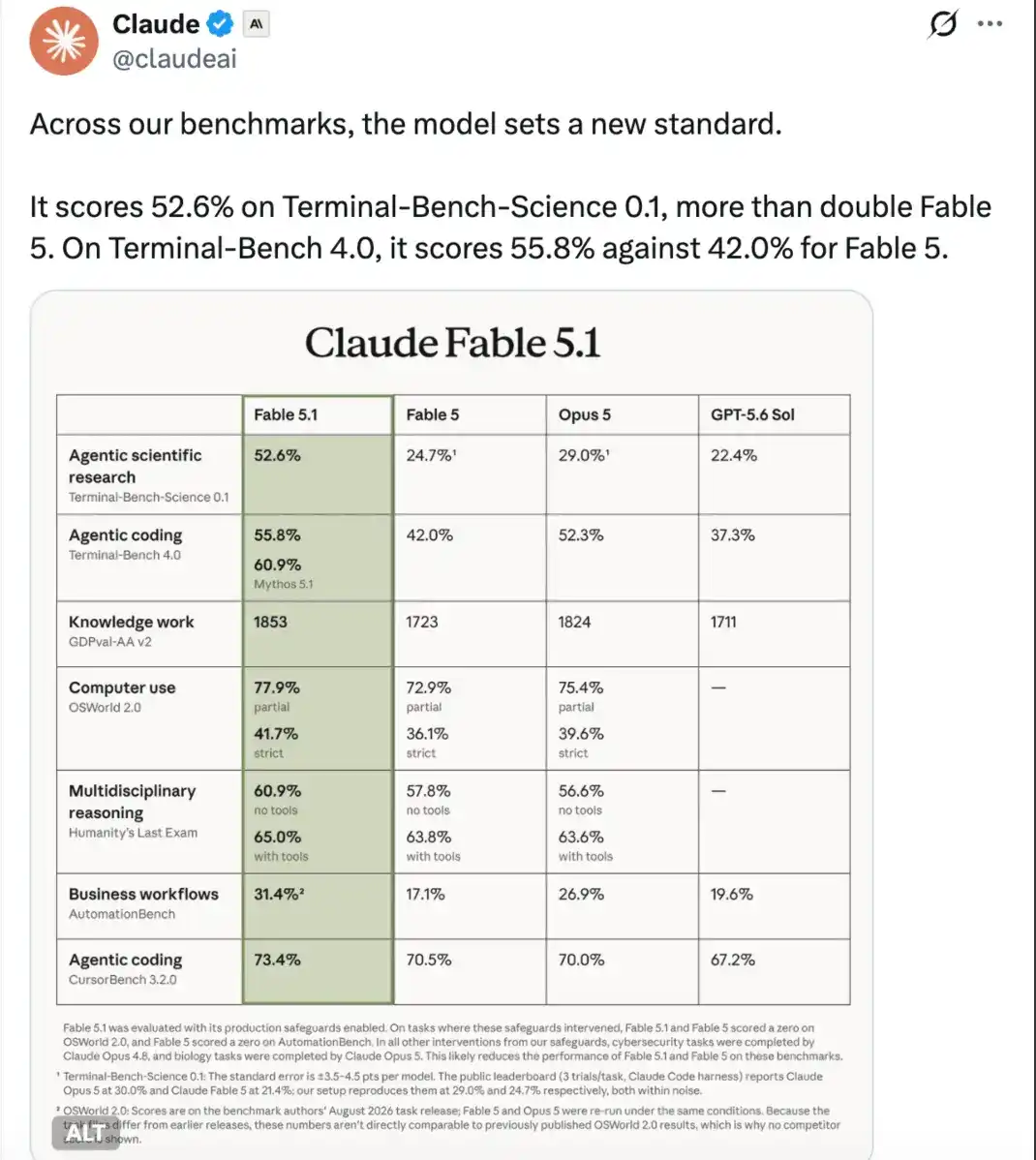
As the "world's most powerful" model, Fable 5.1's performance remains impressive. Official data shows that Fable 5.1 outperforms the previous flagship Fable 5 in multiple benchmark tests.
But with greater power comes a cheaper price. Anthropic states that Fable 5.1 maintains the same base price, while cache read costs are reduced by 75% compared to Fable 5. In practical use, this reduces the overall cost of the model by about 25% for typical workloads; for highly agentic workloads, costs can be reduced by up to 45%.
It seems even the most powerful models are now emphasizing cost-effectiveness.
Let's take a closer look.
Lower Tiers Match the Previous Generation, Fable 5.1 Focuses on "Cost-effectiveness"
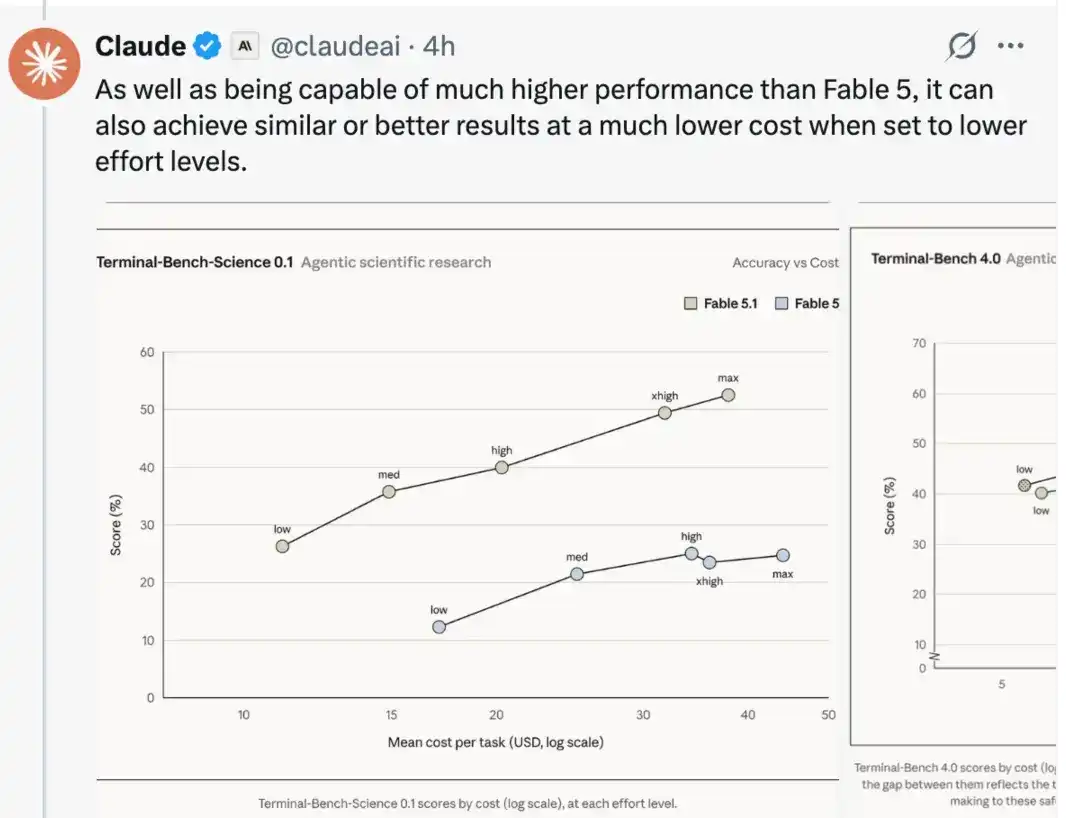
Compared to simply topping the leaderboards, Anthropic this time emphasizes more: Fable 5.1 can complete tasks that previously required Fable 5's higher inference tiers at lower inference costs.
According to official tests, Fable 5.1 at low and medium inference strengths can already achieve performance close to or even surpassing Fable 5. Claude Code defaults to high inference strength, while Claude Cowork and Claude . ai default to medium strength. Users can also adjust between speed, cost, and effectiveness based on task complexity.
Specifically, Fable 5.1 achieved 52.6% on the scientific research-oriented Agent benchmark Terminal-Bench-Science 0.1, more than double the 24.7% of Fable 5; on Terminal-Bench 4.0, Fable 5.1 reached 55.8%, and Mythos 5.1 with more capabilities unlocked further reached 60.9%.
In knowledge work, computer operations, and business process tests, the new models also show improvements. AutomationBench scores increased from 17.1% for Fable 5 to 31.4%, and CursorBench 3.2.0 improved from 70.5% to 73.4%.
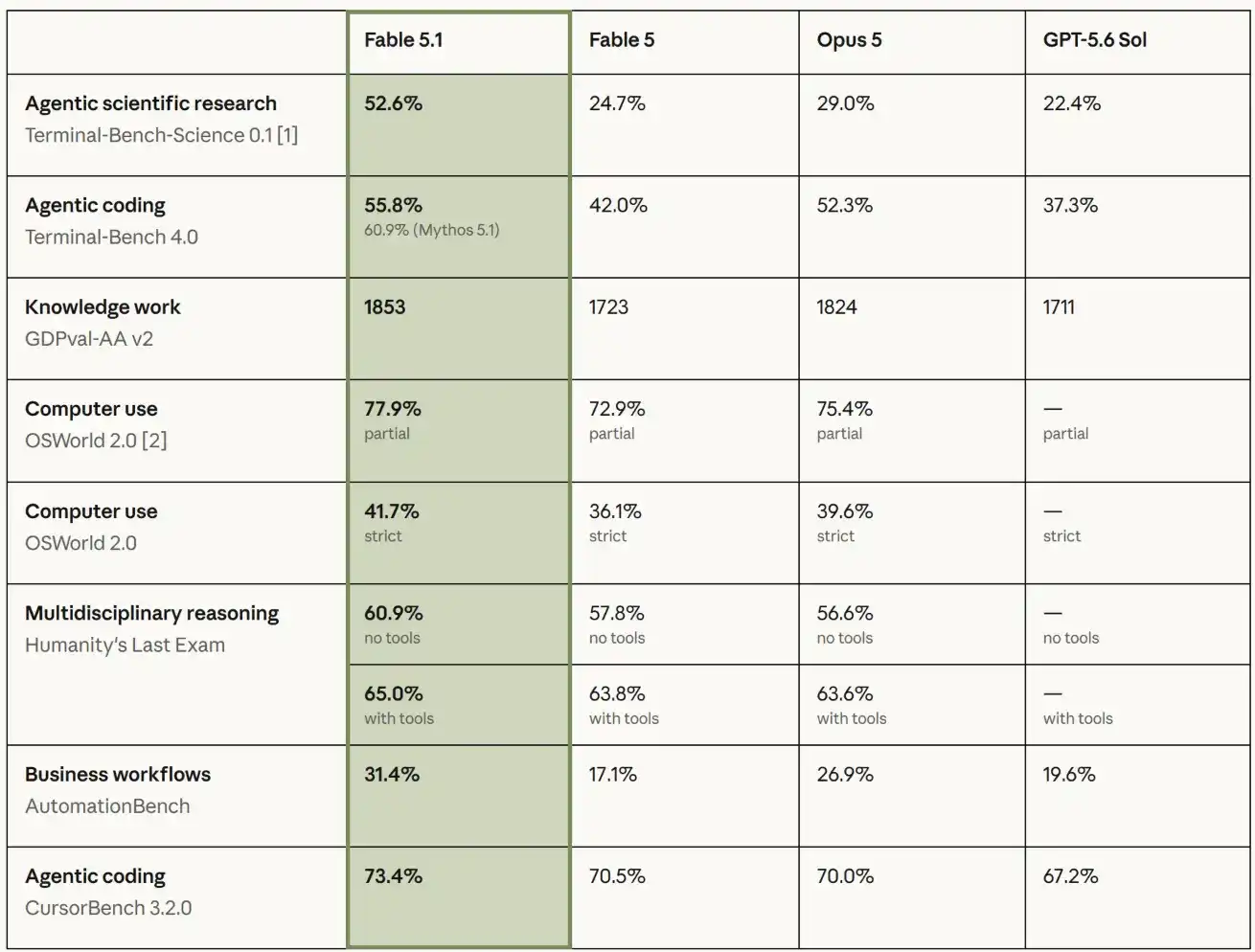
In multiple benchmark tests, Fable 5.1's scores surpassed Fable 5, with the most significant improvements in scientific research Agent and business workflow capabilities.
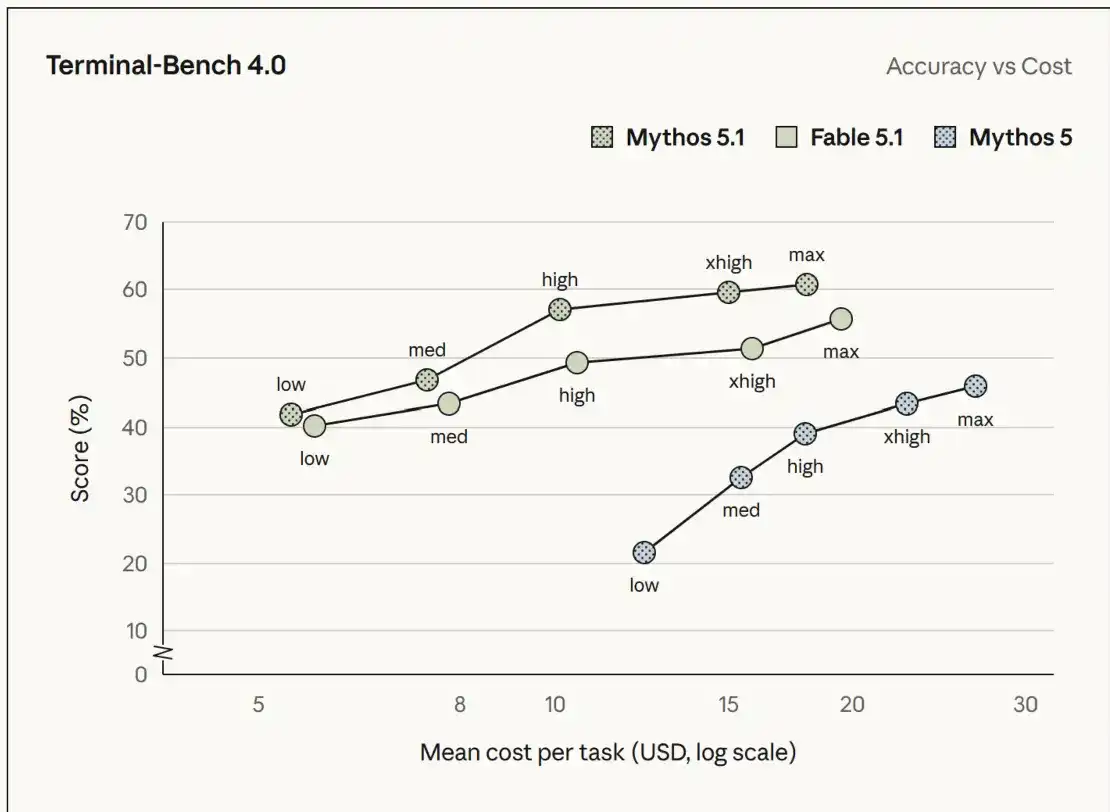
In the Terminal-Bench 4.0 test, both Fable 5.1 and Mythos 5.1 exceeded the previous generation Mythos 5 at different inference strengths.
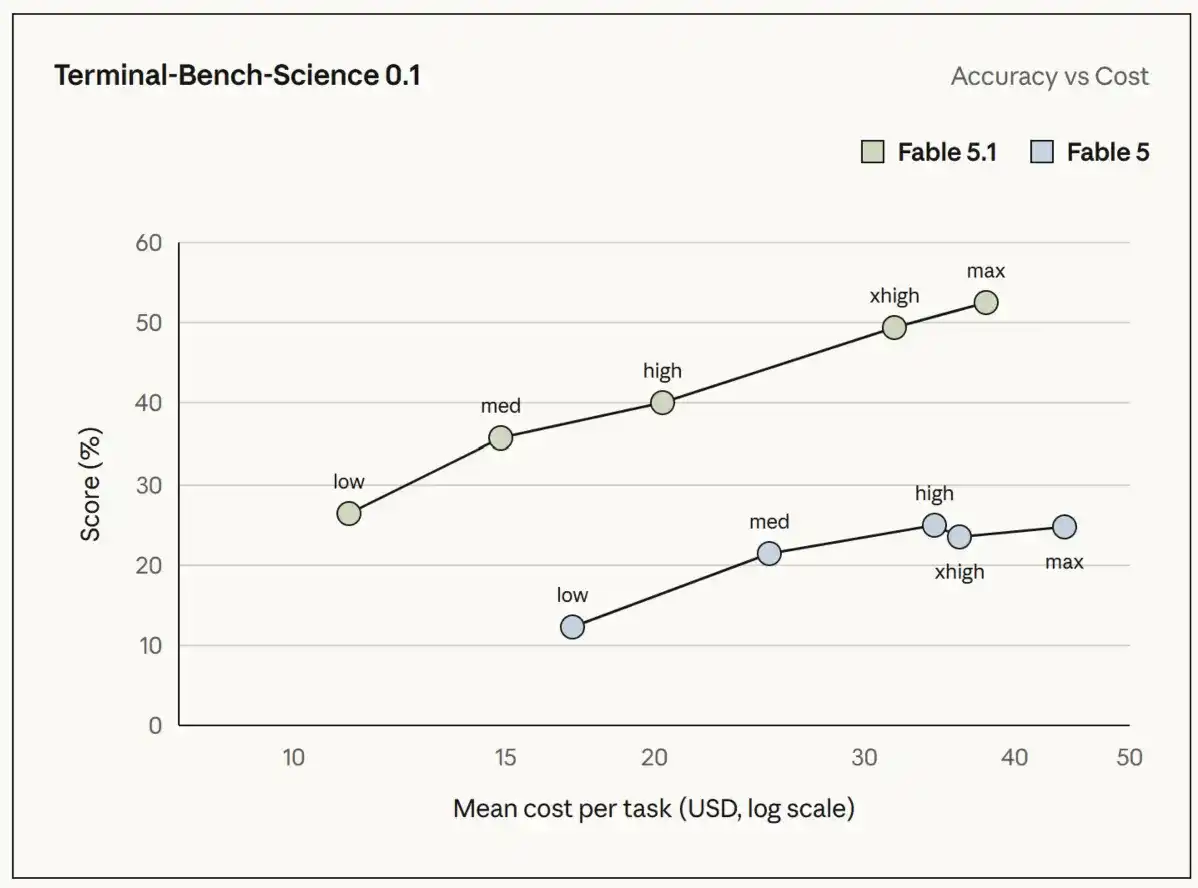
In the Terminal-Bench-Science 0.1 test, Fable 5.1's highest score reached 52.6%, more than double that of Fable 5.
Anthropic believes an important change in Fable 5.1 is its greater willingness to track the root causes of problems, making it more suitable for executing complex tasks lasting hours or even tens of hours.
Investment firm Millennium discovered during testing that an internal piece of code would crash about once every million runs. This problem had troubled the engineering team for four or five years, and other models couldn't find the cause. Fable 5.1, however, by disassembling an external vendor's library and comparing core dump files, ultimately pinpointed the issue to a bug in the third-party library.
Ramp also had Fable 5.1 run continuously for 38 hours. After discovering that original machine learning results were affected by labeling errors, the model corrected the problem, launched six sets of experiments, and finally compiled new results and follow-up recommendations.
From Writing Code to Conducting Scientific Research
In this release, Anthropic dedicates considerable space to introducing the performance of Fable 5.1 and Mythos 5.1 in scientific research.
In a protein design experiment, researchers had Mythos 5.1 call open-source protein design and folding tools, then sent the generated designs to two external institutions for experimental validation.
On three target proteins, the affinity of the binders designed by Mythos 5.1 was 10 times that of the best solutions in the Adaptyv Bio related protein design competition. When targeting 12 proteins, the model's effective binder hit rate approached 50%, while Anthropic cites the common industry level as 10% to 15%.
Fable 5.1 also used radar images collected over 30 years ago by NASA's Magellan probe to generate a new high-resolution elevation map for about one-third of Venus's surface.
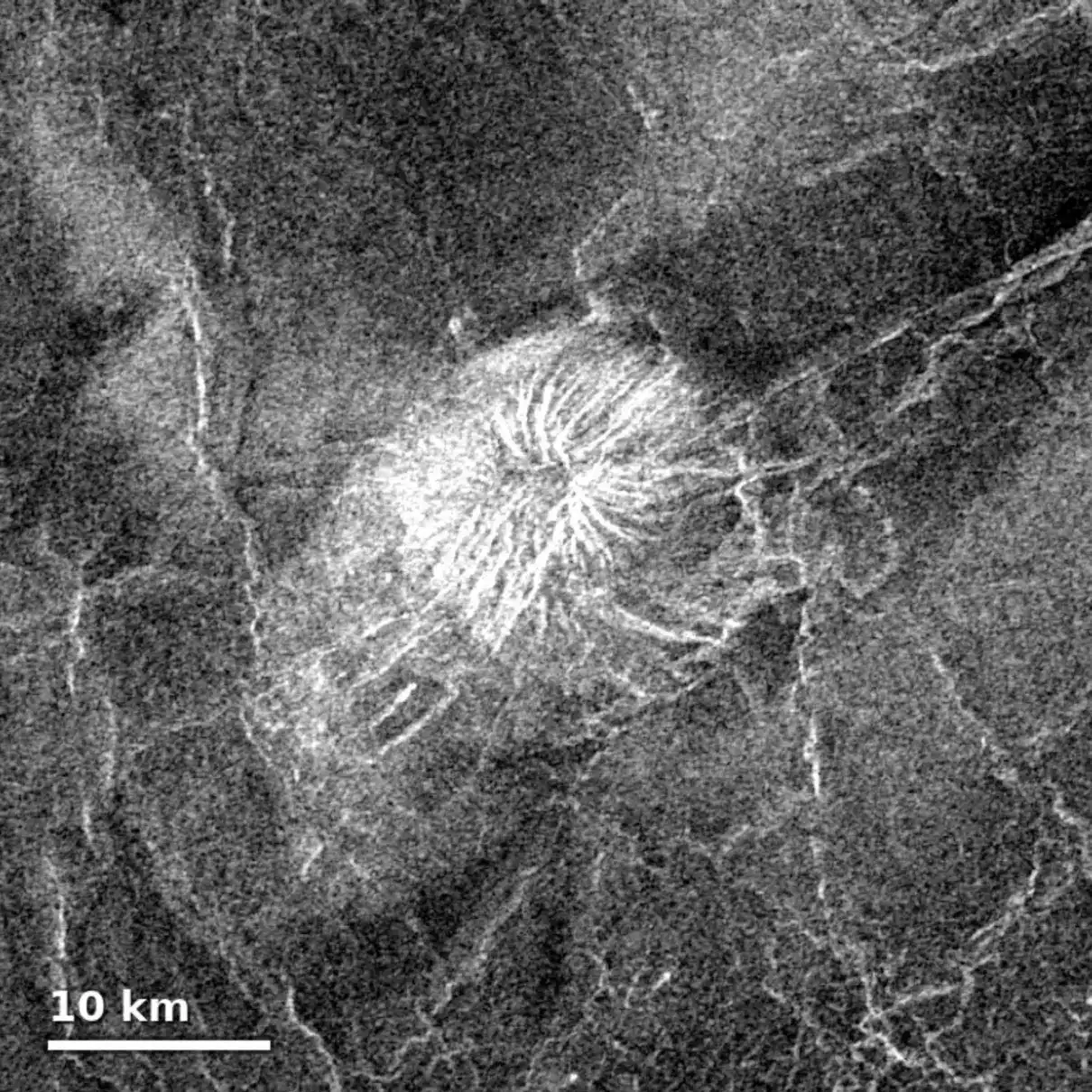
NASA Magellan probe radar image of Venus, showing a small shield volcano about 15 km in diameter at the center.
The original map could only show details at a scale of 10 to 20 kilometers. The new map improves the resolution capability to 2 to 3 kilometers, with elevation measurement accuracy improved by up to 25%. Anthropic plans to release this map under a Creative Commons license for reference by follow-up missions like NASA's VERITAS and the European Space Agency's EnVision.
In computational biology, Mythos 5.1 increased the runtime speed of 7 open-source protein and genome deep learning models by up to 2.5 times by writing custom GPU kernels and caching intermediate results, while maintaining consistent output. For some whole-genome analysis tasks, GPU costs are projected to be reduced by 30% to 60%.
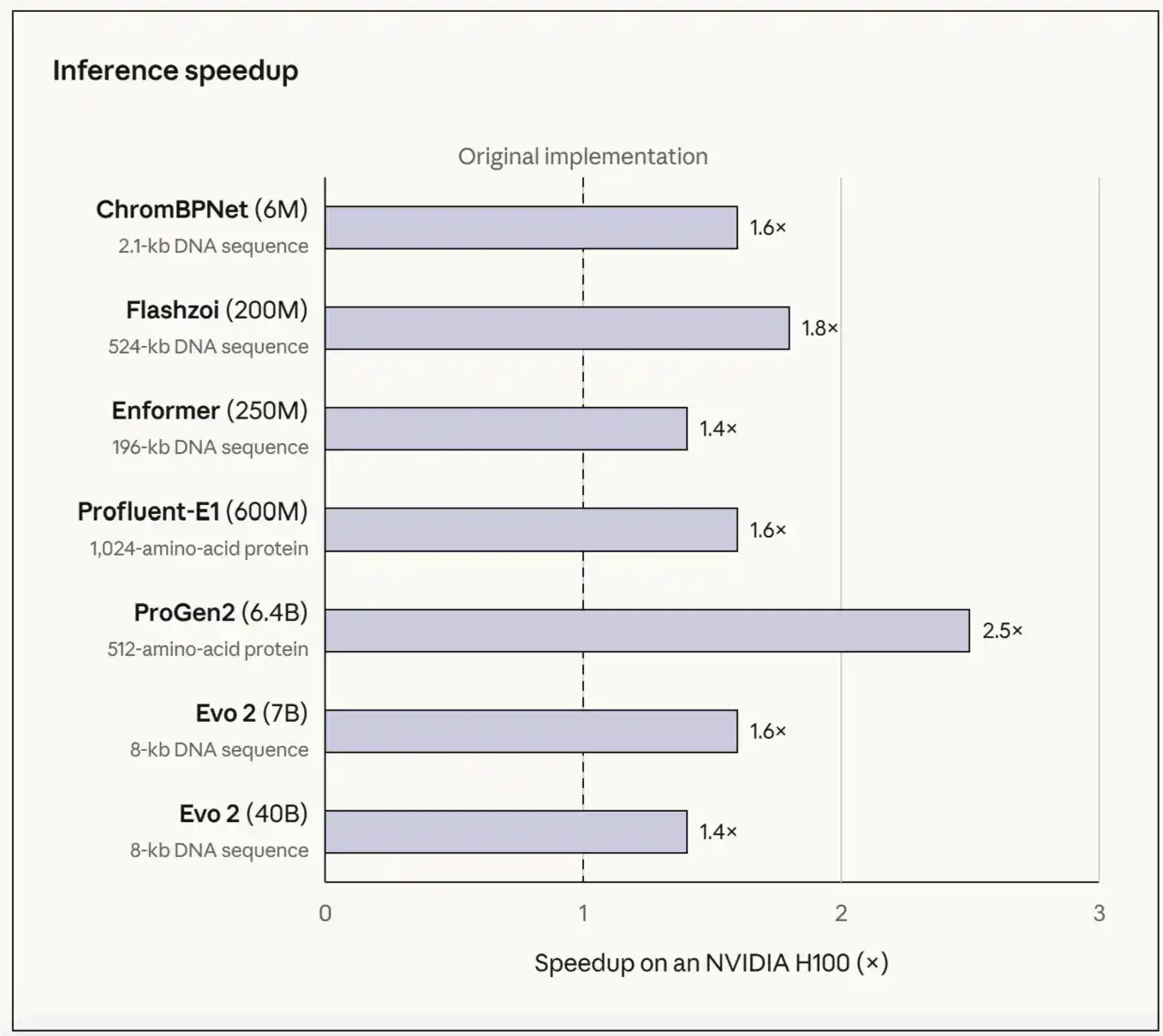
After Mythos 5.1 optimized 7 open-source protein and genome models, inference speed increased by 1.4 to 2.5 times.
Anthropic wants to use these cases to demonstrate that models are moving from organizing materials and writing code to proposing solutions, running tools, and delivering scientific results ready for experimental validation.
Cache Prices Drop 75%, Agent Tasks Up to 45% Cheaper
Beyond performance, pricing is the most direct change for Fable 5.1.
The input and output prices for Fable 5.1 remain unchanged at $10 and $50 per million tokens, respectively. However, the cache read price has been reduced by 75% from previous levels to $0.25 per million tokens.
Cache reading refers to the model reusing already processed context. Its proportion might be limited in simple Q&A, but in Agent tasks that require repeatedly reading codebases, conversation history, and tool results, cache often constitutes the main cost.
Based on Anthropic's calculations from actual usage data in August 2026, the overall cost of running typical tasks with Fable 5.1 is about 25% lower than with Fable 5; for complex Agent tasks with long contexts and frequent tool calls, the cost reduction can reach up to about 45%.
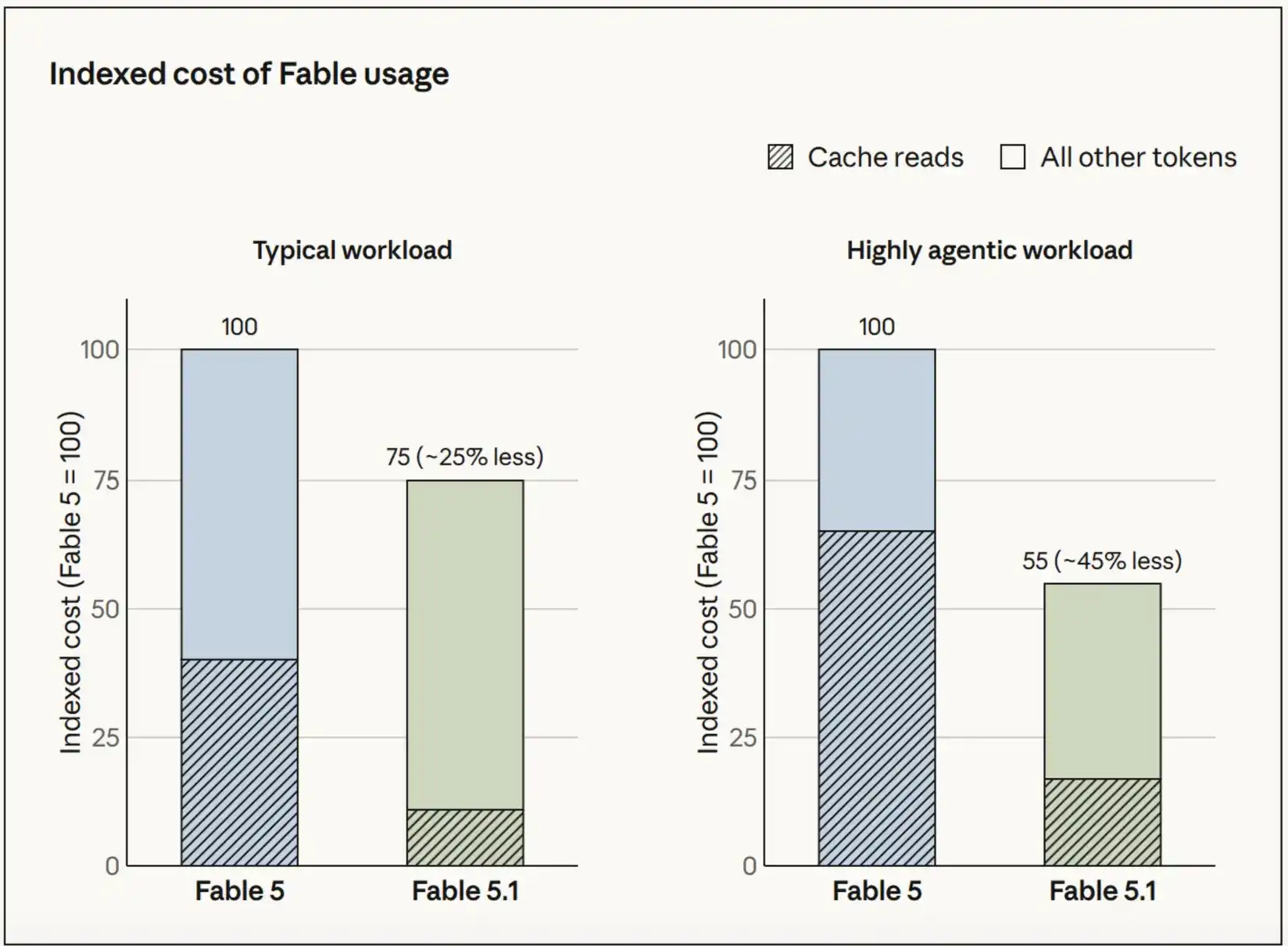
After the cache read price reduction, typical task costs for Fable 5.1 decreased by about 25%, with highly agentic task costs reduced by up to about 45%.
Fable 5.1 is now available on Claude . ai, Claude Code, and the Claude API, and is also offered through AWS, Google Cloud, and Microsoft Azure. Developers can call the new model via claude-fable-5-1.
Anti-Distillation Mechanisms Strengthened
Fable 5.1 and Mythos 5.1 actually use the same underlying model. Their main difference lies in safety restrictions.
Fable 5.1 is fully open to general users and enterprises. Mythos 5.1 has looser cybersecurity and life sciences restrictions and is currently only available to vetted individuals and institutions.
In cybersecurity, Fable 5.1 can already help users discover software vulnerabilities but still cannot directly generate exploit code. Dual-use tasks like penetration testing, exploit generation, and vulnerability scanning based on binary files may still be handed over to more restricted models.
After adjustments, the new cybersecurity protection mechanism's false positive rate is reduced by about 60% compared to Fable 5. The biosafety mechanism's false positive rate for basic biology and medical questions is also reduced by 85%, while advanced capabilities involving life sciences R&D are mainly opened through Mythos 5.1's vetting program.
Anthropic has also introduced Enterprise Frontier Safeguards. Enterprises can keep data in their own controlled cloud infrastructure, with the enterprise responsible for default human review, thereby achieving privacy effects close to "zero data retention" while retaining safety monitoring capabilities. This mechanism is planned to roll out in phases starting this fall.
For large-scale model distillation, Fable 5.1 has also added new restrictions. For API accounts created after today, it will no longer be possible to retain Claude's historical thinking records while manually modifying previous context in multi-turn conversations. Anthropic states this change primarily aims to block a publicly known capability extraction method.
Furthermore, to meet the requirements of the EU AI Act, Fable 5.1's text output will contain invisible watermarks. Anthropic has also begun small-scale testing of a detection API, initially open to regulators, media, fact-checking organizations, and research institutions.
Finally, as netizens say, the early bird gets to use 5.1.