Kaito Revives 'Talk-to-Earn' Economy, But Many Are Hesitant to Install the New Plugin

marsbitОпубликовано 2026-08-21Обновлено 2026-08-21

Введение

Kaito AI has launched a new browser extension called Kaito Pulse, aiming to integrate users' discussions on X (formerly Twitter) with their on-chain activities and social influence to build a new "attention + behavior verification" scoring system. The plugin displays users' public trading positions from platforms like Polymarket directly on the X timeline, allowing others to assess if their statements align with their actual market behavior. This move is seen as reviving "influence-to-earn" incentives. However, the launch sparked significant privacy concerns. Critics, including an analysis by "Ultra," allege the extension collects extensive data, such as device fingerprints (via GPU, hardware info), X user behavior (browsing paths, clicks), and may access sensitive data from third-party accounts (e.g., ChatGPT, trading platforms). This raised debates about trading privacy for verified influence. In response, Kaito founder Yu Hu stated the design follows data minimization principles, aiming to generate verification proofs without collecting or storing raw user data, using technologies like zkTLS. He acknowledged some permission descriptions could be misleading and promised improvements. The controversy highlights a core dilemma for social finance (SocialFi) platforms: as fake engagement and AI content grow, more user data is needed to verify genuine influence, but this risks encroaching on user privacy and trust.

Author | Asher(@Asher_ 0210)

Your X feed might soon be flooded with 'talk-to-earn' projects again.

On August 18th, Kaito AI announced the launch of its browser plugin, Kaito Pulse, further tying users' discussion behavior on X, on-chain activity, and social influence together. Simultaneously, Kaito revealed its first post-relaunch partnership with Axis Robotics, restarting the incentive model centered around content creators and community contributors.

Unlike the simple content incentives previously centered around Yaps, what Kaito aims to do this time is not just 'reward posting,' but to establish a new scoring system based on 'attention + behavior verification.'

What is Kaito Pulse?

Kaito Pulse is a browser plugin launched by Kaito, designed to add more 'on-chain identity' information to the X timeline, allowing users to not only see the views expressed by an X account but also understand the real market behavior behind it.
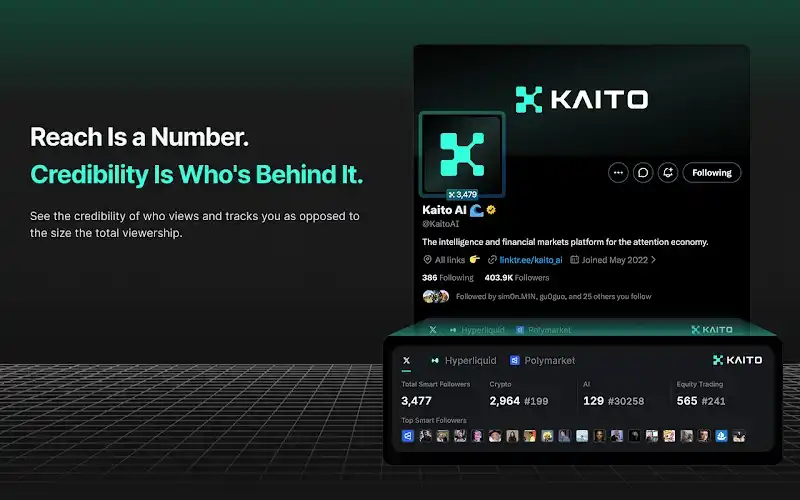
After installing the plugin, users can directly view other users' on-chain activity information within the X timeline, including public trading positions from platforms like Polymarket and Hyperliquid, thereby further assessing whether an account's views align with its actual actions.

By combining social influence with on-chain behavior, Kaito hopes to transform X from a mere information dissemination platform into a social layer that integrates 'views, identity, and trading behavior.'

This is also an evolution for Kaito from Yaps to Pulse.

Previously, Kaito primarily tracked the popularity of crypto discussions on X, creating content influence leaderboards, and incentivized user participation around KAITO. However, as many accounts began mass-producing content, the problem of measuring influence solely based on discussion volume became apparent. Therefore, Pulse further incorporates dimensions such as content influence, community interaction, and on-chain behavior verification, while introducing a new scoring system called Aura to measure user influence and verified on-chain behavior.

Previously, Kaito focused on who generated the most discussion; now, Kaito is more concerned with whose discussion is worth believing.

Plugin Requires Extensive Permissions, Sparking 'Data Collection' Controversy Post-Launch

The launch of Kaito Pulse sparked lively community discussion, with many feeling that as market conditions recover, a new wave of 'talk-to-earn' economy is imminent. However, Kaito Pulse quickly ignited a debate within the community regarding privacy permissions.

Kaito Pulse Plugin Accused of Multiple Deep Data Collection Practices

Ultra stated in an X post that by analyzing the Pulse plugin code, it was found that it may involve multiple data collection behaviors, including device fingerprinting, X platform behavior tracking, and third-party account verification.

Among these, the most concerning is the device identification issue. Ultra stated that Kaito Pulse might generate a device fingerprint using information such as GPU rendering results, hardware models, and hardware test audio, linking this information to X accounts, potentially compromising anonymity for multi-account users and community matrix accounts.

Beyond device information, Ultra also questioned the scope of user X behavior data collection by Kaito Pulse. The plugin may record certain user behaviors on the X platform, including browsing paths, content dwell time, click behavior, and follow status, and use periodic requests to determine if a user is active.

Furthermore, third-party account verification is another focal point of controversy. Ultra pointed out that Pulse involves verification processes for ChatGPT, Claude, and multiple trading platform accounts, suggesting these processes might access sensitive data such as user subscription status, usage quotas, and trading account information.

Community Divided: Verifying Authenticity or Sacrificing Privacy?

In the Yaps era, Kaito primarily relied on discussion popularity on X to measure influence. However, as mass content production by numerous accounts became prevalent, the community gradually began questioning: does high popularity equal real influence?

By incorporating more dimensions like on-chain behavior and external account verification, Kaito Pulse aims to reduce the room for gaining rankings solely through posting and interactions, making the influence score closer to a user's real contribution.

But more verification mechanisms also mean users need to grant more data permissions. Consequently, the community has formed two different views on Kaito Pulse:

  • Supporters believe that the biggest problem with InfoFi is farming and fake influence, and only by adding identity and behavior verification can a more credible incentive system be built;
  • Skeptics argue that platforms should not infinitely expand data collection scope just to improve scoring accuracy, and a new balance needs to be found between user privacy and incentive rewards.

Official Response to Privacy Controversy: Kaito Pulse Does Not Collect User Raw Data

Facing community skepticism, Kaito founder Yu Hu later responded.

Yu Hu stated that Kaito Pulse's design principle is data minimization. The product goal is not to collect user data, but, under active user authorization, to prove certain identities or behaviors through verification mechanisms.

Addressing community concerns about account information, Kaito Pulse does not obtain complete account content from users, nor does it store user raw data. The related processes are primarily used to generate verification results; the platform receives proof information, not the underlying user data.

Regarding the controversy sparked by external account verification, Kaito Pulse uses verification technologies, including zkTLS, hoping to allow users to prove they possess certain off-chain identities or behavior records without exposing the original data.

Simultaneously, Yu Hu acknowledged that the presentation scope of certain permissions might be prone to misunderstanding, and future versions will further optimize permission descriptions and user prompts.

The Next Step for the 'Talk-to-Earn' Economy: Verify Influence, or Surrender Privacy?

The discussion sparked by Kaito Pulse is essentially an unavoidable data dilemma in the InfoFi sector.

In the past, platforms judged an account's value primarily based on follower count, engagement data, and content popularity. However, as AI-generated content, batch accounts, and matrix operations become increasingly common, mere 'discussion volume' has become less and less representative of real influence.

Therefore, Kaito attempts to introduce more verification dimensions, and controversy follows—when a platform wants to further prove 'who you are' and 'whether your views are credible,' users need to surrender more and more information.

For users, installing the plugin to participate in the next wave of the 'talk-to-earn' economy also means they need to reconsider: for the sake of rankings, points, and potential rewards, how much data are they actually willing to open up? Platforms need more data to distinguish real influence from fake hype; but users also need assurance that this data is truly used only for verification and does not become a new digital profile.

Kaito Pulse wants to verify user influence, but as it masters more and more data on devices, behaviors, and accounts, Kaito itself becomes the subject of scrutiny.


Трендовые криптовалюты

Связанные с этим вопросы

QWhat is Kaito Pulse and what does it aim to achieve?

AKaito Pulse is a browser plugin launched by Kaito AI. It aims to enhance the X (Twitter) timeline by displaying users' on-chain activity information, such as public trading positions from platforms like Polymarket and Hyperliquid. The goal is to bind users' discussion behavior, on-chain activity, and social influence to help others assess if an account's opinions align with their actual actions, thereby transforming X into a social layer that integrates viewpoints, identity, and trading behavior.

QWhat were the main privacy concerns raised by the community regarding the Kaito Pulse plugin?

AThe community raised several privacy concerns, including potential device fingerprinting (collecting GPU rendering results, hardware models, and test audio), tracking user behavior on X (browsing paths, content dwell time, clicks, follow status), and accessing sensitive data from third-party account verification processes (like ChatGPT, Claude, and trading platforms). Critics feared this compromised user anonymity and privacy.

QHow did Kaito's founder, Yu Hu, respond to the privacy controversy?

AYu Hu responded that Kaito Pulse operates on a principle of data minimization and does not aim to collect user data. He stated that the plugin verifies identities or behaviors only with active user authorization, and it does not access or store users' complete account content or raw underlying data. He acknowledged that some permission descriptions could be misleading and promised optimizations in future versions.

QWhat is the core dilemma highlighted by the article regarding platforms like Kaito in the InfoFi (Information Finance) space?

AThe core dilemma is balancing the need for data verification against user privacy. Platforms need more data (like on-chain behavior and account verification) to distinguish real influence from fake hype generated by AI or bot accounts. However, requiring users to provide more personal data raises significant privacy concerns. Users must decide how much data they are willing to share for potential rewards and rankings.

QHow did Kaito's approach to measuring user influence change from its Yaps era to the Pulse era?

ADuring the Yaps era, Kaito primarily measured user influence based on the volume of crypto-related discussions on X. The shift to the Pulse era involves moving beyond simple discussion metrics. Kaito Pulse introduces a more comprehensive scoring system called Aura, which evaluates content influence, community interaction, and verified on-chain behavior. The focus has shifted from 'who creates the most discussion' to 'whose discussion is credible and backed by real actions.'

Похожее

MiCA готовится регулировать DeFi-хранилища, но это будет непросто

MiCA оставил криптокредитование за рамками первоначального свода правил, но сейчас в Брюсселе рассматривается вопрос о его включении. 20 мая 2026 года Европейская комиссия запросила мнение заинтересованных сторон по темам, исключённым из первоначальных рамок MiCA, таким как децентрализованные финансы (DeFi) и криптокредитование. Ключевой вопрос — правовой статус кредитных «хранилищ» (vaults), которые направляют миллиарды долларов в ончейн-кредитные рынки, не будучи похожими на традиционное кредитование. В настоящее время их статус определяется необязательными интерпретациями, что они не подпадают под MiCA и правила фондов ЕС. Структура, например, протокола Morpho, где функции разделены между куратором, аллокатором и сентинелем, не соответствует ни одной существующей регуляторной модели, что затрудняет идентификацию «поставщика» регулируемой услуги. Эксперты указывают на сложности регулирования. Джонатан Галеа предупреждает, что категория «DeFi-кредитование» может объединить структуры с совершенно разными функциями. Юрий Брисов предлагает фокус на структуре хранилища и контроле над ним, а не на степени децентрализации, которая является спектром. Майкл Егоров, основатель Curve Finance, настаивает, что DeFi-кредитование требует отдельного подхода и правил, отличных от традиционного финансирования. Консультации Комиссии завершаются 30 сентября, и их итог определит, останутся ли кредитные хранилища вне MiCA или попадут под новые правила. Задача для Брюсселя — не просто решить, регулировать ли DeFi-кредитование, а как создать правила, различающие очень разные формы ончейн-кредитования и лиц, которые ими управляют.

cointelegraph11 мин. назад

MiCA готовится регулировать DeFi-хранилища, но это будет непросто

cointelegraph11 мин. назад

Компания Coinbase, подвергшаяся критике за продажу Ethereum, ответила на критику!

Основатель Coinbase Джесси Поллак ответил на критику компании за продажу Ethereum ($ETH), подчеркнув ее значительный вклад в экосистему. Он заявил, что Coinbase является одним из крупнейших институциональных держателей ETH и крупным клиентом сети через свой L2-решение Base, которое познакомило миллионы пользователей с Ethereum. Поллак отметил, что компания годами хранила около 150 000 ETH и внесла вклад в развитие EVM и дорожной карты Ethereum. Член сообщества Ethereum chaskin.eth поддержал эту позицию, указав на вклад Coinbase в такие проекты, как Base, USDC, EIP-4844 и смарт-кошельки. Поллак призвал прекратить постоянную критику протокола и использующих его компаний, предупредив, что враждебность может оттолкнуть крупных институциональных пользователей и навредить экосистеме. Он уверен, что для роста Ethereum нужно поддерживать, а не исключать компании, развивающие продукты на его основе.

cryptonews.ru1 ч. назад

Компания Coinbase, подвергшаяся критике за продажу Ethereum, ответила на критику!

cryptonews.ru1 ч. назад

Grayscale Research: Почему не стоит игнорировать Zcash в эпоху ИИ и финансовой приватности?

В эпоху развития ИИ и цифрового мониторинга, финансовая конфиденциальность становится все более важной. Grayscale Research отмечает растущий интерес к этой теме и представляет Zcash как децентрализованную цифровую валюту с механизмами приватности на основе технологии доказательств с нулевым разглашением (zk-SNARKs). В отличие от прозрачного Bitcoin, Zcash предлагает «защищенные транзакции», скрывающие отправителя, получателя и сумму, а также поддерживает выборочное раскрытие данных. Статья подчеркивает, что приватность — это не нишевая функция, а основополагающее свойство денег. Несмотря на техническую зрелость Zcash (прошедшего через ключевые обновления, такие как Sapling и Orchard) и высокий процент приватных транзакций в сети, его рыночная капитализация составляет всего 0.6% от сектора цифровых валют. Это указывает на то, что рынок недооценивает потенциальную стоимость приватности. В качестве рисков отмечаются регуляторные вызовы, устаревшие пулы средств, связанные с доверительной настройкой, и сложность выполнения технической дорожной карты. Вывод заключается в том, что Zcash представляет собой недооцененную возможность, так как текущая цена не учитывает вероятность роста значимости финансовой приватности в будущем.

marsbit2 ч. назад

Grayscale Research: Почему не стоит игнорировать Zcash в эпоху ИИ и финансовой приватности?

marsbit2 ч. назад

OriginX соберет лидеров биткоин-сообщества из 22 стран и более 70 партнеров в Сеуле на ORIGIN SEOUL 2026

Компания OriginX, базирующаяся в Сеуле, проведет конференцию ORIGIN SEOUL 2026 1 и 2 сентября в конференц-центре SKY31 башни Lotte World Tower. Мероприятие соберет лидеров биткойн-индустрии из 22 стран и более 70 партнеров, включая компании, СМИ и арт-сообщества. Конференция построена на основе постоянной инфраструктуры Bitcoin House ORIGIN — крупнейшего в Южной Корее коворкинга, посвященного Биткойну. Программа разделена на два дня: 1 сентября (Индустриальный день) будет посвящен институциональным аспектам, таким как инвестиции, ETF, стейблкоины и майнинг. 2 сентября (Публичный день) сосредоточится на анализе рынка, самостоятельном хранении активов и развитии сообществ. Спикеры включают Джеймса Чека, Теруко Нэрики, Кевина Лоаэка и Стефана Ливеру. В рамках ORIGIN SEOUL также запланировано 14 побочных мероприятий по всему Сеулу, включая воркшопы, встречи и благотворительный забег. Конференция связана с событием Bitcoin Asia в Гонконге, формируя «Биткойн-неделю в Азии». Основатель OriginX Райан Ли подчеркивает, что цель мероприятия — не только собрать людей ради Биткойна, но и познакомить их с Сеулом и местным сообществом.

TheNewsCrypto2 ч. назад

OriginX соберет лидеров биткоин-сообщества из 22 стран и более 70 партнеров в Сеуле на ORIGIN SEOUL 2026

TheNewsCrypto2 ч. назад

С переходом ИИ-агентов к реальным тратам для XRP может начаться новый этап

С переходом ИИ-агентов от покупки цифровых ресурсов к выполнению реальных коммерческих задач для XRP может начаться новый этап, как отмечает Чандлер Фанг, соучредитель стартапа t54. Агенты уже провели более миллиона транзакций через XRP Ledger (XRPL) без участия человека. Следующий шаг — интеграция в более широкую коммерческую деятельность, включая автоматизированные закупки и платежи. Ripple выпустила XRPL AI Starter Kit, поддерживающий платежи в XRP и Ripple USD (RLUSD) за API, вычисления и другие услуги. Программа Mastercard «Agent Pay for Machines» расширяет это на счета и транзакции, которые компании хотят автоматизировать. Для внедрения потребуются криптокошельки и инструменты контроля расходов, а торговцам — адаптировать интерфейсы для автономных систем. Использование XRP будет зависеть от потребностей расчётов: для частых мелких платежей, более крупных транзакций или агрегированных обязательств. XRP и RLUSD выполняют взаимодополняющие функции в XRPL. В долгосрочной перспективе внедрение может стать «незаметным»: агенты будут встроены в казначейские и логистические системы, а пользователям не нужно будет напрямую взаимодействовать с XRPL. Ключевыми показателями успеха станут не объёмы транзакций, а повторяющаяся активность, доход продавцов и эффективное урегулирование споров.

cryptonews.ru3 ч. назад

С переходом ИИ-агентов к реальным тратам для XRP может начаться новый этап

cryptonews.ru3 ч. назад

Торговля

Спот

Популярные статьи

Как купить KAITO

Добро пожаловать на HTX.com! Мы сделали приобретение Kaito (KAITO) простым и удобным. Следуйте нашему пошаговому руководству и отправляйтесь в свое крипто-путешествие.Шаг 1: Создайте аккаунт на HTXИспользуйте свой адрес электронной почты или номер телефона, чтобы зарегистрироваться и бесплатно создать аккаунт на HTX. Пройдите удобную регистрацию и откройте для себя весь функционал.Создать аккаунтШаг 2: Перейдите в Купить криптовалюту и выберите свой способ оплатыКредитная/Дебетовая Карта: Используйте свою карту Visa или Mastercard для мгновенной покупки Kaito (KAITO).Баланс: Используйте средства с баланса вашего аккаунта HTX для простой торговли.Третьи Лица: Мы добавили популярные способы оплаты, такие как Google Pay и Apple Pay, для повышения удобства.P2P: Торгуйте напрямую с другими пользователями на HTX.Внебиржевая Торговля (OTC): Мы предлагаем индивидуальные услуги и конкурентоспособные обменные курсы для трейдеров.Шаг 3: Хранение Kaito (KAITO)После приобретения вами Kaito (KAITO) храните их в своем аккаунте на HTX. В качестве альтернативы вы можете отправить их куда-либо с помощью перевода в блокчейне или использовать для торговли с другими криптовалютами.Шаг 4: Торговля Kaito (KAITO)С легкостью торгуйте Kaito (KAITO) на спотовом рынке HTX. Просто зайдите в свой аккаунт, выберите торговую пару, совершайте сделки и следите за ними в режиме реального времени. Мы предлагаем удобный интерфейс как для начинающих, так и для опытных трейдеров.

463 просмотров всегоОпубликовано 2025.02.21Обновлено 2026.06.02

Как купить KAITO

Обсуждения

Добро пожаловать в Сообщество HTX. Здесь вы сможете быть в курсе последних новостей о развитии платформы и получить доступ к профессиональной аналитической информации о рынке. Мнения пользователей о цене на KAITO (KAITO) представлены ниже.

活动图片