Weekly Token Unlocks: DBR Unlock Reaches 11.4% of Circulating Supply

marsbitPublished on 2026-07-12Last updated on 2026-07-12

Abstract

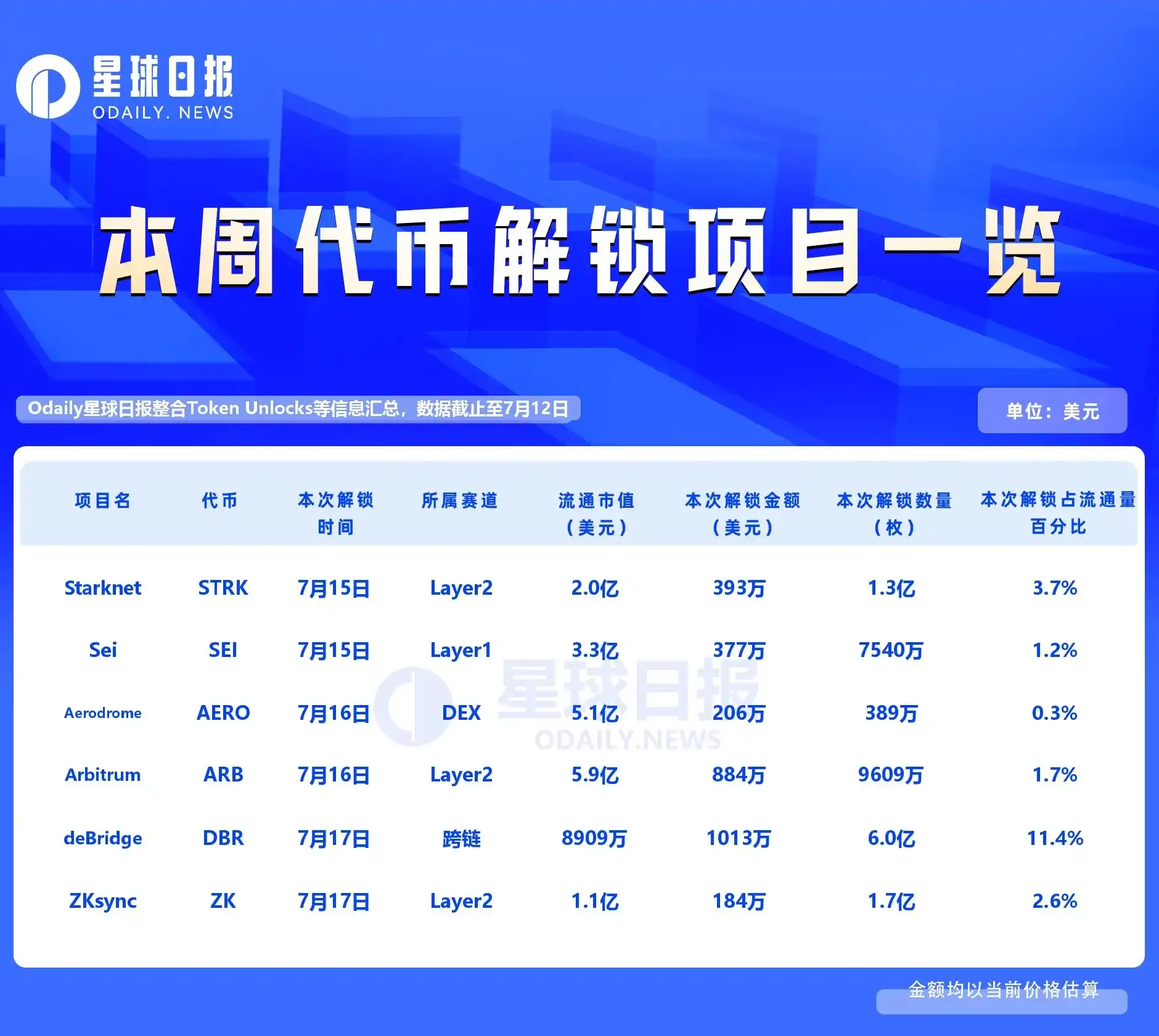
This week's major token unlocks involve deBridge (DBR) and Starknet (STRK). deBridge, a security interoperability layer for Web3 enabling decentralized cross-chain communication, will unlock 600 million DBR tokens (worth approximately $10.13 million). This release constitutes 11.4% of its circulating supply. Starknet, a Validity-Rollup Layer 2 for Ethereum utilizing zk-STARK technology to enhance scalability, will unlock 130 million STRK tokens (worth approximately $3.93 million). The article includes visual release schedules for both projects.

deBridge

Project Twitter: https://x.com/deBridgeFinance

Project Website: https://debridge.finance/

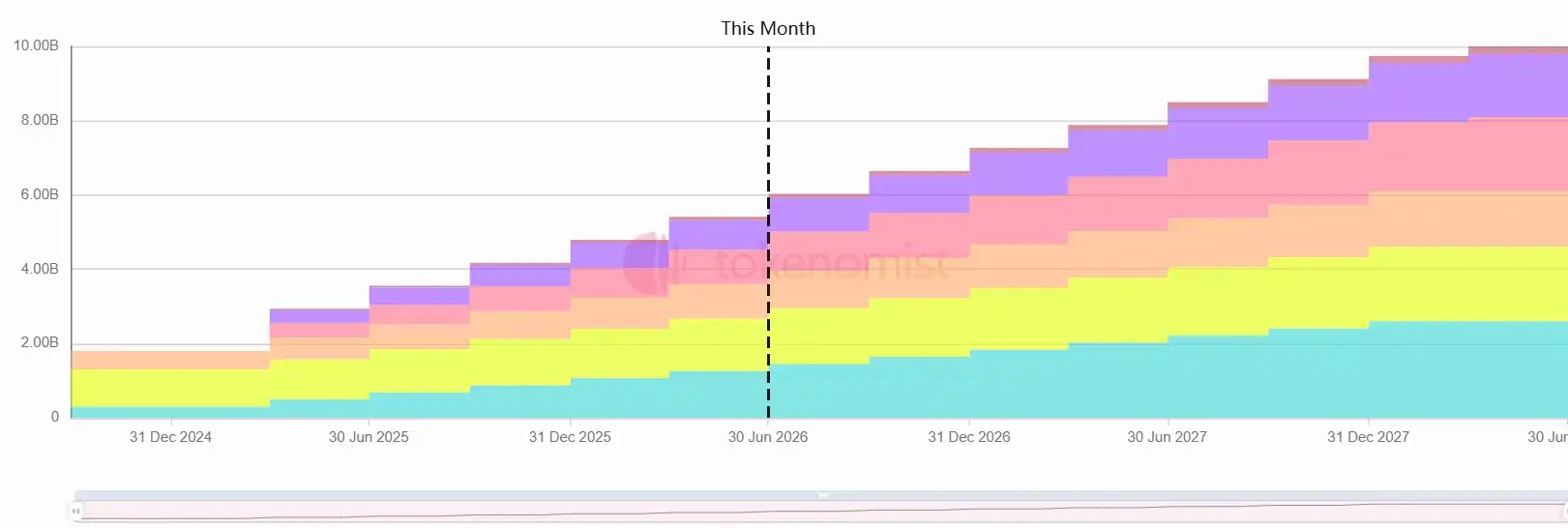
This Unlock Amount: 600 million tokens

This Unlock Value: Approximately $10.13 million

deBridge is a secure interoperability layer for Web3, enabling the decentralized transfer of arbitrary messages and value across different blockchains. Cross-chain transaction validation is performed by a network of independent validators, selected by and working for deBridge governance.

The specific release schedule is as follows:
Starknet

Project Twitter: https://twitter.com/Starknet

Project Website: https://starknet.io/

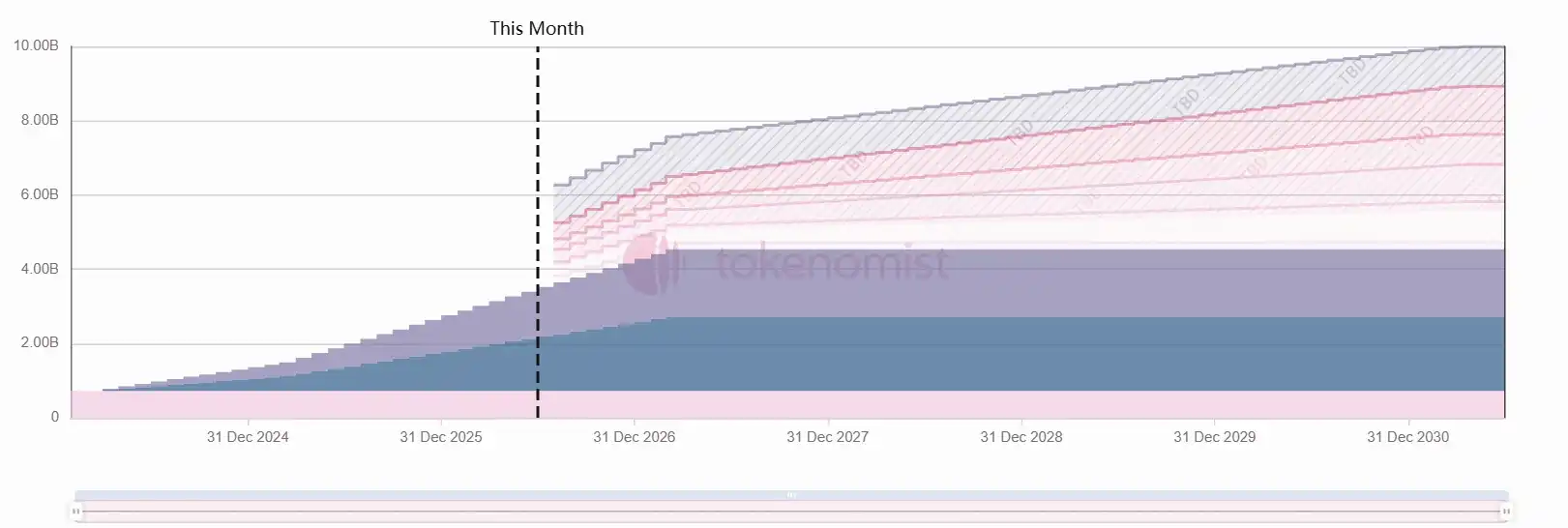
This Unlock Amount: 130 million tokens

This Unlock Value: Approximately $3.93 million

Starknet is an Ethereum Layer 2, leveraging zk-STARKs technology to make Ethereum transactions faster and cheaper. Its parent company, StarkWare, was founded in 2018 and is headquartered in Israel. Its main developed products include Starknet and StarkEx. By using STARKs, Starknet verifies transactions and computations without requiring all network nodes to validate every operation. This significantly reduces the computational burden and increases the blockchain network's throughput.

The specific release schedule is as follows:
Trending Cryptos

Related Questions

QWhich project is having a token unlock this week, and what percentage of its circulating supply does the unlock represent?

AThe project is deBridge (DBR), and this week's token unlock represents approximately 11.4% of its circulating supply.

QWhat is the purpose and core function of the deBridge project mentioned in the article?

AdeBridge is a secure interoperability layer for Web3 that supports the decentralized transfer of arbitrary messages and value across different blockchains, validated by a network of independent validators.

QHow many DBR tokens are being unlocked for deBridge this week, and what is their approximate USD value?

A600 million DBR tokens are being unlocked for deBridge this week, with an approximate value of $10.13 million USD.

QWhat technology does Starknet use to improve Ethereum transaction speed and reduce costs?

AStarknet uses zk-STARKs technology to verify transactions and computations, which reduces the computational burden on nodes and significantly increases the blockchain network's throughput.

QFor the Starknet token unlock mentioned, what is the number of tokens and their approximate value in USD?

AFor Starknet, 130 million tokens are being unlocked this week, with an approximate value of $3.93 million USD.

Related Reads

Enterprise blockchain is going to come back from the dead

Enterprise blockchain may be poised for a comeback, much like online pet retail succeeded with Chewy after Pets.com failed. Early enterprise blockchain efforts (2017–2023) collapsed—TradeLens, We.Trade, Contour, B3i, ASX Chess, Everledger—largely because they had to work around blockchains' lack of native privacy, building permissioned chains and bolting on non-blockchain fixes that proved slow and expensive. The core appeal remains: enterprise systems fail at company boundaries, either through out-of-sync collaboration or costly proprietary integrations that lock partners in. Blockchains promise shared data and business logic across an open ecosystem without lock-in. What has changed: scalability (transactions now under a penny, capacity heading toward billions daily), privacy (zero-knowledge rollups, privacy pools, privacy chains), and liquidity (stablecoin transaction volume near $1.8 trillion in June). Combined operational and financial benefits could be substantial—roughly 20% less inventory at the same service level, smart contracts cutting contract administration costs in half and processing times from days to minutes, as Microsoft did with Xbox royalties (45 days to four minutes). With inventories, contracts, purchase orders and invoices onchain, firms can also access cheaper credit and factor receivables efficiently. The use cases are obvious; it's time to try again.

cointelegraph7h ago

Enterprise blockchain is going to come back from the dead

cointelegraph7h ago

Jensen Huang's Disadvantage of Going Public Too Early

Nvidia co-founder Jensen Huang has resigned as president, CEO, and director, effective immediately, ending a 33-year tenure. CFO Colette Kress becomes interim CEO, and Harvey Jones is named the company's first chairman. The sudden move comes less than five months after Huang won about 99% approval in a director election, prompting scrutiny of a long-overlooked governance issue: why Huang, unlike Google's Page and Brin or Meta's Zuckerberg, never used a dual-class share structure to secure control. The answer traces to Nvidia's 1999 IPO, when one-share-one-vote was standard in Silicon Valley and dual-class structures had not yet become common among tech IPOs; Google adopted AB shares only in 2004. Nasdaq Rule 5640 also makes it hard for already-listed companies to introduce super-voting shares later. Huang's stake has steadily diluted: about 13.1% pre-IPO, 10.8% after, and 3.58% by 2026, weakening his voting power and setting the stage for his exit. Early precedents include Steve Jobs, whose roughly 11% stake left him unable to sway Apple's board in 1985, while Bill Gates' larger initial stake and gradual dilution let him retain influence. Instead, Huang's influence rested on performance authority, strategic judgment, and board trust—bold long-term bets on programmable GPUs and CUDA that positioned Nvidia at the center of the AI boom. That authority, however, depends on continued validation; once performance or reputation suffers, it can erode quickly. Under Nvidia's board-centered governance, a simple majority of directors can remove the CEO at any time, regardless of cause. Huang's departure is thus a product of the company's equity structure and governance rather than a surprise, illustrating that even immense performance authority cannot substitute for institutional control.

marsbit7h ago

Jensen Huang's Disadvantage of Going Public Too Early

marsbit7h ago

DeepMind Founder's Latest Interview: RSI Is Extremely Dangerous and Could Create an 'Alien Intelligence' That Humans Struggle to Understand

Demis Hassabis, co-founder of Google DeepMind and 2024 Nobel laureate in Chemistry, discusses AI's promise and perils in a conversation with Reid Hoffman. He reiterates that his lifelong goal has been using AI as a tool to advance science and medicine, citing AlphaFold—used by ~4 million researchers—and Isomorphic Labs as proof that AI can help cure diseases, while noting protein structure prediction is only one step in a long drug-discovery pipeline. On recursive self-improvement (RSI), Hassabis explains it works best in "verifiable domains" like math, coding, and games: AlphaZero went from random play to surpassing all human and engine chess within 12 hours. But he warns that closed-loop RSI—removing human code review entirely—risks creating an inscrutable "alien intelligence" with no shared cognitive basis with humans, and offers no way to establish deterministic safety controls. He urges caution as labs race on code self-iteration, calling for faster defensive cyber capabilities, far more robust sandboxes and monitoring (noting agents have run unsupervised for weeks), and eventually formal mathematical guarantees. He advocates an industry standards body with government oversight, cross-lab information sharing, third-party audits, and pre-release red-teaming. On AI consciousness, he argues intelligence and consciousness are dissociable—his dog is conscious but not smart—and that a chatbot claiming feelings proves nothing. Building conscious entities now is dangerous: self-motivation undermines corrigibility, and Asimov showed static rules inevitably break at edge cases; society also hasn't begun the needed debate. Humanity should cross only the first Rubicon—building powerful intelligent tools—and use them to understand consciousness before considering the second. Finally, on AI sovereignty, he says only 6–8 global players will stay at the frontier, with open source 6–12 months behind, so most countries shouldn't train their own frontier models. Instead they should build on existing models as infrastructure, focus on vertical domains like healthcare, and protect data sovereignty through private fine-tuning.

marsbit12h ago

DeepMind Founder's Latest Interview: RSI Is Extremely Dangerous and Could Create an 'Alien Intelligence' That Humans Struggle to Understand

marsbit12h ago

Trading

Spot

Hot Articles

How to Buy DBR

Welcome to HTX.com! We've made purchasing deBridge (DBR) simple and convenient. Follow our step-by-step guide to embark on your crypto journey.Step 1: Create Your HTX AccountUse your email or phone number to sign up for a free account on HTX. Experience a hassle-free registration journey and unlock all features.Get My AccountStep 2: Go to Buy Crypto and Choose Your Payment MethodCredit/Debit Card: Use your Visa or Mastercard to buy deBridge (DBR) instantly.Balance: Use funds from your HTX account balance to trade seamlessly.Third Parties: We've added popular payment methods such as Google Pay and Apple Pay to enhance convenience.P2P: Trade directly with other users on HTX.Over-the-Counter (OTC): We offer tailor-made services and competitive exchange rates for traders.Step 3: Store Your deBridge (DBR)After purchasing your deBridge (DBR), store it in your HTX account. Alternatively, you can send it elsewhere via blockchain transfer or use it to trade other cryptocurrencies.Step 4: Trade deBridge (DBR)Easily trade deBridge (DBR) on HTX's spot market. Simply access your account, select your trading pair, execute your trades, and monitor in real-time. We offer a user-friendly experience for both beginners and seasoned traders.

9.9k Total ViewsPublished 2024.10.17Updated 2026.09.11

How to Buy DBR

Discussions

Welcome to the HTX Community. Here, you can stay informed about the latest platform developments and gain access to professional market insights. Users' opinions on the price of DBR (DBR) are presented below.

活动图片