Best Altcoins to Buy as Thailand Trials Crypto Trading System

bitcoinistОпубликовано 2025-02-03Обновлено 2025-02-03

Введение

The Securities and Exchange Commission (SEC) of Thailand looks set to introduce a distributed ledger technology (DLT)-based trading platform for...

The Securities and Exchange Commission (SEC) of Thailand looks set to introduce a distributed ledger technology (DLT)-based trading platform for securities firms.

The initiative aims to leverage extensive investor networks to facilitate digital token transactions.

In the process, Thailand’s SEC decision achieves several key breakthroughs for the local market, which could have an impact on the broader crypto economy:

  • Regulatory Support for Digital Tokens
  • Comprehensive Digitalization of Bond Trading
  • Tokenized and Electronic Securities Categories
  • Approved Digital Token Projects

Thailand’s decision is, of course, limited to Thailand. And it notably doesn’t cross existing crypto regulations (which currently forbid crypto payments).

But the Thai government is already planning to experiment with allowing crypto payments in select areas; combined with the DLT decision, it could set the stage for an expanded crypto framework – and perhaps a model for other countries.

With crypto adoption seemingly set to grow, what are the best altcoins to buy? Here’s a list of some non-Bitcoin cryptos with big potential.

Best Wallet Token ($BEST) – 2025’s Next-Gen Crypto Presale Wallet

Crypto presales are increasingly popular ways for upcoming projects to gauge interest, raise funds, and incentivize investors.

But finding the best crypto presales can be a bit of a challenge. Fortunately, Best Wallet gathers the best presales in the best place for easy access – right inside a leading Web3 wallet.

best wallet token presale

The $BEST token supercharges the entire Best Wallet ecosystem, providing a number of key benefits for investors who use the Best Wallet and hold $BEST tokens:

  • Early project access
  • Reduced transaction fees
  • Increased staking rewards
  • Enhanced governance

The Best Wallet Ecosystem also includes Best DEX and Best Card, making $BEST an ecosystem token with incredible utility.

The Best Wallet Token is currently in its own presale and has raised over $9M so far. $BEST tokens are priced at $0.02385.

Visit the $BEST presale to learn more.

Cardano ($ADA) – Rare Top-10 Altcoin With Room To Grow

Cardano occupies a strange role in the crypto ecosystem. $ADA is the utility token for the Cardano blockchain, which at one point hoped to challenge Ethereum for the DeFi crown.

That hasn’t happened. But the $ADA token itself still ranks in the top ten cryptos by market cap with over $25B, and founder Charles Hoskinson remains a vocal advocate and keen proponent of broader crypto adoption.

Hoskinson recently discussed bringing stablecoins to Cardano, as well as involving $ADA in the growing Wyoming stablecoin project. Hoskinson expressed a desire to integrate Cardano’s Hydra layer-2 solution with the Lightning Network (built on Bitcoin) to bring $BTC and $ADA under one structure.

In terms of potential, Cardano remains an altcoin with plenty of room in front of it.

Meme Index ($MEMEX) – Multiple Meme Indexes for Meme Market Mastery

Meme Index makes it easy to navigate the memecoin market by putting it all in one place. Indexes, a stock market tool, track the performance of ‘baskets’ of stocks under one ticker, allowing investors to follow and invest in entire sectors of the market without buying individual stocks.
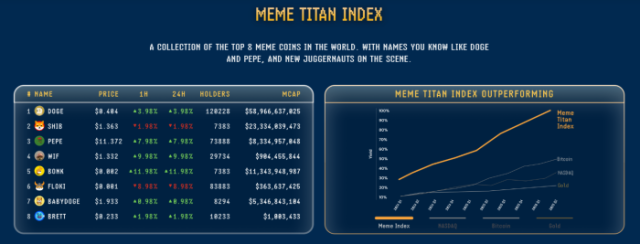
Meme Titan Index

$MEMEX holders can do the same thing with memecoins. By holding $MEMEX, investors can follow one or more of the Meme Titan, Meme Moonshot, Meme Midcap, and Meme Frenzy indexes.

The Meme Index project, currently in presale, has brought in $3.2M so far, with a current token price of $0.0158443.

Follow the $MEMEX presale here.

Toncoin ($TON) – Altcoin Powered By Social Media

The Open Network’s Toncoin integrates natively with Telegram and various web3 applications and deploys a multi-sharding architecture for greater scalability. It can be used for payments with $TON and to handle payments within Telegram and other apps.

Put another way, Toncoin is a blockchain with a built-in use case for anyone using Telegram or Telegram mini-apps. That made $TON the de facto cryptocurrency for those applications.

And it explains why $TON performed the way it did in 2024:

TON performance 2024

While $TON’s performance declined heading into 2025, that utility continues to make a bullish case.

MIND of Pepe ($MIND) – AI Memecoin Momentum with 456% Staking

Gain insight into memecoins through the mind of one of the originals. MIND of Pepe gives crypto’s favorite green frog an AI upgrade, with plans to deploy a fully autonomous AI agent on X and teach it how to navigate the memecoin market.

Mind of pepe ai agent

In turn, $MIND token holders will be able to benefit directly from the AI’s insights. The project will deliver exclusive alpha to $MIND holders along with market analysis. Down the line, MIND of Pepe will receive the full 25% of $MIND tokens allocated to it and be free to distribute them and even launch new tokens altogether.

Investors have poured nearly $5M into MIND of Pepe, where tokens currently cost $0.0032532. Presale purchasers can also stake $MIND at a current rate of 456% APY.

Learn more at $MIND’s presale page.

As Adoption Grows, Altcoins Stand to Benefit

Thailand’s SEC decision stands to push crypto further along the path with widespread adoption. That will mean more than just Bitcoin; altcoins also stand to benefit.

But before investing in the five altcoins mentioned here – or any other crypto – do your own research. These recommendations are not financial advice.

And keep a weather eye on the altcoin market; with growing adoption comes growing demand.

Bitcoinist

Bitcoinist

Bitcoinist is the ultimate news and review site for the crypto currency community!

Похожее

Google CEO Admits Lagging Behind in Coding

Google CEO Sundar Pichai acknowledged in a recent interview that Google's Gemini AI models are currently "lagging behind" in coding capabilities, particularly for complex, long-horizon tasks requiring advanced developer expertise. He noted the field is advancing at an "unprecedented" pace, where 30-60 days now brings changes equivalent to five years in the past. Pichai expressed that achieving Artificial General Intelligence (AGI) now seems closer than previously imagined due to rapid progress. While highlighting strengths in text, multimodal, and reasoning tasks, Pichai admitted competitors like Anthropic and OpenAI have focused more intently on coding. He emphasized Google's commitment to catching up, citing internal tools like Antigravity 2.0 and the newly released Gemini 3.5 Flash, which aims to address previous shortcomings. Regarding Google Search's AI-driven overhaul, Pichai stated changes will be gradual to align with user needs, not disrupt the core search experience or its advertising model. He addressed public AI anxiety as understandable, given the technology's potential to reshape jobs and society, but remained optimistic about AI augmenting human capabilities and creating new opportunities. Pichai stressed the need for broad societal dialogue and responsible development as AI approaches more advanced, potentially recursive self-improvement stages. He affirmed Google's long-term commitment to leading in AI while navigating its profound implications responsibly.

marsbit1 ч. назад

Google CEO Admits Lagging Behind in Coding

marsbit1 ч. назад

The Paradox of Automation: The Stronger the AI, the Busier Humans Become

The Paradox of Automation: The more powerful AI becomes, the more work humans have to do. This article, based on observations from AI-heavy company Every, argues that while AI agents automate tasks like coding, writing, and customer service, they don't eliminate human jobs. Instead, they transform work and create *more* demand for human expertise. AI commoditizes "yesterday's human capabilities" by cheaply generating code, text, and images from past data. This leads to an abundance of similar, generic outputs. Consequently, what becomes scarce and valuable is human judgment in the present moment: knowing *what* is worth doing, *why*, and *how* to do it well. The article identifies two collaboration models: "Agent employees" for delegated tasks and "human-AI collaboration" within tools like Claude Code for complex work. In both cases, humans are essential to set direction, judge quality, and maintain systems. As AI makes execution cheap, human roles shift from executors to designers, reviewers, and meaning-makers. The author addresses "benchmark anxiety" by explaining that AI excels within specific, human-defined problem "frames." As AI masters one frame (e.g., code rewriting), new, more complex frames emerge (e.g., deciding *when* to rewrite). This creates an ongoing cycle where AI chases the frames, but humans remain the "framers." Even with advanced AGI, this dynamic may persist as long as AI lacks true human-like agency and self-directed purpose. The core paradox holds: automation amplifies the need for the very human judgment it seems to replace.

marsbit2 ч. назад

The Paradox of Automation: The Stronger the AI, the Busier Humans Become

marsbit2 ч. назад

a16z: 7 Charts to Understand How Tokenization is Changing the Nature of Assets

"a16z: 7 Charts on How Tokenization is Changing the Nature of Assets" Tokenized Assets (or Real-World Assets - RWA) are transforming asset forms, liquidity, and financial system construction. The market recently surpassed $30 billion, stabilizing around $34 billion (excluding stablecoins), representing a tenfold increase in less than two years, driven by clearer regulations, mature institutional infrastructure, and increased financial institution adoption. The primary driver of recent growth is tokenized U.S. Treasury bonds. These offer investors efficient, flexible digital access to yield-bearing assets and improve institutional operations like settlement and collateral management. Other asset classes show varied growth: asset-backed credit leads, followed by niche financial assets (e.g., reinsurance, mining notes), while venture capital took longer to scale. Market segmentation shows high concentration. In commodities, tokenized gold dominates (~$5 billion), as its standardized, storable nature fits tokenization well. Bonds are the largest category ($15.2B), but only ~5% are used in DeFi protocols. Conversely, smaller niches like reinsurance tokens see high (~84%) on-chain utilization, highlighting a core industry divide: most current tokenized assets are merely digitized records for easier holding/transfer, lacking the "composability" (free combination/interaction) that is key to blockchain-native finance. The ecosystem is distributed across multiple blockchains, with Ethereum hosting over half the value ($15.7B), followed by BNB Chain, Solana, and others. Future market size predictions vary widely (e.g., $2-$30 trillion by 2030+), but all indicate massive potential from the current small base. Tokenized assets currently represent minuscule fractions of their global counterparts (e.g., 0.01% of global bonds). The current phase focuses on digitizing straightforward assets. The next challenge is to bring more complex financial components on-chain and deeply integrate tokenized assets into composable, internet-native financial infrastructure.

链捕手3 ч. назад

a16z: 7 Charts to Understand How Tokenization is Changing the Nature of Assets

链捕手3 ч. назад

a16z: How Tokenization is Transforming the Nature of Assets in 7 Charts

"Tokenized Assets: How Tokenization Changes the Nature of Assets" by a16z Crypto The market for tokenized assets, excluding stablecoins, has grown from under $3 billion two years ago to over $340 billion today. US Treasury bonds are the primary growth driver, allowing investors to hold yield-bearing assets digitally and enabling more efficient settlement. Other key sectors include private credit (growing fastest), commodities (dominated by gold), and niche financial assets. However, the market remains concentrated in tokenized US Treasuries and gold. A critical insight is that most tokenized assets currently lack "composability." While the total market is large, only a small fraction is actively used within DeFi protocols. For instance, only about 5% of tokenized bonds and a low percentage of tokenized gold are utilized on-chain. In contrast, assets like reinsurance and private credit tokens show much higher on-chain usage rates (84% and 33%, respectively). This highlights a divide: many tokenized assets are merely digital records on a blockchain without enabling new, programmable financial applications. The Pantera Capital Token Native Index indicates over 70% of tokenized assets have minimal on-chain native functionality. Ethereum remains the dominant blockchain for tokenized assets (over $150B), but the ecosystem is diversifying across chains like BNB Chain, Solana, and Stellar, based on factors like cost and compliance. Major institutions forecast massive future growth, with predictions for the tokenized asset market ranging from $2 trillion to over $30 trillion by the early 2030s. However, compared to the global financial system (e.g., ~$140T bonds, multi-trillion dollar gold market), tokenized assets currently represent a tiny fraction (0.01% or less). The conclusion is that while tokenization has begun by digitizing and streamlining settlement for simpler assets, the next phase involves bringing more complex financial instruments on-chain and deeply integrating them into composable, internet-native financial infrastructure.

Odaily星球日报3 ч. назад

a16z: How Tokenization is Transforming the Nature of Assets in 7 Charts

Odaily星球日报3 ч. назад

The Revived Codex, Carrying OpenAI's Hopes for IPO

This article analyzes the intense recent development of OpenAI's Codex, positioning it as a crucial component for OpenAI's impending IPO. Over the past two months, Codex has seen a rapid series of major updates focused on integrating into real enterprise workflows. Key new features include enhanced context capture (Appshots, file previews, built-in browser), long-running task execution ("Goal Mode"), remote operation (phone control, lock-screen access), and enterprise management tools (plugin sharing, access tokens, automated risk review). These updates aim to make Codex a comprehensive AI workbench that can "see the scene, push tasks, and manage risks." The author argues that while ChatGPT proves OpenAI's massive user base and API provides foundational revenue, Codex represents OpenAI's clearest path to demonstrating tangible, high-value commercial viability. It targets developers and engineering teams—a segment already accustomed to paying for efficiency gains in costly software development cycles. This is critical because, despite higher overall revenue, OpenAI's adjusted operating margins remain deeply negative, highlighting the challenge of outrunning immense compute costs. The pressure is amplified by competitor Anthropic's success with Claude Code, which has shown that a focused approach on high-value enterprise and developer workflows can lead to a path toward profitability. Codex's aggressive evolution is thus seen as OpenAI's strategic move to capture a similar enterprise-ready, revenue-generating narrative essential for its market debut. In essence, "ChatGPT proved OpenAI has users. Codex needs to prove OpenAI is a business that can make money."

marsbit4 ч. назад

The Revived Codex, Carrying OpenAI's Hopes for IPO

marsbit4 ч. назад

Торговля

Спот
Фьючерсы
活动图片