FOMC Preview: What Crypto Investors Should Expect From The Upcoming Meeting

bitcoinistОпубликовано 2025-01-28Обновлено 2025-01-28

Введение

As markets await the Federal Open Market Committee’s (FOMC) decision on January 29, crypto investors find themselves at a critical...

As markets await the Federal Open Market Committee’s (FOMC) decision on January 29, crypto investors find themselves at a critical juncture. Following the first ever crypto executive order by US President Donald Trump and yesterday’s DeepSeek price crash, macroeconomics are once in the focus.

Crypto Market FOMC Preview

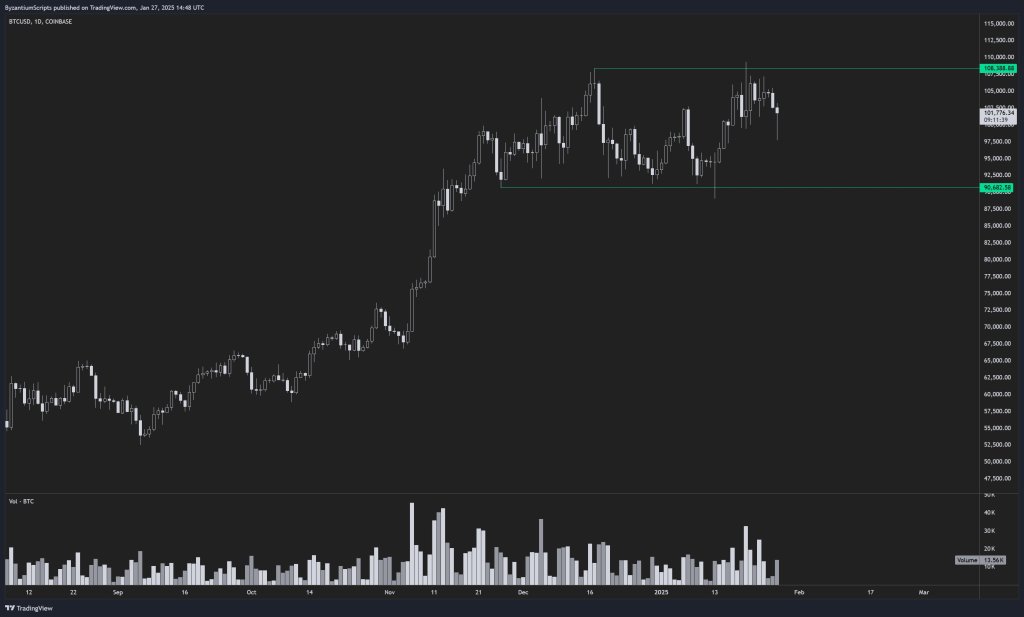
Crypto analyst Byzantine General (@ByzGeneral) has identified a consolidation range between $90,682 and $108,388 for Bitcoin. He anticipates limited movement prior to the FOMC meeting, citing three potential scenarios for how the market might respond once the Fed concludes its discussions: “Like I said in my thread yesterday, we’re really just consolidating between this range ($90,682 – $108,388). And I expect nothing material to happen until Wednesday FOMC. And then there are 3 possibilities with only 2 outcomes…FOMC surprise dovish -> break out of range, FOMC neutral -> chop in range for longer, FOMC hawkish -> chop in range for longer”
Bitcoin price
Bitcoin price, 1-day chart | Source: X @ByzGeneral

Crypto market participants often interpret a dovish stance—one that signals or enacts interest rate cuts or an extended pause—as supportive of risk-on assets, including Bitcoin and crypto. A surprise dovish tilt could be the catalyst for breaking the current trading range, according to Byzantine General. A neutral or hawkish outlook, on the other hand, might mean an extended period of sideway price movement.

In their assessment, banking giant ING laid out the broader macroeconomic context that could influence the Fed’s decision and projections for 2025. According to ING: “Federal Reserve set for an extended pause. After 100bp of rate cuts the Fed has signalled it needs evidence of economic weakness and more subdued inflation prints to justify further policy loosening. President Trump’s low tax, light-touch regulation policies should be good news for growth, while immigration controls and trade tariffs provide upside risk for prices, suggesting we could have a long wait for the next cut.”

The December FOMC saw a 25bp rate cut, but the subsequent commentary suggested a slower and more gradual path of easing for 2025, potentially totaling just 50bp for the year. ING points out that strong economic performance and persistent inflation pressures provide less incentive for the Fed to lower rates quickly. The bank also highlights a lingering possibility that the Fed may even adopt a more hawkish tone than it has publicly acknowledged so far:

“In fact, the risk is that the Fed is actually more hawkish than they indicated… However, with President Trump having just won re-election and his policy plans differing so starkly from President Joe Biden’s, Fed Chair Jay Powell acknowledged that some felt the need to incorporate the potential policy shifts into their December 2024 projections ahead of time. However, not all did and since his inauguration, there has been little sign of any moderation in Trump’s key policy thrust.”

ING’s economists further note that market participants largely expect no policy change on January 29, while the bank itself previously anticipated a March rate cut—an event it now sees as increasingly unlikely: “That means no change to monetary policy is a certainty on 29 January and it makes our previous call of a March rate cut look unlikely – currently just 6bp of a 25bp move is discounted by financial markets.”

However, ING still forecasts three rate cuts for 2025, hinging on a gradual cooling of the labor market and moderating wage pressures. They emphasize that rising Treasury yields, higher borrowing costs, and a stronger dollar could combine to tighten financial conditions, ultimately forcing the Fed’s hand later in the year: “Therefore we take the view that the Fed may need to push harder and cut rates a little further than currently priced by markets, but that is more likely to be a second half of 2025 development.”

On the balance sheet reduction (quantitative tightening, or QT), ING sees the Fed possibly ending QT in 2025 if excess liquidity shrinks to levels below what the central bank deems comfortable. The bank pegs $3 trillion in reserves as a critical threshold: “We are currently at US$3.5tn. So we’re comfortable. At the same time, the reverse repo balance is running at US$125bn, and if that were to hit zero, then we’d hit some degree of tightness. That’s close, as QT is running at US$60bn per month. QT may have to end by mid-2025 based on a simple extrapolation of this.”

Regarding currency markets, ING suggests that the dollar could retain its strength if the Fed remains cautious about easing: “December’s FOMC meeting certainly added support to the dollar bull run… it is hard to see the January FOMC event risk being read more dovishly… We doubt the Fed is ready to push back against those market expectations. This should keep dollar rate spreads relatively wide and argues that the FOMC will not be the reason the dollar corrects lower.”

With President Donald Trump starting his second term, questions about the Fed’s independence have resurfaced. Historically, Chair Jerome Powell has deflected suggestions of political influence: At the upcoming FOMC meeting, Powell can be expected to dodge questions about the Fed’s independence and the potential impact by Trump.

The President, however, has been explicit about his views on interest rates. When asked if he expected the Fed to listen to his demands for rate cuts, Trump responded: “I would make a strong statement.” After being asked if he expects the Fed to listen, he answered “Yeah.”

At press time, the total crypto market cap stood at $3.45 trillion.

Total crypto market cap
Total crypto market cap, 1-week chart | Source: TOTAL on TradingView.com
Featured image from Shutterstock, chart from TradingView.com
Jake Simmons

Jake Simmons

Jake Simmons has been a Bitcoin enthusiast since 2016. Ever since he heard about Bitcoin, he has been studying the topic every day and trying to share his knowledge with others. His goal is to contribute to Bitcoin's financial revolution, which will replace the fiat money system. Besides BTC and crypto, Jake studied Business Informatics at a university. After graduation in 2017, he has been working in the blockchain and crypto sector. You can follow Jake on Twitter at @realJakeSimmons.

Похожее

a16z: 7 Charts to Understand How Tokenization Is Changing the Nature of Assets

a16z: 7 Charts on How Tokenization is Transforming the Nature of Assets Tokenized Assets, often referred to as "real-world assets" (RWA), are altering the form, flow, and structure of the financial system. The market recently surpassed $30 billion (excluding stablecoins), driven largely by tokenized U.S. Treasuries. These offer investors digital, yield-bearing assets with efficient settlement. Growth varies significantly by asset class. Asset-backed credit leads in speed, followed by niche financial assets, while venture capital and active strategies took longer to scale. U.S. Treasuries and commodities dominate, holding about two-thirds of the current market share. Within commodities, gold tokenization dominates entirely due to its standardization and historical appeal in crypto. The ecosystem is spread across multiple blockchains. Ethereum holds over half the market, with others like BNB Chain, Solana, and Stellar holding significant shares. However, a key insight is that most tokenized assets currently lack "composability." While the total market is large, only a small fraction (e.g., 5% of tokenized bonds) is used within DeFi protocols. Many tokens are simply digital records of off-chain assets, not natively programmable financial building blocks. In contrast, smaller categories like reinsurance tokens see very high on-chain usage. Looking ahead, forecasts for the tokenized asset market by 2030 range from $2 trillion to over $30 trillion, representing immense potential growth from today's ~$340 billion base. Yet, relative to global markets (e.g., $140T+ in bonds), tokenization's penetration remains minuscule (<0.02%). The current phase focuses on digitizing straightforward assets for efficiency. The next major challenge is bringing more complex financial instruments on-chain and integrating tokenized assets into truly composable, internet-native financial infrastructure.

marsbit29 мин. назад

a16z: 7 Charts to Understand How Tokenization Is Changing the Nature of Assets

marsbit29 мин. назад

Data Theft at Will! Major Vulnerability Exposed in This Popular AI Programming Tool

A critical vulnerability in Anthropic's Claude Code AI programming tool allowed attackers to bypass its network sandbox for over five months, enabling potential data exfiltration. Independent researcher Aonan Guan discovered a second complete bypass exploiting a null-byte injection in the SOCKS5 proxy. This flaw, present since the sandbox's launch in October 2025, let processes inside the sandbox access any host, contrary to user-configured domain whitelists. The attack chain involved manipulating hostnames (e.g., `attacker.com\x00.google.com`). JavaScript's `endsWith()` check would pass `.google.com`, while the underlying C `getaddrinfo()` function would only parse `attacker.com` due to the null byte, creating a parser discrepancy. Combined with a previously disclosed prompt injection method, this could leak API keys, credentials, and internal data. Anthropic silently fixed the issue in April 2026 without a security advisory, CVE, or user notification. The researcher noted that Claude Code itself confirmed the vulnerability's severity when tested. This incident highlights broader industry issues, as similar vulnerabilities found in Google's Gemini CLI and GitHub's Copilot Agent also lacked public disclosures. The report criticizes the false sense of security created by a broken sandbox and emphasizes the need for defense-in-depth and transparency in AI tool security.

marsbit3 ч. назад

Data Theft at Will! Major Vulnerability Exposed in This Popular AI Programming Tool

marsbit3 ч. назад

Under the squeeze between giants Tether and Circle, how can foreign exchange stablecoins break through?

In the face of dominance by Tether (USDT) and Circle (USDC), new entrants in the stablecoin space face significant challenges competing directly, especially in the foreign exchange (FX) market. A more viable and efficient path forward is the adoption of synthetic foreign exchange (Forex) built atop existing USD stablecoin rails. The rise of stablecoin neo-banks represents the next major growth area for mass crypto adoption, with FX becoming a core component. However, replicating the vast liquidity, distribution channels, and network effects of USDT/USDC is extremely difficult for new FX stablecoin issuers. The total market cap of all FX stablecoins is a fraction (roughly 1/700th) of USD stablecoins, leading to issues like poor liquidity, peg instability, limited acceptance, and complex compliance hurdles. Instead of issuing spot FX stablecoins, the article advocates for a model inspired by traditional finance's non-deliverable forwards (NDFs). Users would continue to hold underlying USDT/USDC, while their account balances are displayed and economically settled in their preferred local currency through MtM (Mark-to-Market) NDF structures. This approach leverages the deep liquidity and infrastructure of USD stablecoins while providing synthetic forex exposure. Key advantages include strong peg stability via oracles, retained access to USD stablecoin yields and liquidity, high capital efficiency, and easy scalability to new currencies. Primary use cases for this on-chain NDF forex include: 1. Neo-banks, custodians, and wallets offering multi-currency accounts to attract international users and increase deposits. 2. Forex carry trade strategies, potentially offering more stable and scalable yields compared to crypto-native products like Ethena. 3. Global corporate payments, allowing businesses to receive payments in local currencies while hedging forex risk on-chain, similar to services offered by Stripe in traditional finance. This synthetic forex model presents a pragmatic solution to overcome the network effects of incumbents and unlock the next wave of stablecoin utility for global consumers and businesses.

marsbit4 ч. назад

Under the squeeze between giants Tether and Circle, how can foreign exchange stablecoins break through?

marsbit4 ч. назад

Торговля

Спот
Фьючерсы

Популярные статьи

Как купить S

Добро пожаловать на HTX.com! Мы сделали приобретение Sonic (S) простым и удобным. Следуйте нашему пошаговому руководству и отправляйтесь в свое крипто-путешествие.Шаг 1: Создайте аккаунт на HTXИспользуйте свой адрес электронной почты или номер телефона, чтобы зарегистрироваться и бесплатно создать аккаунт на HTX. Пройдите удобную регистрацию и откройте для себя весь функционал.Создать аккаунтШаг 2: Перейдите в Купить криптовалюту и выберите свой способ оплатыКредитная/Дебетовая Карта: Используйте свою карту Visa или Mastercard для мгновенной покупки Sonic (S).Баланс: Используйте средства с баланса вашего аккаунта HTX для простой торговли.Третьи Лица: Мы добавили популярные способы оплаты, такие как Google Pay и Apple Pay, для повышения удобства.P2P: Торгуйте напрямую с другими пользователями на HTX.Внебиржевая Торговля (OTC): Мы предлагаем индивидуальные услуги и конкурентоспособные обменные курсы для трейдеров.Шаг 3: Хранение Sonic (S)После приобретения вами Sonic (S) храните их в своем аккаунте на HTX. В качестве альтернативы вы можете отправить их куда-либо с помощью перевода в блокчейне или использовать для торговли с другими криптовалютами.Шаг 4: Торговля Sonic (S)С легкостью торгуйте Sonic (S) на спотовом рынке HTX. Просто зайдите в свой аккаунт, выберите торговую пару, совершайте сделки и следите за ними в режиме реального времени. Мы предлагаем удобный интерфейс как для начинающих, так и для опытных трейдеров.

1.3k просмотров всегоОпубликовано 2025.01.15Обновлено 2025.03.21

Как купить S

Sonic: Обновления под руководством Андре Кронье – новая звезда Layer-1 на фоне спада рынка

Он решает проблемы масштабируемости, совместимости между блокчейнами и стимулов для разработчиков с помощью технологических инноваций.

2.3k просмотров всегоОпубликовано 2025.04.09Обновлено 2025.04.09

Sonic: Обновления под руководством Андре Кронье – новая звезда Layer-1 на фоне спада рынка

HTX Learn: Пройдите обучение по "Sonic" и разделите 1000 USDT

HTX Learn — ваш проводник в мир перспективных проектов, и мы запускаем специальное мероприятие "Учитесь и Зарабатывайте", посвящённое этим проектам. Наше новое направление .

1.8k просмотров всегоОпубликовано 2025.04.10Обновлено 2025.04.10

HTX Learn: Пройдите обучение по "Sonic" и разделите 1000 USDT

Обсуждения

Добро пожаловать в Сообщество HTX. Здесь вы сможете быть в курсе последних новостей о развитии платформы и получить доступ к профессиональной аналитической информации о рынке. Мнения пользователей о цене на S (S) представлены ниже.

活动图片