Author: Maciej Zerelik
Compilation: AididiaoJP, Foresight News
The altcoin season begins when alternative cryptocurrencies start outperforming Bitcoin. However, pinpointing its exact start is not easy. This guide will detail the cyclical patterns of altcoin seasons, the impact of the 'ETF wall', narrative-driven sector rotations, and potential cross-chain strategies for 2026.
Understanding Altcoin Season
Definition of Altcoin Season
Many newcomers wonder what exactly an altcoin season is and why it attracts so much attention from crypto investors.
Altcoin season refers to a phase where at least 75% of the top 50 cryptocurrencies outperform Bitcoin over a rolling 90-day period. Analysts use this benchmark to gauge whether capital is flowing from BTC to other digital assets.
This concept became widely known during the 2017-2018 bull market. Countless investors shifted Bitcoin profits into Ethereum and other smaller coins, resulting in many altcoins achieving returns far exceeding BTC within months.
Historically, a full altcoin season typically lasts 2 to 6 months, though the rhythm varies each cycle.
'Outperformance' means that an altcoin's return over the same period is higher than Bitcoin's. For example, if Bitcoin rises 25% in 90 days and Solana rises 80%, then Solana has significantly outperformed BTC. When a majority of leading cryptocurrencies show similar performance, the market is generally considered to be in an altcoin season.
Bitcoin vs. Altcoin Dynamics: The ETF Wall
Bitcoin Dominance represents Bitcoin's share of the total cryptocurrency market capitalization. When this metric starts to decline, investors often interpret it as a signal that capital is flowing into altcoins.
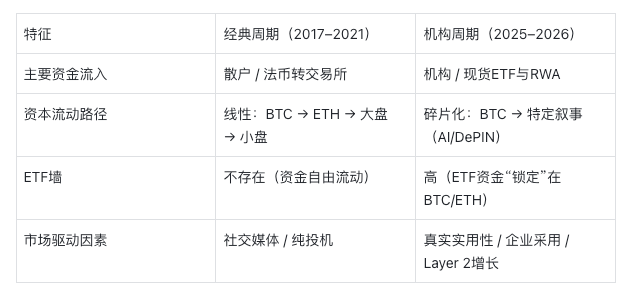
However, this market cycle is different from previous ones due to the so-called 'ETF wall'.
Spot Bitcoin ETFs launched by asset managers like BlackRock and Fidelity have attracted tens of billions from institutional investors. These investors typically gain Bitcoin exposure only through regulated financial products, effectively locking a portion of capital within the BTC ecosystem.
In the 2017 bull market, retail capital could flow more freely into thousands of altcoins. In contrast, for a broad altcoin season to emerge in 2026, it may require Bitcoin profit-taking combined with a fresh injection of retail and on-chain liquidity for capital to diffuse into the broader market.
Comparison of Classic Cycle (2017–2021) vs. Institutional Cycle (2025–2026):
How to Identify an Altcoin Season
Identifying an altcoin season early can make a huge difference, as entering after the biggest gains often carries higher risk and less upside.
Altcoin Season Index & New Metrics for 2026
The Altseason Index is one of the most popular tools for tracking market rotation. Developed by Blockchaincenter, it measures the performance of major cryptocurrencies against Bitcoin over the past 90 days on a 0-100 scale.
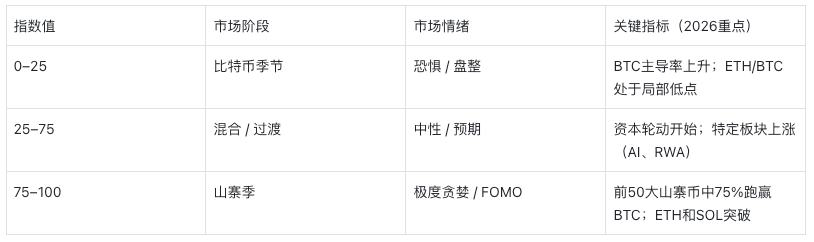
An index below 25 indicates a Bitcoin season, 25-75 is a mixed market, and when the index rises above 75, the market is generally considered to be in an altcoin season, as most leading altcoins are outperforming BTC.
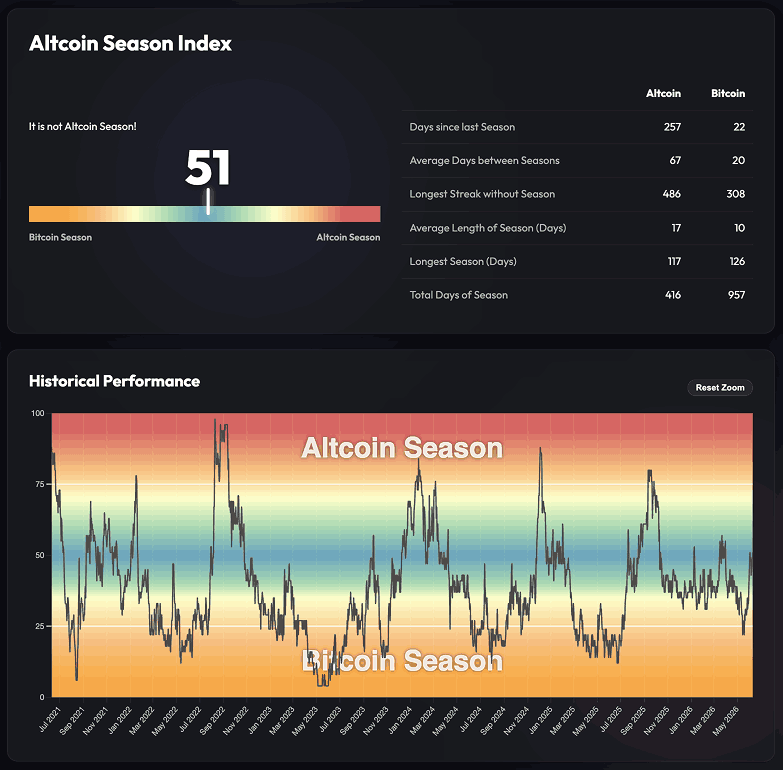
(Image: Altcoin Season Index, BlockchainCenter, June 10, 2026)
However, the 2026 market requires additional confirmation. Many analysts now simultaneously watch the ETH/BTC and SOL/BTC trading pairs. If Ethereum and Solana fail to strengthen against Bitcoin, even an index above 75 might indicate fleeting speculation rather than a sustainable rotation. Strong performance in these benchmark pairs often confirms that capital has flowed from Bitcoin into a broader ecosystem.
Table of Index Values Corresponding to Market Phases:
Key Indicators and Metrics
No single indicator perfectly predicts the market. Experienced investors combine multiple signals to judge whether a new rotation is truly beginning.
One of the strongest indicators is Bitcoin Dominance. When it retreats from above 50% to 40% or lower, it typically signals capital leaving BTC for altcoins. Concurrently, the total altcoin market cap growth rate should far outpace Bitcoin's, preferably by 2-3 times.
Trading activity also provides important clues. Week-over-week growth in altcoin/BTC trading volume exceeding 50% often signals rising investor interest. Social media engagement and Google Trends can corroborate, especially when search terms like 'best altcoins' or 'altcoin season' grow 30-50% over a few weeks.
When multiple indicators align, the probability of a genuine altcoin season is far higher than relying on the Altseason Index alone.
Historical Altcoin Rally Patterns
Each major altcoin rally leaves valuable lessons, helping investors recognize repeating trends and avoid emotional decisions in future cycles.
2017-2018 vs. 2020-2021 Bull Markets
While both cycles produced astonishing returns, the driving forces behind them were quite different.
The 2017-2018 altcoin season was fueled by the ICO boom. Hundreds of new blockchain projects raised funds directly from retail investors, with speculation often outweighing fundamentals. As Bitcoin reached new highs and slowed, capital quickly shifted to smaller coins, with many tokens skyrocketing hundreds of percent within months.
The 2020-2021 cycle took a different path. Market focus shifted to DeFi protocols, NFT platforms, Layer 1 blockchains, and later, meme coins. Simultaneously, institutional investors entered the crypto space through corporations, funds, and regulated products, bringing in capital volumes far exceeding previous eras.
Retail still played a major role in the NFT and meme coin frenzy, but institutional participation made the market larger and more mature. This shift also changed how capital rotates, making Ethereum and key sectors' leadership more important than widespread speculation. Therefore, future altcoin seasons may become increasingly selective rather than lifting all projects simultaneously.
Stages of an Altcoin Season: From BTC to Narrative-Driven
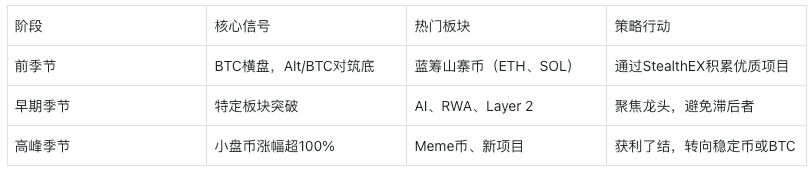
Modern altcoin cycles are no longer about all tokens rising in sync. Capital now rotates between different narratives, rewarding sectors with the strongest adoption and momentum. Understanding these stages helps investors see where money is flowing, rather than chasing projects that have already peaked.
Stage Comparison Table:
Pre-Season (Accumulation Phase)
The accumulation phase often begins when Bitcoin is ranging or correcting by 10-20%. During this time, many altcoins fall an additional 20-40% from local highs, causing retail interest to vanish.
Volume remains low, social media activity declines, and discussions are filled with negative sentiment. Behind the scenes, experienced investors are gradually accumulating fundamentally strong projects at discounted prices.
This phase often ends when Bitcoin stabilizes, Ethereum starts outperforming BTC, and volume slowly recovers. For long-term investors, this is the optimal time to research projects, build watchlists, and establish positions ahead of widespread market attention returning.
Early Season: Narrative-Led Breakouts
Many investors ask, when does the altcoin season start? In today's market, the answer often lies with narratives rather than market cap.
Not all top ten cryptocurrencies rise simultaneously; capital flows first into the most talked-about sectors. AI agents, Real World Assets (RWA), and DePIN projects have recently been prime examples of this trend.
The traditional strategy of buying the largest altcoins simply because they are in the top ten is much less effective now. Early winners are increasingly those projects with clear use cases, growing ecosystems, and the ability to attract fresh liquidity.
Peak Season (Maximum Activity)
When mid and small-cap coins achieve 100-500% gains within weeks, is this the typical altcoin season? During this phase, optimism reaches extremes, with the Fear & Greed Index often exceeding 80.
Retail investors aggressively buy every dip, while experienced traders begin scaling out and locking in profits. New token launches surge, leverage amplifies, and social media fills with unrealistic price predictions.
These conditions are often warning signs rather than buying opportunities. Rising volatility, excessive leverage, and parabolic moves typically signal that the market is nearing exhaustion. Historically, this peak phase lasts 2 to 6 weeks, followed by a sharp correction or a broader market rotation.
Trading Strategies for Altcoin Season
Successful altcoin investing depends on a clear plan. A structured strategy helps investors manage risk, protect profits, and avoid emotional decisions amidst intense volatility.
Portfolio Allocation & Sector Rotation
A balanced portfolio should match your risk tolerance and market environment. Conservative investors allocate more to Bitcoin, Ethereum, and stablecoins, while aggressive traders increase exposure to high-growth sectors during strong trends.
Sector rotation is equally important. Capital rarely stays in one narrative for the entire cycle. For instance, profits taken from AI-related projects might later shift to RWA, DePIN, gaming, or other emerging sectors. Following liquidity rather than chasing past winners often yields better long-term results.
Risk Management & Stop-Loss Discipline
Even the strongest altcoin season eventually ends, making risk management one of the most crucial parts of any strategy.
Many seasoned investors limit single positions to 5-10% of their portfolio to mitigate the impact of any one trade failing. Diversifying across 8-12 carefully selected projects further reduces overall risk while maintaining exposure to multiple narratives.
Keeping a portion of the portfolio in stablecoins also provides flexibility. Stablecoin reserves allow you to buy quality assets on pullbacks and protect profits when markets are overheated. Combined with pre-set stop-losses and profit targets, this disciplined approach often leads to steadier results than trying to maximize gains on every trade.
Altcoin Season vs. Bitcoin Season
Understanding the transition between Bitcoin seasons and altcoin seasons helps investors spot market rotations and adjust strategies before capital shifts.
Key Differences & Rotation Signals
The distinction between an altcoin season and a Bitcoin season lies in capital flow. During a Bitcoin season, BTC dominance typically rises above 50-60%, showing investor preference for the market's largest, most mature asset. Meanwhile, many altcoins underperform or decline against BTC even if their USD price is stable.
An altcoin season tells the opposite story. Bitcoin dominance often retreats to 40% or lower, with Ethereum and other major cryptocurrencies beginning to attract more liquidity. This rotation eventually spreads to mid and small-cap projects, creating the cycle's strongest gains.
Investor profiles also shift. Bitcoin seasons attract more conservative investors and institutions seeking lower volatility and long-term exposure. Altcoin seasons bring more speculative capital, with traders accepting higher risk in pursuit of significantly higher returns.
Historically, Bitcoin dominance phases can last for months, while intense altcoin seasons might last only 2-6 weeks before momentum fades. Therefore, watching BTC dominance is crucial. If dominance starts rising again, stablecoin inflows increase, and leading altcoins begin weakening against Bitcoin, these are often early signals that capital is flowing back to BTC or defensive positions, indicating the altcoin season is nearing its end.
Expert Predictions & Future Outlook for Altcoin Seasons
While all predictions involve uncertainty, understanding altcoin season forecasts and their key catalysts can help investors build smarter long-term strategies.
When Will the Next Altcoin Season Start
Many investors ask when the altcoin season will start, but no indicator provides an exact date. Successful prediction relies on a synthesis of macroeconomic conditions, Bitcoin's market cycle, and capital rotation patterns.
Historically, the strongest altcoin rallies have occurred 18 to 30 months after a Bitcoin market bottom, often following halving events. Given the most recent Bitcoin halving in April 2024, many analysts believe 2026-2027 could still offer favorable conditions if liquidity continues to improve.
Macroeconomic factors will play a significant role. Lower interest rates, expanding global liquidity, and stronger investor risk appetite could encourage capital flows into higher-risk digital assets. Institutional adoption will also support the market, though a large portion of investment remains concentrated in Bitcoin ETFs rather than altcoins.
Technological advancement will likely shape the next cycle alongside macro factors. Narratives like AI infrastructure, real-world asset tokenization, DePIN, next-gen DeFi, and blockchain gaming could become major destinations for fresh capital. Investors should not expect all cryptocurrencies to rise in unison but rather focus on sectors attracting real users, developer activity, and institutional interest.
When Will the 2026 Altcoin Season Start
The officially confirmed 2026 altcoin season has not yet begun, as Bitcoin currently accounts for roughly 56-60% of total market capitalization. Analysts predict that a sustained shift towards altcoins will only occur once Bitcoin dominance falls below 50-55% and the Altseason Index reaches its 75 threshold.
How to Prepare for the Next Altcoin Season
Preparing during market calm periods often creates better opportunities than reacting after prices have already surged. A solid plan allows you to act confidently when momentum returns.
Building a Watchlist
The best watchlists prioritize quality over quantity. Before adding a project, investors should confirm it has a working product, active users, an experienced and transparent development team, reasonable valuation, and a strong community supporting long-term growth.
A practical research checklist should include: token utility, ecosystem activity, developer updates, partnerships, liquidity, tokenomics, and competitive advantages. Regularly reviewing these factors makes it easier to distinguish lasting projects from short-term hype.
Frequently Asked Questions
What is the current Altcoin Season Index value?
You can view the Altcoin Season Index in real-time on Blockchaincenter. A score of 0-25 indicates a Bitcoin season, 25-75 a mixed market, and 75-100 hints at an altcoin season. While the index updates daily, checking it weekly often provides clearer signals and avoids overtrading due to short-term noise.
When will the altcoin season come?
Many investors ask when the altcoin season will come, but there is no fixed date. Historically, major altcoin rallies have often occurred 12-18 months after a Bitcoin halving. Although the last halving was in April 2024, market conditions, Bitcoin dominance, liquidity, and ETH/BTC strength are more important than the calendar.
Will an altcoin season still happen if Bitcoin crashes?
No. A broad altcoin season requires Bitcoin to remain stable or rise moderately. When Bitcoin drops more than 20% in a short time, capital typically leaves the entire crypto market rather than rotating into altcoins. Historically, significant altcoin rallies have occurred during Bitcoin consolidation or moderate uptrends, with only a few exceptions during minor BTC corrections.
When will altcoins surge?
The answer to when altcoins will surge usually depends on market rotation. Altcoins often accelerate after Bitcoin dominance peaks above 50-55% and starts to decline, simultaneously with the ETH/BTC ratio strengthening. A 15-30% rise in ETH/BTC frequently heralds broader gains, with capital gradually flowing from Ethereum to large-cap, then mid-cap, and finally small-cap altcoins.