Zcash Founder Says Ironwood Will Verify ZEC Supply On Day One

bitcoinistPublicado em 2026-06-10Última atualização em 2026-06-10

Resumo

Zcash founder Zooko Wilcox states that the proposed Ironwood upgrade will allow users to independently and immediately verify the correctness of ZEC's circulating supply from its first day of activation. This addresses community concerns following a remediated Orchard vulnerability, shifting focus from proving past counterfeiting to enabling trustless, real-time supply verification. Ironwood will deactivate the old, shielded Orchard pool for new transactions, requiring funds to pass through a turnstile accounting mechanism to enter the new pool. This design, according to Wilcox, will "snuff out" any potential excess ZEC above the legitimate 4.5 million ZEC in Orchard, ensuring the total supply aligns with the known 16 million ZEC (eventually 21 million). Users running a full node can thus verify supply soundness without relying on trust in developers or assumptions about past events. While Wilcox personally believes no counterfeiting occurred, Ironwood is designed to function regardless. If excess ZEC attempts to exit the old pool, the turnstile will block it, both protecting the supply and potentially revealing any past exploit. The upgrade aims to provide definitive, trustless assurance about the current supply state.

Zcash founder Zooko Wilcox says the proposed Ironwood upgrade will give users immediate, trustless verification that ZEC’s circulating supply is sound from the first block of activation. His comments address a central concern in the Zcash community following the disclosure of a recently remediated Orchard vulnerability: whether users can verify the supply without relying on developers, auditors, or post-hoc assumptions.

In a post on X and a follow-up discussion on the Zcash Community Forum, Wilcox argued that Ironwood’s purpose is not primarily to prove whether counterfeiting ever occurred inside Orchard. Instead, he framed the upgrade as a way to make the current circulating supply independently verifiable by any user running a full node.

“When Zcash Ironwood activates, you will immediately, on Day 1 of Ironwood, gain trustless verification from your own full node that the actual supply of Zcash is correct,” Wilcox wrote, referring to “16M ZEC now, 21M ZEC eventually.”

Zcash Ironwood To Enable Trustless Supply Checks

The distinction matters because the Orchard pool is shielded. That privacy property is central to Zcash’s design, but it also complicates the question of whether a past soundness bug could have been exploited without leaving the kind of public trace visible in a transparent ledger. Wilcox’s response is to separate two issues that have become conflated in the debate: whether counterfeit coins were ever created, and whether the current supply can be verified as sound after Ironwood.

“This appears to be super confusing to almost everyone, because they are confusing two different things: No counterfeit coins were created. The current supply is sound,” Wilcox wrote. “These are different things! I’m prioritizing the second one.”

Under the Ironwood proposal, the old Orchard pool would effectively be prevented from continuing as an active internal circulation venue. Transactions creating new outputs in the old Orchard pool would be rejected, meaning funds could no longer keep moving privately inside that pool after activation. Instead, funds would have to exit through Zcash’s turnstile accounting mechanism before entering the new Ironwood pool.

That turnstile is the key to the argument. It tracks how much ZEC legitimately entered and exited a pool and blocks attempts to move out more than the amount that entered. According to Wilcox, that means users do not need to wait for every Orchard user to migrate, nor rely on game-theoretic assumptions about how a hypothetical attacker might behave.

“And what I said above — that you will immediately gain that trustless, local verification of the soundness of the Zcash supply — is true regardless of whether or not there are any counterfeit coins in the Orchard pool,” he wrote. “How is this possible!? Because Ironwood will, on Day 1, in the first block that activates Ironwood, snuff out any excess ZEC in the Orchard pool.”

Wilcox specified the relevant threshold as the amount “legitimately part of the supply of ZEC in the Orchard pool,” which he put at 4.5 million ZEC. Any excess ZEC above that would be unable to remain economically useful under the new rules, because it could not continue circulating within the old Orchard pool or escape into another pool beyond the turnstile limit.

“It will snuff out any excess ZEC immediately, trustlessly, and globally,” he added. “It will snuff out any excess ZEC regardless of whether there actually is any excess ZEC. If there isn’t, then all Ironwood does is give you the ability to prove to yourself that there isn’t.”

Wilcox said he personally believes there is no counterfeit ZEC, citing reasons he said he had previously given. But he emphasized that Ironwood is designed to remove the need for trust in his assessment, or in any other individual’s judgment. In his forum post, he laid out two possible worlds: one in which an unlimited amount of counterfeit ZEC was created inside Orchard before the vulnerability was closed, and one in which it was not. In both, he argued, Ironwood should allow users to verify on Day 1 that no more than 16 million ZEC is currently circulating.

The proposal may also produce evidence over time about whether Orchard was ever exploited. If no excess ZEC attempts to leave the old pool as users migrate, that would support the view that no counterfeiting occurred. If excess ZEC does try to leave, the turnstile should reject it, preserving the circulating supply while exposing that counterfeiting had taken place.

At press time, ZEC traded at $
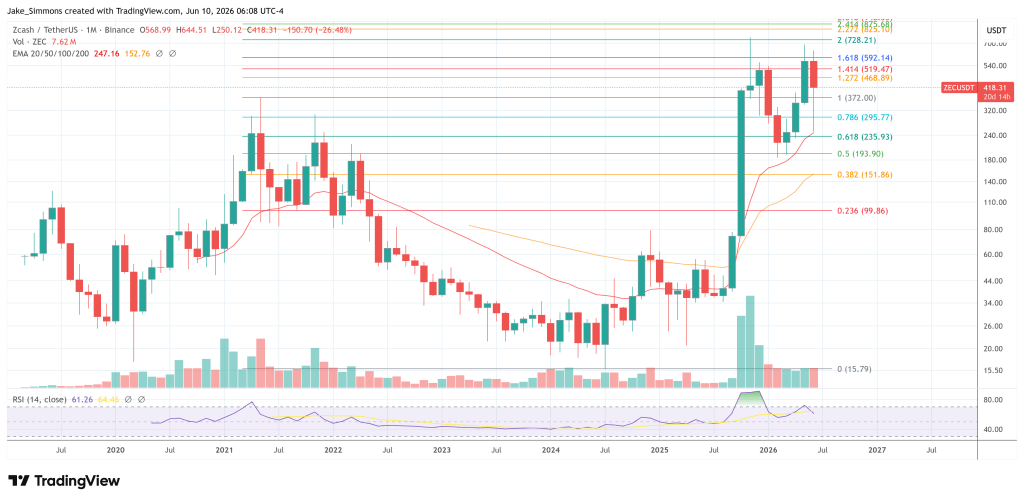
ZEC remains above the prior all-time high, 1-month chart | Source: ZECUSDT on TradingView.com

Criptomoedas em alta

Leituras Relacionadas

Robinhood Chain's Success Proves Ethereum is Not Dead

Robinhood Chain's success demonstrates that Ethereum's L1+L2 model is thriving, not dying. Traditional crypto projects often focused on token sales and chose infrastructure to maximize token value. However, real-world businesses building cash-based products make different, pragmatic choices. When launching its chain, Robinhood chose Ethereum as its base layer and built a custom L2 using Arbitrum technology. It uses Ethereum blobs for data availability, ETH for gas, and relies on Ethereum for security. This mirrors Coinbase's earlier decision to build Base as an Ethereum L2. These are not ideological choices but sound business decisions driven by needs for security, liquidity, control, and predictable economics. The shift in the industry is from "token-centric" models to "cash business" models. Real companies serving broad user bases prioritize risk reduction, product improvement, and profit. For them, blockchain is infrastructure. The Ethereum L1+L2 "barbell" structure is ideal: the highly decentralized, neutral, and liquid L1 for settlement and security, combined with customizable, high-performance L2s for execution. This trend is positive for Ethereum and ETH. As more real businesses build on it, ETH becomes more integrated, distributed, and useful, strengthening its network effects and monetary premium. Robinhood's path—starting on an existing L2 and graduating to a dedicated one—is likely to become a standard playbook, proving the enduring utility of Ethereum's layered architecture for serious commercial adoption.

Odaily星球日报Há 11m

Robinhood Chain's Success Proves Ethereum is Not Dead

Odaily星球日报Há 11m

Tencent Heavily Invests in an IPO

"Tencent-Backed DPU Unicorn Leopard Cloud Intelligence Files for IPO on Shenzhen's ChiNext Board" Leopard Cloud Intelligence, a Shenzhen-based developer of Data Processing Unit (DPU) chips, has officially applied for an IPO on the ChiNext Board, aiming to become China's first publicly listed DPU company. Founded in August 2020 by Dr. Xiaoyang Xiao, a Stanford PhD graduate and serial entrepreneur who previously co-founded chip company RMI (acquired by Broadcom), the company focuses on the high-growth DPU sector. Its development accelerated following NVIDIA's formal introduction of the DPU concept in late 2020. The company has developed China's first high-performance, general-purpose programmable DPU SoC chip, boasting 400Gbps network bandwidth and claiming significant performance improvements and power savings over traditional solutions. Financially, Leopard Cloud's revenue grew exponentially from RMB 170,000 in 2023 to RMB 370 million in 2025, yet it remains unprofitable with substantial net losses. Its IPO application utilizes ChiNext's recently introduced fourth set of listing standards, which emphasize R&D and market valuation over short-term profitability. Tencent is the company's most significant backer and largest shareholder, holding a 19.78% stake after participating in multiple funding rounds. Other prominent investors include Sequoia Capital China, Shenzhen Capital Group, Five Dimensions Capital, and various government-guided funds from Shenzhen and Hangzhou. Pre-IPO, the company was valued at over RMB 14 billion. This listing is seen as a milestone for Shenzhen's semiconductor industry, complementing the recent successful IPO review of Yuexin Semiconductor (a Guangzhou-based wafer manufacturer) and signaling a wave of high-end hardware technology companies from the Greater Bay Area going public on the ChiNext Board.

marsbitHá 42m

Tencent Heavily Invests in an IPO

marsbitHá 42m

Circle Secures a 'Federal Infrastructure License' for Stablecoins: The Deep Implications of Circle National Trust Receiving Final Approval from the OCC

Circle announced on July 10, 2026, that it has received final approval from the U.S. Office of the Comptroller of the Currency (OCC) to establish Circle National Trust, a federally chartered national trust bank. This landmark event marks the first time a stablecoin issuer has formally entered the U.S. federal regulatory system as a trust bank, signifying a major shift in competition from simply issuing tokens to controlling regulated infrastructure for issuance, custody, reserve management, and settlement. Initially, Circle National Trust will focus on providing digital asset custody services for Circle and its affiliates, with plans to potentially extend services to institutional clients later. While reserve management for USDC is planned as a future capability, the approval of the trust charter creates a federal pathway for it. This grants Circle significant federal regulatory credibility, a crucial factor for institutional adoption of USDC. The move positions USDC to evolve from a crypto-company stablecoin toward a federally supervised dollar settlement infrastructure. The approval underscores a strategic focus on building vertical integration for stablecoins—encompassing issuance, custody, and settlement—within a specialized trust bank model rather than a traditional commercial bank. This model aligns with the full-reserve, payment-oriented nature of stablecoins while leveraging federal oversight. For the broader payments industry, this development strengthens the stablecoin settlement rail for use cases like cross-border payments and real-time settlement, complementing rather than replacing existing systems like Visa or Mastercard. The move reshapes the competitive landscape, as other players like Coinbase and Paxos also seek similar trust charters. Circle has now established a significant regulatory moat. Overall, this approval represents a pivotal step for stablecoins, transitioning them from innovative tools to core financial infrastructure governed by the highest levels of U.S. banking regulation.

marsbitHá 1h

Circle Secures a 'Federal Infrastructure License' for Stablecoins: The Deep Implications of Circle National Trust Receiving Final Approval from the OCC

marsbitHá 1h

Trading

Spot

Artigos em Destaque

Como comprar ZEC

Bem-vindo à HTX.com!Tornámos a compra de Zcash (ZEC) simples e conveniente.Segue o nosso guia passo a passo para iniciar a tua jornada no mundo das criptos.Passo 1: cria a tua conta HTXUtiliza o teu e-mail ou número de telefone para te inscreveres numa conta gratuita na HTX.Desfruta de um processo de inscrição sem complicações e desbloqueia todas as funcionalidades.Obter a minha contaPasso 2: vai para Comprar Cripto e escolhe o teu método de pagamentoCartão de crédito/débito: usa o teu visa ou mastercard para comprar Zcash (ZEC) instantaneamente.Saldo: usa os fundos da tua conta HTX para transacionar sem problemas.Terceiros: adicionamos métodos de pagamento populares, como Google Pay e Apple Pay, para aumentar a conveniência.P2P: transaciona diretamente com outros utilizadores na HTX.Mercado de balcão (OTC): oferecemos serviços personalizados e taxas de câmbio competitivas para os traders.Passo 3: armazena teu Zcash (ZEC)Depois de comprar o teu Zcash (ZEC), armazena-o na tua conta HTX.Alternativamente, podes enviá-lo para outro lugar através de transferência blockchain ou usá-lo para transacionar outras criptomoedas.Passo 4: transaciona Zcash (ZEC)Transaciona facilmente Zcash (ZEC) no mercado à vista da HTX.Acede simplesmente à tua conta, seleciona o teu par de trading, executa as tuas transações e monitoriza em tempo real.Oferecemos uma experiência de fácil utilização tanto para principiantes como para traders experientes.

346 Visualizações TotaisPublicado em {updateTime}Atualizado em 2026.06.02

Como comprar ZEC

Discussões

Bem-vindo à Comunidade HTX. Aqui, pode manter-se informado sobre os mais recentes desenvolvimentos da plataforma e obter acesso a análises profissionais de mercado. As opiniões dos utilizadores sobre o preço de ZEC (ZEC) são apresentadas abaixo.

活动图片













