Zcash Developers Spin Out New Wallet After ECC Breakup

bitcoinistPublicado em 2026-01-10Última atualização em 2026-01-10

Resumo

Following the breakup of the Electric Coin Company, the team behind Zashi has formed a new Zcash-focused company and is launching a new wallet called "cashZ," built from the existing Zashi codebase. The move aims to scale Zcash to billions of users while maintaining a dedicated focus on the Zcash ecosystem. The team emphasized its commitment to full-stack Zcash development, with no plans to launch new coins. The decision to spin out was driven by three factors: Zcash's cypherpunk roots, governance and incentive alignment, and the need for scalability. The team criticized the current regulatory environment as "a decade of compliance theater," arguing that privacy is a civil-liberties issue requiring assertive leadership. They also highlighted misalignments between nonprofit and for-profit structures, advocating for a governance model free from bureaucratic constraints. The goal is to make Zcash so large that privacy cannot be marginalized. The team cited Zcash's recent resurgence and ecosystem growth, stating, "We are no longer so small they can’t see us. We now need to get so big they can’t stop us." The cashZ wallet is currently accepting waitlist sign-ups, with a full launch expected in a few weeks.

A day after the Electric Coin Company’s breakup, the team behind Zashi said it is spinning out into a new Zcash-focused company and launching a new wallet built from the existing Zashi codebase. The move is framed as an effort to “scale Zcash to billions,” while keeping the group’s work narrowly centered on the Zcash stack.

In a message signed by Josh Swihart, the developers said the new wallet is code-named “cashZ” and will reuse the codebase originally built for Zashi. The team also opened a waitlist for early access, telling existing Zashi users that “all you need to do is join the waitlist” and that a migration will be designed to feel as seamless as the current Zashi experience once cashZ is live “in a few weeks.”

The announcement attempted to answer what it expects will be the community’s first question after an organizational breakup: whether the engineers are still committed to Zcash. “The entire team that worked at Electric Coin Company and built Zashi is still 100% focused on full-stack Zcash development,” the post said. “We aren’t launching any new coins, we’re just scaling Zcash. To do that, it required that we leave and start a new Zcash-focused company.”

Why Zcash’s Core Builders Are Starting A New Company

The team said the decision to form a new company came down to three ideas: Zcash’s cypherpunk roots, governance and incentive alignment, and a need to scale.

In the longest section, the developers cast the past decade of crypto regulation as a kind of prolonged stress test for privacy, describing it as “a decade of compliance theater.” The post argued that privacy-preserving tools are not merely a technical preference but a civil-liberties issue that requires a more assertive posture from the organizations building them.

“This effort was not simply about complying with unjust laws. Of course, we must abide by the law, or else be thrown in a cage,” the message said. “But when the law is unjust, we have a moral imperative to work to change the unjust law. One tool for that is code.”

From that premise, the team connected Zcash’s mission to mainstreaming privacy online, positioning the protocol as “a peaceful global reform movement” and saying that a structure bogged down by internal friction would be poorly suited to that fight. “To do this, we need an organization that has courage,” it added, arguing for “cypherpunk leadership” and a governance model that “can’t cut through red tape.”

A second argument centered on what the post described as chronic misalignment when nonprofits and venture-style startups are intertwined. The team cited recent commentary from Andreessen Horowitz to bolster the idea that crypto’s “foundation era” is ending, while distinguishing the Zcash Foundation as an example of a standalone nonprofit that can do effective work.

The critique was not subtle: “Nonprofits are about rule-lawyering, while tech startups are about rewriting the rules,” the statement said, adding that nonprofit boards often lack the accountability mechanisms of corporate boards. The team also pointed to heightened scrutiny of US nonprofits and the risk of tax exemptions being challenged, arguing there is “no benefit in keeping a fast-growing technology company under a nonprofit when the substance of the organization is a for-profit.”

The final section placed the wallet launch inside a bigger ambition: to make Zcash large enough that privacy becomes difficult to marginalize. It framed the strategic choice as binary: “to be so small they can’t see you, or so big they can’t stop you.”

The post claimed that Zcash has undergone “a complete rebirth” over the past two years, crediting an ecosystem-wide effort and naming contributors including Sean Bowe, genzcash, and Shielded Labs, alongside “many more who prefer to remain unnamed.” That resurgence, it argued, changes the operating environment: “We are no longer so small they can’t see us. Everyone can see us. We now need to get so big they can’t stop us.”

For now, the tangible deliverable is cashZ, with the team promising more details later and signaling that execution will be the message. “Actions will speak louder than words,” Swihart wrote, urging users to join the waitlist as the developers “boot up” the new wallet and push toward what they describe as “onboarding billions to Zcash.”

At press time, the ZEC price recovered some losses from yesterday’s crash and traded at $436.
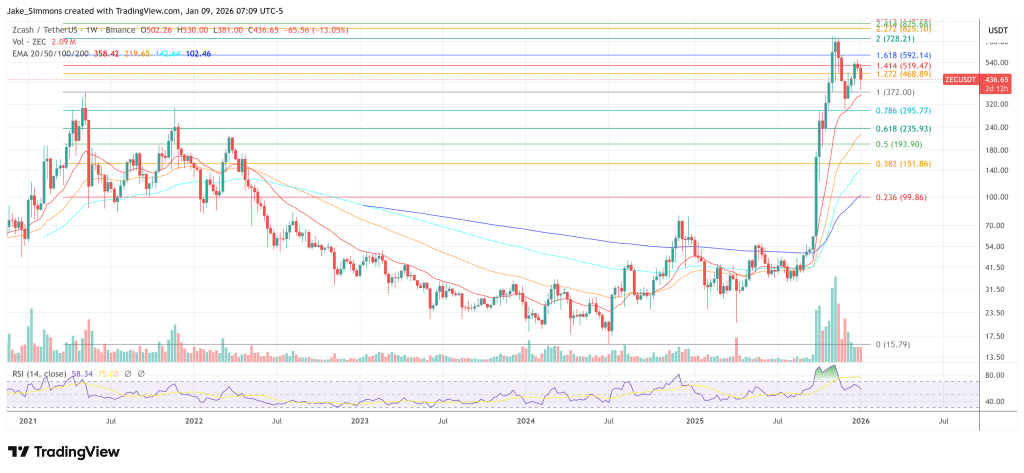
Zcash makes a higher low, 1-week chart | Source: BTCUSDT on TradingView.com

Perguntas relacionadas

QWhat is the name of the new wallet being launched by the developers after the ECC breakup?

AThe new wallet is code-named 'cashZ'.

QWhy did the team decide to form a new company instead of staying with the Electric Coin Company?

AThe decision was based on three main ideas: Zcash's cypherpunk roots, governance and incentive alignment, and the need to scale Zcash to billions of users.

QAccording to the announcement, what is the team's stance on launching new coins?

AThe team stated they are not launching any new coins and are '100% focused on full-stack Zcash development' with the goal of scaling Zcash.

QWhat did the developers describe as a 'chronic misalignment' in their post?

AThey described a chronic misalignment when nonprofits and venture-style startups are intertwined, arguing that nonprofits are about 'rule-lawyering' while tech startups are about 'rewriting the rules'.

QWhat is the team's stated ultimate goal for the Zcash protocol?

AThe ultimate goal is to make Zcash so large that 'privacy becomes difficult to marginalize,' aiming to onboard billions of users and become 'so big they can’t stop us.'

Leituras Relacionadas

Google and Amazon Simultaneously Invest Heavily in a Competitor: The Most Absurd Business Logic of the AI Era Is Becoming Reality

In a span of four days, Amazon announced an additional $25 billion investment, and Google pledged up to $40 billion—both direct competitors pouring over $65 billion into the same AI startup, Anthropic. Rather than a typical venture capital move, this signals the latest escalation in the cloud wars. The core of the deal is not equity but compute pre-orders: Anthropic must spend the majority of these funds on AWS and Google Cloud services and chips, effectively locking in massive future compute consumption. This reflects a shift in cloud market dynamics—enterprises now choose cloud providers based on which hosts the best AI models, not just price or stability. With OpenAI deeply tied to Microsoft, Anthropic’s Claude has become the only viable strategic asset for Google and Amazon to remain competitive. Anthropic’s annualized revenue has surged to $30 billion, and it is expanding into verticals like biotech, positioning itself as a cross-industry AI infrastructure layer. However, this funding comes with constraints: Anthropic’s independence is challenged as it balances two rival investors, its safety-first narrative faces pressure from regulatory scrutiny, and its path to IPO introduces new financial pressures. Globally, this accelerates a "tri-polar" closed-loop structure in AI infrastructure, with Microsoft-OpenAI, Google-Anthropic, and Amazon-Anthropic forming exclusive model-cloud alliances. In contrast, China’s landscape differs—investments like Alibaba and Tencent backing open-source model firm DeepSeek reflect a more decoupled approach, though closed-source models from major cloud providers still dominate. The $65 billion bet is ultimately about securing a seat at the table in an AI-defined future—where missing the model layer means losing the cloud war.

marsbitHá 1h

Google and Amazon Simultaneously Invest Heavily in a Competitor: The Most Absurd Business Logic of the AI Era Is Becoming Reality

marsbitHá 1h

Computing Power Constrained, Why Did DeepSeek-V4 Open Source?

DeepSeek-V4 has been released as a preview open-source model, featuring 1 million tokens of context length as a baseline capability—previously a premium feature locked behind enterprise paywalls by major overseas AI firms. The official announcement, however, openly acknowledges computational constraints, particularly limited service throughput for the high-end DeepSeek-V4-Pro version due to restricted high-end computing power. Rather than competing on pure scale, DeepSeek adopts a pragmatic approach that balances algorithmic innovation with hardware realities in China’s AI ecosystem. The V4-Pro model uses a highly sparse architecture with 1.6T total parameters but only activates 49B during inference. It performs strongly in agentic coding, knowledge-intensive tasks, and STEM reasoning, competing closely with top-tier closed models like Gemini Pro 3.1 and Claude Opus 4.6 in certain scenarios. A key strategic product is the Flash edition, with 284B total parameters but only 13B activated—making it cost-effective and accessible for mid- and low-tier hardware, including domestic AI chips from Huawei (Ascend), Cambricon, and Hygon. This design supports broader adoption across developers and SMEs while stimulating China's domestic semiconductor ecosystem. Despite facing talent outflow and intense competition in user traffic—with rivals like Doubao and Qianwen leading in monthly active users—DeepSeek has maintained technical momentum. The release also comes amid reports of a new funding round targeting a valuation exceeding $10 billion, potentially setting a new record in China’s LLM sector. Ultimately, DeepSeek-V4 represents a shift toward open yet realistic infrastructure development in the constrained compute landscape of Chinese AI, emphasizing engineering efficiency and domestic hardware compatibility over pure model scale.

marsbitHá 2h

Computing Power Constrained, Why Did DeepSeek-V4 Open Source?

marsbitHá 2h

Trading

Spot
Futuros
活动图片

