Zcash Developers Spin Out New Wallet After ECC Breakup

bitcoinistPublicado em 2026-01-10Última atualização em 2026-01-10

Resumo

Following the breakup of the Electric Coin Company, the team behind Zashi has formed a new Zcash-focused company and is launching a new wallet called "cashZ," built from the existing Zashi codebase. The move aims to scale Zcash to billions of users while maintaining a dedicated focus on the Zcash ecosystem. The team emphasized its commitment to full-stack Zcash development, with no plans to launch new coins. The decision to spin out was driven by three factors: Zcash's cypherpunk roots, governance and incentive alignment, and the need for scalability. The team criticized the current regulatory environment as "a decade of compliance theater," arguing that privacy is a civil-liberties issue requiring assertive leadership. They also highlighted misalignments between nonprofit and for-profit structures, advocating for a governance model free from bureaucratic constraints. The goal is to make Zcash so large that privacy cannot be marginalized. The team cited Zcash's recent resurgence and ecosystem growth, stating, "We are no longer so small they can’t see us. We now need to get so big they can’t stop us." The cashZ wallet is currently accepting waitlist sign-ups, with a full launch expected in a few weeks.

A day after the Electric Coin Company’s breakup, the team behind Zashi said it is spinning out into a new Zcash-focused company and launching a new wallet built from the existing Zashi codebase. The move is framed as an effort to “scale Zcash to billions,” while keeping the group’s work narrowly centered on the Zcash stack.

In a message signed by Josh Swihart, the developers said the new wallet is code-named “cashZ” and will reuse the codebase originally built for Zashi. The team also opened a waitlist for early access, telling existing Zashi users that “all you need to do is join the waitlist” and that a migration will be designed to feel as seamless as the current Zashi experience once cashZ is live “in a few weeks.”

The announcement attempted to answer what it expects will be the community’s first question after an organizational breakup: whether the engineers are still committed to Zcash. “The entire team that worked at Electric Coin Company and built Zashi is still 100% focused on full-stack Zcash development,” the post said. “We aren’t launching any new coins, we’re just scaling Zcash. To do that, it required that we leave and start a new Zcash-focused company.”

Why Zcash’s Core Builders Are Starting A New Company

The team said the decision to form a new company came down to three ideas: Zcash’s cypherpunk roots, governance and incentive alignment, and a need to scale.

In the longest section, the developers cast the past decade of crypto regulation as a kind of prolonged stress test for privacy, describing it as “a decade of compliance theater.” The post argued that privacy-preserving tools are not merely a technical preference but a civil-liberties issue that requires a more assertive posture from the organizations building them.

“This effort was not simply about complying with unjust laws. Of course, we must abide by the law, or else be thrown in a cage,” the message said. “But when the law is unjust, we have a moral imperative to work to change the unjust law. One tool for that is code.”

From that premise, the team connected Zcash’s mission to mainstreaming privacy online, positioning the protocol as “a peaceful global reform movement” and saying that a structure bogged down by internal friction would be poorly suited to that fight. “To do this, we need an organization that has courage,” it added, arguing for “cypherpunk leadership” and a governance model that “can’t cut through red tape.”

A second argument centered on what the post described as chronic misalignment when nonprofits and venture-style startups are intertwined. The team cited recent commentary from Andreessen Horowitz to bolster the idea that crypto’s “foundation era” is ending, while distinguishing the Zcash Foundation as an example of a standalone nonprofit that can do effective work.

The critique was not subtle: “Nonprofits are about rule-lawyering, while tech startups are about rewriting the rules,” the statement said, adding that nonprofit boards often lack the accountability mechanisms of corporate boards. The team also pointed to heightened scrutiny of US nonprofits and the risk of tax exemptions being challenged, arguing there is “no benefit in keeping a fast-growing technology company under a nonprofit when the substance of the organization is a for-profit.”

The final section placed the wallet launch inside a bigger ambition: to make Zcash large enough that privacy becomes difficult to marginalize. It framed the strategic choice as binary: “to be so small they can’t see you, or so big they can’t stop you.”

The post claimed that Zcash has undergone “a complete rebirth” over the past two years, crediting an ecosystem-wide effort and naming contributors including Sean Bowe, genzcash, and Shielded Labs, alongside “many more who prefer to remain unnamed.” That resurgence, it argued, changes the operating environment: “We are no longer so small they can’t see us. Everyone can see us. We now need to get so big they can’t stop us.”

For now, the tangible deliverable is cashZ, with the team promising more details later and signaling that execution will be the message. “Actions will speak louder than words,” Swihart wrote, urging users to join the waitlist as the developers “boot up” the new wallet and push toward what they describe as “onboarding billions to Zcash.”

At press time, the ZEC price recovered some losses from yesterday’s crash and traded at $436.
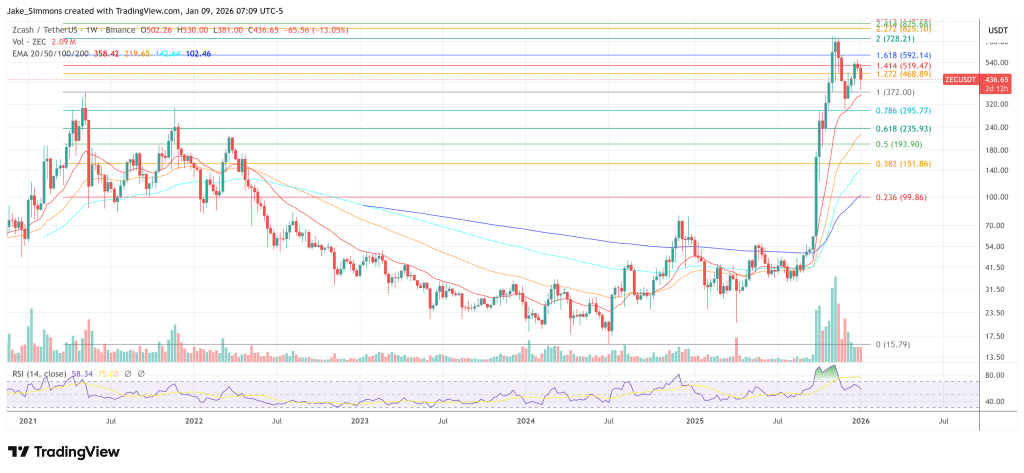
Zcash makes a higher low, 1-week chart | Source: BTCUSDT on TradingView.com

Perguntas relacionadas

QWhat is the name of the new wallet being launched by the developers after the ECC breakup?

AThe new wallet is code-named 'cashZ'.

QWhy did the team decide to form a new company instead of staying with the Electric Coin Company?

AThe decision was based on three main ideas: Zcash's cypherpunk roots, governance and incentive alignment, and the need to scale Zcash to billions of users.

QAccording to the announcement, what is the team's stance on launching new coins?

AThe team stated they are not launching any new coins and are '100% focused on full-stack Zcash development' with the goal of scaling Zcash.

QWhat did the developers describe as a 'chronic misalignment' in their post?

AThey described a chronic misalignment when nonprofits and venture-style startups are intertwined, arguing that nonprofits are about 'rule-lawyering' while tech startups are about 'rewriting the rules'.

QWhat is the team's stated ultimate goal for the Zcash protocol?

AThe ultimate goal is to make Zcash so large that 'privacy becomes difficult to marginalize,' aiming to onboard billions of users and become 'so big they can’t stop us.'

Leituras Relacionadas

Bitwise: Crypto Becomes a Contrarian Investment, Three Logics to Understand the Current Market

**Summary** Matt Hougan, Bitwise's CIO, analyzes the current crypto market through three key lenses, arguing it has shifted from a momentum-driven to a contrarian investment. **1) Crypto Becomes a Contrarian Play:** The market is weak, with major assets like Bitcoin and Ethereum down significantly. Capital has moved to hot sectors like AI, leaving crypto as an "unloved" asset class. This transforms crypto investing from trend-following to a test of patience and fundamental analysis. Investors now favor projects with solid fundamentals (e.g., Hyperliquid) over speculative ones. **2) Regulatory Overhang:** The uncertain fate of the U.S. CLARITY Act, a major crypto regulatory framework, is a key headwind. With its passage in 2024 seen as far from guaranteed (estimates range from 30-55%), institutional capital remains on the sidelines, choosing less risky alternatives like AI stocks. The market needs clarity—whether the bill passes or fails—more than any specific outcome to move decisively. **3) Capital Rotates to New Fundamentals:** This cycle differs from past bear markets where money fled to Bitcoin. Now, capital seeks smaller assets with strong use cases. While major cryptos fell in May 2024, tokens like Hyperliquid (+72%), Zcash (+50%), and XLM (+44%) rallied on their specific fundamentals. This rotation confirms the new contrarian, fundamentals-driven logic and signals the bear market may be in its later stages. **Conclusion:** Short-term pressure persists due to regulatory uncertainty and competition from AI narratives. Investing in crypto now requires a contrarian mindset—acting against the crowd and focusing on fundamental value. Patience and targeting high-quality projects based on their merits are essential for capturing long-term gains.

marsbitHá 20m

Bitwise: Crypto Becomes a Contrarian Investment, Three Logics to Understand the Current Market

marsbitHá 20m

ChatGPT Might Be Disappearing Soon

OpenAI announced at its "Intelligence at Work" event that its coding assistant, Codex, will be fully integrated into the ChatGPT app within weeks. This move marks a strategic shift from a conversational AI (Chat) towards a unified "agentic" platform capable of execution. Codex, originally launched to compete with Anthropic's Claude Code, has grown rapidly to 5 million weekly active users, with 20% being non-developers like analysts and designers. Its enterprise revenue now constitutes 40% of OpenAI's total. The integration is the first step in creating a super-app combining ChatGPT (interface), Codex (execution engine), and the Atlas browser (web access). OpenAI also unveiled new Codex features: specialized Agent plugins for six professional roles, an "Annotations" tool for direct document editing, and a "Sites" function to turn work into shareable web apps. Internally, this reflects a power shift; the Codex team now leads core product strategy. While the ChatGPT brand remains for its vast user base, the platform's future is focused on autonomous agents that perform tasks, not just chat. The article notes that competition with Claude Code pushed OpenAI's development, with Codex competing on cost-effectiveness and accessibility rather than raw coding quality. It concludes that the essence of "ChatGPT" is evolving from a chatbot into an AI agent platform, with the name potentially becoming a legacy symbol of its original function.

marsbitHá 31m

ChatGPT Might Be Disappearing Soon

marsbitHá 31m

WWDC26 Ultimate Preview: The All-New Siri is the Main Course, iOS 27 is Another Year of Refinements

Apple has confirmed WWDC26 will begin on June 8, with the keynote at 10 AM PT (1 AM Beijing Time, June 9). This year's focus is expected to shift significantly from routine OS updates to Apple's progress in AI, particularly a major overhaul of Siri. Reports indicate the highlight will be a new Siri, reportedly powered by Google's Gemini technology. This upgraded assistant is expected to appear as a lightweight bubble from the Dynamic Island and be accessible via a unified "Search or Ask" system-wide entry point. It aims to deeply integrate with iOS 27, iPadOS 27, and macOS 27, accessing personal data like messages, photos, and documents, with a potential standalone Siri app also in development. For iOS 27, leaks suggest incremental improvements rather than major redesigns. Key updates may include a redesigned, more customizable Camera app, enhanced photo editing tools within the Photos app, and potential early system optimizations for a future foldable iPhone. The update is also rumored to prioritize bug fixes, stability, and performance optimization. iPadOS 27 is anticipated to focus on improving productivity features like window management, file systems, and external display support to better utilize the iPad's hardware. macOS 27 is seen as a core platform for Apple Intelligence, likely receiving an optimized Siri, new AI features, and continued refinement of the "Liquid Glass" design language. Notably, macOS 27 may finally drop support for Intel-based Macs. The overarching theme for WWDC26 is whether Apple can effectively integrate AI across its ecosystem. The success of the new Siri and Apple Intelligence will be judged on their ability to move beyond standalone features and become a cohesive, context-aware system layer that understands user workflows across iPhone, iPad, Mac, and other devices, while maintaining Apple's emphasis on privacy and stability. The conference represents Apple's critical attempt to catch up and redefine the AI assistant experience after a perceived slow start in the generative AI era.

marsbitHá 56m

WWDC26 Ultimate Preview: The All-New Siri is the Main Course, iOS 27 is Another Year of Refinements

marsbitHá 56m

Trading

Spot
Futuros
活动图片