Zcash Developer Rift: Entire ECC Team Walks Out Of Bootstrap

bitcoinistPublicado em 2026-01-09Última atualização em 2026-01-09

Resumo

The entire Electric Coin Company (ECC) team behind Zcash has left the nonprofit Bootstrap, citing a governance breakdown. ECC CEO Josh Swihart stated the team was constructively discharged by a majority faction of the board (Zaki Manian, Christina Garman, Alan Fairless, and Michelle Lai), making their work untenable. The ECC team will form a new company but will continue building on Zcash, stressing the protocol itself is unaffected. Zcash founder Zooko Wilcox reassured users the network remains secure and operational. Bootstrap's board responded that the dispute was not about Zcash's mission but about legal and fiduciary obligations as a nonprofit. They were negotiating a deal involving Zashi and argued the proposed structure introduced legal and political risks to the ecosystem. The conflict caused ZEC's price to drop by 13%.

The entire Electric Coin Company (ECC) team behind privacy coin Zcash has left Bootstrap, a nonprofit created to support the token, after what ECC CEO Josh Swihart described as a governance breakdown that made the team’s work untenable. Swihart said the team will form a new company and continue building on Zcash, while stressing that the protocol itself is unaffected.

A Zcash Civil War In The Making?

In a statement posted to X, Swihart said that “over the past few weeks, it’s become clear that the majority of Bootstrap board members ... have moved into clear misalignment with the mission of Zcash,” naming Zaki Manian, Christina Garman, Alan Fairless, and Michelle Lai, which he referred to collectively as “ZCAM.”

Swihart framed the departure as a response to employment changes imposed by the board majority. “Yesterday, the entire ECC team left after being constructively discharged* by ZCAM,” he wrote. “In short, the terms of our employment were changed in ways that made it impossible for us to perform our duties effectively and with integrity.”

The exit represents a sharp escalation in tensions inside one of the support structures surrounding Zcash, a network that has historically relied on a small number of specialist organizations to fund and coordinate development. Swihart did not provide specific details on the governance actions or employment terms at issue, but portrayed the split as a defensive move to protect Electric Coin Company’s ability to execute its mandate.

“We’re founding a new company, but we’re still the same team with the same mission: building unstoppable private money,” Swihart said. He emphasized that “the Zcash protocol is unaffected,” adding that the decision was “simply about protecting our team’s work from malicious governance actions that have made it impossible to honor ECC’s original mission.”

Zooko Wilcox, the founder of Zcash said the conflict does not involve him or Shielded Labs, also sought to separate the organizational dispute from the operational status of the network. “Big drama in one (or two now?) of the many Zcash support orgs,” he wrote on X, before offering reassurance to users.

“The Zcash network is open source, permissionless, secure, and private, and nothing that happens in this conflict can change that,” Zooko said. “You can safely continue to use Zcash.”

In a second point, Zooko offered a character reference for the board members named by Swihart, highlighting how personal trust and long-running working relationships can factor into ecosystem governance disputes. “I’ve worked closely with Alan Fairless, Zaki Manian, and Christina Garman for more than 10 years, through many intense and difficult situations, and with Michelle Lai for about 5 years,” he wrote. “Based on my experiences, I believe them all to be people of exceptionally high integrity.”

Bootstrap Board Responds

[UPDATE:] After Swihart’s post, Bootstrap’s board issued its own statement tying the dispute to governance and legal constraints around a proposed transaction involving Zashi, describing the fallout as a disagreement over structure rather than over Zcash’s underlying mission. “We are saddened by this outcome and respect the contributions of those who have chosen to depart,” the board wrote, before adding that “it’s important to clarify the nature of the disagreement.”

Bootstrap said it was formed as a 501(c)(3) public-benefit nonprofit with “specific legal and fiduciary obligations” governing how assets, intellectual property, and transactions can be structured. According to the board, it had been discussing “external investment and alternative structures to privatize Zashi,” while working with legal counsel to ensure any path forward complied with US nonprofit law and preserved the long-term Zcash mission.

“There is nothing wrong with for-profits,” the statement said, adding that a well-executed effort could bring “a large amount of outside capital into making Zcash and privacy great and user-friendly,” but emphasizing that “Bootstrap/ECC’s nonprofit constraints are real.”

The board warned that the most recent version of the proposed deal could create legal and political risk for the broader ecosystem, arguing it “introduces new vulnerabilities for politically-motivated attacks on Zcash.” It cited the possibility of donor lawsuits and even an unwinding scenario in which “Zashi would have to be transferred back to ECC,” framing those tail risks as a threat not just to the parties involved but to “the entire Zcash ecosystem.”

In that context, the statement cast the standoff as a compliance issue: “This is not a disagreement about Zcash’s mission, which remains unchanged,” the board wrote. “It is about compliance with the legal and fiduciary obligations of a 501(c)(3), and about the moral imperative of ensuring Bootstrap’s assets remain dedicated to the mission they were meant to serve.”

At press time, the ZEC price was strongly affected by the drama, trading at $408.57.
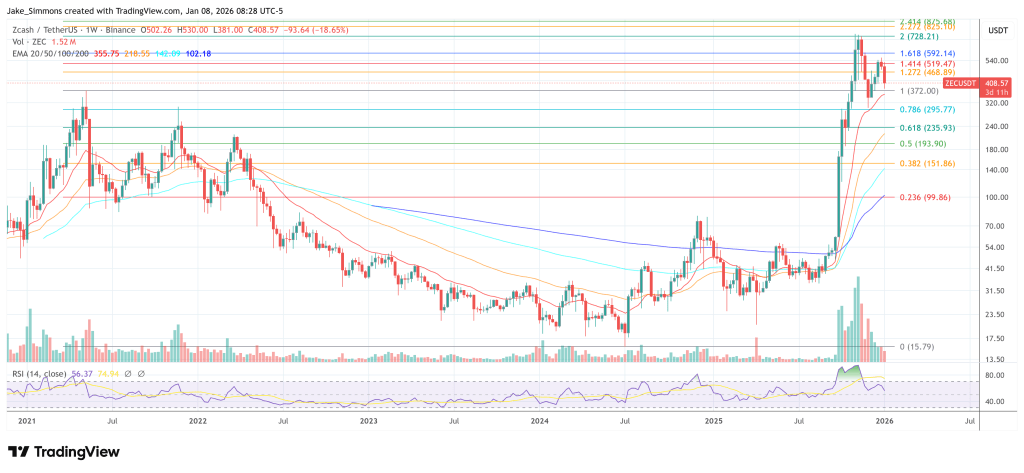
ZEC price crashes by 13%, 1-week chart | Source: ZECUSDT on TradingView.com

Leituras Relacionadas

7 Months After the Collapse of Huiwang, Southeast Asia's Escrow Platforms Undergo a Major Reshuffle

Following the collapse of Huione Pay—dubbed the "Alipay of Southeast Asia"—seven months ago, the region's underground financial guarantee platform sector is undergoing a significant reshuffle. This power vacuum has been swiftly filled by emerging platforms such as XinBi, Tiger/Navigator, JinBei (renamed JinBo), Dali/Tiancheng, and FullyLight. These platforms, operating largely via Telegram and offering services like escrow for illicit transactions, have absorbed the vast user base and markets left behind by Huione. While positioning themselves as "trust intermediaries," their primary clientele consists of networks involved in online scams, money laundering, illegal gambling, and even human trafficking. For instance, the Tiger/Navigator platform explicitly provides "escrow" services for kidnapping-for-ransom operations ("强押车交易"). Data underscores the immense scale: Huione alone processed over $103 billion in cryptocurrency payments and facilitated over $31 billion through its escrow market before its downfall, linking it to Cambodia's notorious Prince Group. Since its collapse, competitors have seen explosive growth. For example, the XinBi platform has accumulated over $1.6 billion in total USDT revenue, while platforms like NewPay, OkPay (under Dali), and FullyLight Wallet collectively processed over $4.8 billion in USDT in a single year. This ecosystem thrives in regions like Cambodia and Myanmar, where regulatory gaps allow these platforms to act as critical financial infrastructure for sprawling cybercrime industries, from scam compounds to online casinos. The article concludes that the moniker "Southeast Asian Alipay" is a misnomer, obscuring the platforms' fundamental role in enabling serious criminal enterprises rather than representing legitimate financial innovation.

Odaily星球日报Há 2m

7 Months After the Collapse of Huiwang, Southeast Asia's Escrow Platforms Undergo a Major Reshuffle

Odaily星球日报Há 2m

The Changing Landscape: What Are Crypto VCs Experiencing?

Title: The Shifting Landscape of Crypto Venture Capital The era of dedicated crypto venture capital funds is undergoing a significant transformation. Once essential for navigating the sector's complexity and high risk, these specialized funds are now facing an identity crisis as the market matures. This shift mirrors historical patterns in other specialized investment classes like cleantech and SPACs, where initial information advantages dissipate as technologies become mainstream and integrated into existing industry frameworks. The article argues that crypto is reaching a critical inflection point, transitioning from a "building phase" to an "integration phase." Major players like Stripe, BlackRock, and Visa now engage with crypto not for its novel mechanics but as a foundational financial infrastructure. Their needs—regulatory compliance, banking partnerships, distribution channels—align with traditional fintech, a domain easily understood by large, generalist funds like Sequoia and Founders Fund. This evolution creates a "barbell effect" within the VC landscape. On one end are massive, diversified platforms that can incorporate crypto as one vertical among many. On the other are small, nimble funds focused on niche, experimental projects. The middle ground—medium-sized dedicated crypto funds—is being squeezed out. Their typical fund size makes it impossible to generate sufficient returns solely from early-stage crypto bets, yet they cannot compete with giants for later-stage deals. Consequently, leading crypto-native firms like Paradigm and Framework Ventures are expanding into AI, robotics, and other sectors, driven partly by LP pressure for better returns amid a broader VC DPI crisis. Others, like Dragonfly and a16z, have narrowed their crypto focus predominantly to financial infrastructure like stablecoins, reframing the sector's core narrative. For crypto entrepreneurs, this consolidation presents challenges. While generalist funds offer larger checks and broader resources, crypto projects now compete fiercely with AI for attention and capital within these firms. Furthermore, the long-term, non-commercial foundational work that built the ecosystem—funded by dedicated crypto VCs—is less likely to attract generalist capital focused on direct returns. The conclusion is that "crypto investor" as a standalone category is becoming obsolete, akin to "internet investor." Crypto is becoming a baseline infrastructure layer. The future will see a barbell structure: large-scale growth financing handled by generalist funds, while pioneering, speculative projects are funded by small, specialized vehicles. The dedicated crypto funds of the 2017-2021 boom, which incubated core infrastructure, are giving way to this new, bifurcated reality.

Foresight NewsHá 20m

The Changing Landscape: What Are Crypto VCs Experiencing?

Foresight NewsHá 20m

As Consensus Accelerates, What Are Young Investors Betting On?

Title: As Consensus Forms Faster, What Are Young Investors Betting On? In the rapid evolution of tech investment, a new generation of young investors is navigating a landscape where AI, robotics, commercial aerospace, and quantum computing are advancing simultaneously. Traditional investment logic based on financial models is giving way to a need for deep technical understanding and the ability to act before industry consensus forms. An analysis of trends from the "WAIC FUTURE TECH" list of young investment leaders reveals key shifts in focus. The first major trend is the movement of AI from the digital screen into the physical world. Investment is shifting from large language models and chatbots towards embodied AI, robotics, AI hardware, and edge computing. While demonstrations generate excitement, the real challenge lies in achieving scalable, reliable, and cost-effective delivery in complex real-world environments like factories and logistics. Success depends not just on algorithms but on the integration of sensors, actuators, and control systems. Second, the competitive focus for large models is moving beyond raw capability toward building an "intelligence flywheel." The goal is to create self-reinforcing systems where user interaction generates data, improving the model, which in turn enhances the user experience and attracts more engagement. Companies that successfully embed AI into workflows to create these closed-loop systems can build lasting value that isn't easily erased by the next model upgrade. Third, facing a potential bottleneck in high-quality human-generated data, investors are looking at new underlying technologies. Reinforcement learning and self-play, as demonstrated by AlphaGo Zero, offer paths for AI to generate its own experience. Scientific foundation models, which aim to build general AI capabilities for fields like life sciences and materials discovery, represent a non-consensus direction that could unlock new frontiers of knowledge and data. Finally, in deep-tech areas like quantum computing, commercial aerospace, and space-based infrastructure, patient capital is essential. These fields have long, uncertain development and validation cycles involving complex engineering, supply chains, and regulations. Investment here requires a long-term view, focusing on foundational team capabilities and the eventual emergence of market demand, even if commercial returns are distant. Collectively, these trends illustrate how young investors are adapting to a new era. They are learning to make earlier, technically-informed judgments, balance hype with real-world viability, and provide the patient capital needed to build the deep-tech foundations of the future.

marsbitHá 48m

As Consensus Accelerates, What Are Young Investors Betting On?

marsbitHá 48m

Trading

Spot
活动图片





