Zcash Bug Could Have Minted Unlimited ZEC Undetected

bitcoinistPublicado em 2026-06-05Última atualização em 2026-06-05

Resumo

A critical vulnerability in Zcash's Orchard shielded pool, discovered by researcher Taylor Hornby on May 29, 2026, could have allowed an attacker to create an unlimited amount of undetectable counterfeit ZEC. The flaw, involving an under-constrained element in the Orchard circuit, existed from the pool's 2022 activation until an emergency fix was deployed by June 2, 2026. Hornby identified the bug using AI-assisted auditing tools and confirmed its exploitability in a test environment. Due to Orchard's privacy features, which hide transaction amounts and history, there is no cryptographic way to prove whether the vulnerability was exploited before the fix. While Shielded Labs assesses prior exploitation as unlikely, this uncertainty has sparked a debate on proving supply integrity in privacy-preserving systems. In response, Shielded Labs and other developers are exploring a network upgrade, potentially involving a new shielded pool and formal verification of the circuit rules to prevent future vulnerabilities and allow verification of the ZEC supply's integrity. ZEC's price fell nearly 45% following the disclosure.

A critical vulnerability in Zcash’s Orchard shielded pool could have allowed an attacker to create an unlimited amount of counterfeit ZEC without detection, according to a new disclosure from Zooko Wilcox, Jason McGee and security researcher Taylor Hornby. The flaw was discovered on May 29, remediated through an emergency ecosystem response completed by June 2, and has now triggered a broader debate over how Zcash can prove supply integrity in a privacy-preserving system.

Orchard Flaw Puts Zcash Supply Integrity Under Scrutiny

The vulnerability was found by Hornby, an experienced security engineer hired by Shielded Labs in April 2026 to conduct ongoing security research on the Zcash protocol. According to the disclosure, the mandate was straightforward: find protocol-level weaknesses before adversaries did. Hornby began reviewing Zcash with a combination of traditional security research and newer AI-assisted auditing methods.

The timing was unusually compressed. Shortly after Anthropic released its Opus 4.8 model on May 28, Hornby used it in a targeted review of the Orchard circuit. One day later, he found a critical counterfeiting flaw and disclosed it to Zcash Open Development Lab, or ZODL, whose engineers coordinated the emergency response with other ecosystem participants.

“The vulnerability could have been exploited to undetectably create an unlimited amount of counterfeit ZEC within Orchard,” the Shielded Labs post said. “Because of the privacy properties of Orchard, there is no way to cryptographically prove whether the vulnerability was exploited before it was remediated. However, a network upgrade can be deployed to protect users and prove the integrity of the Zcash supply.”

The disclosure states that the bug was “real and exploitable.” Hornby, with the help of Opus 4.8, wrote a complete exploit and tested it in a local regtest environment, where it generated unlimited counterfeit ZEC that could not be detected. The authors said that had the same tool been run on mainnet, it would have generated unlimited, undetectable counterfeit ZEC in Hornby’s mainnet wallet.

Technically, the issue involved an under-constrained element of the Orchard circuit. That made it possible to feed arbitrary false inputs into an elliptic curve multiplication while still passing the multiplication check. The vulnerability existed from Orchard’s activation in May 2022 until the emergency fix was deployed on June 1, 2026.

That timeline is central to the concern. In a transparent ledger, supply irregularities can generally be audited by inspecting public balances and transaction values. Orchard is different by design: it hides amounts and transaction history. That privacy model means the system depends heavily on the correctness of the circuit rules that define valid shielded transactions.

Josh Swihart, founder and CEO of Zcash Open Development Lab, the team behind the creation and launch of Zcash and builder of the Zodl wallet, framed the issue in those terms in a separate post. “A shielded Zcash transaction includes a proof that it followed the protocol’s rules, as defined in the rulebook (the circuit) that defines what constitutes a valid transaction. The Orchard vulnerability was in one of the rules, written loosely enough that it would accept false information and still pass. As a result, the engine could be convinced that a fake transaction was valid.”

Swihart added that the flaw was not in Zcash’s underlying cryptography or the proof engine itself, but in the handwritten rules. In his words, “This was a flaw in the handwritten rules, not in the underlying cryptography or the engine that creates proofs.”

Shielded Labs said prior exploitation appears unlikely, while emphasizing that users should not be asked to rely on that assessment alone. The authors pointed to several reasons for their view: the flaw had evaded years of scrutiny by leading cryptographers, Hornby was specifically hired to find such vulnerabilities, and the response window after discovery was sharply narrowed by the speed of ZODL and the broader Zcash ecosystem.

“The discovery was not accidental—it was the result of a deliberate effort to identify vulnerabilities of this kind before malicious actors could,” the post said. “Taylor is one of the most skilled people in the world at this. He used the most recent AI tools, available only to white-hat security researchers, along with a sophisticated custom-built AI harness and prompts, and worked hard to outrace the attackers. We think he probably succeeded.”

Still, the authors acknowledged the unresolved cryptographic uncertainty. Because of Orchard’s privacy properties and the nature of the bug, they said there is no definitive way to prove solely through cryptography whether the vulnerability was exploited before the fix.

Shielded Labs Eyes New Pool And Formal Verification

To address that, Shielded Labs is exploring a proposed network upgrade with other Zcash developers. The plan would deploy a new shielded pool and enforce turnstile accounting on coins moving from the existing Orchard pool, with the goal of allowing anyone to verify the integrity of the Zcash supply and prove the non-existence of counterfeit ZEC in Orchard. A follow-up post is expected next week with more details, including tradeoffs and implementation mechanics. Any major upgrade would still need community support and the standard governance process before activation.

Swihart said a second Orchard pool could, in principle, be targeted for NU7 at the end of July, though he did not take a fixed position on whether that path should be pursued. He argued that the larger issue is preventing this class of failure from recurring, with formal verification as the strongest answer.

“Formal verification fixes this,” Swihart wrote. “A mathematical proof can be constructed to reduce the parts humans must review to a concise, readable statement of the rules. A computer then checks the entire rulebook to ensure it matches. AI tools can now do the work of writing these proofs.”

Shielded Labs said it is already accelerating proactive security work with Hornby and Anthropic, initiating a project to formally verify the Orchard circuit, and opening searches for a Head of Security and a Cryptographer. The episode leaves Zcash with a difficult but clear path: repair the trust assumptions around Orchard, prove supply integrity where possible, and move future shielded design closer to machine-checked guarantees rather than human-reviewed complexity.

Over the past 24 hours, ZEC has fallen nearly 45% amid the uncertainty. At press time, it was trading at $337.
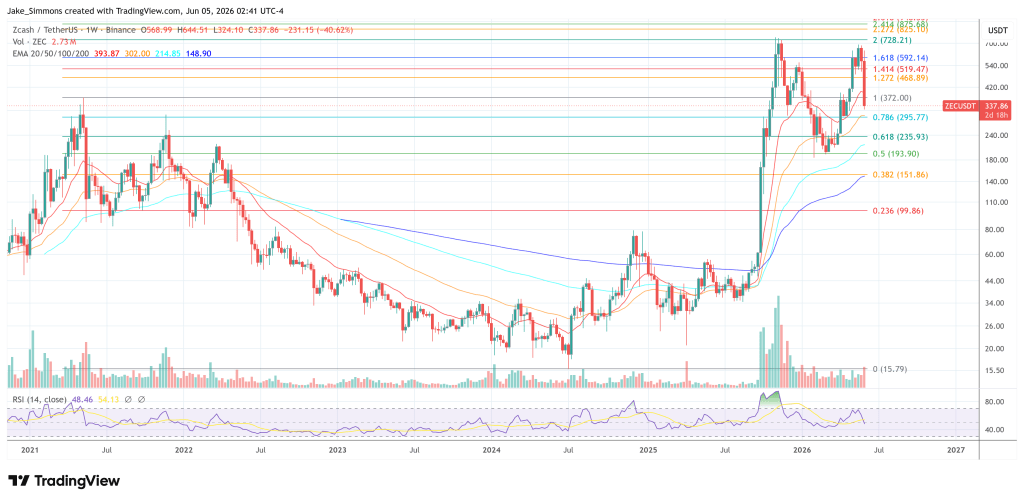
ZEC trades below the 1.618 Fib again, 1-week chart | Source: ZECUSDT on TradingView.com

Perguntas relacionadas

QWhat was the nature of the critical vulnerability discovered in Zcash's Orchard shielded pool?

AThe vulnerability was a critical counterfeiting flaw. An under-constrained element in the Orchard circuit allowed an attacker to feed arbitrary false inputs into an elliptic curve multiplication while still passing the multiplication check, potentially enabling the creation of an unlimited amount of counterfeit ZEC that could not be detected.

QWho discovered the vulnerability, and what tools aided in its discovery?

AThe vulnerability was discovered by security researcher Taylor Hornby, who was hired by Shielded Labs. He used a combination of traditional security research and newer AI-assisted auditing methods, specifically employing Anthropic's Opus 4.8 model released on May 28 in a targeted review of the Orchard circuit, which led to the discovery the next day.

QWhy is it impossible to cryptographically prove whether the Orchard vulnerability was exploited before it was fixed?

ADue to the privacy properties of the Orchard shielded pool, which hides transaction amounts and history by design. This means supply irregularities cannot be audited by inspecting public data, unlike transparent ledgers. The system relies on the correctness of the circuit rules, and the bug's nature leaves no definitive cryptographic trace of prior exploitation.

QWhat proposed solution is Shielded Labs exploring to address the supply integrity concerns raised by the Orchard bug?

AShielded Labs is exploring a proposed network upgrade to deploy a new shielded pool. This plan would enforce turnstile accounting on coins moving from the existing Orchard pool, with the goal of allowing anyone to verify the integrity of the Zcash supply and prove the non-existence of counterfeit ZEC in Orchard.

QAccording to Josh Swihart, what is the strongest long-term solution to prevent this class of failure from recurring?

AJosh Swihart identified formal verification as the strongest answer. This involves constructing a mathematical proof to reduce the human-reviewed parts to a concise statement of the rules, and then using a computer to check that the entire rulebook matches those rules, with AI tools now capable of writing these proofs.

Leituras Relacionadas

SharpLink CEO: How to Understand Ethereum Developers Just Exceeded 1 Million?

SharpLink CEO reflects on the milestone of Ethereum surpassing 1 million historical developers, emphasizing that this figure represents the largest pool of technical talent ever assembled around an open, permissionless blockchain network. While approximately 232,000 developers remain active, the key question for the crypto industry is not which chain is fastest, but where the best builders choose to build long-term. Ethereum's advantage lies in a decade-long accumulation of infrastructure, standards, tools, liquidity, and a cohesive culture, making it the default operating system for programmable finance. This developer base is tackling complex challenges: the Glamsterdam upgrade aims to enhance scalability while preserving core principles; synchronous composability seeks to unify Rollup ecosystems; and significant efforts are underway for post-quantum security. Ethereum's deeper network effects stem from composability and shared standards (like the EVM and Solidity), creating a flywheel of more developers, tools, and liquidity. Three reinforcing strengths cement Ethereum's lead: credible neutrality (secured by ~900k validators), a modular architecture with interconnected Rollups, and a culture that attracts top researchers. The ecosystem is consolidating as the trusted coordination layer for internet-native finance, favored by large institutions valuing security and liquidity. The future of Ethereum is being built by this global community of founders and architects.

链捕手Mesmo agora

SharpLink CEO: How to Understand Ethereum Developers Just Exceeded 1 Million?

链捕手Mesmo agora

A Clod of Chinese Soil Chokes Two Japanese Giants

"Chinese Soil Chokes Japanese Giants" The production of a key electronic specialty gas, tungsten hexafluoride (WF6), vital for manufacturing AI chips, was halted by two leading Japanese producers—Kanto Denka and Central Glass. Their shutdown was not due to a technological failure but a sudden, critical shortage of a raw material they had long taken for granted: ultra-high-purity (6N-grade) tungsten powder, which is almost entirely sourced from China. Following a quiet Chinese export announcement in January 2026, tungsten powder shipments to Japan dropped to zero for months. Despite frantic efforts, Japanese companies found no viable alternative; imported powder was three times more expensive and lacked the required purity. Their existing stockpiles were exhausted by mid-2026. WF6 is essential for depositing tungsten into the microscopic contact holes of High Bandwidth Memory (HBM) chips, which are crucial for advanced processors like those from Nvidia. While Japanese firms had mastered producing ultra-pure WF6 gas, their entire supply chain relied on China's 6N tungsten powder—a dependency now revealed as a fatal vulnerability. China's dominance in this "soil" results from decades of painstaking R&D by companies like Xiamen Tungsten and China Tungsten & Hightech. They overcame immense technical hurdles, such as separating chemically similar molybdenum from tungsten, to achieve mass production of the world's purest tungsten powder. With their primary suppliers gone, Kanto Denka and Central Glass announced a permanent halt to WF6 production starting July 1, 2026. This immediately created a supply crisis for major semiconductor manufacturers like Samsung and SK Hynix, forcing them to urgently seek and certify new Chinese suppliers for WF6 itself. The reversal marks a dramatic shift: China has moved from exporting low-value raw materials to controlling the high-purity foundation of a critical global tech supply chain, upending a long-established industrial hierarchy.

marsbitHá 31m

A Clod of Chinese Soil Chokes Two Japanese Giants

marsbitHá 31m

Without Tencent, What's Left for Suiyuan?

The article centers on the crucial question posed in the title: what is Seyond Technology really worth if its dominant customer, Tencent, were to stop purchasing its AI chips? As the last of China's "Four AI Chip Dragons" to secure approval for a public listing, Seyond's IPO filing reveals a profound and controversial dependency. In 2025, 74.9% to over 80% of its revenue came from Tencent. The piece argues that this extreme customer concentration is not merely a vulnerability but a strategic outcome of China's AI industry evolution. It contrasts Seyond's path with its peers (Moore Thread, Biren Technology, and MetaX), noting that while others raced to market with ambitious stories, Seyond focused first on securing and delivering for a major client. Its explosive revenue growth—with Q1 2026 up 1474.85% year-on-year—is driven by concentrated orders from Tencent, which itself faces massive, escalating AI compute demands for products like its Yuanbao and Hunyuan models. The relationship is framed as a deliberate, symbiotic cultivation of a supply chain. As both a major shareholder (20.26%) and primary client, Tencent is actively fostering Seyond to build a controllable, stable alternative to NVIDIA, similar to how global tech giants historically nurtured key suppliers. The high switching costs—involving software stacks and deployed systems—create a deep "ecological moat" for Seyond within Tencent's ecosystem. The analysis positions the AI chip landscape in three tiers: NVIDIA as the global leader, Huawei's Ascend as the state-backed player, and commercial firms like Seyond competing for market orders. Seyond is increasingly seen as "Tencent's compute foundation," with its product roadmap closely aligned with the tech giant's needs. The conclusion is that the industry's metric for success is shifting from fundraising and technical specs to real orders, delivery capability, and ecosystem binding. Seyond's value, therefore, lies not just in its chips but in holding a massive, multi-year procurement order from China's largest internet company—a tangible asset arguably more telling than any technical whitepaper in the current climate. The core insight is that for domestic chips, the ultimate challenge isn't just catching up technologically with NVIDIA, but earning the trust, scenarios, and recurring orders from a major anchor client.

marsbitHá 1h

Without Tencent, What's Left for Suiyuan?

marsbitHá 1h

Trading

Spot
Futuros

Artigos em Destaque

Como comprar ZEC

Bem-vindo à HTX.com!Tornámos a compra de Zcash (ZEC) simples e conveniente.Segue o nosso guia passo a passo para iniciar a tua jornada no mundo das criptos.Passo 1: cria a tua conta HTXUtiliza o teu e-mail ou número de telefone para te inscreveres numa conta gratuita na HTX.Desfruta de um processo de inscrição sem complicações e desbloqueia todas as funcionalidades.Obter a minha contaPasso 2: vai para Comprar Cripto e escolhe o teu método de pagamentoCartão de crédito/débito: usa o teu visa ou mastercard para comprar Zcash (ZEC) instantaneamente.Saldo: usa os fundos da tua conta HTX para transacionar sem problemas.Terceiros: adicionamos métodos de pagamento populares, como Google Pay e Apple Pay, para aumentar a conveniência.P2P: transaciona diretamente com outros utilizadores na HTX.Mercado de balcão (OTC): oferecemos serviços personalizados e taxas de câmbio competitivas para os traders.Passo 3: armazena teu Zcash (ZEC)Depois de comprar o teu Zcash (ZEC), armazena-o na tua conta HTX.Alternativamente, podes enviá-lo para outro lugar através de transferência blockchain ou usá-lo para transacionar outras criptomoedas.Passo 4: transaciona Zcash (ZEC)Transaciona facilmente Zcash (ZEC) no mercado à vista da HTX.Acede simplesmente à tua conta, seleciona o teu par de trading, executa as tuas transações e monitoriza em tempo real.Oferecemos uma experiência de fácil utilização tanto para principiantes como para traders experientes.

322 Visualizações TotaisPublicado em {updateTime}Atualizado em 2026.06.02

Como comprar ZEC

Discussões

Bem-vindo à Comunidade HTX. Aqui, pode manter-se informado sobre os mais recentes desenvolvimentos da plataforma e obter acesso a análises profissionais de mercado. As opiniões dos utilizadores sobre o preço de ZEC (ZEC) são apresentadas abaixo.

活动图片