Zashi Becomes Zodl: Zcash Wallet Rebrands Following Internal Split

bitcoinistPublicado em 2026-02-17Última atualização em 2026-02-17

Resumo

Zashi, the flagship mobile wallet for Zcash, has been rebranded to "Zodl" following a formal split from the Electric Coin Company (ECC), its original developer. The rebrand signals continuity in the product and team, but under a new corporate entity called the Zcash Open Development Lab (ZODL). Users are not required to take any action, as the update will not impact the wallet's functionality. The change comes after a governance rupture in January 2025, when the entire ECC team left due to a dispute with Bootstrap, the nonprofit governing ECC. The conflict centered around a proposal to move Zashi into a for-profit structure and attract external investment, which Bootstrap argued required careful handling due to nonprofit fiduciary duties. Despite the corporate restructuring, the team's mission remains focused on privacy-first payments and financial sovereignty. The wallet will continue operating as Zcash's flagship product, now independently developed and funded outside the Zcash development fund.

Zashi, the flagship mobile wallet built by Zcash’s original engineering team, is rebranding to “Zodl” as its developers formally operate outside the Electric Coin Company (ECC) structure. The change matters less as a cosmetic refresh than as a signal: the same builders are continuing product work, but under a new corporate banner after a governance rupture that spilled into public view in early January.

Zcash Wallet Zashi Renamed Zodl

In a post on X dated Feb. 16, the wallet team said the next app update will rename Zashi to Zodl “without impacting the user experience,” stressing there is “no action required” from users. “It’s a new brand for a new chapter, but everything else stays the same: the wallet, the team behind it, and our commitment to Zcash,” the announcement read. “We’re moving forward with clarity and purpose, and this change reflects the building momentum.”

The post also tied the rebrand to a broader organizational reset. “In January of this year, the entire Electric Coin Company (ECC) team, the original creators of Zcash and Zashi, left ECC and formed a new company,” it said, naming the new entity Zcash Open Development Lab (ZODL) and positioning Zodl as the “Zcash flagship wallet.” The team framed the move as a way to pursue growth “without reliance on the Zcash development fund,” while keeping continuity on shipping and support.

On mission, the wallet team used language that will be familiar to long-time Zcash followers, explicitly anchoring the product roadmap to privacy-first payments. “We envision a world without mass financial surveillance. A world where law-abiding people can transact freely and privately, without fear that their data will be exploited or weaponized,” the post said. “There is no sovereignty without privacy. Our banner has changed, but our mission has not.”

The immediate practical effect for users is limited: the same app is expected to update in place, with branding changes rolling out across channels, including the Discord support presence. The more consequential change is governance and ownership context: the wallet is now explicitly presented as a product of ZODL rather than ECC, after weeks of public dispute about who could control, finance, and potentially commercialize consumer-facing efforts around Zashi.

The Background Story

The break traces back to a late-2025 clash between ECC leadership and Bootstrap, the 501(c)(3) nonprofit that governs ECC. In early January, former ECC CEO Josh Swihart said board actions left the team no viable path inside the existing structure. “Unfortunately, decisions made by four of Bootstrap’s board members forced every person at ECC to exit the company, very quickly,” Swihart wrote on the Zcash Community Forum on Jan. 9. “I wish we hadn’t been forced to move so quickly. But we had no choice. This is a serious matter. It is not a game. And as you see, the consequences, severe.”

Bootstrap, for its part, has argued the flashpoint was a proposed transaction to move Zashi into a for-profit structure and attract outside capital, which it says had to be handled as a related-party deal involving nonprofit-controlled assets.

In a public statement and accompanying timeline, Bootstrap described talks around external investment and “alternative structures to privatize Zashi” intensifying in late October 2025, then accelerating in December amid rushed deadlines, incomplete documentation, and legal constraints tied to nonprofit fiduciary duties. The timeline states that matters “rapidly escalated” around Dec. 20 when the board was presented with a Jan. 1 deadline to approve a deal, followed by leadership departures in early January and the broader team exit shortly after.

At press time, Zcash traded at $284.34.
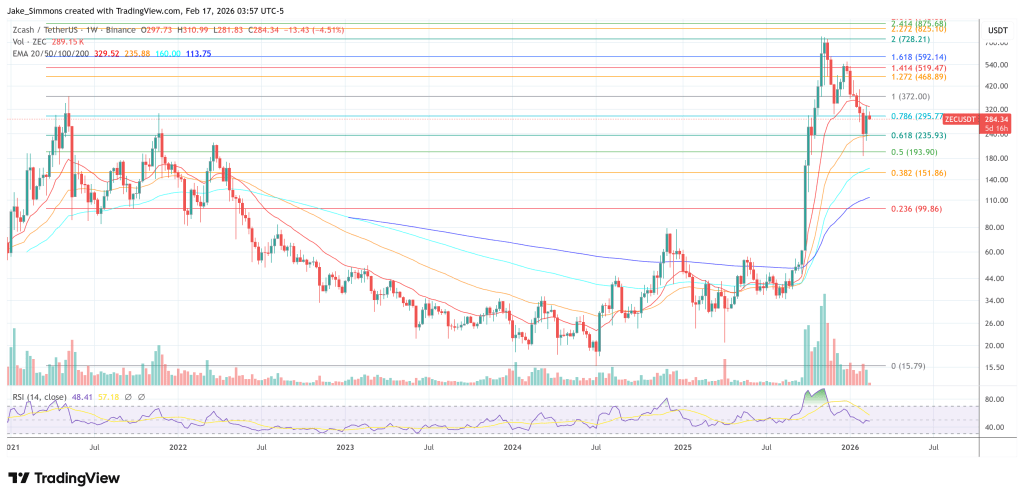
ZEC price remains below the 0.786 Fib, 1-week chart | Source: ZECUSDT on TradingView.com

Leituras Relacionadas

Misjudged A-Shares: Resilience, Expectations, and Confidence

China's A-share market recently faced selling pressure, especially in tech sectors, initially triggered by a global tech sell-off that began in South Korea. However, the article argues this is a case of "mistaken injury" and highlights the market's underlying resilience. This resilience stems from three main pillars: **1) Tech Sector Fundamentals:** Unlike Korea's market dominated by a few memory chip stocks, China's tech sector is diversified across computing, communications, electronics, and semiconductors, supported by dual narratives of global AI supply chains and domestic substitution. Core areas like optical modules and fiber optics continue to show strong earnings growth. **2) "National Team" Support:** State-backed institutions and large corporations have made significant market purchases and announced buybacks, providing liquidity and signaling confidence. This is seen as a stabilizing policy signal, often associated with market bottoms. **3) Broader Market Pillars:** Other major sectors are showing endogenous recovery momentum. Consumer stocks benefit from stabilizing CPI and signs of sector recovery (e.g., liquor price hikes). Cyclical sectors like aluminum have high earnings, potential price increases due to tight supply, and low valuations. The financial sector offers stable dividends and low valuations. The conclusion is that the sell-off was driven by external contagion, not a collapse in fundamentals. With strong policy support and recovering momentum across key sectors, the A-share market possesses the toughness to regain stability.

marsbitHá 30m

Misjudged A-Shares: Resilience, Expectations, and Confidence

marsbitHá 30m

The Clarity Act's Journey Through Congress: The Thorny Path of Bipartisan Compromise in the U.S.

The U.S. Congress is struggling to advance the crypto market structure bill known as the Clarity Act, with bipartisan compromise proving difficult. Key hurdles include unresolved disputes over "yield" products and, more critically, the inclusion of strong ethics provisions for elected officials—a non-negotiable demand for many Democrats. While a compromise on yield was reached in May, securing only limited Democratic support in committee, the separate Senate Agriculture Committee version later passed with no Democratic votes due to the ethics impasse. As Republicans push for a full Senate vote in July, demands for ethics rules have expanded, and other contentious issues like developer protections and concerns from law enforcement and large banks further complicate negotiations. Despite consensus on the need for legislation, the path forward is unclear. Recent discussions between senators and White House officials aim to find acceptable ethics language. Some lawmakers question whether a compromise text can garner enough bipartisan support, with one Democrat stating the current proposal lacks the strong ethics provisions required for their vote. Potential short-term goals for the crypto community include symbolic Senate action before the August recess, a longer-term aim for passage by 2026, or establishing a detailed framework that addresses ethics and other compromises. The process remains arduous, relying on the traditional, vote-by-vote effort to build bipartisan support.

marsbitHá 50m

The Clarity Act's Journey Through Congress: The Thorny Path of Bipartisan Compromise in the U.S.

marsbitHá 50m

Are Kalshi and Polymarket Founders at Odds? This Business Rivalry Is More Brutal Than You Think

"The Rivalry Between Kalshi and Polymarket Founders Turns Bitter and Litigious" The intense feud between Tarek Mansour, CEO of Kalshi, and Shayne Coplan, founder of Polymarket, has escalated far beyond typical business competition into personal animosity and regulatory battles. Both lead billion-dollar prediction market platforms, but their approaches differ sharply. Kalshi positions itself as the compliant operator, securing U.S. regulatory approval before launching. In contrast, Polymarket initially operated offshore, allowing U.S. users to access its platform via VPN, which drew regulatory scrutiny. The conflict reached a peak in November 2024 when FBI agents raided Coplan's New York apartment. While Coplan publicly blamed political motives, his team privately suspected Kalshi was involved. According to sources, Kalshi's lawyers had previously reported Polymarket's operations to federal prosecutors, highlighting its accessibility to U.S. users despite a ban. This incident fueled mutual accusations and underhanded tactics, including social media smear campaigns and attempts to sabotage each other's major business deals. Their rivalry also played out in Washington, influencing regulatory debates. Kalshi actively lobbied against Polymarket's practices, framing them as illegal and unethical. Polymarket, after facing a CFTC fine and investigation, later acquired a licensed U.S. firm to launch a domestic app, regaining a foothold. Despite the hostility, both companies have seen massive growth, with combined trading volumes soaring. However, increased regulatory scrutiny, particularly around insider trading on Polymarket's platform, continues to pose challenges. The founders' deep-seated mutual disdain ensures their battle for market dominance remains as much a personal vendetta as a commercial one.

marsbitHá 58m

Are Kalshi and Polymarket Founders at Odds? This Business Rivalry Is More Brutal Than You Think

marsbitHá 58m

Trading

Spot
活动图片





