YouTube enables PYUSD stablecoin payouts for US creators: Report

cointelegraphPublicado em 2025-12-12Última atualização em 2025-12-12

Resumo

YouTube has enabled US-based creators to receive payouts in PayPal’s stablecoin, PYUSD, according to a report. The feature, confirmed by PayPal’s head of crypto, allows creators to accept payments in PYUSD without YouTube directly handling cryptocurrency. This integration builds on PayPal’s existing payment relationship with the platform. The move signals a shift for YouTube, which has historically restricted crypto-related content, and could significantly boost stablecoin adoption given the platform’s large user base. PYUSD, launched in 2023, has grown rapidly, with its market cap surging from around $500 million in January to $3.9 billion, aided by recent integrations with platforms like Spark and Bitfinex.

Video-sharing giant YouTube has reportedly enabled US-based creators to accept payouts in PayPal’s stablecoin, PYUSD.

Fortune reported on Thursday that PayPal’s head of crypto, May Zabaneh, said the feature is live, but only for users in the US. The firm integrated the ability for recipients to accept payments in PYUSD earlier this year, with YouTube ultimately opting to open that choice up to its creators.

“The beauty of what we’ve built is that YouTube doesn’t have to touch crypto and so we can help take away that complexity,” she said.

PayPal has had a long-running relationship with YouTube, with the platform allowing users to pay via its services for many years, alongside utilizing it for creator AdSense payouts.

YouTube may be warming up to crypto, after its history of shadowbanning crypto content, as digital assets are making their way into the mainstream. The move could also be a potential boon for stablecoin adoption, given the size of YouTube’s platform.

Related: Visa pilots fiat-funded stablecoin payouts for US businesses

The stablecoin market has exploded over the past year as mainstream businesses, institutions and governments have moved to integrate the assets with traditional finance.

PSYUD was launched in mid-2023 and has a current market cap of $3.9 billion according to CoinGecko data. It has skyrocketed in market value since the start of the year, increasing from around $500 million in January.
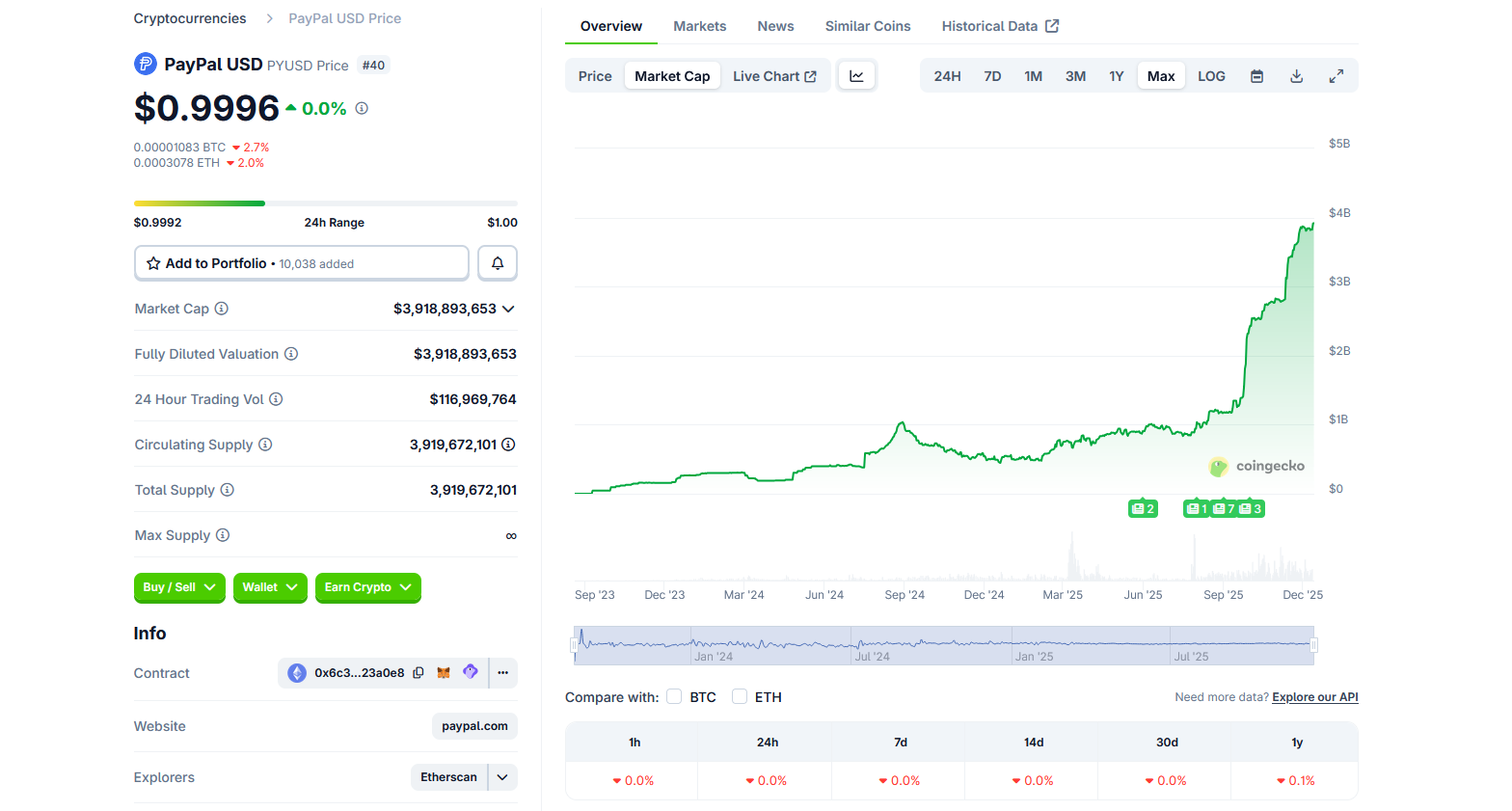
PYUSD market cap. Source: CoinGecko

A significant chunk of PYUSD’s growth has come since the start of September, when the market cap was sitting around $1 billion. During that month, PYUSD was integrated with Spark’s lending markets and Bitfinex’s Stable, an institutional-grade stablecoin blockchain.
Magazine: Stablecoins will see explosive growth in 2025 as world embraces asset class


Criptomoedas em alta

Leituras Relacionadas

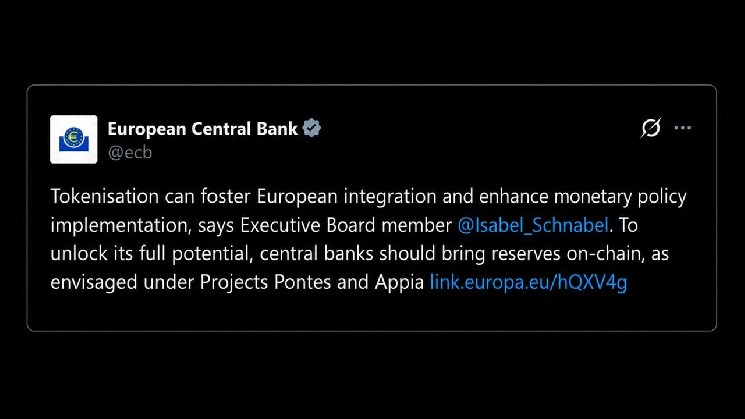
ECB's Schnabel says central bank money 'should move to blockchain'

ECB Executive Board member Isabel Schnabel stated that central bank money "must move onto the blockchain." She argued that stablecoins lack the independent ability to scale liquidity during financial stress—a gap only a central bank can fill. Her proposed solution involves tokenization, which she says can make transactions faster, safer, and more programmable, but only if the safest asset (central bank money) is on the same "rails" as other tokenized assets. This marks a notable shift for the Eurosystem, which had previously viewed Distributed Ledger Technology (DLT) mainly as a tool for regulating stablecoins and crypto, not as infrastructure to adopt directly. The first step is Project Pontes, launching in September. It will initially synchronize the ECB’s existing TARGET services with private DLT platforms. Eventually, it aims to enable settlement finality on a Eurosystem-managed DLT platform with smart contract functionality and 24/7 operation. The long-term strategy is Project Appia, tasked with developing the architecture, standards, and legal framework for a genuine European tokenized asset market by 2028. Trials have already processed around €1.6 billion, and since March 2026, the ECB accepts DLT-based assets as collateral. While not directly impacting Bitcoin's price, these developments signal that a major G7 central bank is preparing to settle transactions on-chain, lending legitimacy to the underlying infrastructure of crypto markets. The ECB's move to avoid "disintermediation" by private tokenization shows that debates in central bank boardrooms are now aligning with discussions long followed in the crypto space.

cryptonews.ruHá 1h

ECB's Schnabel says central bank money 'should move to blockchain'

cryptonews.ruHá 1h

Ripple Labs Warns of a New Challenge for Blockchains

Ripple Labs is preparing the XRP Ledger for quantum threats but now emphasizes a broader challenge: ensuring financial infrastructure can adapt simultaneously to quantum computing and artificial intelligence. Senior Director of Engineering Ayo Akinyele states the goal is not merely anticipating a "Q-Day" but building infrastructure capable of preemptively adopting new security mechanisms without network disruption. The shift to post-quantum cryptography involves more than swapping algorithms; it requires flexible infrastructure, improved key management, and clear upgrade paths. Financial systems were not designed with quantum computers in mind, necessitating a rethink of transaction, identity, asset, and data protection. This is underscored by significant investments, such as the $2 billion U.S.-IBM quantum factory initiative and a 2030 U.S. government mandate for post-quantum cryptography adoption. AI introduces distinct risks by driving automation and autonomous economic activity, increasing demand for an always-on, internet-oriented payment infrastructure. AI agents could soon conduct transactions independently, creating new security requirements. Ripple Labs advocates for proactive, orderly preparation rather than a crisis-driven transition, having outlined a four-phase strategy aiming for a full XRP Ledger transition by 2028, now expanded to address both quantum and AI-driven challenges.

cryptonews.ruHá 1h

Ripple Labs Warns of a New Challenge for Blockchains

cryptonews.ruHá 1h

Trading

Spot

Artigos em Destaque

Como comprar US

Bem-vindo à HTX.com!Tornámos a compra de Talus Network (US) simples e conveniente.Segue o nosso guia passo a passo para iniciar a tua jornada no mundo das criptos.Passo 1: cria a tua conta HTXUtiliza o teu e-mail ou número de telefone para te inscreveres numa conta gratuita na HTX.Desfruta de um processo de inscrição sem complicações e desbloqueia todas as funcionalidades.Obter a minha contaPasso 2: vai para Comprar Cripto e escolhe o teu método de pagamentoCartão de crédito/débito: usa o teu visa ou mastercard para comprar Talus Network (US) instantaneamente.Saldo: usa os fundos da tua conta HTX para transacionar sem problemas.Terceiros: adicionamos métodos de pagamento populares, como Google Pay e Apple Pay, para aumentar a conveniência.P2P: transaciona diretamente com outros utilizadores na HTX.Mercado de balcão (OTC): oferecemos serviços personalizados e taxas de câmbio competitivas para os traders.Passo 3: armazena teu Talus Network (US)Depois de comprar o teu Talus Network (US), armazena-o na tua conta HTX.Alternativamente, podes enviá-lo para outro lugar através de transferência blockchain ou usá-lo para transacionar outras criptomoedas.Passo 4: transaciona Talus Network (US)Transaciona facilmente Talus Network (US) no mercado à vista da HTX.Acede simplesmente à tua conta, seleciona o teu par de trading, executa as tuas transações e monitoriza em tempo real.Oferecemos uma experiência de fácil utilização tanto para principiantes como para traders experientes.

631 Visualizações TotaisPublicado em {updateTime}Atualizado em 2026.06.02

Como comprar US

Discussões

Bem-vindo à Comunidade HTX. Aqui, pode manter-se informado sobre os mais recentes desenvolvimentos da plataforma e obter acesso a análises profissionais de mercado. As opiniões dos utilizadores sobre o preço de US (US) são apresentadas abaixo.

活动图片