Yen Weakness Triggers Inflation Red Line: Bank of Japan May Be Forced to Raise Rates Early

marsbitPublicado em 2026-01-16Última atualização em 2026-01-16

Resumo

Japanese policymakers are increasingly concerned about the impact of the weak yen on inflation, which may force the Bank of Japan (BOJ) to consider earlier interest rate hikes. Although the BOJ is expected to keep rates unchanged at 0.75% in its upcoming January meeting, officials are closely monitoring how yen depreciation is amplifying price pressures, as businesses pass rising import costs to consumers. While the central bank recently raised rates in December and has no fixed timeline for further hikes, sustained yen weakness could accelerate the tightening cycle. Market expectations of a six-month hike interval may shift if the BOJ acts more promptly. The yen recently touched a 18-month low near 158.68 against the dollar, reflecting ongoing volatility and political uncertainty, including potential early elections. Business leaders have called for government intervention to curb excessive currency declines.

Bank of Japan officials are increasingly focusing on the potential impact of the weak yen on inflation, a trend that could substantially disrupt the future path of interest rate hikes. According to sources familiar with the matter who spoke to Bloomberg, although the Bank of Japan may keep interest rates unchanged at the upcoming policy meeting, exchange rate factors may prompt it to reassess the timing of rate hikes, and could even force it to act earlier than planned.

As reported by Bloomberg, Bank of Japan officials believe that the influence of the weak yen on prices is strengthening, particularly as companies are increasingly inclined to pass rising input costs on to consumers, which could further intensify inflationary pressures. Although the Bank of Japan just raised its benchmark interest rate last month and has not set a predetermined path for borrowing costs, if the yen continues to weaken, policymakers may consider moving forward with rate hikes that were originally expected to occur later.

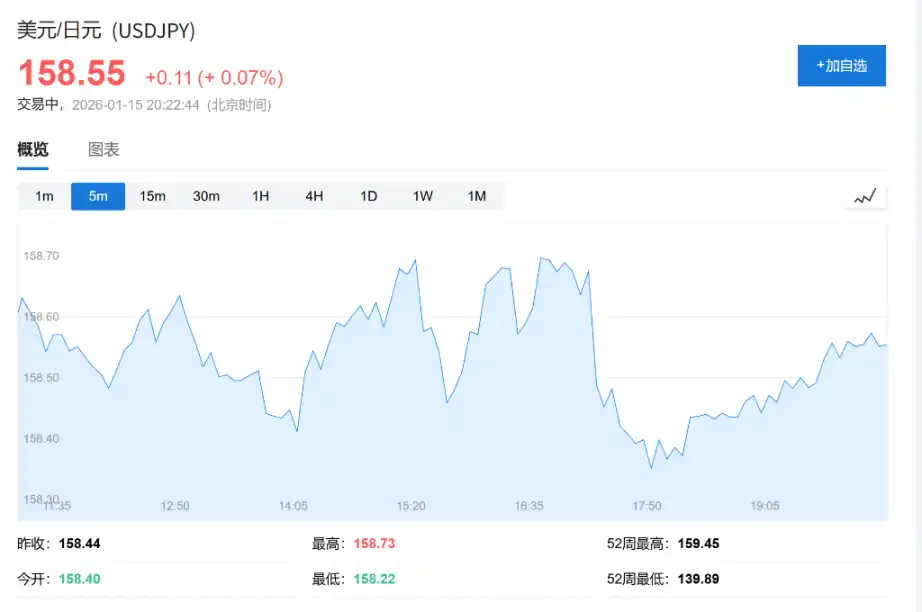
Currently, the general expectation among private economists is that the Bank of Japan will raise rates at a pace of about once every six months, meaning the next move could occur this summer. However, sources told Bloomberg that officials prefer to execute policy adjustments in a timely manner rather than being excessively cautious, suggesting that the previously market-expected pace of hikes is now facing uncertainty. Affected by this news, the yen briefly fell to around 158.68 against the U.S. dollar before rebounding to 158.33. As of the time of writing, the yen has fallen to 158.55 against the dollar.
January Meeting Expectations: Rates to Remain Unchanged

The Bank of Japan will announce its latest policy decision on January 23. Sources told media that officials currently view maintaining the interest rate at 0.75% as appropriate, a level that has reached a three-decade high. Although the overall inclination is to hold steady, the committee will continue to monitor economic data and financial market developments up to the last moment to make a final decision.

The focus of this meeting will be on how the central bank assesses the impact of the yen on potential inflation. Sources told Bloomberg that, given that inflation trends are already close to the bank's 2% target, officials will closely watch how exchange rate fluctuations alter the price expectations of households and businesses.

Exchange Rate Transmission Mechanism Under Scrutiny

Yen depreciation typically increases inflationary pressures by raising import costs, while also boosting exporters' profits. However, some officials point out that as the yen remains weak, its negative impact on the economy may be increasing. Officials believe the Bank of Japan still has room to continue raising rates, with the key being to time the policy adjustments correctly.

The Japanese business community is also speaking out more frequently on the exchange rate issue. Yoshinobu Tsutsui, head of Keidanren (Japan Business Federation), the country's largest business lobby group, made rare comments this week calling for government currency measures to prevent excessive yen depreciation, describing recent yen movements as "a bit too much."

Market Background and Political Factors

Although the Bank of Japan raised its benchmark interest rate on December 19, the yen remained weak against the U.S. dollar. The yen slid further to a new 18-month low this week, affected by news that Prime Minister Takaichi Sanae will call a snap election next month.

Data compiled by Bloomberg shows that the 10-year average exchange rate for the yen against the U.S. dollar is 123.20, while over the past two-plus years, the yen has generally fluctuated between 140 and 161.95. Although it rebounded slightly after hitting an 18-month low earlier this week as monetary authorities stepped up warnings, the overall depreciation trend continues to put persistent pressure on the central bank's decision-making.


Criptomoedas em alta

Perguntas relacionadas

QWhy is the Bank of Japan considering an earlier interest rate hike than previously expected?

AThe Bank of Japan is considering an earlier interest rate hike because officials are increasingly concerned that the weak yen is amplifying inflationary pressures. As companies are more inclined to pass on rising import costs to consumers, sustained yen weakness could force the central bank to reassess and accelerate its policy tightening timeline.

QWhat is the current market expectation for the Bank of Japan's next interest rate move?

APrivate economists generally expect the Bank of Japan to raise interest rates approximately once every six months, which would place the next hike around this summer. However, this expected pace is now facing uncertainty due to the yen's persistent weakness.

QWhat decision is the Bank of Japan expected to make at its January policy meeting regarding interest rates?

AThe Bank of Japan is widely expected to maintain its current benchmark interest rate of 0.75% at the January policy meeting. This level represents a three-decade high, and officials currently view holding rates steady as appropriate, though they will continue monitoring economic data and market conditions until the last moment.

QHow does a weak yen typically affect the Japanese economy and inflation?

AA weak yen typically increases inflationary pressures by raising the cost of imports, which can then be passed on to consumers. It also boosts profits for export-oriented companies. However, some officials note that the negative economic impacts may be increasing as the yen's weakness persists.

QWhat recent political development has contributed to further weakness in the Japanese yen?

AThe Japanese yen weakened further this week, hitting an 18-month low, following news that Prime Minister Takaichi Sanae will call an early election next month. This political uncertainty added downward pressure on the currency.

Leituras Relacionadas

As Consensus Accelerates, What Are Young Investors Betting On?

Title: As Consensus Forms Faster, What Are Young Investors Betting On? In the rapid evolution of tech investment, a new generation of young investors is navigating a landscape where AI, robotics, commercial aerospace, and quantum computing are advancing simultaneously. Traditional investment logic based on financial models is giving way to a need for deep technical understanding and the ability to act before industry consensus forms. An analysis of trends from the "WAIC FUTURE TECH" list of young investment leaders reveals key shifts in focus. The first major trend is the movement of AI from the digital screen into the physical world. Investment is shifting from large language models and chatbots towards embodied AI, robotics, AI hardware, and edge computing. While demonstrations generate excitement, the real challenge lies in achieving scalable, reliable, and cost-effective delivery in complex real-world environments like factories and logistics. Success depends not just on algorithms but on the integration of sensors, actuators, and control systems. Second, the competitive focus for large models is moving beyond raw capability toward building an "intelligence flywheel." The goal is to create self-reinforcing systems where user interaction generates data, improving the model, which in turn enhances the user experience and attracts more engagement. Companies that successfully embed AI into workflows to create these closed-loop systems can build lasting value that isn't easily erased by the next model upgrade. Third, facing a potential bottleneck in high-quality human-generated data, investors are looking at new underlying technologies. Reinforcement learning and self-play, as demonstrated by AlphaGo Zero, offer paths for AI to generate its own experience. Scientific foundation models, which aim to build general AI capabilities for fields like life sciences and materials discovery, represent a non-consensus direction that could unlock new frontiers of knowledge and data. Finally, in deep-tech areas like quantum computing, commercial aerospace, and space-based infrastructure, patient capital is essential. These fields have long, uncertain development and validation cycles involving complex engineering, supply chains, and regulations. Investment here requires a long-term view, focusing on foundational team capabilities and the eventual emergence of market demand, even if commercial returns are distant. Collectively, these trends illustrate how young investors are adapting to a new era. They are learning to make earlier, technically-informed judgments, balance hype with real-world viability, and provide the patient capital needed to build the deep-tech foundations of the future.

marsbitHá 27m

As Consensus Accelerates, What Are Young Investors Betting On?

marsbitHá 27m

Can Japan Buy Growth with AI? Will the Bond Market Believe It?

Japan's cabinet has introduced the 2026 Basic Policy on Economic and Fiscal Management and Reform, shifting its primary fiscal target. The new framework moves away from the traditional annual primary balance goal and instead prioritizes a stable reduction of the debt-to-GDP ratio. This change is tied to a strategy of increased "responsible proactive fiscal" spending, aiming to boost long-term growth through investments in strategic sectors like AI, semiconductors, energy, and robotics. The government estimates total public and private investment in 62 key technologies could exceed 370 trillion yen by 2040. The market reaction has been mixed and cautious. While equity markets may respond to policy signals, bond markets are focused on fiscal credibility. Concerns center on whether the weakening of the clear primary balance anchor could lead to looser fiscal discipline. If investors doubt that these strategic investments will generate sufficient productivity gains, tax revenue, and nominal growth to outpace rising interest costs, they may demand higher yields on Japanese Government Bonds (JGBs). Recent volatility in the yen and JGB yields, with the 10-year yield briefly reaching 2.9%, reflects this skepticism. The success of this new framework hinges on two factors: whether Japan can achieve a nominal growth rate consistently higher than its long-term interest rates, and whether future budgets demonstrate disciplined control over bond issuance. The government's narrative is that strategic investment is essential to break Japan's cycle of low growth, aging, and labor shortages. However, the bond market will continuously assess the credibility of this plan, pricing the risk that it may represent fiscal expansion rather than a viable growth strategy.

marsbitHá 1h

Can Japan Buy Growth with AI? Will the Bond Market Believe It?

marsbitHá 1h

Misjudged A-Shares: Resilience, Expectations, and Confidence

China's A-share market recently faced selling pressure, especially in tech sectors, initially triggered by a global tech sell-off that began in South Korea. However, the article argues this is a case of "mistaken injury" and highlights the market's underlying resilience. This resilience stems from three main pillars: **1) Tech Sector Fundamentals:** Unlike Korea's market dominated by a few memory chip stocks, China's tech sector is diversified across computing, communications, electronics, and semiconductors, supported by dual narratives of global AI supply chains and domestic substitution. Core areas like optical modules and fiber optics continue to show strong earnings growth. **2) "National Team" Support:** State-backed institutions and large corporations have made significant market purchases and announced buybacks, providing liquidity and signaling confidence. This is seen as a stabilizing policy signal, often associated with market bottoms. **3) Broader Market Pillars:** Other major sectors are showing endogenous recovery momentum. Consumer stocks benefit from stabilizing CPI and signs of sector recovery (e.g., liquor price hikes). Cyclical sectors like aluminum have high earnings, potential price increases due to tight supply, and low valuations. The financial sector offers stable dividends and low valuations. The conclusion is that the sell-off was driven by external contagion, not a collapse in fundamentals. With strong policy support and recovering momentum across key sectors, the A-share market possesses the toughness to regain stability.

marsbitHá 1h

Misjudged A-Shares: Resilience, Expectations, and Confidence

marsbitHá 1h

Trading

Spot

Artigos em Destaque

O que é $BANK

Bank AI: Um Passo Revolucionário no Futuro da Banca Introdução Em uma era marcada por avanços rápidos na tecnologia, o Bank AI está na interseção da inteligência artificial (IA) e dos serviços bancários. Este projeto inovador visa redefinir o panorama financeiro, melhorando a eficiência operacional, as medidas de segurança e as experiências dos clientes através do poder da IA. Ao embarcarmos nesta exploração do Bank AI, iremos aprofundar no que o projeto implica, suas dinâmicas operacionais, seu contexto histórico e marcos significativos. O que é o Bank AI? No seu cerne, o Bank AI representa uma iniciativa transformadora com o objetivo de integrar a inteligência artificial em várias operações bancárias. Este projeto aproveita as capacidades da IA para automatizar processos, melhorar os protocolos de gestão de risco e melhorar a interação com os clientes através de serviços personalizados. Os principais objetivos do Bank AI incluem: Automatização das Funções Bancárias: Ao aproveitar as tecnologias de IA, o Bank AI visa automatizar tarefas rotineiras, reduzindo o peso sobre os recursos humanos e aumentando a eficiência. Gestão de Risco Melhorada: O projeto utiliza algoritmos de IA para prever e identificar riscos, fortalecendo assim as medidas de segurança contra fraudes e outras ameaças. Personalização dos Serviços Bancários: O Bank AI foca em oferecer produtos e serviços financeiros ajustados, analisando dados e comportamentos dos clientes. Melhoria da Experiência do Cliente: A implementação de soluções impulsionadas por IA, como chatbots e assistentes virtuais, visa proporcionar aos usuários interações mais humanizadas, revolucionando a forma como os clientes se envolvem com os bancos. Com esses objetivos, o Bank AI posiciona-se como um ator crucial para tornar a banca mais eficiente, segura e centrada no usuário. Quem é o Criador do Bank AI? Os detalhes sobre o criador do Bank AI permanecem desconhecidos. Assim, nenhuma pessoa ou organização específica foi identificada nas informações disponíveis. O anonimato que cerca a origem do projeto levanta questões, mas não diminui a sua ambiciosa visão e objetivos. Quem são os Investidores do Bank AI? Semelhante ao criador do projeto, informações específicas sobre os investidores ou organizações que apoiam o Bank AI não foram divulgadas. Sem essas informações, é difícil delinear o apoio financeiro e institucional que pode estar impulsionando o projeto para frente. No entanto, a importância de ter uma sólida base de investimento é fundamental para sustentar o desenvolvimento em um campo tão inovador. Como Funciona o Bank AI? O Bank AI opera em várias frentes inovadoras, focando em fatores únicos que o diferenciam das estruturas bancárias tradicionais. Abaixo estão as principais características operacionais: Automatização: Ao aplicar algoritmos de aprendizado de máquina, o Bank AI automatiza vários processos manuais dentro dos bancos. Isso resulta na redução dos custos operacionais e permite que os trabalhadores humanos redirecionem os seus esforços para atividades mais estratégicas. Gestão de Risco Avançada: A integração da IA nas práticas de gestão de risco equipa os bancos com ferramentas para prever com precisão potenciais ameaças, como fraudes, garantindo que as informações e ativos dos clientes permaneçam seguros. Recomendações Financeiras Personalizadas: Através do aprendizado contínuo a partir das interações com os clientes, os sistemas de IA desenvolvem uma compreensão sutil das necessidades dos usuários, permitindo oferecer conselhos adaptados sobre decisões financeiras. Interações Melhoradas com os Clientes: Utilizando chatbots e assistentes virtuais alimentados por IA, o Bank AI permite uma experiência de cliente mais envolvente, permitindo que os usuários tenham suas dúvidas resolvidas rapidamente, reduzindo assim os tempos de espera e melhorando os níveis de satisfação. Juntas, estas características operacionais posicionam o Bank AI como um pioneiro no setor bancário, estabelecendo novos padrões para a prestação de serviços e a excelência operacional. Cronologia do Bank AI Compreender a trajetória do Bank AI requer uma análise do seu contexto histórico. Abaixo está uma cronologia que destaca marcos e desenvolvimentos importantes: Início de 2010: A conceituação da integração da IA nos serviços bancários começou a ganhar atenção à medida que instituições bancárias reconheciam os potenciais benefícios. 2018: Ocorreu um aumento significativo na implementação de tecnologias de IA, quando os bancos começaram a usar ferramentas de IA como chatbots para atendimento ao cliente básico e sistemas de gestão de risco para melhorar o tratamento de segurança. 2023: A sofisticação da IA continuou a avançar, com a introdução de IA generativa para tarefas mais complexas, como processamento de documentos e análise de investimentos em tempo real. Este ano marcou um salto significativo nas capacidades proporcionadas aos bancos pela tecnologia de IA. 2024-Estado Atual: Neste ano, o Bank AI está em uma trajetória ascendente, com pesquisas e desenvolvimentos em andamento prontos para aprimorar ainda mais as capacidades nas operações bancárias. A exploração contínua das aplicações de IA sugere desenvolvimentos emocionantes por vir. Pontos Chave Sobre o Bank AI Integração da IA na Banca: O Bank AI foca na adoção da inteligência artificial para simplificar os processos bancários e melhorar as experiências dos usuários. Automatização e Foco em Gestão de Risco: O projeto enfatiza fortemente essas áreas, visando transferir o peso das tarefas rotineiras enquanto melhora as estruturas de segurança através de análises preditivas. Soluções Bancárias Personalizadas: Ao aproveitar os dados dos clientes, o Bank AI possibilita serviços bancários ajustados que atendem às necessidades individuais dos usuários. Compromisso com o Desenvolvimento: O Bank AI permanece comprometido com contínuas pesquisas e esforços de desenvolvimento, garantindo a sua adaptabilidade e relevância contínua à medida que a tecnologia continua a evoluir. Conclusão Em resumo, o Bank AI exemplifica um passo crucial em frente na indústria bancária, aproveitando a inteligência artificial para remodelar paradigmas operacionais, melhorar a segurança e promover a satisfação do cliente. Apesar das lacunas de informação em torno do criador e dos investidores, os objetivos claros e os mecanismos funcionais do Bank AI fornecem uma base sólida para sua evolução contínua. À medida que a tecnologia de IA continua a avançar e se fundir com o setor bancário, o Bank AI está bem posicionado para impactar significativamente o futuro dos serviços financeiros, aprimorando a maneira como entendemos e interagimos com a banca.

75 Visualizações TotaisPublicado em {updateTime}Atualizado em 2024.12.03

O que é $BANK

Como comprar BANK

Bem-vindo à HTX.com!Tornámos a compra de Lorenzo Protocol (BANK) simples e conveniente.Segue o nosso guia passo a passo para iniciar a tua jornada no mundo das criptos.Passo 1: cria a tua conta HTXUtiliza o teu e-mail ou número de telefone para te inscreveres numa conta gratuita na HTX.Desfruta de um processo de inscrição sem complicações e desbloqueia todas as funcionalidades.Obter a minha contaPasso 2: vai para Comprar Cripto e escolhe o teu método de pagamentoCartão de crédito/débito: usa o teu visa ou mastercard para comprar Lorenzo Protocol (BANK) instantaneamente.Saldo: usa os fundos da tua conta HTX para transacionar sem problemas.Terceiros: adicionamos métodos de pagamento populares, como Google Pay e Apple Pay, para aumentar a conveniência.P2P: transaciona diretamente com outros utilizadores na HTX.Mercado de balcão (OTC): oferecemos serviços personalizados e taxas de câmbio competitivas para os traders.Passo 3: armazena teu Lorenzo Protocol (BANK)Depois de comprar o teu Lorenzo Protocol (BANK), armazena-o na tua conta HTX.Alternativamente, podes enviá-lo para outro lugar através de transferência blockchain ou usá-lo para transacionar outras criptomoedas.Passo 4: transaciona Lorenzo Protocol (BANK)Transaciona facilmente Lorenzo Protocol (BANK) no mercado à vista da HTX.Acede simplesmente à tua conta, seleciona o teu par de trading, executa as tuas transações e monitoriza em tempo real.Oferecemos uma experiência de fácil utilização tanto para principiantes como para traders experientes.

429 Visualizações TotaisPublicado em {updateTime}Atualizado em 2026.06.02

Como comprar BANK

Discussões

Bem-vindo à Comunidade HTX. Aqui, pode manter-se informado sobre os mais recentes desenvolvimentos da plataforma e obter acesso a análises profissionais de mercado. As opiniões dos utilizadores sobre o preço de BANK (BANK) são apresentadas abaixo.

活动图片













