XRP Spot ETFs Riding The Bullish Wave, Attracting Broader Wall Street Allocation

bitcoinistPublicado em 2026-02-13Última atualização em 2026-02-13

Resumo

Despite a volatile and bearish broader cryptocurrency market, Spot XRP ETFs continue to demonstrate strong performance, attracting significant capital from both retail and institutional investors. Data shows consistent inflows into these regulated products since January 27, with Canary Capital, Franklin Templeton, Bitwise, and 21Shares collectively accumulating over 48.7 million XRP in a nine-day period. This trend reflects growing institutional confidence in gaining exposure to XRP without direct custodial risks. Notably, Goldman Sachs has invested over $152 million in XRP Spot ETFs, as revealed in its Q4 2025 filing, signaling deeper Wall Street involvement and a new phase of integration with traditional finance.

Even with the broader cryptocurrency market becoming highly volatile and bearish, the Spot XRP ETFs are still displaying remarkable performance. In the unfavorable conditions, capital from both retail and institutional investors continues to flow into the funds, and they are drawing the attention of Wall Street.

Institutional Capital Still Following Into XRP Spot ETFs

XRP may be experiencing steady downside action in price, but the Spot XRP Exchange-Traded Funds (ETFs) are still riding the broader bullish wave, drawing in huge capital. Interestingly, as they continue to gain momentum across the sector, traditional finance is paying close attention to the newly launched products.

In a post on the X platform, market researcher and investor Tokenicer highlighted that the funds have been recording inflows over the past few days despite the ongoing volatile crypto landscape. Specifically, this fund has been seeing steady capital inflows since January 27.

The consistent flow of funds into these regulated instruments demonstrates the rising conviction of traditional and institutional market players looking to gain exposure to XRP without taking on direct custodial risks. In contrast to transient speculative surges, persistent inflows usually signify more profound strategic allocation choices.
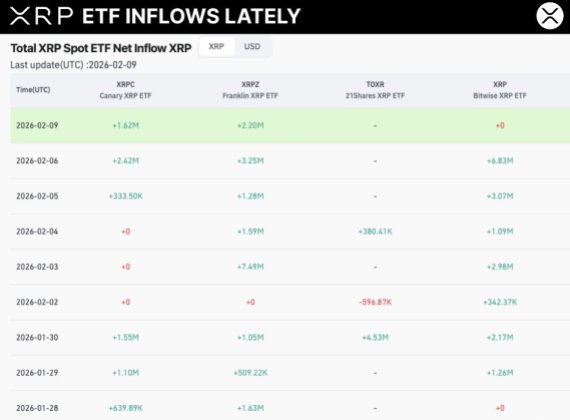
Source: Chart from Tokenicer on X

Since January 27, Canary Capital has recorded inflows of over 7.66 million XRP, Franklin Templeton has amassed over 18.9 million, Bitwise added more than 17.74 million, and 21Shares saw inflows of +4.31 million of the token. As seen on the chart shared by the expert, there has been a total of 48.7 million XRP across 4 ETFs in a 9-day period.

According to the expert, all of these inflows are taking place in a market that is laced by downside pressure. This period is where most of the retail interest in crypto has been sucked out, bringing the market back to the point where players are making fun of crypto again. “Now just imagine what these numbers look like during a euphoria run as we saw in Nov 2024,” Tokenicer added.

Goldman Sachs Expands ETF Exposure

The recent capital flows indicate that rather than buying tokens directly, Wall Street investors are growing more at ease exposing themselves to XRP through regulated investment vehicles. An indication of this trend is Goldman Sachs’s significant investment in the funds and the token.

Xaif Crypto, an investor and crypto analyst, reported that Goldman Sachs has invested over $152 million in XRP Spot ETFs. This was disclosed in the firm’s Q4 2025 13F filing. With this substantial amount invested in the funds, Wall Street is no longer just watching the altcoin; instead, it is allocating its capital into the token.

Such a move marks a notable step for institutional adoption of the altcoin within regulated markets. As inflows increase and liquidity deepens, its increasing position in mainstream portfolios may signal a new stage in its integration with conventional financial markets.

XRP trading at $1.37 on the 1D chart | Source: XRPUSDT on Tradingview.com

Perguntas relacionadas

QDespite the bearish crypto market, what is the current performance trend of Spot XRP ETFs?

ASpot XRP ETFs are displaying remarkable performance and continue to attract capital inflows from both retail and institutional investors, riding the broader bullish wave.

QAccording to the article, which specific financial institution has invested over $152 million in XRP Spot ETFs as per its Q4 2025 filing?

AGoldman Sachs has invested over $152 million in XRP Spot ETFs, as disclosed in the firm's Q4 2025 13F filing.

QWhat total amount of XRP flowed into the 4 mentioned ETFs over the 9-day period starting January 27?

AA total of 48.7 million XRP flowed into the 4 ETFs (Canary Capital, Franklin Templeton, Bitwise, and 21Shares) over the 9-day period.

QHow does the article characterize the significance of persistent inflows into XRP ETFs, as opposed to transient speculative surges?

APersistent inflows into these regulated instruments usually signify more profound strategic allocation choices by traditional and institutional players, rather than transient speculative surges, demonstrating rising conviction.

QWhat does the increasing institutional investment in XRP through ETFs indicate about Wall Street's approach to gaining exposure to the asset?

AIt indicates that Wall Street investors are growing more comfortable gaining exposure to XRP through regulated investment vehicles like ETFs, rather than buying tokens directly, to avoid custodial risks.

Leituras Relacionadas

Will the Next Crypto Bull Run Start with On-Chain Trading of SpaceX?

This article presents a scenario-based forecast for the crypto industry from 2026 to 2029, arguing that the next major cycle will be driven not by technological narratives but by legal access to real-world assets. The author predicts that by mid-2026, pre-IPO perpetual contracts for top private companies like SpaceX, OpenAI, and Anthropic on platforms like Hyperliquid will become the primary gateway for accessing quality assets, as most crypto-native tokens fail to capture real value. The much-hyped AI x Crypto intersection largely fails except for prediction markets, which thrive on betting on AI model supremacy. By 2027, public blockchain foundations are forced to choose between catering to retail speculation or building compliant infrastructure for institutions, with many opting for the latter. Growth in stablecoins and tokenized private credit/equity hits a "triple ceiling" due to regulatory and political uncertainty rather than market demand. The pivotal shift is forecast for 2028. A major liquidation event in pre-IPO perpetuals exposes the structural flaw of synthetic markets lacking a real underlying asset anchor. In response, regulatory changes finally allow the public solicitation of private securities resales to verified accredited investors. This creates a legitimate secondary market for real company equity, which then becomes the core asset class of the new bull market, relegating synthetic perps to a niche role. By 2029, the industry becomes "boring" but foundational. Tokens without claims on real cash flows or assets cease trading. Stablecoin growth is steady but politically capped. Crypto infrastructure fades from view as it gets absorbed into traditional finance backends. The article's central thesis is that the key bottleneck for crypto's next phase is legal and regulatory channels for real asset ownership, not technology.

marsbitHá 40m

Will the Next Crypto Bull Run Start with On-Chain Trading of SpaceX?

marsbitHá 40m

The Value Distribution of Stablecoins

**Summary: The Value Distribution of Stablecoins** The article argues that stablecoins are evolving from mere trading tools into broader channels for dollar access. It divides the stablecoin ecosystem into four layers to analyze how value is distributed: 1. **Issuance Layer:** Mints stablecoins, holds reserve assets, and captures the spread between reserve yield and user costs (e.g., Tether, Circle). This layer currently earns the largest profit margin. 2. **Infrastructure Layer:** Connects stablecoins to the traditional financial system, handling fiat on/off-ramps, banking integration, compliance (KYC/AML), and asset management (e.g., Bridge, BVNK). This is the "unglamorous" but critical work, building the essential bridges between crypto and real-world finance. 3. **Acquiring/Distribution Layer:** Integrates stablecoins into merchant systems, manages payment flows, and provides enterprise financial software (e.g., Stripe, Coinbase). They act as the access point for businesses. 4. **Application Layer:** The end-users and businesses that ultimately use stablecoins for payments, settlements, or as a store of value. They benefit from convenience but have little pricing power. The core thesis is that while the issuance layer currently dominates profits, the often-overlooked **infrastructure layer holds significant long-term potential**. The real challenge and barrier to mass adoption is not the on-chain transfer of stablecoins (which is simple), but the complex "last mile" integration into existing business workflows, banking systems, and regulatory frameworks across different countries. Companies in this layer are currently in a "land grab" phase, investing heavily to build networks, secure bank partnerships, and establish compliance pathways. While their position is currently pressured by the profitable issuers above and distribution platforms below, the article suggests that if stablecoins become a default financial rail for businesses, the infrastructure providers who have done the hard work of integration will ultimately gain strong pricing power and become entrenched, essential players.

marsbitHá 7h

The Value Distribution of Stablecoins

marsbitHá 7h

The Value Distribution of Stablecoins

The Value Distribution of Stablecoins The article argues that stablecoins are evolving from a mere trading tool into a broad "dollar channel." It analyzes the industry's value chain through four layers: 1. **Issuance Layer (e.g., Tether, Circle):** The top layer that mints stablecoins, holds reserve assets, and captures the thickest interest rate spread. 2. **Infrastructure Layer (e.g., Bridge, BVNK):** Connects stablecoins to the traditional financial system, handling critical but complex "dirty work" like fiat on/off-ramps, banking integration, compliance (KYC/AML), and cross-border settlement. 3. **Acquiring/Distribution Layer (e.g., Stripe, Coinbase):** Embeds stablecoins into merchant systems, manages payment flows, and integrates with enterprise software. 4. **Application Layer:** End-users and businesses that ultimately use stablecoins for payments, settlement, or storing value. The author posits that while the issuance layer currently captures the most profit, the most overlooked and potentially critical layer is infrastructure. The core challenge for stablecoin adoption isn't the on-chain transfer (which is simple), but bridging the gap between blockchain and the real-world financial system. This involves solving practical problems for businesses: fiat conversion, reconciliation, tax handling, and user onboarding. Infrastructure companies are currently in a difficult "land-grab" phase—building networks, securing banking relationships, and achieving compliance country-by-country. They face pressure from both the profitable issuance layer above and distribution platforms below. However, the author suggests this layer is building a crucial moat. Once stablecoins become a default business rail, the infrastructure players who have done the hard work of integration may gain significant, durable value and pricing power.

链捕手Há 7h

The Value Distribution of Stablecoins

链捕手Há 7h

Trading

Spot
Futuros
活动图片





