XRP Retests $1.29 Support: Is $2 Still in Play or Will LiquidChain Capture the Momentum?

bitcoinistPublicado em 2026-02-06Última atualização em 2026-02-06

Resumo

XRP is currently retesting a key support level at $1.29, a critical point that will determine whether it can resume its upward trajectory toward $2.00 or face a deeper decline. The recent pullback is seen as a healthy consolidation after a strong rally, driven by profit-taking and broader market volatility. Technical indicators suggest that holding above $1.25 could pave the way for a run to $1.96 and beyond, while a drop below $1.10 may lead to a fall toward $0.85. Regulatory developments, including potential SEC leadership changes and ETF approvals, remain central to XRP's bullish narrative. Meanwhile, LiquidChain ($LIQUID) is emerging as a high-risk, high-reward alternative, positioning itself as a cross-chain liquidity solution integrating Bitcoin, Ethereum, and Solana. Having raised over $529K in its presale, it aims to address fragmentation in DeFi through specialized Layer-3 infrastructure. While XRP's focus remains tied to regulatory clarity and institutional adoption, LiquidChain offers a speculative bet on the future of interoperable decentralized finance.

Trusted Editorial content, reviewed by leading industry experts and seasoned editors. Ad Disclosure

Quick Facts:

  • ➡️ XRP’s dip to $1.29 is a technical retest of support; holding here is key for a potential run toward $2.00.
  • ➡️ Regulatory clarity (post-SEC changes) remains the main driver, with ETFs as the next potential spark to unlock institutional flows.
  • ➡️ Losing the $1.10 level would invalidate the bullish view, likely opening the trapdoor to the $0.85 region.
  • ➡️ LiquidChain offers a high-risk, high-reward alternative, aiming to unify liquidity across Bitcoin, Ethereum, and Solana through specialized L3 infrastructure.

XRP hit a wall.

After a blistering rally that momentarily silenced years of regulatory suppression, the asset is retracing to the $1.29 level.

The-1 year chart looks abysmal, but this goes for pretty much the entire market as a whole.
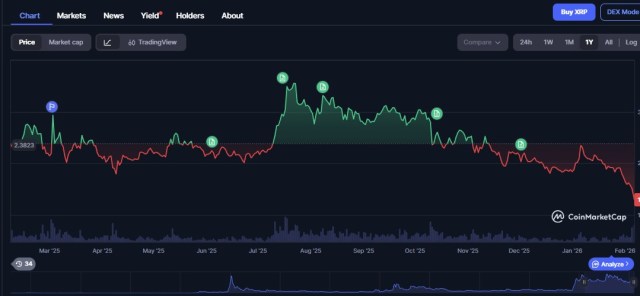
It’s a necessary cooldown. Traders are taking profit, and the market is digesting the broader implications of the impending SEC leadership change. While the dip has shaken out over-leveraged long positions, on-chain data suggests this isn’t a reversal, it’s likely just healthy consolidation.

What’s driving the volatility? A mix of macro rotation and simple technical exhaustion. The “regulatory relief” trade got crowded fast after the news of Gary Gensler’s potential exit broke.

Now, the market wants receipts, specifically, progress on the RLUSD stablecoin or confirmed ETF filings, to justify the next leg higher. This price action is a classic retest of previous resistance-turned-support. And frankly, that’s often exactly what an asset needs before attacking a psychological barrier like $2.00.

But crypto isn’t a zero-sum game between one asset and the dollar. As XRP churns, capital is starting to rotate into high-utility infrastructure plays solving different problems. Does XRP have the muscle to reclaim the $2 handle before year-end?

Or will liquidity siphon off into emerging Layer 3 protocols like LiquidChain ($LIQUID), which are positioning themselves (perhaps ambitiously) as the connective tissue of the next DeFi cycle?

$LIQUID is available here.

Technical Outlook: Why the $1.29 Retest Could Trigger a Run to $2

The drop to $1.29 puts XRP at a critical juncture.

This level lines up perfectly with the 0.382 Fibonacci retracement from the recent swing low, a high-probability zone for institutional accumulation. Even better, the Relative Strength Index (RSI) on the daily chart has reset. It dropped from ‘overbought’ (above 70) to a neutral 55, giving bulls room to maneuver without fighting immediate exhaustion signals.

Extended rallies need these cooling periods to build the structure for sustainable growth.

Fundamentally, the thesis for a $2 XRP remains intact, underpinned by the ‘SEC pivot’ narrative. With a pro-crypto administration likely taking the reins, the regulatory cloud that suppressed XRP price discovery for four years is finally lifting.

That changes the risk premium entirely. Plus, whispers of a Bitwise or Canary Capital ETF approval continue to circulate. If an XRP ETF application moves to the “acknowledged” phase, it could be the spark needed to shatter the $1.60 resistance wall.

Traders should monitor three distinct scenarios in the coming weeks:

  • The Bull Case: XRP holds support above $1.25, chops sideways for 5-7 days, then reclaims $1.50 on heavy volume. That validates $1.29 as a ‘higher low’ and opens the door to $1.96 and eventually $2.20.
  • The Base Case: We see a chop-fest. The asset trades in an accumulation range between $1.20 and $1.45, frustrating impatient retail traders while smart money absorbs supply.
  • The Bear Case (Invalidation): A daily close below $1.10 breaks the thesis. This invalidates the immediate bullish structure, risking a deeper flush down to the 200-day moving average near $0.85.

Keep an eye on volume. Declining volume on this pullback suggests the sellers are running out of steam, which favors the bulls.

LiquidChain Emerges as a High-Beta Alternative for Cross-Chain Liquidity

While XRP battles for dominance in cross-border payments, a different story is playing out in decentralized infrastructure. Investors hunting for high-beta opportunities, assets that tend to move faster than majors during a bull run, are looking at Layer 3 (L3) solutions.

That’s where LiquidChain ($LIQUID) comes in, pitching itself as a specialized fix for the fragmentation plaguing today’s multi-chain world.

Unlike XRP, which focuses on fiat-to-crypto bridging, LiquidChain operates as a ‘Cross-Chain Liquidity Layer.’ It fuses Bitcoin, Ethereum, and Solana liquidity into a single execution environment. The idea?

A ‘deploy-once’ architecture allowing developers to build apps that access users and capital across all three giants without the security risks of traditional wrapped assets. If interoperability becomes the theme of the next DeFi summer, this utility puts it in a prime position.

You can see the project’s early traction in the presale numbers. To date, LiquidChain has raised over $529K so far. The native token is currently priced at $0.01355, an entry level far below the established caps of legacy L1s. Join the presale here.
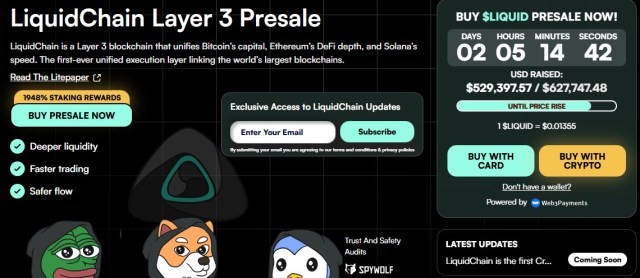
Moving from established majors like XRP to presale assets obviously carries risk. While LiquidChain offers a unified liquidity layer and verifiable settlement, it’s still early in its roadmap.

The potential for outsized returns comes with the usual dangers: regulatory uncertainty and the technical hurdles of executing a complex cross-chain VM. But for those with the stomach for it, the rotation into $LIQUID represents a bet on the plumbing that will power the next generation of dApps, distinct from Ripple’s payment-focused utility.

Buy $LIQUID here.

Disclaimer: This article is for informational purposes only and does not constitute financial advice. Cryptocurrency investments, particularly in presale projects and volatile assets like XRP, carry high risks. Readers should conduct their own independent research and consult with financial professionals before making investment decisions.

Editorial Process for bitcoinist is centered on delivering thoroughly researched, accurate, and unbiased content. We uphold strict sourcing standards, and each page undergoes diligent review by our team of top technology experts and seasoned editors. This process ensures the integrity, relevance, and value of our content for our readers.

patrubogdan

Follow

Full Profile

Related Posts

Bitcoin Teeters on Edge: Will $60K Hold or Is a V-Shape Recovery Imminent? $HYPER Keeps Pumping

Senator Lummis Urges Banks to Adopt Stablecoins Amidst CLARITY Act Delay, as Maxi Doge Turns Heads

$BTC Needs to Drop to $8K for Holdings Not to Cover Debt, Says Strategy, as $HYPER’s Presale Soars

Robinhood CEO Says Prediction Markets Will Soar as Bitcoin Hyper ($HYPER) Reaches $31.2M in Presale

Vitalik Buterin Cashes Out $6.6 Million In Ether After Early Signals

While Bitcoin And Ether Falter, XRP Optimism Stands Out: Analysts

Perguntas relacionadas

QWhat is the critical support level for XRP mentioned in the article, and why is it important?

AThe critical support level for XRP is $1.29. It is important because it represents a technical retest of previous resistance-turned-support and aligns with the 0.382 Fibonacci retracement level, making it a high-probability zone for institutional accumulation. Holding this level is key for a potential price run toward $2.00.

QAccording to the article, what is the main fundamental driver for XRP's price action?

AThe main fundamental driver for XRP's price action is regulatory clarity, specifically the potential changes at the SEC following Gary Gensler's anticipated exit. This 'regulatory relief' trade, along with the possibility of XRP ETF approvals, is seen as a major catalyst for unlocking institutional investment.

QWhat price level would invalidate the immediate bullish thesis for XRP?

AA daily close below the $1.10 level would invalidate the immediate bullish thesis for XRP. This break of support would likely trigger a deeper price decline toward the 200-day moving average, which is near $0.85.

QHow does LiquidChain ($LIQUID) differentiate itself from XRP in terms of utility?

ALiquidChain differentiates itself by focusing on cross-chain liquidity as a Layer 3 solution, whereas XRP focuses on cross-border payments. $LIQUID aims to unify liquidity across Bitcoin, Ethereum, and Solana through a 'deploy-once' architecture, allowing developers to build apps that access users and capital across all three chains.

QWhat was the amount raised in the LiquidChain presale and what is the current token price mentioned?

AThe LiquidChain presale had raised over $529,000 at the time of writing. The native $LIQUID token was being offered at a price of $0.01355 during its presale phase.

Leituras Relacionadas

A Clod of Chinese Soil Chokes Two Japanese Giants

"Chinese Soil Chokes Japanese Giants" The production of a key electronic specialty gas, tungsten hexafluoride (WF6), vital for manufacturing AI chips, was halted by two leading Japanese producers—Kanto Denka and Central Glass. Their shutdown was not due to a technological failure but a sudden, critical shortage of a raw material they had long taken for granted: ultra-high-purity (6N-grade) tungsten powder, which is almost entirely sourced from China. Following a quiet Chinese export announcement in January 2026, tungsten powder shipments to Japan dropped to zero for months. Despite frantic efforts, Japanese companies found no viable alternative; imported powder was three times more expensive and lacked the required purity. Their existing stockpiles were exhausted by mid-2026. WF6 is essential for depositing tungsten into the microscopic contact holes of High Bandwidth Memory (HBM) chips, which are crucial for advanced processors like those from Nvidia. While Japanese firms had mastered producing ultra-pure WF6 gas, their entire supply chain relied on China's 6N tungsten powder—a dependency now revealed as a fatal vulnerability. China's dominance in this "soil" results from decades of painstaking R&D by companies like Xiamen Tungsten and China Tungsten & Hightech. They overcame immense technical hurdles, such as separating chemically similar molybdenum from tungsten, to achieve mass production of the world's purest tungsten powder. With their primary suppliers gone, Kanto Denka and Central Glass announced a permanent halt to WF6 production starting July 1, 2026. This immediately created a supply crisis for major semiconductor manufacturers like Samsung and SK Hynix, forcing them to urgently seek and certify new Chinese suppliers for WF6 itself. The reversal marks a dramatic shift: China has moved from exporting low-value raw materials to controlling the high-purity foundation of a critical global tech supply chain, upending a long-established industrial hierarchy.

marsbitHá 20m

A Clod of Chinese Soil Chokes Two Japanese Giants

marsbitHá 20m

Without Tencent, What's Left for Suiyuan?

The article centers on the crucial question posed in the title: what is Seyond Technology really worth if its dominant customer, Tencent, were to stop purchasing its AI chips? As the last of China's "Four AI Chip Dragons" to secure approval for a public listing, Seyond's IPO filing reveals a profound and controversial dependency. In 2025, 74.9% to over 80% of its revenue came from Tencent. The piece argues that this extreme customer concentration is not merely a vulnerability but a strategic outcome of China's AI industry evolution. It contrasts Seyond's path with its peers (Moore Thread, Biren Technology, and MetaX), noting that while others raced to market with ambitious stories, Seyond focused first on securing and delivering for a major client. Its explosive revenue growth—with Q1 2026 up 1474.85% year-on-year—is driven by concentrated orders from Tencent, which itself faces massive, escalating AI compute demands for products like its Yuanbao and Hunyuan models. The relationship is framed as a deliberate, symbiotic cultivation of a supply chain. As both a major shareholder (20.26%) and primary client, Tencent is actively fostering Seyond to build a controllable, stable alternative to NVIDIA, similar to how global tech giants historically nurtured key suppliers. The high switching costs—involving software stacks and deployed systems—create a deep "ecological moat" for Seyond within Tencent's ecosystem. The analysis positions the AI chip landscape in three tiers: NVIDIA as the global leader, Huawei's Ascend as the state-backed player, and commercial firms like Seyond competing for market orders. Seyond is increasingly seen as "Tencent's compute foundation," with its product roadmap closely aligned with the tech giant's needs. The conclusion is that the industry's metric for success is shifting from fundraising and technical specs to real orders, delivery capability, and ecosystem binding. Seyond's value, therefore, lies not just in its chips but in holding a massive, multi-year procurement order from China's largest internet company—a tangible asset arguably more telling than any technical whitepaper in the current climate. The core insight is that for domestic chips, the ultimate challenge isn't just catching up technologically with NVIDIA, but earning the trust, scenarios, and recurring orders from a major anchor client.

marsbitHá 1h

Without Tencent, What's Left for Suiyuan?

marsbitHá 1h

War Trade Unwinding | TradeXYZ Weekend Observations

Weekend markets saw a clear return of risk appetite. Major indices rose broadly, with significant gains in tech and precious metals, while energy sectors fell sharply on the "end of war" narrative. On June 14, oil prices initially rose on reports Iran had not yet finalized a memorandum of understanding. Later, YNET reported Trump might immediately lift the maritime blockade on Iran and the Strait of Hormuz. At 21:30, Trump confirmed on Truth Terminal that a deal with Iran was done, authorizing an immediate end to the US blockade and toll-free opening of the Strait. Iran's deputy foreign minister simultaneously announced an immediate and permanent halt to military actions on multiple fronts. Oil prices had already fallen to weekend boundaries, pre-pricing the news. The S&P 500 subsequently touched 7530. Markets will likely remain in a waiting period until the formal peace deal signing on June 19. At the moment of the deal announcement, gold jumped from ~4,221 to a high of 4,337, and silver from ~67.85 to 70.83, before stabilizing at higher levels. Individual stocks and ETFs like NBIS, RKLB, and LITE performed strongly. NBIS, added to the Nasdaq index, saw a target price increase due to strong AI cloud growth. RKLB, also added to the index, benefited from positive SpaceX valuation sentiment. LITE received a $1,130 target from JPMorgan. SPCX rose quickly after Musk tweeted SpaceX could potentially reach ~$1 trillion in revenue by 2030. In summary, the market shock from the multi-month war is beginning to dissipate. Israel's actions remain the key variable before the June 19 signing. Upcoming events like Fed Chair Warsh's debut and BoJ rate hike expectations will also significantly impact markets this week.

marsbitHá 1h

War Trade Unwinding | TradeXYZ Weekend Observations

marsbitHá 1h

Trading

Spot
Futuros
活动图片