XRP Retests $1.29 Support: Is $2 Still in Play or Will LiquidChain Capture the Momentum?

bitcoinistPublicado em 2026-02-06Última atualização em 2026-02-06

Resumo

XRP is currently retesting a key support level at $1.29, a critical point that will determine whether it can resume its upward trajectory toward $2.00 or face a deeper decline. The recent pullback is seen as a healthy consolidation after a strong rally, driven by profit-taking and broader market volatility. Technical indicators suggest that holding above $1.25 could pave the way for a run to $1.96 and beyond, while a drop below $1.10 may lead to a fall toward $0.85. Regulatory developments, including potential SEC leadership changes and ETF approvals, remain central to XRP's bullish narrative. Meanwhile, LiquidChain ($LIQUID) is emerging as a high-risk, high-reward alternative, positioning itself as a cross-chain liquidity solution integrating Bitcoin, Ethereum, and Solana. Having raised over $529K in its presale, it aims to address fragmentation in DeFi through specialized Layer-3 infrastructure. While XRP's focus remains tied to regulatory clarity and institutional adoption, LiquidChain offers a speculative bet on the future of interoperable decentralized finance.

Trusted Editorial content, reviewed by leading industry experts and seasoned editors. Ad Disclosure

Quick Facts:

  • ➡️ XRP’s dip to $1.29 is a technical retest of support; holding here is key for a potential run toward $2.00.
  • ➡️ Regulatory clarity (post-SEC changes) remains the main driver, with ETFs as the next potential spark to unlock institutional flows.
  • ➡️ Losing the $1.10 level would invalidate the bullish view, likely opening the trapdoor to the $0.85 region.
  • ➡️ LiquidChain offers a high-risk, high-reward alternative, aiming to unify liquidity across Bitcoin, Ethereum, and Solana through specialized L3 infrastructure.

XRP hit a wall.

After a blistering rally that momentarily silenced years of regulatory suppression, the asset is retracing to the $1.29 level.

The-1 year chart looks abysmal, but this goes for pretty much the entire market as a whole.
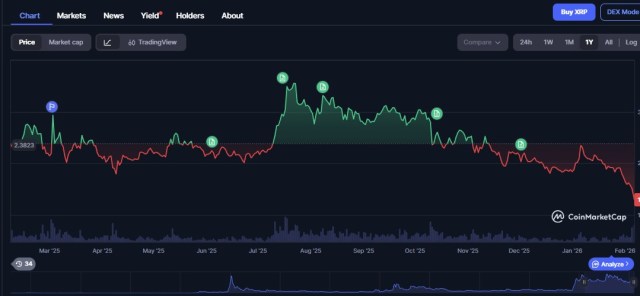
It’s a necessary cooldown. Traders are taking profit, and the market is digesting the broader implications of the impending SEC leadership change. While the dip has shaken out over-leveraged long positions, on-chain data suggests this isn’t a reversal, it’s likely just healthy consolidation.

What’s driving the volatility? A mix of macro rotation and simple technical exhaustion. The “regulatory relief” trade got crowded fast after the news of Gary Gensler’s potential exit broke.

Now, the market wants receipts, specifically, progress on the RLUSD stablecoin or confirmed ETF filings, to justify the next leg higher. This price action is a classic retest of previous resistance-turned-support. And frankly, that’s often exactly what an asset needs before attacking a psychological barrier like $2.00.

But crypto isn’t a zero-sum game between one asset and the dollar. As XRP churns, capital is starting to rotate into high-utility infrastructure plays solving different problems. Does XRP have the muscle to reclaim the $2 handle before year-end?

Or will liquidity siphon off into emerging Layer 3 protocols like LiquidChain ($LIQUID), which are positioning themselves (perhaps ambitiously) as the connective tissue of the next DeFi cycle?

$LIQUID is available here.

Technical Outlook: Why the $1.29 Retest Could Trigger a Run to $2

The drop to $1.29 puts XRP at a critical juncture.

This level lines up perfectly with the 0.382 Fibonacci retracement from the recent swing low, a high-probability zone for institutional accumulation. Even better, the Relative Strength Index (RSI) on the daily chart has reset. It dropped from ‘overbought’ (above 70) to a neutral 55, giving bulls room to maneuver without fighting immediate exhaustion signals.

Extended rallies need these cooling periods to build the structure for sustainable growth.

Fundamentally, the thesis for a $2 XRP remains intact, underpinned by the ‘SEC pivot’ narrative. With a pro-crypto administration likely taking the reins, the regulatory cloud that suppressed XRP price discovery for four years is finally lifting.

That changes the risk premium entirely. Plus, whispers of a Bitwise or Canary Capital ETF approval continue to circulate. If an XRP ETF application moves to the “acknowledged” phase, it could be the spark needed to shatter the $1.60 resistance wall.

Traders should monitor three distinct scenarios in the coming weeks:

  • The Bull Case: XRP holds support above $1.25, chops sideways for 5-7 days, then reclaims $1.50 on heavy volume. That validates $1.29 as a ‘higher low’ and opens the door to $1.96 and eventually $2.20.
  • The Base Case: We see a chop-fest. The asset trades in an accumulation range between $1.20 and $1.45, frustrating impatient retail traders while smart money absorbs supply.
  • The Bear Case (Invalidation): A daily close below $1.10 breaks the thesis. This invalidates the immediate bullish structure, risking a deeper flush down to the 200-day moving average near $0.85.

Keep an eye on volume. Declining volume on this pullback suggests the sellers are running out of steam, which favors the bulls.

LiquidChain Emerges as a High-Beta Alternative for Cross-Chain Liquidity

While XRP battles for dominance in cross-border payments, a different story is playing out in decentralized infrastructure. Investors hunting for high-beta opportunities, assets that tend to move faster than majors during a bull run, are looking at Layer 3 (L3) solutions.

That’s where LiquidChain ($LIQUID) comes in, pitching itself as a specialized fix for the fragmentation plaguing today’s multi-chain world.

Unlike XRP, which focuses on fiat-to-crypto bridging, LiquidChain operates as a ‘Cross-Chain Liquidity Layer.’ It fuses Bitcoin, Ethereum, and Solana liquidity into a single execution environment. The idea?

A ‘deploy-once’ architecture allowing developers to build apps that access users and capital across all three giants without the security risks of traditional wrapped assets. If interoperability becomes the theme of the next DeFi summer, this utility puts it in a prime position.

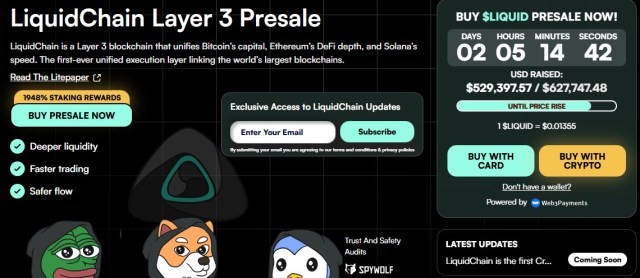
You can see the project’s early traction in the presale numbers. To date, LiquidChain has raised over $529K so far. The native token is currently priced at $0.01355, an entry level far below the established caps of legacy L1s. Join the presale here.
Moving from established majors like XRP to presale assets obviously carries risk. While LiquidChain offers a unified liquidity layer and verifiable settlement, it’s still early in its roadmap.

The potential for outsized returns comes with the usual dangers: regulatory uncertainty and the technical hurdles of executing a complex cross-chain VM. But for those with the stomach for it, the rotation into $LIQUID represents a bet on the plumbing that will power the next generation of dApps, distinct from Ripple’s payment-focused utility.

Buy $LIQUID here.

Disclaimer: This article is for informational purposes only and does not constitute financial advice. Cryptocurrency investments, particularly in presale projects and volatile assets like XRP, carry high risks. Readers should conduct their own independent research and consult with financial professionals before making investment decisions.

Editorial Process for bitcoinist is centered on delivering thoroughly researched, accurate, and unbiased content. We uphold strict sourcing standards, and each page undergoes diligent review by our team of top technology experts and seasoned editors. This process ensures the integrity, relevance, and value of our content for our readers.

patrubogdan

Follow

Full Profile

Related Posts

Bitcoin Teeters on Edge: Will $60K Hold or Is a V-Shape Recovery Imminent? $HYPER Keeps Pumping

Senator Lummis Urges Banks to Adopt Stablecoins Amidst CLARITY Act Delay, as Maxi Doge Turns Heads

$BTC Needs to Drop to $8K for Holdings Not to Cover Debt, Says Strategy, as $HYPER’s Presale Soars

Robinhood CEO Says Prediction Markets Will Soar as Bitcoin Hyper ($HYPER) Reaches $31.2M in Presale

Vitalik Buterin Cashes Out $6.6 Million In Ether After Early Signals

While Bitcoin And Ether Falter, XRP Optimism Stands Out: Analysts

Perguntas relacionadas

QWhat is the critical support level for XRP mentioned in the article, and why is it important?

AThe critical support level for XRP is $1.29. It is important because it represents a technical retest of previous resistance-turned-support and aligns with the 0.382 Fibonacci retracement level, making it a high-probability zone for institutional accumulation. Holding this level is key for a potential price run toward $2.00.

QAccording to the article, what is the main fundamental driver for XRP's price action?

AThe main fundamental driver for XRP's price action is regulatory clarity, specifically the potential changes at the SEC following Gary Gensler's anticipated exit. This 'regulatory relief' trade, along with the possibility of XRP ETF approvals, is seen as a major catalyst for unlocking institutional investment.

QWhat price level would invalidate the immediate bullish thesis for XRP?

AA daily close below the $1.10 level would invalidate the immediate bullish thesis for XRP. This break of support would likely trigger a deeper price decline toward the 200-day moving average, which is near $0.85.

QHow does LiquidChain ($LIQUID) differentiate itself from XRP in terms of utility?

ALiquidChain differentiates itself by focusing on cross-chain liquidity as a Layer 3 solution, whereas XRP focuses on cross-border payments. $LIQUID aims to unify liquidity across Bitcoin, Ethereum, and Solana through a 'deploy-once' architecture, allowing developers to build apps that access users and capital across all three chains.

QWhat was the amount raised in the LiquidChain presale and what is the current token price mentioned?

AThe LiquidChain presale had raised over $529,000 at the time of writing. The native $LIQUID token was being offered at a price of $0.01355 during its presale phase.

Leituras Relacionadas

Must-Watch Events Next Week|CLARITY Act Could Face Senate Vote; SpaceX, Circle to Report Earnings (8.3-8.9)

**Summary: Key Events and Developments to Watch (August 3-9)** The upcoming week is marked by significant financial disclosures, key legislative deadlines, and notable product updates. **Major Financial Events:** Several companies are scheduled to release their Q2 2026 earnings. American Bitcoin (ABTC) will report on August 3, followed by SpaceX and Hut 8 Mining Corp. on August 4, and Circle on August 5. Notably, a significant portion of SpaceX shares (up to 12% of total shares) will be unlocked on August 6 following their earnings release. **Key Legislative Deadline:** The U.S. Senate faces an August 7 deadline to secure 60 votes for the CLARITY Act, a bipartisan bill aiming to establish a federal regulatory framework for cryptocurrencies. The Senate may hold a full vote on the bill during the week. **Economic Data:** The U.S. July Non-Farm Payrolls report will be released on August 7, providing crucial labor market data. **Technology & Product Updates:** * **Shutdowns:** DeFi portfolio tracker Zapper and wallet app Ctrl Wallet will cease operations on August 3. * **Upgrades:** LayerZero will deprecate its v1 relayers on August 3. XRP Ledger's new version 3.3.0, featuring five new functions, is expected next week. * **AI:** Elon Musk announced that the advanced Grok 4.6 AI model is set for release around August 7. * **Bitcoin:** The BIP-110 forced signaling for a potential Bitcoin network change is scheduled to begin around August 8. **Other Notable Events:** Chinese robotics firm Unitree Tech has set its preliminary price inquiry for its IPO for August 5. South Korean exchange Upbit will delist AQT and AERGO tokens on August 3.

marsbitHá 1h

Must-Watch Events Next Week|CLARITY Act Could Face Senate Vote; SpaceX, Circle to Report Earnings (8.3-8.9)

marsbitHá 1h

Stocks Are Plummeting More Sharply Than Cryptocurrencies. Where Has the Money Gone?

Stock Markets Plunge Deeper Than Cryptocurrencies: Where Did the Money Go? In late July, Seoul's Kospi index triggered circuit breakers for two consecutive days, plummeting over 40% from its June high. The collapse was led by heavyweight stocks like SK Hynix, whose record profits still disappointed investors, and devastating leveraged ETFs, with one major product losing over 83% of its value. This signaled a global, forced deleveraging targeting the most crowded trades. Interestingly, while stocks exhibited extreme volatility akin to crypto markets, Bitcoin rose nearly 15% in July after a prior steep drop. Analysis shows the money fleeing equities did not flow into Bitcoin. Instead, Bitcoin had already absorbed its sell-off in May-June, when U.S. spot Bitcoin ETFs saw historic outflows. The true safe-haven beneficiary was gold, whose price rose over 20% year-on-year, highlighting a decoupling between Bitcoin and gold as "digital gold." The sell-off was a targeted unwinding of leveraged positions in tech and semiconductors, accelerated by broker-dealer risk management and shifts in the AI narrative, including new competition from Chinese memory chipmakers. The retreat path was clear: from high-valuation tech stocks to cash and U.S. Treasuries, then to gold. For Bitcoin to attract sustained institutional inflows, conditions like eased global liquidity pressure, a "soft-landing" Fed rate cut, and U.S. regulatory clarity via legislation like the stalled CLARITY Act are needed. Currently, Bitcoin is not a safe haven but an already-cleared asset. Its low correlation with tech stocks, however, makes it a potential diversification play for institutional portfolios once the storm passes. The money isn't here yet, but the positioning is underway.

marsbitHá 1h

Stocks Are Plummeting More Sharply Than Cryptocurrencies. Where Has the Money Gone?

marsbitHá 1h

In Conversation with Ray Dalio: We Are Currently in an AI Bubble, with 1% of My Portfolio in Bitcoin

Ray Dalio, founder of Bridgewater Associates, warns in an interview that the current AI boom shows classic bubble characteristics, which could lead to significant economic downturns as seen in past cycles like 1929 or 2000. He explains that speculative enthusiasm, fueled by debt and overvaluation, often precedes a crash when rising rates or taxation force asset sales, causing widespread losses and recession. Dalio also outlines his "Big Cycle" theory, describing an approximate 80-year pattern where widening wealth gaps, massive government deficits, and shifting geopolitical power (like China's rise) create internal conflict and global instability. He emphasizes that we are in a late-cycle, transitional phase where traditional powers like the US and UK face decline. For personal wealth protection, Dalio advises diversification beyond cash into assets like stocks, bonds, real estate, and particularly gold, which he prefers over Bitcoin. While he holds about 1% of his portfolio in Bitcoin as a non-printable hard asset, he views gold as more secure from technological or governmental threats. Regarding AI's impact, Dalio believes it will disproportionately benefit capital owners, worsening inequality by replacing both physical and cognitive labor. He suggests that human intuition and emotional intelligence, combined with AI, will be key for future workers. On taxation, Dalio argues that wealth taxes are impractical and risk triggering asset sell-offs, reducing productive investment. He points to the UK as a cautionary example of debt, low productivity, and political strife. Geopolitically, Dalio foresees a more regionalized world, with the US showing weakness in prolonged conflicts like with Iran, akin to past imperial declines. The ideal outcome, he suggests, is coexisting powerful blocs (e.g., Americas, China-Asia Pacific) without major war.

marsbitHá 5h

In Conversation with Ray Dalio: We Are Currently in an AI Bubble, with 1% of My Portfolio in Bitcoin

marsbitHá 5h

Trading

Spot
活动图片





