XRP Regime Check: What On-Chain Data Suggests Right Now

bitcoinistPublicado em 2025-12-29Última atualização em 2025-12-29

Resumo

CryptoQuant analyst Darkfost highlights a significant increase in XRP selling pressure, evidenced by a sharp rise in exchange inflows, particularly on Binance. Since December 15, daily inflows surged, peaking at 116 million XRP on December 19, indicating intensified distribution rather than accumulation. This suggests profit-taking by older holders and capitulation from recent buyers. The broader crypto market faces liquidity constraints, with stablecoin inflows to exchanges dropping significantly and overall sentiment turning bearish. Darkfost notes that without a reduction in these inflows, the current correction may deepen and prolong. At the time of writing, XRP was trading at $1.90.

The current XRP drawdown is accompanied by a notable jump in exchange inflows, a setup CryptoQuant analyst Darkfost (@Darkfost_Coc) says is consistent with rising sell pressure and a market that has not yet transitioned into accumulation.

XRP Selling Pressure Intensifies

In an X post, Darkfost wrote that “recent data point to a clear intensification of selling pressure on XRP,” placing it in the context of a sharp drawdown. “This dynamic comes in the context of a sharp correction, with the price dropping by around 50%, falling from a peak near $3.66 to an area around $1.85,” he said.

Darkfost’s main signal is exchange inflows, with an emphasis on Binance, which he called the venue that “continues to concentrate the largest trading volumes among all exchanges.” The underlying idea is simple but often effective: when inflows ramp up quickly, the market is seeing more coins positioned where they can be sold.

“One way to visualize this selling pressure is by analyzing XRP inflows to exchanges, particularly Binance,” he wrote. “These inflows are generally interpreted as a potential intent to sell, especially when they increase rapidly.”

He described the shift as starting mid-month. “After a relatively calm period marked by moderate and stable inflows, the situation shifted noticeably starting on December 15,” he said. “Since then, XRP inflows to Binance have risen sharply, with daily volumes ranging from 35 million XRP to a significant peak of 116 million XRP recorded on December 19.”
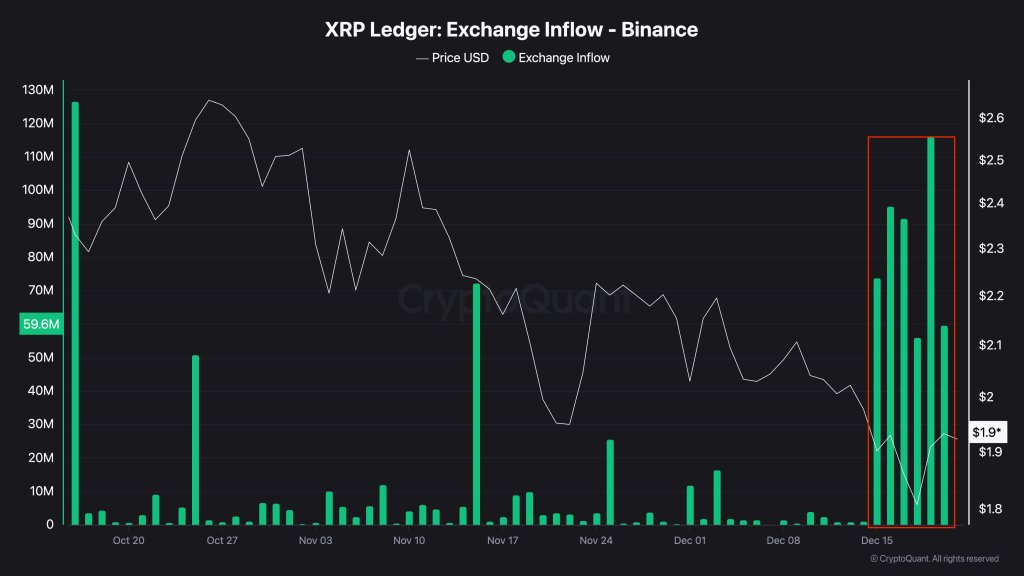
XRP Ledger Exchange Inflow Binance | Source: X @Darkfost_Coc

The implication is less about a single spike and more about the persistence of elevated prints. In that framing, repeated large inflows during a drawdown tend to read like ongoing distribution rather than a clean washout.

Darkfost argued the inflow regime also maps to a behavioral change across cohorts. “This change in dynamics also suggests a shift in investor behavior,” he wrote. “While a large portion of the market had been following a holding strategy since October, the trend over the past two weeks points to a move toward profit taking for older positions, as well as capitulation and loss selling from more recent entrants.”

He was explicit about what would need to change before “accumulation” becomes a defensible label. “As long as these elevated inflows persist or intensify further, it will be difficult for XRP to establish a true accumulation phase,” he said. “If this selling pressure continues, the current correction could not only extend in time but also deepen further.”

The Macro Backdrop

In separate posts, Darkfost tied the XRP signal to a wider market condition he characterized as liquidity constrained. “The crypto market continues to suffer from a lack of liquidity,” he wrote, adding that “the market cap of the main stablecoins has been stagnating for the past few weeks.”

He offered a specific interpretation of what that means for marginal demand. “There is no longer any fresh liquidity entering the market (fiat → crypto),” he said, while also arguing that “liquidity is still present within the market and is not leaving it.” The catch, in his view, is that available liquidity is staying sidelined: “However, this liquidity is not being deployed either, if we look at current stablecoin inflows to exchanges.”

Darkfost quantified the slowdown using exchange inflow averages. “Between September and today, the average monthly inflow to exchanges has been cut in half, dropping from $136B to around $70B,” he wrote, adding that “the annual average has also started to decline over the past few weeks.”
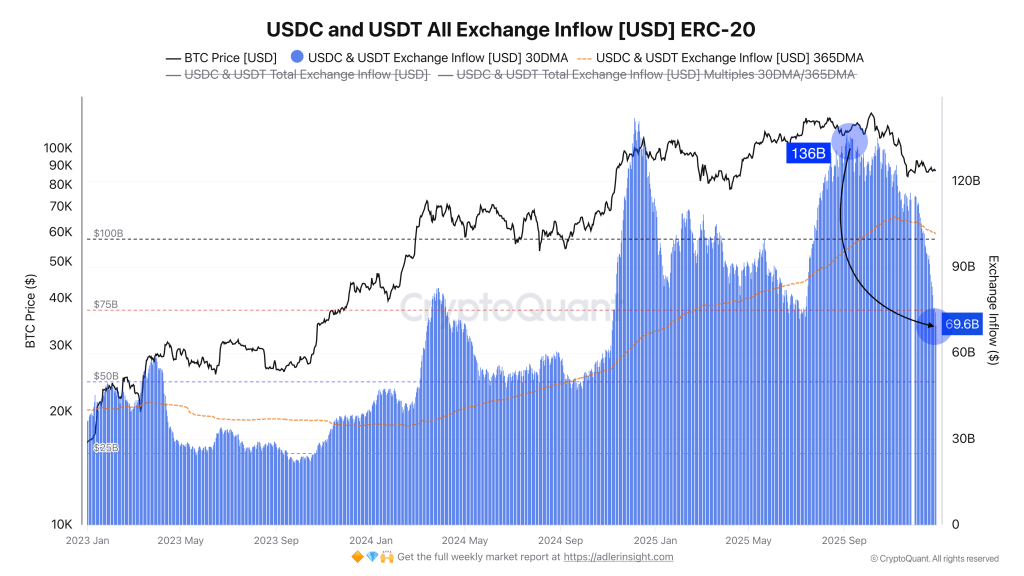
USDC and USDT All Exchange Inflow ERC20 | Source: X @Darkfost_Coc

Sentiment Turning Bearish

Darkfost also said sentiment in the entire crypto market has swung negative, based on a composite he tracks. “The general consensus has turned bearish,” he wrote, saying the indicator is “based on media articles, data from X, and several other sentiment indicators.” He noted that “when a shared consensus forms, the market tends to reverse and prove the majority wrong,” citing similar setups he observed between July and October 2024 and between February and April 2025.
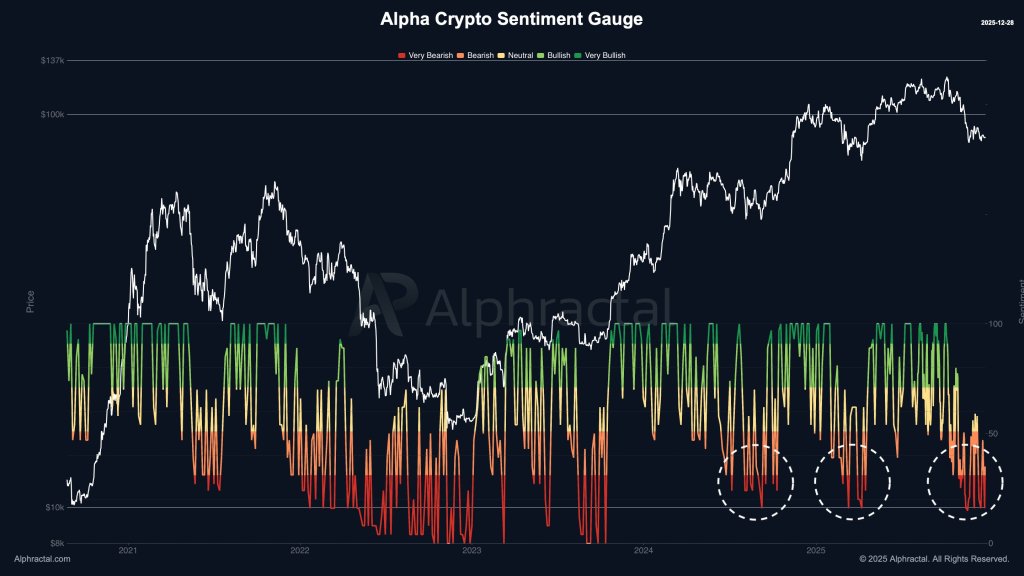
Alpha Crypto Sentiment Gauge | Source: X @Darkfost_Coc

At the same time, he warned against treating the signal as a timing tool, especially if broader conditions deteriorate. “These phases can last for some time, especially when the market enters a prolonged bear market phase,” he wrote. “We have only started to enter this period since early November, so there is no need to rush, but it is probably already a bit late to turn bearish.”

At press time, XRP traded at $1.90.
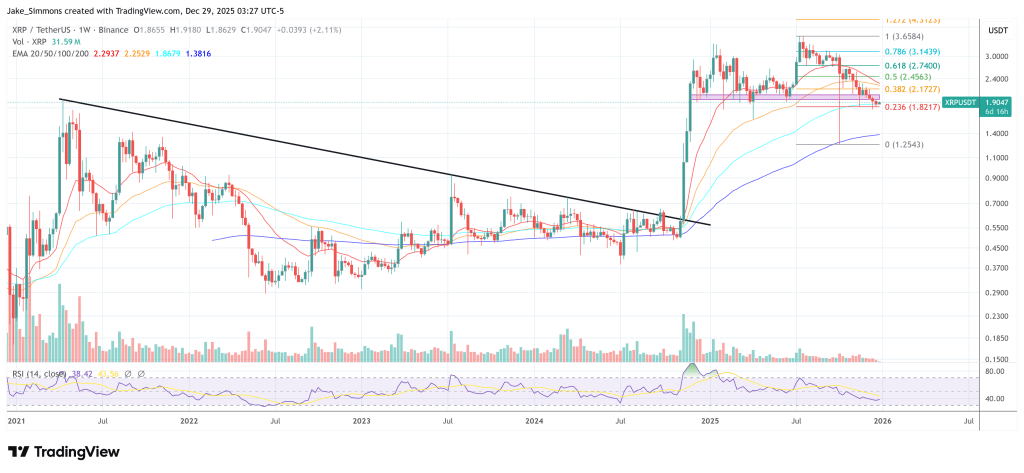
XRP falls below key support, 1-week chart | Source: XRPUSDT on TradingView.com

Perguntas relacionadas

QAccording to CryptoQuant analyst Darkfost, what on-chain data suggests a clear intensification of selling pressure on XRP?

AA notable jump in exchange inflows, particularly to Binance, suggests a clear intensification of selling pressure. Daily volumes ranged from 35 million XRP to a peak of 116 million XRP.

QWhat two specific investor behaviors does Darkfost attribute to the recent shift in XRP's on-chain dynamics?

AThe shift points to profit-taking from older positions and capitulation and loss selling from more recent entrants.

QWhat broader market condition does Darkfost link the XRP signals to, and what is the specific state of stablecoin liquidity?

AHe links it to a wider liquidity-constrained market. While liquidity is present and not leaving the market, it is not being deployed, as shown by stagnating stablecoin market cap and declining exchange inflows.

QBased on the sentiment gauge, what is the current general consensus in the crypto market, and what historical periods does Darkfost compare it to?

AThe general consensus has turned bearish. This is compared to similar setups observed between July and October 2024 and between February and April 2025.

QWhat condition must be met for XRP to establish a true accumulation phase, according to the analysis?

AThe elevated exchange inflows must subside. As long as they persist or intensify, it will be difficult to establish a true accumulation phase.

Leituras Relacionadas

Raising Interest Rates Is Not a Tech Killer, EPS Is: A Strategy for Discarding the Weak and Retaining the Strong After the AI Theme's Sharp Decline

**Summary: Rising Interest Rates Are Not the Killer of Tech; EPS Is: The "Keep the Strong, Ditch the Weak" Strategy After the AI Theme Plunge** The author argues that the sharp sell-off in tech and AI-related stocks, triggered by a strong US jobs report that heightened Fed rate hike fears, represents a "pullback to pick up passengers" rather than a "car crash." The true end of a tech bull market is not determined by an extra 25 basis point hike, but by industry overcapacity and the disproval of earnings per share (EPS) expectations. Historical analysis shows that during past rate hike cycles, the Nasdaq-100 often outperformed, provided EPS growth remained strong. The current phase is seen as a shift from a "broad narrative-driven rally" to a "focused verification stage" for AI. The investment strategy should be to "keep the strong, ditch the weak." * **Retain exposure** to high-conviction AI infrastructure leaders with clear order visibility, stable margins, strong cash flow, and upward EPS revisions (e.g., AI servers, advanced packaging, optical modules, key cloud suppliers). * **Reduce exposure** to high-beta, narrative-driven stocks with unclear profit paths (e.g., some quantum computing, space, or speculative chip stocks), especially on rebounds. Valuation concerns should focus on whether earnings can catch up to high multiples, not on high P/E alone. Crowded positioning signals a concentration into quality assets, not necessarily a market top. The upcoming Q2 earnings season will be a key validation point. The core principle is to hold stocks with proven EPS, while using macro events (CPI data, central bank meetings) to manage timing and risk.

marsbitHá 31m

Raising Interest Rates Is Not a Tech Killer, EPS Is: A Strategy for Discarding the Weak and Retaining the Strong After the AI Theme's Sharp Decline

marsbitHá 31m

The Largest IPO in History Ignites Heated Debate: Is SpaceX Worth $1.77 Trillion?

SpaceX's potential IPO is priced at $135 per share, aiming to raise $75 billion and valuing the company at approximately $1.77 trillion, which would make it the largest IPO in history. This valuation has sparked intense debate among investors. Bullish analysts, including major underwriters Goldman Sachs and Morgan Stanley, argue the valuation is justified by SpaceX's long-term potential. They see it not just as a rocket company but as a future leader in space infrastructure, with key growth drivers being Starlink satellite internet, low-cost rocket launches, and future AI-related ventures. They project revenues reaching hundreds of billions to trillions of dollars by 2030-2040. ARK Invest's model suggests a 2030 enterprise value could reach $2.5 trillion. Bearish analysts from independent research firms like Morningstar, PitchBook, and New Constructs contend the IPO price is excessively high, already pricing in unrealistic future growth. Using DCF and sum-of-the-parts models, they estimate fair value between $780 billion and $1.7 trillion, significantly below the IPO target. They highlight risks such as the speculative nature of AI projections, over-dependence on Elon Musk, high growth expectations, and corporate governance concerns. Trefis set a target price of just $79 per share. While both sides acknowledge SpaceX's unique position in commercial space, the core disagreement centers on whether the $135 share price offers a reasonable margin of safety or is overly optimistic. Despite the valuation controversy, reported strong demand for the IPO indicates significant market interest.

marsbitHá 2h

The Largest IPO in History Ignites Heated Debate: Is SpaceX Worth $1.77 Trillion?

marsbitHá 2h

After the Passage of the GENIUS Act and the CLARITY Act, What Is the Correct Architecture for On-Chain Yield?

The article discusses the evolution of on-chain credit, distinguishing three markets: overcollateralized crypto lending, unsecured lending (largely unsuccessful), and asset-backed credit (ABC). ABC, backed by identifiable real-world collateral with legal recourse, is identified as the fastest-growing category and the only one credibly addressing adverse selection—the core problem in credit where the riskiest borrowers self-select. Current growth in on-chain Real World Assets (RWAs), particularly tokenized private credit funds (e.g., Maple Finance, Centrifuge), is substantial but often merely "wraps" existing fund structures, inheriting their risks rather than solving adverse selection at the protocol level. The regulatory landscape is a key driver, with the US GENIUS Act (prohibiting stablecoin issuers from paying yield) and the proposed CLARITY Act (closing loopholes on indirect yield) set to redefine permissible yield-bearing products. This makes vaults (like ERC-4626) the critical architecture—they become the primary compliant vehicle for delivering yield, functioning as issuance, disclosure, distribution, and recovery mechanisms. The author's thesis is that the correct post-GENIUS/CLARITY architecture involves building ABC solutions where credit assessment, structure, and recovery are encoded directly into the smart contract vault layer, moving beyond mere tokenized fund wrappers to solve adverse selection fundamentally and ensure regulatory compliance.

Foresight NewsHá 2h

After the Passage of the GENIUS Act and the CLARITY Act, What Is the Correct Architecture for On-Chain Yield?

Foresight NewsHá 2h

Trading

Spot
Futuros

Artigos em Destaque

O que é XRP 2.0

XRP 2.0: Uma Nova Fronteira no Landscape das Criptomoedas Introdução ao XRP 2.0 No reino em constante evolução das criptomoedas, novos projetos surgem continuamente, lutando por atenção e adoção. Uma dessas iniciativas promissoras é o XRP 2.0, um novo projeto de criptomoeda concebido para aproveitar a tecnologia de blockchain avançada e as metodologias de criptografia robustas. Embora o nome tenha paralelos com o XRP da Ripple, é crucial notar que o XRP 2.0 opera de forma independente, focando em melhorar a segurança das transações, a privacidade e a escalabilidade. À medida que o panorama financeiro digital abraça cada vez mais soluções descentralizadas, o XRP 2.0 visa contribuir de forma significativa para a web3 e a expansão global dos projetos de criptomoedas. O que é o XRP 2.0? No seu núcleo, o XRP 2.0 é um projeto de criptomoeda que visa criar um ecossistema de moeda digital seguro e descentralizado. Sua tecnologia fundamental integra princípios de blockchain sofisticados com técnicas de criptografia de ponta. O objetivo abrangente do XRP 2.0 é estabelecer-se como uma plataforma confiável e eficiente que possibilita a execução rápida de transações, priorizando a proteção de privacidade aprimorada para os seus usuários. O projeto é promovido como uma solução para muitas limitações enfrentadas pelas criptomoedas existentes, propondo um sistema que pode lidar com um volume maior de transações com velocidade e privacidade melhoradas. Esta versatilidade posiciona o XRP 2.0 como um concorrente significativo em um mercado repleto de várias moedas digitais. Quem é o Criador do XRP 2.0? A identidade do criador por trás do XRP 2.0 foi identificada como 'Wilbur.' No entanto, detalhes abrangentes sobre Wilbur ou a sua entidade associada permanecem elusivos. O anonimato de muitos criadores de criptomoedas não é um fenômeno incomum na indústria, muitas vezes concebido para manter um grau de privacidade e segurança. Quem são os Investidores do XRP 2.0? Até agora, informações específicas relacionadas às fundações ou organizações de investimento que apoiam o XRP 2.0 não estão disponíveis publicamente. No setor das criptomoedas, o apoio de investidores reputados pode influenciar significativamente a credibilidade e o sucesso de um projeto, no entanto, a transparência em relação aos apoiantes financeiros do XRP 2.0 não foi estabelecida. Como Funciona o XRP 2.0? O XRP 2.0 destaca-se por empregar uma combinação de tecnologia blockchain e algoritmos de criptografia avançados que asseguram transações seguras e descentralizadas. Sua estrutura inovadora inclui características únicas projetadas para fomentar o envolvimento dos usuários e ampliar as funcionalidades além das transações convencionais de criptomoedas. Entre essas características, o XRP 2.0 incorpora capacidades potenciadas por IA, como funcionalidades de texto-para-imagem e texto-para-fala. Estas adições são projetadas para melhorar a experiência interativa dos usuários, promovendo uma maior aplicabilidade em vários setores. Ao unir avanços tecnológicos com um design centrado no utilizador, o XRP 2.0 pretende captar a atenção de uma diversa gama de indivíduos e empresas que procuram integrar soluções de criptomoedas em suas estruturas operacionais. Cronologia do XRP 2.0 Compreender o XRP 2.0 requer examinar os marcos que definiram sua jornada até agora: 23 de Julho de 2023: O XRP 2.0 é apresentado como um novo projeto de criptomoeda, visando revolucionar as capacidades de transação seguras e descentralizadas no domínio do blockchain. 8 de Setembro de 2023: O lançamento de outro projeto, XRP20, ocorre, marcando o surgimento de um token ERC-20 na blockchain Ethereum que permanece não relacionado ao XRP 2.0. 13 de Novembro de 2023: O XRP Ledger passa por uma atualização significativa com o lançamento da versão 2.0.0 do software do servidor rippled. É importante notar que este desenvolvimento está desconectado do projeto de criptomoeda XRP 2.0. Pontos-chave sobre o XRP 2.0 Para destilar a essência do XRP 2.0, vários fatores críticos emergem: Características Únicas: A inclusão de características como texto-para-imagem e texto-para-fala potenciadas por IA diversifica ainda mais as aplicações potenciais do XRP 2.0. Tecnologia Blockchain: A estrutura utiliza mecanismos de blockchain avançados e protocolos de criptografia, assegurando um ambiente seguro e descentralizado para transações. Escalabilidade e Privacidade: O XRP 2.0 prioriza proteção de privacidade aprimorada nos processos de transação e a escalabilidade necessária para acomodar uma base de utilizadores crescente. Sem Afiliação com a Ripple: Importante, apesar do seu nome, o XRP 2.0 não tem qualquer lealdade ou colaboração com o XRP da Ripple, distinguindo sua estrutura operacional e objetivos dentro do ecossistema das criptomoedas. Conclusão O XRP 2.0 representa uma empreitada ambiciosa no domínio das criptomoedas, visando oferecer uma combinação de segurança, privacidade e eficiência em transações digitais. Ao integrar tecnologias sofisticadas e características amigáveis ao utilizador, o projeto propõe-se a ampliar os horizontes do que as criptomoedas podem alcançar na economia digital atual. Embora o anonimato do seu criador e a falta de investidores divulgados possam levantar questões para alguns, o foco do XRP 2.0 em funcionalidades avançadas e descentralização aumenta seu apelo num mercado de criptomoedas cada vez mais congestionado. À medida que o panorama das criptomoedas continua a evoluir, o XRP 2.0 pode ainda emergir como um jogador crucial na expansão de soluções de blockchain seguras e escaláveis.

99 Visualizações TotaisPublicado em {updateTime}Atualizado em 2024.12.03

O que é XRP 2.0

Como comprar XRP

Bem-vindo à HTX.com!Tornámos a compra de XRP (XRP) simples e conveniente.Segue o nosso guia passo a passo para iniciar a tua jornada no mundo das criptos.Passo 1: cria a tua conta HTXUtiliza o teu e-mail ou número de telefone para te inscreveres numa conta gratuita na HTX.Desfruta de um processo de inscrição sem complicações e desbloqueia todas as funcionalidades.Obter a minha contaPasso 2: vai para Comprar Cripto e escolhe o teu método de pagamentoCartão de crédito/débito: usa o teu visa ou mastercard para comprar XRP (XRP) instantaneamente.Saldo: usa os fundos da tua conta HTX para transacionar sem problemas.Terceiros: adicionamos métodos de pagamento populares, como Google Pay e Apple Pay, para aumentar a conveniência.P2P: transaciona diretamente com outros utilizadores na HTX.Mercado de balcão (OTC): oferecemos serviços personalizados e taxas de câmbio competitivas para os traders.Passo 3: armazena teu XRP (XRP)Depois de comprar o teu XRP (XRP), armazena-o na tua conta HTX.Alternativamente, podes enviá-lo para outro lugar através de transferência blockchain ou usá-lo para transacionar outras criptomoedas.Passo 4: transaciona XRP (XRP)Transaciona facilmente XRP (XRP) no mercado à vista da HTX.Acede simplesmente à tua conta, seleciona o teu par de trading, executa as tuas transações e monitoriza em tempo real.Oferecemos uma experiência de fácil utilização tanto para principiantes como para traders experientes.

1.6k Visualizações TotaisPublicado em {updateTime}Atualizado em 2026.06.02

Como comprar XRP

Discussões

Bem-vindo à Comunidade HTX. Aqui, pode manter-se informado sobre os mais recentes desenvolvimentos da plataforma e obter acesso a análises profissionais de mercado. As opiniões dos utilizadores sobre o preço de XRP (XRP) são apresentadas abaixo.

活动图片














