XRP Realized Profit-To-Loss Ratio Plunges – What The Market Should Be Expecting

bitcoinistPublicado em 2026-06-10Última atualização em 2026-06-10

Resumo

XRP's Realized Profit-to-Loss Ratio has plunged sharply to 0.38, indicating that for every dollar of loss realized, only 38 cents of profit is being taken. This deep drop below 1 signals a market where most moving coins are sold at a loss, reflecting intense capitulation amid ongoing bearish price pressure below $1.2. Despite the weak price performance, spot trading activity is increasing, led predominantly by large whale investors who often dominate during accumulation phases. Concurrently, XRP reserves on major exchanges like Upbit are showing a slight decline—a trend historically associated with subsequent price rallies. Analysts suggest these dynamics could potentially set the stage for a market bounce if the withdrawal trend continues.

Several key metrics of XRP are starting to change course, falling drastically along with the ongoing bearish performance of the altcoin’s price. As the downside pressure mounts, the Realized Profit to Loss Ratio has experienced a sharp decline to levels that reflect the intensity of the current bear market phase.

Investor Profitability On XRP Takes A Hit

The price of XRP is still trapped below $1.2, as bearish pressure returns to the market following a brief upswing. Investors are still feeling the impact of the persistent downside action of the leading altcoin, which is triggering a shift in market dynamics.

In light of this significant price decline, the XRP’s Realized Profit to Loss Ratio is notably dropping to negative levels. As seen in the chart shared by Glassnode, a popular on-chain data analytics platform, the metric on the 90-day time frame has fallen to 0.38, indicating a decrease in profitability among investors.

Furthermore, a change in market mood and investor behavior is reflected in the drop as an increasing number of transactions are being completed at a loss compared to those realized in profit. During this period, an inflection or more selling pressure is highly likely, which will be vital for the possible next major move.

According to the platform, for every dollar of loss being realized in the market, only 38 cents of profit are being taken. At the 2025 peak, this ratio reached level 50, implying that profit-takers were overwhelming loss sellers by a factor of 50x, but that key dynamic has completely inverted.
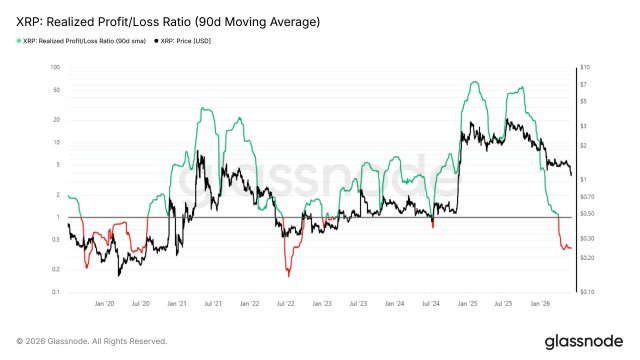
Source: Chart from Glassnode on X

Glassnode highlighted that when a ratio drops deep below 1, it reflects a market where the majority of participants who are moving coins are doing so at a loss. This trend is a clear indication of a hallmark of intense capitulation.

Despite the waning price performance, XRP spot trading is picking up pace. Data shows that this rise in spot trading is being led by large investors or big whales, and has maintained this dominance since July 2022.

An important aspect of this development is that these traders often lead the spot market trading in periods of accumulation phases rather than making significant orders during the uptrend phases. In addition, Glassnode highlighted that the cohort has been leading spot trading very actively since October last year.

Withdrawal Ongoing On Crypto Exchanges

XRP investors’ sentiment and behavior are experiencing a key shift as the altcoin is starting to leave cryptocurrency exchanges. One of the major exchanges where this trend is being spotted is the Korea-based leading trading platform, Upbit.

The reserves appear to be slightly declining, but subtly. CW noted that in periods when XRP’s reserves on Upbit grow, it has generally coincided with bearish trends. Meanwhile, when the reserves decrease on the platform, the altcoin has displayed notable rallies. As a result, the data analyst believes that a bounce could be on the horizon if this trend continues.

XRP trading at $1.11 on the 1D chart | Source: XRPUSDT on Tradingview.com

Perguntas relacionadas

QWhat is the current trend of XRP's Realized Profit to Loss Ratio according to the article?

AXRP's Realized Profit to Loss Ratio has plunged sharply to negative levels, falling to 0.38 on the 90-day timeframe. This indicates that for every dollar of loss realized, only 38 cents of profit is being taken, reflecting intense selling pressure and capitulation.

QHow does the article describe the behavior of large investors (whales) in the XRP spot market currently?

AThe article states that XRP spot trading is being led by large investors or whales, a dominance they have maintained since July 2022. These traders are typically more active in accumulation phases rather than during uptrends, and have been leading spot trading very actively since October last year.

QWhat is the significance of XRP reserves declining on exchanges like Upbit, as mentioned in the article?

AA decline in XRP reserves on exchanges like Upbit is seen as a potentially bullish signal. Historically, decreasing reserves on this platform have coincided with notable rallies for XRP, while growing reserves have aligned with bearish trends. The data analyst believes a price bounce could be imminent if this withdrawal trend continues.

QWhat does a Realized Profit to Loss Ratio dropping deep below 1 signify for the market?

AWhen the Realized Profit to Loss Ratio drops deep below 1, it signifies a market where the majority of participants moving coins are doing so at a loss. This is a clear hallmark of intense capitulation, indicating widespread selling pressure and a negative shift in investor sentiment.

QWhat was the peak level of the Realized Profit to Loss Ratio mentioned for XRP in 2025, and how does it compare to the current level?

AAt the 2025 peak, the Realized Profit to Loss Ratio for XRP reached level 50, meaning profit-takers were overwhelming loss sellers by a factor of 50x. This has completely inverted to the current level of 0.38, showing a dramatic shift from a strong profit-taking environment to one dominated by loss realization.

Leituras Relacionadas

12.9 Million Candidates: The First Summer of Fate in the Hands of AI

The 2026 Chinese college entrance exam, or Gaokao, saw a novel phenomenon: AI aggressively entering the college application advice arena before results were even released. Major tech companies like Alibaba, Tencent, Baidu, and others launched free AI-powered "agents" and tools designed to generate personalized university and major recommendations for over 12.9 million candidates. For years, a lucrative industry thrived on the "information gap" in college applications, with personalized consulting services costing families thousands of dollars. AI is now disrupting this by providing similar, data-driven analysis for free. These tools process standardized data—scores, rankings, historical admission trends—to create tailored application strategies, offering a form of information parity previously unavailable, especially to students from rural or less-resourced backgrounds. This shift represents more than just a marketing trend; it signifies AI's first large-scale entry into a critical, high-stakes life decision for millions of Chinese families. The Gaokao application, with its clear inputs and outputs, is an ideal scenario for AI. Its involvement begins to level the informational playing field, potentially reducing the advantage held by families with greater social capital or access to expensive consultants. However, the article raises a profound question: while AI can optimize choices for employability and financial return based on cold data, it risks promoting a homogenized, utilitarian path. It might steer a passionate student away from a less lucrative field like literature or archaeology toward supposedly "safer" options like computer science. The core dilemma remains: as AI flattens information disparities, does it also flatten the diversity of life choices and the freedom to make—and learn from—mistakes? Ultimately, 2026 may be remembered not for exam questions, but as the year AI began formally influencing the life trajectories of ordinary Chinese people. The real test lies not in the algorithm's recommendations, but in whether individuals will retain the courage to make their own choices and bear the consequences in an increasingly algorithmic age.

marsbitHá 27m

12.9 Million Candidates: The First Summer of Fate in the Hands of AI

marsbitHá 27m

IC3 Top Universities Collaborative Analysis: Is AI x Crypto the Real Future or Just a Narrative Bubble?

IC3 researchers from leading universities analyze the convergence of AI and crypto. They argue meaningful integration is still nascent, with hype often outstripping progress. The report frames AI as a "translation middleware" making blockchain accessible, while crypto serves as a "trust middleware" via tools like ZK proofs and TEEs for integrity, availability, and confidentiality. Two main directions are examined: 1) **Crypto x AI**: Using AI to enhance blockchain via analysis (fraud detection), algorithmic design, and AI oracles (with accuracy varying by task). New risks include AI-driven malicious smart contracts. 2) **AI x Crypto**: Using crypto to enhance AI via decentralized infrastructure (DePIN), data markets, agent micropayments, governance, and securing AI pipelines (training/federated learning, secure inference). The "Protected Pipeline" (Props) framework combines oracles and trusted computation for secure use of private data. Key challenges are highlighted: The industry must rigorously prove decentralized AI's cost competitiveness and crypto's utility for agent payments. Major research gaps include providing systemic security for autonomous agents and addressing novel threats like unstoppable AI agents. The report concludes by debunking five common misconceptions: blockchain cannot inherently detect AI content, solve algorithmic bias, grant true AI autonomy, ensure AI trustworthiness through mere transparency, or guarantee that decentralization is always cheaper for AI tasks. The field remains in an early, evidence-seeking phase.

marsbitHá 1h

IC3 Top Universities Collaborative Analysis: Is AI x Crypto the Real Future or Just a Narrative Bubble?

marsbitHá 1h

Anthropic Released the "Most Powerful Model," But Most People Can't Use It

In April, Anthropic launched a preview of its "Mythos" model, which was not publicly released due to its exceptional ability to autonomously discover high-risk zero-day vulnerabilities, posing a security threat if misused. It was restricted to a trusted group of security partners under "Project Glasswing." On June 10, Anthropic officially released Fable 5 and Mythos 5. They share the same underlying model but are distributed under different rules. Fable 5 is for general users, while Mythos 5 remains locked for trusted security partners. Benchmarks show Fable 5 leading in software engineering and long-task execution, with significant improvements in generating production-ready code. However, Fable 5 includes a safety classifier that automatically downgrades requests related to cybersecurity, biochemistry, or model distillation to the weaker Opus 4.8 model. This mechanism, while intended for safety, can affect the user experience and has faced criticism for being overly conservative. Pricing is another key point. Fable 5's API costs are double that of Opus 4.8. Furthermore, after a free trial period ending June 23, it will be removed from standard subscription plans, requiring users to purchase additional credits for access. This shift signals a move towards pay-as-you-go pricing for the most advanced capabilities. The strategy highlights a growing divergence in the AI industry: while some players like DeepSeek are drastically cutting prices, Anthropic is increasing them for its top-tier model, using cost as a filter for high-value users. The article suggests the AI market is stratifying, with commoditized capabilities becoming cheaper while premium, cutting-edge models command a significant price premium.

marsbitHá 1h

Anthropic Released the "Most Powerful Model," But Most People Can't Use It

marsbitHá 1h

Trading

Spot
Futuros

Artigos em Destaque

O que é XRP 2.0

XRP 2.0: Uma Nova Fronteira no Landscape das Criptomoedas Introdução ao XRP 2.0 No reino em constante evolução das criptomoedas, novos projetos surgem continuamente, lutando por atenção e adoção. Uma dessas iniciativas promissoras é o XRP 2.0, um novo projeto de criptomoeda concebido para aproveitar a tecnologia de blockchain avançada e as metodologias de criptografia robustas. Embora o nome tenha paralelos com o XRP da Ripple, é crucial notar que o XRP 2.0 opera de forma independente, focando em melhorar a segurança das transações, a privacidade e a escalabilidade. À medida que o panorama financeiro digital abraça cada vez mais soluções descentralizadas, o XRP 2.0 visa contribuir de forma significativa para a web3 e a expansão global dos projetos de criptomoedas. O que é o XRP 2.0? No seu núcleo, o XRP 2.0 é um projeto de criptomoeda que visa criar um ecossistema de moeda digital seguro e descentralizado. Sua tecnologia fundamental integra princípios de blockchain sofisticados com técnicas de criptografia de ponta. O objetivo abrangente do XRP 2.0 é estabelecer-se como uma plataforma confiável e eficiente que possibilita a execução rápida de transações, priorizando a proteção de privacidade aprimorada para os seus usuários. O projeto é promovido como uma solução para muitas limitações enfrentadas pelas criptomoedas existentes, propondo um sistema que pode lidar com um volume maior de transações com velocidade e privacidade melhoradas. Esta versatilidade posiciona o XRP 2.0 como um concorrente significativo em um mercado repleto de várias moedas digitais. Quem é o Criador do XRP 2.0? A identidade do criador por trás do XRP 2.0 foi identificada como 'Wilbur.' No entanto, detalhes abrangentes sobre Wilbur ou a sua entidade associada permanecem elusivos. O anonimato de muitos criadores de criptomoedas não é um fenômeno incomum na indústria, muitas vezes concebido para manter um grau de privacidade e segurança. Quem são os Investidores do XRP 2.0? Até agora, informações específicas relacionadas às fundações ou organizações de investimento que apoiam o XRP 2.0 não estão disponíveis publicamente. No setor das criptomoedas, o apoio de investidores reputados pode influenciar significativamente a credibilidade e o sucesso de um projeto, no entanto, a transparência em relação aos apoiantes financeiros do XRP 2.0 não foi estabelecida. Como Funciona o XRP 2.0? O XRP 2.0 destaca-se por empregar uma combinação de tecnologia blockchain e algoritmos de criptografia avançados que asseguram transações seguras e descentralizadas. Sua estrutura inovadora inclui características únicas projetadas para fomentar o envolvimento dos usuários e ampliar as funcionalidades além das transações convencionais de criptomoedas. Entre essas características, o XRP 2.0 incorpora capacidades potenciadas por IA, como funcionalidades de texto-para-imagem e texto-para-fala. Estas adições são projetadas para melhorar a experiência interativa dos usuários, promovendo uma maior aplicabilidade em vários setores. Ao unir avanços tecnológicos com um design centrado no utilizador, o XRP 2.0 pretende captar a atenção de uma diversa gama de indivíduos e empresas que procuram integrar soluções de criptomoedas em suas estruturas operacionais. Cronologia do XRP 2.0 Compreender o XRP 2.0 requer examinar os marcos que definiram sua jornada até agora: 23 de Julho de 2023: O XRP 2.0 é apresentado como um novo projeto de criptomoeda, visando revolucionar as capacidades de transação seguras e descentralizadas no domínio do blockchain. 8 de Setembro de 2023: O lançamento de outro projeto, XRP20, ocorre, marcando o surgimento de um token ERC-20 na blockchain Ethereum que permanece não relacionado ao XRP 2.0. 13 de Novembro de 2023: O XRP Ledger passa por uma atualização significativa com o lançamento da versão 2.0.0 do software do servidor rippled. É importante notar que este desenvolvimento está desconectado do projeto de criptomoeda XRP 2.0. Pontos-chave sobre o XRP 2.0 Para destilar a essência do XRP 2.0, vários fatores críticos emergem: Características Únicas: A inclusão de características como texto-para-imagem e texto-para-fala potenciadas por IA diversifica ainda mais as aplicações potenciais do XRP 2.0. Tecnologia Blockchain: A estrutura utiliza mecanismos de blockchain avançados e protocolos de criptografia, assegurando um ambiente seguro e descentralizado para transações. Escalabilidade e Privacidade: O XRP 2.0 prioriza proteção de privacidade aprimorada nos processos de transação e a escalabilidade necessária para acomodar uma base de utilizadores crescente. Sem Afiliação com a Ripple: Importante, apesar do seu nome, o XRP 2.0 não tem qualquer lealdade ou colaboração com o XRP da Ripple, distinguindo sua estrutura operacional e objetivos dentro do ecossistema das criptomoedas. Conclusão O XRP 2.0 representa uma empreitada ambiciosa no domínio das criptomoedas, visando oferecer uma combinação de segurança, privacidade e eficiência em transações digitais. Ao integrar tecnologias sofisticadas e características amigáveis ao utilizador, o projeto propõe-se a ampliar os horizontes do que as criptomoedas podem alcançar na economia digital atual. Embora o anonimato do seu criador e a falta de investidores divulgados possam levantar questões para alguns, o foco do XRP 2.0 em funcionalidades avançadas e descentralização aumenta seu apelo num mercado de criptomoedas cada vez mais congestionado. À medida que o panorama das criptomoedas continua a evoluir, o XRP 2.0 pode ainda emergir como um jogador crucial na expansão de soluções de blockchain seguras e escaláveis.

99 Visualizações TotaisPublicado em {updateTime}Atualizado em 2024.12.03

O que é XRP 2.0

Como comprar XRP

Bem-vindo à HTX.com!Tornámos a compra de XRP (XRP) simples e conveniente.Segue o nosso guia passo a passo para iniciar a tua jornada no mundo das criptos.Passo 1: cria a tua conta HTXUtiliza o teu e-mail ou número de telefone para te inscreveres numa conta gratuita na HTX.Desfruta de um processo de inscrição sem complicações e desbloqueia todas as funcionalidades.Obter a minha contaPasso 2: vai para Comprar Cripto e escolhe o teu método de pagamentoCartão de crédito/débito: usa o teu visa ou mastercard para comprar XRP (XRP) instantaneamente.Saldo: usa os fundos da tua conta HTX para transacionar sem problemas.Terceiros: adicionamos métodos de pagamento populares, como Google Pay e Apple Pay, para aumentar a conveniência.P2P: transaciona diretamente com outros utilizadores na HTX.Mercado de balcão (OTC): oferecemos serviços personalizados e taxas de câmbio competitivas para os traders.Passo 3: armazena teu XRP (XRP)Depois de comprar o teu XRP (XRP), armazena-o na tua conta HTX.Alternativamente, podes enviá-lo para outro lugar através de transferência blockchain ou usá-lo para transacionar outras criptomoedas.Passo 4: transaciona XRP (XRP)Transaciona facilmente XRP (XRP) no mercado à vista da HTX.Acede simplesmente à tua conta, seleciona o teu par de trading, executa as tuas transações e monitoriza em tempo real.Oferecemos uma experiência de fácil utilização tanto para principiantes como para traders experientes.

1.6k Visualizações TotaisPublicado em {updateTime}Atualizado em 2026.06.02

Como comprar XRP

Discussões

Bem-vindo à Comunidade HTX. Aqui, pode manter-se informado sobre os mais recentes desenvolvimentos da plataforma e obter acesso a análises profissionais de mercado. As opiniões dos utilizadores sobre o preço de XRP (XRP) são apresentadas abaixo.

活动图片













