XRP price retreats to $1.35 support – But ONE signal points to recovery

ambcryptoPublicado em 2026-03-27Última atualização em 2026-03-27

Resumo

XRP's risk-adjusted returns, as measured by the Sharpe Ratio, have shown signs of recovery, moving into positive territory at 0.0267 after a significant decline in February. This suggests the asset may be generating better returns relative to its volatility. However, the price has repeatedly retreated to the $1.35 support level. For a sustained bullish recovery, increased spot demand and aggressive buyer activity are crucial. Recent data shows a drop in the Taker Buy-Sell Ratio, indicating sellers have regained dominance. Additionally, a recent spike in Open Interest and the Estimated Leverage Ratio points to increased speculative trading, which raises the risk of liquidation events and higher price volatility.

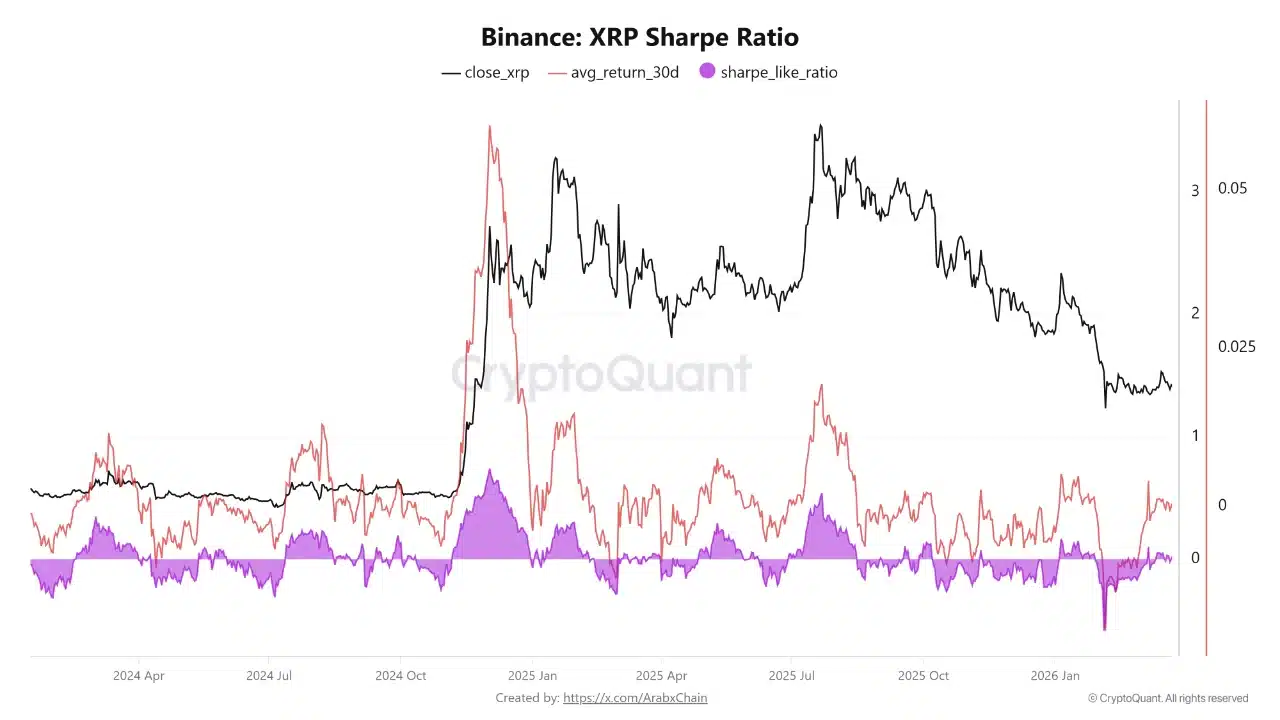
The risk-adjusted returns could be improving for Ripple [XRP], data showed. The Sharpe Ratio is used to help investors understand if an asset generates high returns, once adjusted for volatility.
Source: CryptoQuant

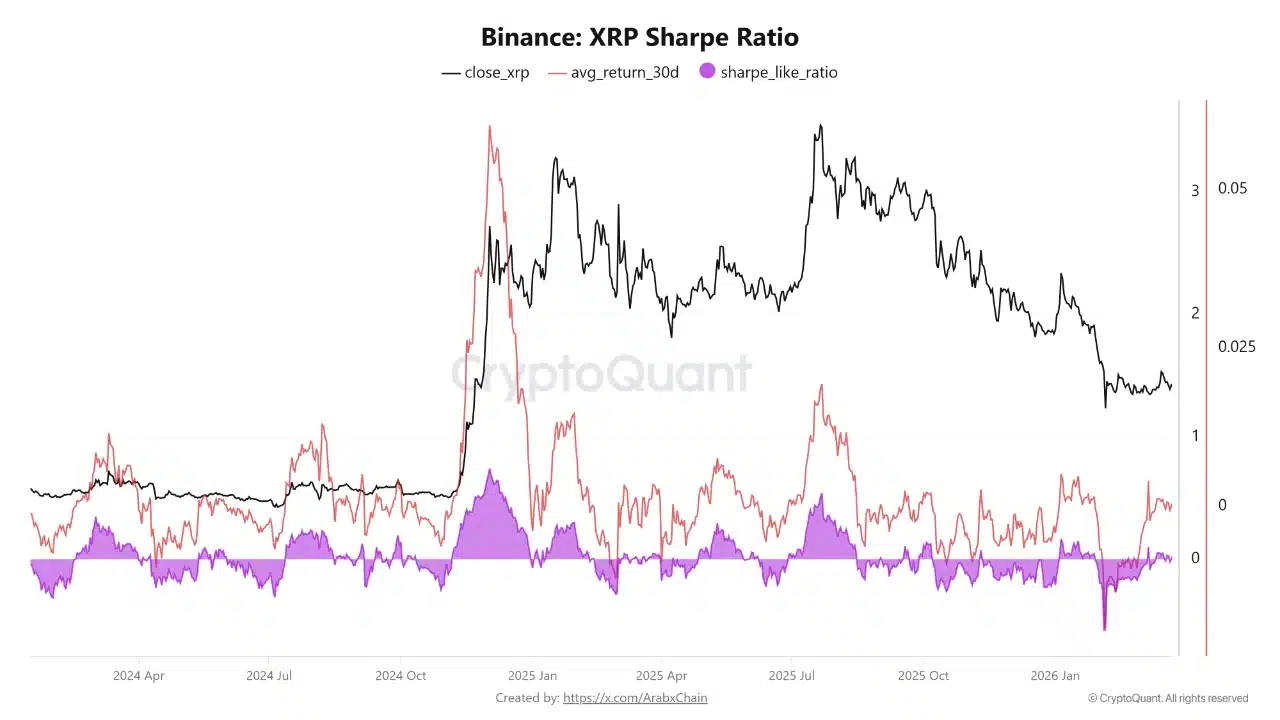
A rising Sharpe Ratio would imply a better risk-adjusted performance, observed an analyst in a post on CryptoQuant Insights. The metric saw a deep decline in February as the early January rally faded into a deeper downtrend. At that time, a Bitcoin [BTC] and crypto market-wide sell-off forced XRP prices from $2.35 to $1.21, a 48% drop.

The XRP gains in mid-March saw the 30-day returns spike higher. Recently, the Sharpe Ratio has improved gradually and has been hovering around the positive territory with a reading of 0.0267.

A sustained increase in the metric would mean that XRP is generating more gains with less volatility and could set the stage for a gradual bullish recovery. Yet, over the past six weeks, the price has kept pulling back to the $1.35 support, the same level XRP retested once more on the 26th of March.

The positive reading on the Sharpe Ratio showed that the risk-adjusted returns have improved moderately. It remains to be seen if the situation improves for the investors.

A drop-off in demand reflected bearish XRP sentiment

To keep the risk-adjusted returns rising, XRP needs increased demand which drive a sustained uptrend. A market that is not overleveraged would also keep the deep liquidity hunts at bay, reducing the daily volatility.
Source: CryptoQuant

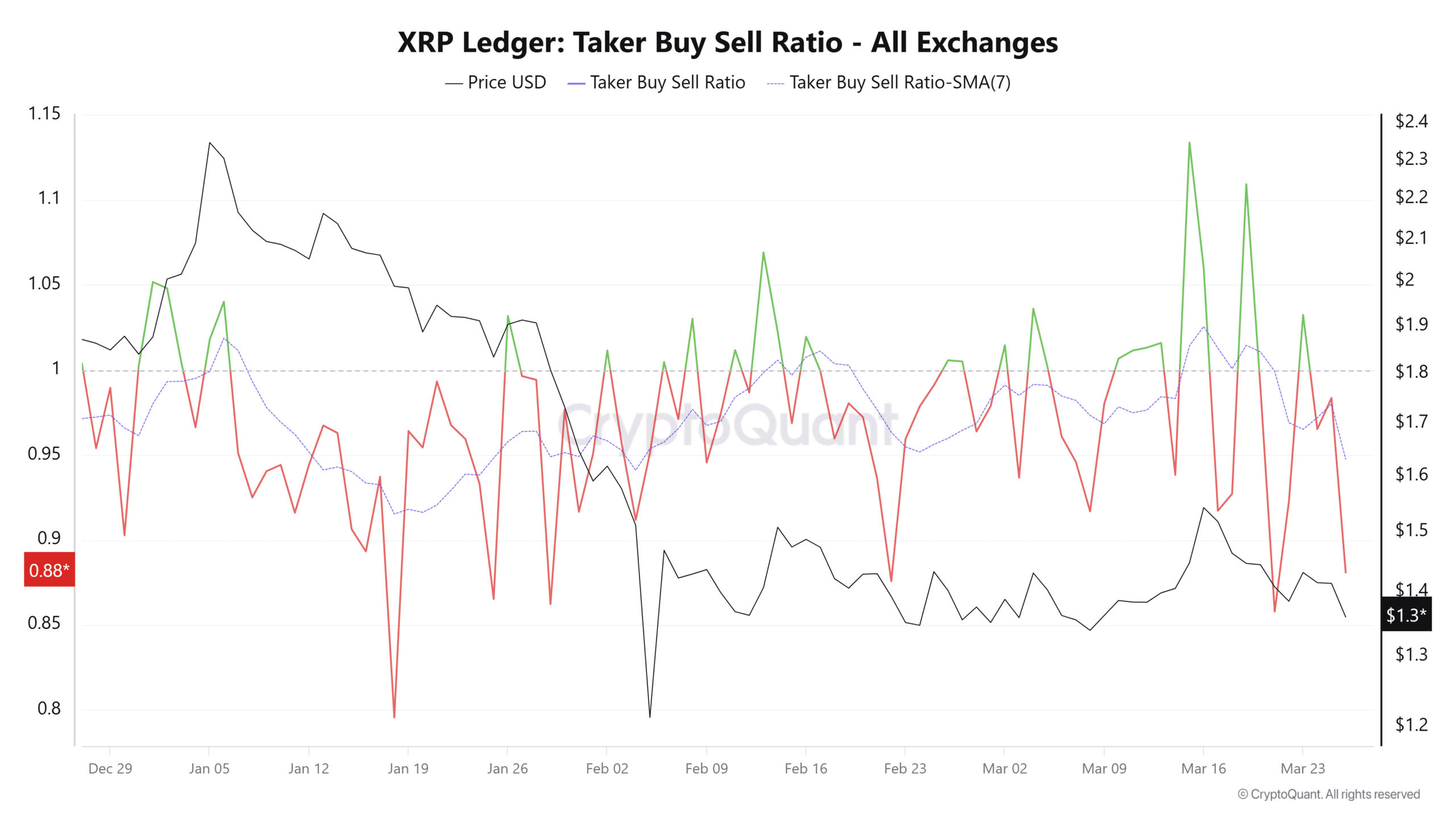
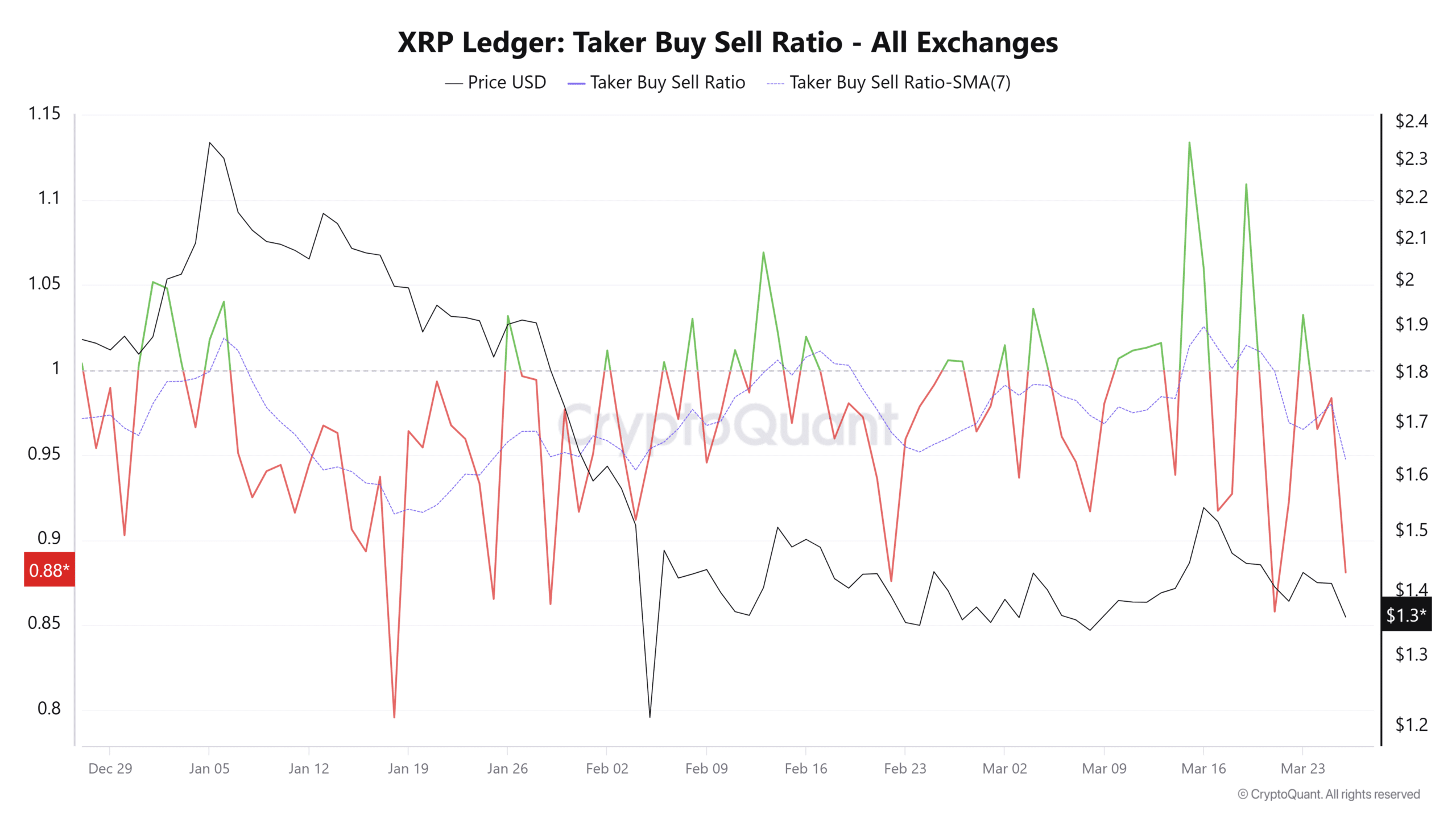
The Taker Buy-Sell Ratio was examined to understand the buyer aggression. In mid-March, when XRP rallied to $1.54 when Bitcoin reached $75k, the taker buy orders were prevalent. The 7-day moving average of the taker Buy/Sell Ratio climbed above 1 and stayed there for a few days, something that has only happened thrice in 2026.

This impetus didn’t last long. Over the past ten days, the crypto market correction saw sellers take the upper hand once again.
Source: CryptoQuant

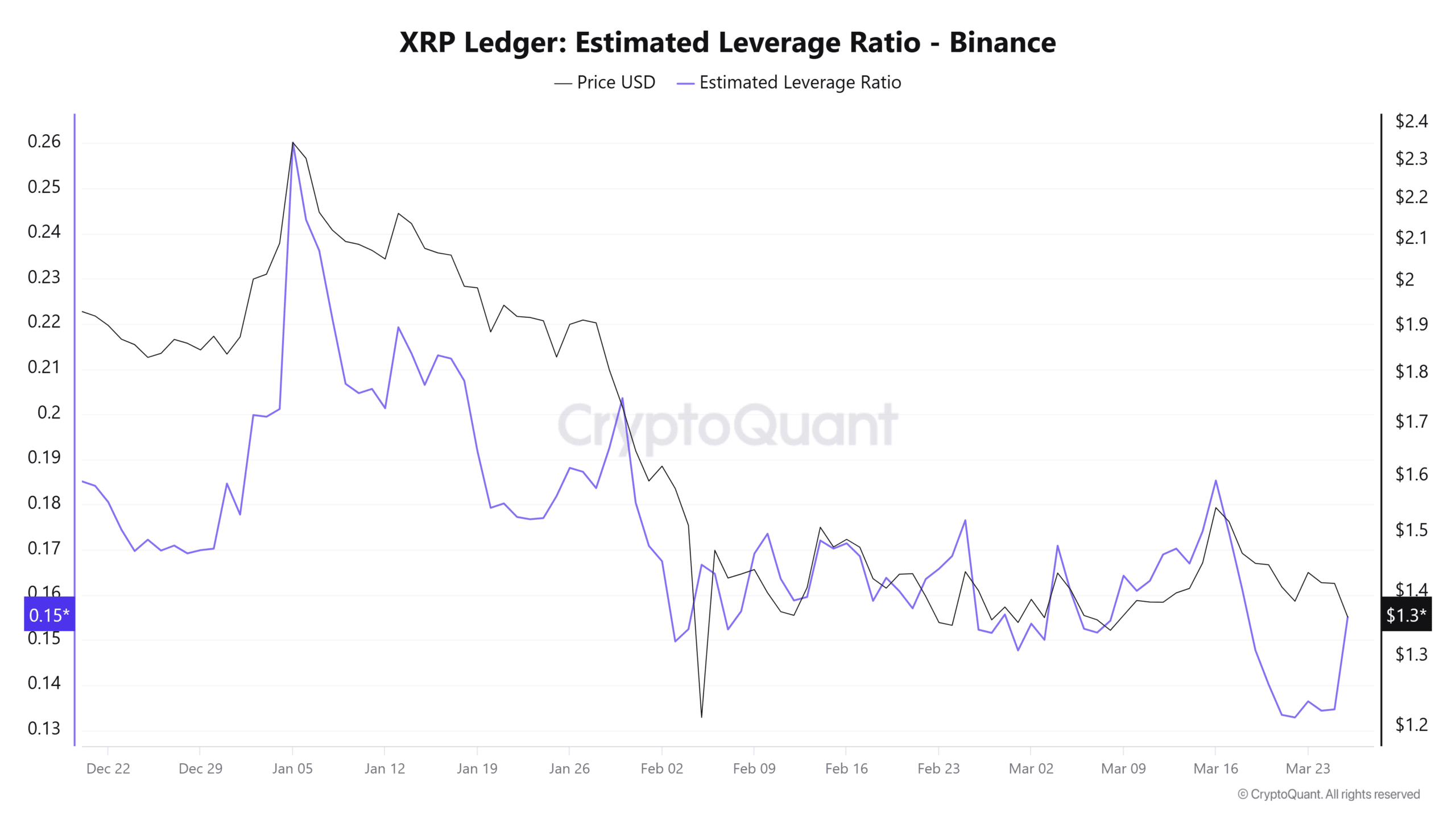
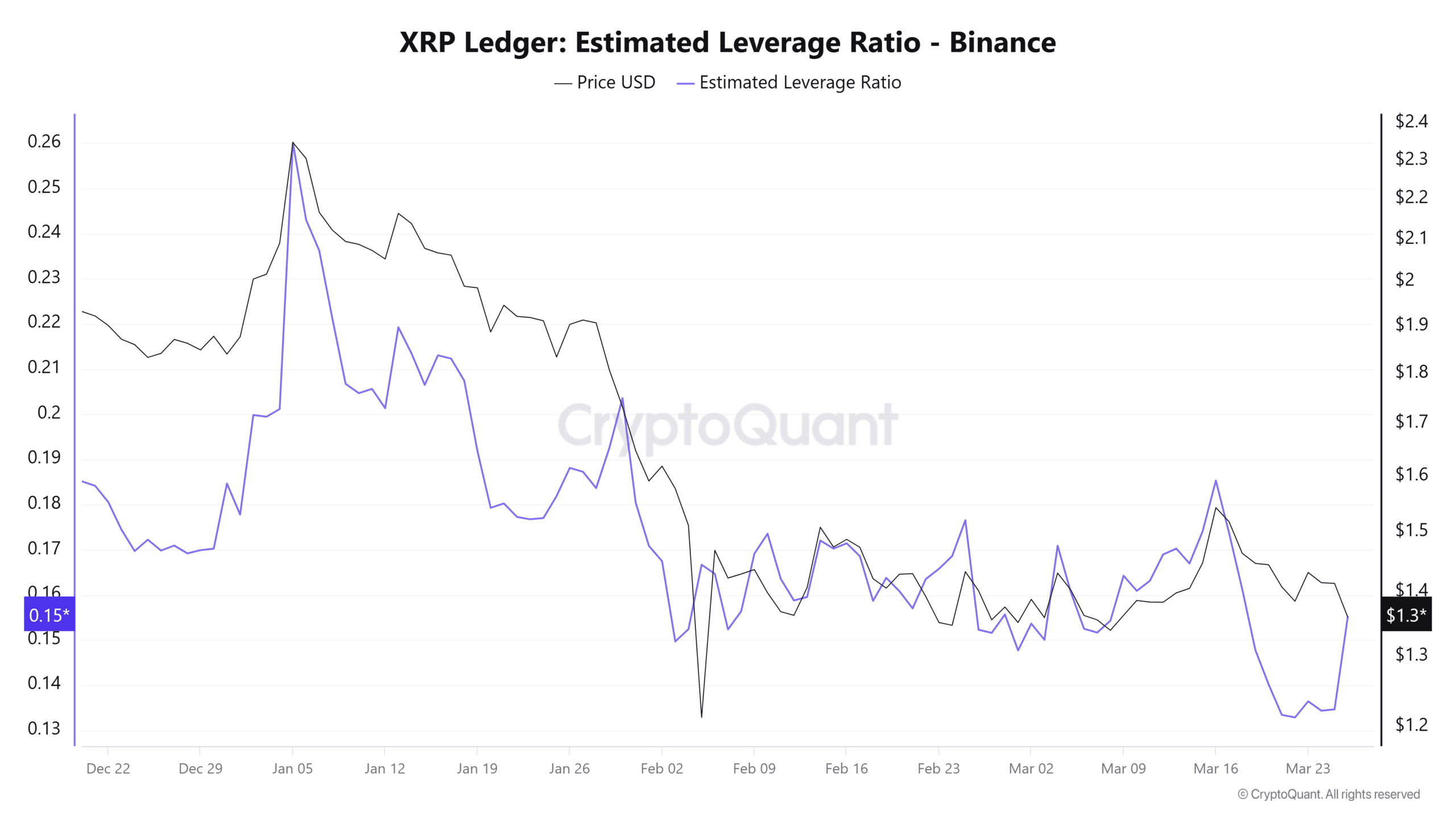
Additionally, the estimated leverage ratio has seen an uptick lately. An AMBCrypto report had pointed out that the reduced Open Interest (OI) behind XRP, combined with increased spot demand, meant that volatility risk was falling.

However, in the past 24 hours, the XRP OI has increased by 5.4%, the Estimated Leverage Ratio also spiked from 0.134 to 0.155. It signaled increased risk appetite from speculative traders. At the same time, it also warned of an increased threat of a hunt for liquidations and the associated price volatility.


Final Summary

  • The Sharpe ratio climbed back into positive territory after the deep drop during the February price correction.
  • Sustained spot demand and aggressive buyer activity are needed for XRP to defend the $1.20-$1.35 support and climb higher. Current market conditions were not favorable.


Perguntas relacionadas

QWhat does the Sharpe Ratio indicate for Ripple (XRP) according to the article?

AThe Sharpe Ratio indicates that the risk-adjusted returns for XRP are improving, meaning it is generating more gains with less volatility, which could set the stage for a gradual bullish recovery.

QWhat was the price range of XRP during the February sell-off mentioned in the article?

ADuring the February sell-off, XRP prices dropped from $2.35 to $1.21, representing a 48% decline.

QWhat does the Taker Buy-Sell Ratio measure, and what did it show for XRP in mid-March?

AThe Taker Buy-Sell Ratio measures buyer aggression. In mid-March, it showed that taker buy orders were prevalent, and its 7-day moving average climbed above 1, indicating strong buying pressure.

QWhat recent change in the Estimated Leverage Ratio signals increased risk for XRP traders?

AThe Estimated Leverage Ratio spiked from 0.134 to 0.155, signaling an increased risk appetite from speculative traders and a heightened threat of liquidation hunts and price volatility.

QWhat are the two key factors needed for XRP to defend its support level and climb higher, as per the final summary?

ASustained spot demand and aggressive buyer activity are needed for XRP to defend the $1.20-$1.35 support level and climb higher.

Leituras Relacionadas

The Value Distribution of Stablecoins

**Summary: The Value Distribution of Stablecoins** The article argues that stablecoins are evolving from mere trading tools into broader channels for dollar access. It divides the stablecoin ecosystem into four layers to analyze how value is distributed: 1. **Issuance Layer:** Mints stablecoins, holds reserve assets, and captures the spread between reserve yield and user costs (e.g., Tether, Circle). This layer currently earns the largest profit margin. 2. **Infrastructure Layer:** Connects stablecoins to the traditional financial system, handling fiat on/off-ramps, banking integration, compliance (KYC/AML), and asset management (e.g., Bridge, BVNK). This is the "unglamorous" but critical work, building the essential bridges between crypto and real-world finance. 3. **Acquiring/Distribution Layer:** Integrates stablecoins into merchant systems, manages payment flows, and provides enterprise financial software (e.g., Stripe, Coinbase). They act as the access point for businesses. 4. **Application Layer:** The end-users and businesses that ultimately use stablecoins for payments, settlements, or as a store of value. They benefit from convenience but have little pricing power. The core thesis is that while the issuance layer currently dominates profits, the often-overlooked **infrastructure layer holds significant long-term potential**. The real challenge and barrier to mass adoption is not the on-chain transfer of stablecoins (which is simple), but the complex "last mile" integration into existing business workflows, banking systems, and regulatory frameworks across different countries. Companies in this layer are currently in a "land grab" phase, investing heavily to build networks, secure bank partnerships, and establish compliance pathways. While their position is currently pressured by the profitable issuers above and distribution platforms below, the article suggests that if stablecoins become a default financial rail for businesses, the infrastructure providers who have done the hard work of integration will ultimately gain strong pricing power and become entrenched, essential players.

marsbitHá 5h

The Value Distribution of Stablecoins

marsbitHá 5h

The Value Distribution of Stablecoins

The Value Distribution of Stablecoins The article argues that stablecoins are evolving from a mere trading tool into a broad "dollar channel." It analyzes the industry's value chain through four layers: 1. **Issuance Layer (e.g., Tether, Circle):** The top layer that mints stablecoins, holds reserve assets, and captures the thickest interest rate spread. 2. **Infrastructure Layer (e.g., Bridge, BVNK):** Connects stablecoins to the traditional financial system, handling critical but complex "dirty work" like fiat on/off-ramps, banking integration, compliance (KYC/AML), and cross-border settlement. 3. **Acquiring/Distribution Layer (e.g., Stripe, Coinbase):** Embeds stablecoins into merchant systems, manages payment flows, and integrates with enterprise software. 4. **Application Layer:** End-users and businesses that ultimately use stablecoins for payments, settlement, or storing value. The author posits that while the issuance layer currently captures the most profit, the most overlooked and potentially critical layer is infrastructure. The core challenge for stablecoin adoption isn't the on-chain transfer (which is simple), but bridging the gap between blockchain and the real-world financial system. This involves solving practical problems for businesses: fiat conversion, reconciliation, tax handling, and user onboarding. Infrastructure companies are currently in a difficult "land-grab" phase—building networks, securing banking relationships, and achieving compliance country-by-country. They face pressure from both the profitable issuance layer above and distribution platforms below. However, the author suggests this layer is building a crucial moat. Once stablecoins become a default business rail, the infrastructure players who have done the hard work of integration may gain significant, durable value and pricing power.

链捕手Há 5h

The Value Distribution of Stablecoins

链捕手Há 5h

Trading

Spot
Futuros

Artigos em Destaque

Como comprar ONE

Bem-vindo à HTX.com!Tornámos a compra de Harmony (ONE) simples e conveniente.Segue o nosso guia passo a passo para iniciar a tua jornada no mundo das criptos.Passo 1: cria a tua conta HTXUtiliza o teu e-mail ou número de telefone para te inscreveres numa conta gratuita na HTX.Desfruta de um processo de inscrição sem complicações e desbloqueia todas as funcionalidades.Obter a minha contaPasso 2: vai para Comprar Cripto e escolhe o teu método de pagamentoCartão de crédito/débito: usa o teu visa ou mastercard para comprar Harmony (ONE) instantaneamente.Saldo: usa os fundos da tua conta HTX para transacionar sem problemas.Terceiros: adicionamos métodos de pagamento populares, como Google Pay e Apple Pay, para aumentar a conveniência.P2P: transaciona diretamente com outros utilizadores na HTX.Mercado de balcão (OTC): oferecemos serviços personalizados e taxas de câmbio competitivas para os traders.Passo 3: armazena teu Harmony (ONE)Depois de comprar o teu Harmony (ONE), armazena-o na tua conta HTX.Alternativamente, podes enviá-lo para outro lugar através de transferência blockchain ou usá-lo para transacionar outras criptomoedas.Passo 4: transaciona Harmony (ONE)Transaciona facilmente Harmony (ONE) no mercado à vista da HTX.Acede simplesmente à tua conta, seleciona o teu par de trading, executa as tuas transações e monitoriza em tempo real.Oferecemos uma experiência de fácil utilização tanto para principiantes como para traders experientes.

312 Visualizações TotaisPublicado em {updateTime}Atualizado em 2026.06.02

Como comprar ONE

Discussões

Bem-vindo à Comunidade HTX. Aqui, pode manter-se informado sobre os mais recentes desenvolvimentos da plataforma e obter acesso a análises profissionais de mercado. As opiniões dos utilizadores sobre o preço de ONE (ONE) são apresentadas abaixo.

活动图片












