XRP Open Interest Falls to Lowest Level Since 2024: Market Reset Or Warning Signal?

bitcoinistPublicado em 2026-02-04Última atualização em 2026-02-04

Resumo

XRP is undergoing a significant market reset as its open interest in derivatives has dropped to approximately 902 million, the lowest level since 2024, indicating a broad unwinding of leveraged positions. This decline, observed across major exchanges like Binance, reflects a market-wide de-risking trend rather than a mere shift between platforms. The reduction in leverage suggests a move away from speculative trading, potentially leading to slower but more deliberate price action. Currently, XRP is testing critical support near $1.60 after breaking below the key $1.80 level, signaling structural weakness. Trading below major moving averages, the asset shows a bearish trend with lower highs and lower lows. While the volume remains muted, indicating a controlled unwind rather than panic selling, holding the $1.55–$1.60 zone is crucial for stabilization. A breakdown could lead to a deeper retracement toward $1.30–$1.40. Analysts are watching for a rebound in open interest alongside improving price momentum as a potential early signal of a new trend.

XRP has entered a critical phase after losing the $1.80 level and sliding toward the $1.60 zone, where price is now attempting to find short-term support. The move comes amid broader weakness across the crypto market, but XRP’s structure shows an additional layer of stress that goes beyond spot price action. According to a recent report from CryptoQuant, the derivatives side of the XRP market is undergoing a sharp contraction in leverage, signaling a meaningful shift in trader behavior.

Data shows that open interest across all XRP derivatives platforms has fallen to roughly 902 million, marking its lowest level since 2024. This is a stark contrast to conditions seen during 2025, when open interest consistently hovered between 2.5 and 3.0 billion. The magnitude of this decline suggests that leverage is being actively unwound rather than merely rotating between exchanges, pointing to a broader risk-off adjustment.
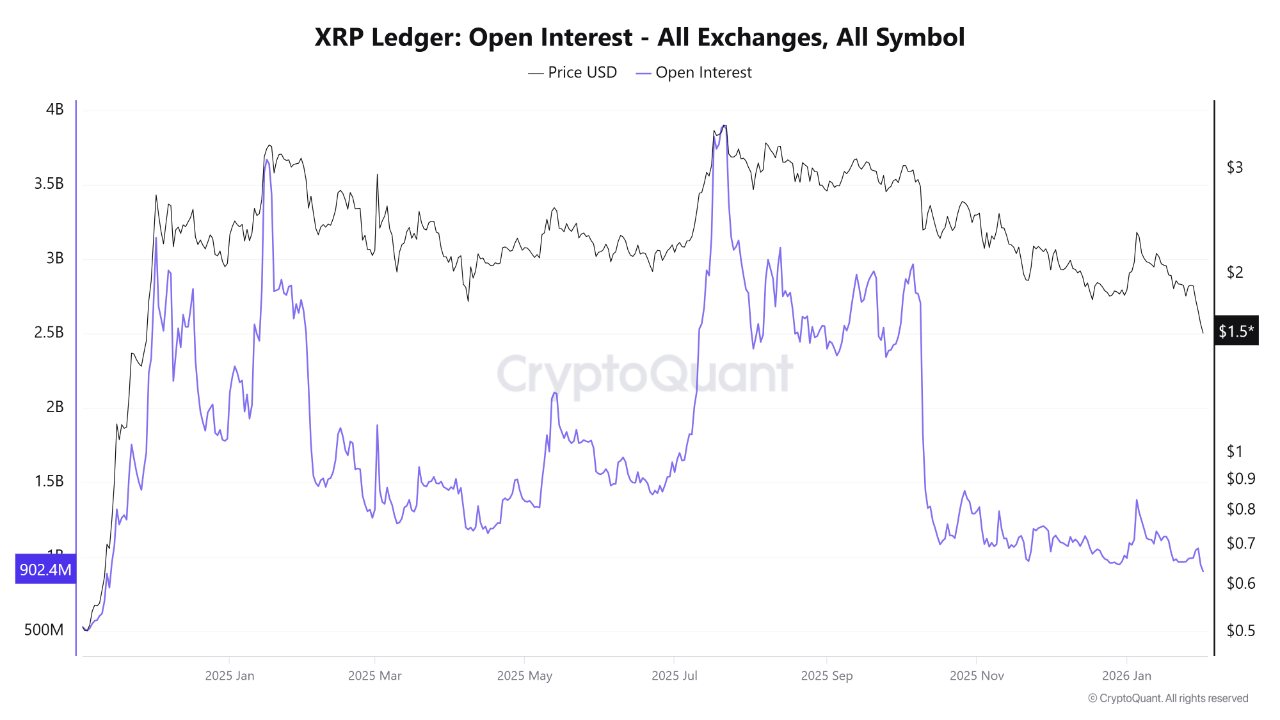
XRP Ledger Open Interest | Source: CryptoQuant

Such contractions often reflect a market that is de-risking after extended volatility. With fewer leveraged positions in play, price movements tend to become slower but more deliberate, as speculative excess is flushed out. As XRP tests the $1.60 area, analysts are closely watching whether this leverage reset lays the groundwork for stabilization—or signals deeper downside still ahead.

The report adds important color by breaking down where the leverage reduction is taking place. On Binance, open interest in XRP derivatives has fallen to around 458 million. While this figure remains above the levels observed last December, it still represents a sharp contraction from the highs seen earlier in the cycle.

Crucially, this decline on Binance mirrors what is happening across other major trading venues, reinforcing the view that the market is undergoing a broad deleveraging phase rather than a simple migration of positions between exchanges.

From a structural standpoint, this matters. When open interest compresses simultaneously across platforms, it typically reflects traders actively reducing risk and closing leveraged exposure. This kind of environment often precedes periods of price consolidation, as the market digests prior volatility and searches for a new equilibrium. In past cycles, these phases have frequently led to the formation of base structures, particularly when selling pressure fades and volatility compresses.

Looking ahead, analysts note that any recovery in open interest will be critical to monitor. A rebound in leverage that coincides with improving price momentum could serve as an early signal that a new trend is developing.

For now, however, the drop in open interest to its lowest level since 2024 points to a clear market cleanup. While this reset may appear quiet on the surface, it can provide a healthier foundation for future moves—provided risk management remains front and center in the next phase of XRP’s market evolution.

XRP Price Showing Weakness

XRP price action continues to reflect structural weakness as the asset trades decisively below its key moving averages and tests the $1.60 zone for support. The chart shows a clear transition from a prior uptrend into a sustained downtrend, marked by lower highs and lower lows since the October peak near the $3.50–$3.60 region. Momentum has steadily deteriorated, with each rebound failing below the declining short- and medium-term moving averages, signaling persistent seller control.
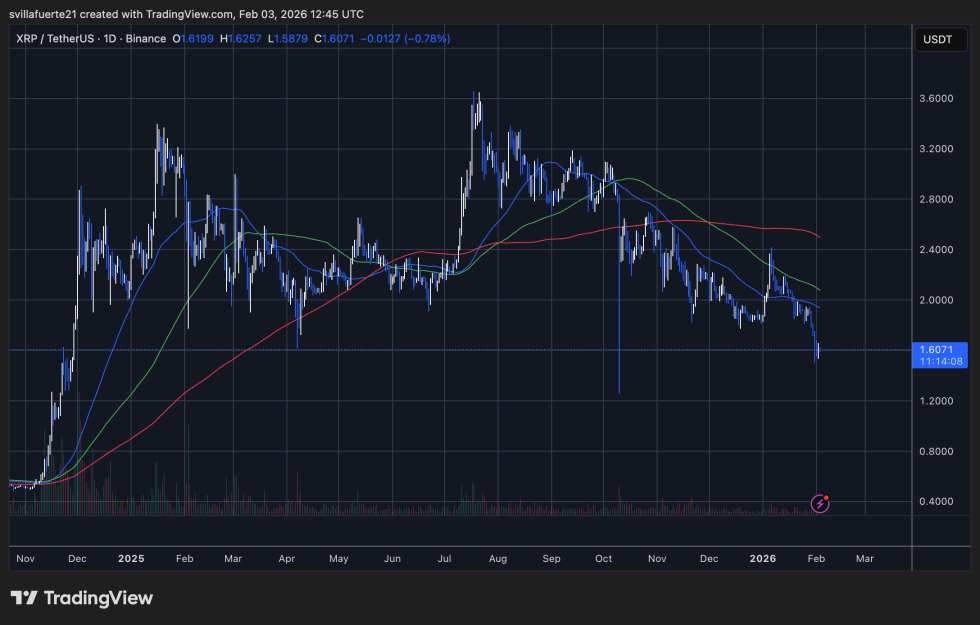
XRP testing critical demand level | Source: XRPUSDT chart on TradingView

The loss of the $1.80 level is technically significant. This zone previously acted as a consolidation base and demand area, but the clean breakdown suggests that buyers have stepped aside rather than aggressively defending the price. XRP is now trading below the 50-day and 100-day moving averages, while the 200-day moving average above continues to slope downward, reinforcing a bearish medium-term structure.

Volume remains relatively muted compared to earlier distribution phases, which aligns with the derivatives data showing a contraction in leverage rather than panic-driven liquidation. This supports the view that the current move is more of a controlled unwind than a capitulation event.

As long as price holds the $1.55–$1.60 region, XRP may attempt to stabilize and form a base. However, a failure to hold this area would expose the market to a deeper retracement toward prior demand zones near $1.30–$1.40.

Featured image from ChatGPT, chart from TradingView.com

Criptomoedas em alta

Perguntas relacionadas

QWhat is the current level of XRP open interest and why is it significant?

AXRP open interest has fallen to roughly 902 million, marking its lowest level since 2024. This is significant because it represents a sharp contraction from the 2.5-3.0 billion levels seen during 2025, indicating a broad deleveraging phase and a meaningful shift in trader behavior away from speculative excess.

QAccording to the article, what does a simultaneous decline in open interest across multiple exchanges typically indicate?

AA simultaneous decline in open interest across multiple exchanges typically indicates that traders are actively reducing risk and closing leveraged exposure, rather than simply moving positions between venues. This often reflects a broad market de-risking and can precede periods of price consolidation.

QWhat key price level did XRP lose that the article describes as 'technically significant'?

AThe article describes the loss of the $1.80 level as technically significant. This zone previously acted as a consolidation base and demand area, and its clean breakdown suggests that buyers have stepped aside rather than aggressively defending the price.

QWhat potential price levels are identified as critical support and next downside targets for XRP?

AThe $1.55–$1.60 region is identified as critical short-term support. If this area fails to hold, the article states it would expose the market to a deeper retracement toward prior demand zones near $1.30–$1.40.

QHow does the article characterize the nature of the price decline based on volume and derivatives data?

AThe article characterizes the decline as a controlled unwind rather than a capitulation event. This is supported by relatively muted volume compared to earlier distribution phases and derivatives data showing a contraction in leverage instead of panic-driven liquidations.

Leituras Relacionadas

Agent Race Ends, Super Workbench Takes Over

The era of fragmented AI agents is ending. Over the past month, China's tech giants—Tencent, Alibaba, and ByteDance—have simultaneously shifted strategy: instead of launching new, standalone AI agents, they are consolidating their various agent projects into unified "super workbenches." Tencent integrated its QClaw teams into WorkBuddy, a strategic product hailed as a potential third flagship after QQ and WeChat. Alibaba is merging its QoderWork, Wukong, and MuleRun agents into a new "Qianwen Office" platform under DingTalk's leadership. ByteDance rebranded its TRAE SOLO coding agent to TRAE Work, signaling a broader focus on workflow collaboration. This convergence marks a pivotal industry consensus. The initial exploration phase, where companies rapidly built numerous overlapping agents for different scenarios, proved costly and inefficient. With open-source tools eroding technical barriers, competition has shifted from agent creation to resource consolidation and cost control. Historically, platform wars are won not by creating more products, but by simplifying them—as seen with browsers unifying web access and super-apps consolidating services. Now, the "super workbench" aims to become the unified AI entry point for work. This reflects a deeper market realization: the primary audience for AI is no longer just programmers (a market in the tens of millions) but all knowledge workers (a market of billions). The real opportunity lies in augmenting everyday tasks—managing emails, documents, data, and meetings—across the entire workday. The core battleground is becoming control over the primary AI entry point that employees use daily. Tencent's WorkBuddy leverages WeChat and Tencent Docs; Alibaba's Qianwen Office taps into DingTalk's organizational data; ByteDance's TRAE Work integrates with Feishu's workflows. Whoever owns this "super workbench" gains strategic control over orchestrating enterprise data and APIs. This shift is redefining enterprise software. Traditional SaaS applications, valued for their user interfaces, will recede into the background. Their core functionalities will be exposed as standardized "Skills" or APIs for the super workbench's agents to invoke. Software value will shift from selling user seats to charging based on API calls and outcomes delivered. The evolution of agents is moving through clear stages: first as novel standalone products, then as consolidated primary work entry points, and finally as pervasive, invisible capabilities embedded into the digital fabric. The recent moves by major tech firms signal the transition from the first stage into the second, accelerating toward the third. In the end, the most successful agent technology may become invisible—like electricity or the HTTP protocol—a fundamental, unnamed infrastructure powering work itself.

marsbitHá 18m

Agent Race Ends, Super Workbench Takes Over

marsbitHá 18m

Michael Saylor: 110 Reasons to Oppose BIP-110

Michael Saylor presents 110 arguments against Bitcoin Improvement Proposal (BIP) 110, a soft fork aimed at restricting certain non-monetary data storage uses (like inscriptions) on the Bitcoin blockchain. He acknowledges the proponents' valid concerns—such as node costs, fee pressure, and preserving Bitcoin's monetary focus—but fundamentally disagrees with the proposed solution. Saylor argues that BIP 110 represents a dangerous precedent of using consensus rules to enforce value judgments on transaction validity, moving away from Bitcoin's core principles of neutrality and permissionless innovation. His key objections are organized into eleven categories: 1) It violates neutrality and hard consensus by banning currently valid transactions. 2) It fails to meet the high burden of proof required for a consensus change, lacking concrete data on the alleged crisis. 3) Its seven bundled technical restrictions are overly broad, targeting generic script functionalities and blocking future upgrade paths. 4) It sacrifices compatibility and future optionality by closing off designed upgrade hooks. 5) Its temporary rules add significant complexity (grandfathering, expiry states) without sufficient justification. 6) The economic and security impacts, particularly on miner revenue and fee markets, are uncertain and unmodeled. 7) Superior, market-based tools (fee markets, relay/mining policies) already exist to manage blockchain load. 8) It stifles innovation by creating a chilling effect for developers. 9) Its modified activation mechanism (55% threshold, forced signaling) is aggressive and risks network splits. 10) The precedent it sets—using consensus to suppress disliked but legal uses—is more dangerous than the problem it aims to solve. 11) A better path exists: improving measurements, refining resource-based policies, and allowing market forces to work. Saylor concludes that Bitcoin's strength lies in its neutral rules, open markets, and hard consensus. Changing these foundational elements to target specific use cases is an unnecessary and risky "iatrogenic" intervention. He advocates for guarding Bitcoin's neutrality rather than acting as its redeemer.

marsbitHá 33m

Michael Saylor: 110 Reasons to Oppose BIP-110

marsbitHá 33m

Trading

Spot

Artigos em Destaque

O que é XRP 2.0

XRP 2.0: Uma Nova Fronteira no Landscape das Criptomoedas Introdução ao XRP 2.0 No reino em constante evolução das criptomoedas, novos projetos surgem continuamente, lutando por atenção e adoção. Uma dessas iniciativas promissoras é o XRP 2.0, um novo projeto de criptomoeda concebido para aproveitar a tecnologia de blockchain avançada e as metodologias de criptografia robustas. Embora o nome tenha paralelos com o XRP da Ripple, é crucial notar que o XRP 2.0 opera de forma independente, focando em melhorar a segurança das transações, a privacidade e a escalabilidade. À medida que o panorama financeiro digital abraça cada vez mais soluções descentralizadas, o XRP 2.0 visa contribuir de forma significativa para a web3 e a expansão global dos projetos de criptomoedas. O que é o XRP 2.0? No seu núcleo, o XRP 2.0 é um projeto de criptomoeda que visa criar um ecossistema de moeda digital seguro e descentralizado. Sua tecnologia fundamental integra princípios de blockchain sofisticados com técnicas de criptografia de ponta. O objetivo abrangente do XRP 2.0 é estabelecer-se como uma plataforma confiável e eficiente que possibilita a execução rápida de transações, priorizando a proteção de privacidade aprimorada para os seus usuários. O projeto é promovido como uma solução para muitas limitações enfrentadas pelas criptomoedas existentes, propondo um sistema que pode lidar com um volume maior de transações com velocidade e privacidade melhoradas. Esta versatilidade posiciona o XRP 2.0 como um concorrente significativo em um mercado repleto de várias moedas digitais. Quem é o Criador do XRP 2.0? A identidade do criador por trás do XRP 2.0 foi identificada como 'Wilbur.' No entanto, detalhes abrangentes sobre Wilbur ou a sua entidade associada permanecem elusivos. O anonimato de muitos criadores de criptomoedas não é um fenômeno incomum na indústria, muitas vezes concebido para manter um grau de privacidade e segurança. Quem são os Investidores do XRP 2.0? Até agora, informações específicas relacionadas às fundações ou organizações de investimento que apoiam o XRP 2.0 não estão disponíveis publicamente. No setor das criptomoedas, o apoio de investidores reputados pode influenciar significativamente a credibilidade e o sucesso de um projeto, no entanto, a transparência em relação aos apoiantes financeiros do XRP 2.0 não foi estabelecida. Como Funciona o XRP 2.0? O XRP 2.0 destaca-se por empregar uma combinação de tecnologia blockchain e algoritmos de criptografia avançados que asseguram transações seguras e descentralizadas. Sua estrutura inovadora inclui características únicas projetadas para fomentar o envolvimento dos usuários e ampliar as funcionalidades além das transações convencionais de criptomoedas. Entre essas características, o XRP 2.0 incorpora capacidades potenciadas por IA, como funcionalidades de texto-para-imagem e texto-para-fala. Estas adições são projetadas para melhorar a experiência interativa dos usuários, promovendo uma maior aplicabilidade em vários setores. Ao unir avanços tecnológicos com um design centrado no utilizador, o XRP 2.0 pretende captar a atenção de uma diversa gama de indivíduos e empresas que procuram integrar soluções de criptomoedas em suas estruturas operacionais. Cronologia do XRP 2.0 Compreender o XRP 2.0 requer examinar os marcos que definiram sua jornada até agora: 23 de Julho de 2023: O XRP 2.0 é apresentado como um novo projeto de criptomoeda, visando revolucionar as capacidades de transação seguras e descentralizadas no domínio do blockchain. 8 de Setembro de 2023: O lançamento de outro projeto, XRP20, ocorre, marcando o surgimento de um token ERC-20 na blockchain Ethereum que permanece não relacionado ao XRP 2.0. 13 de Novembro de 2023: O XRP Ledger passa por uma atualização significativa com o lançamento da versão 2.0.0 do software do servidor rippled. É importante notar que este desenvolvimento está desconectado do projeto de criptomoeda XRP 2.0. Pontos-chave sobre o XRP 2.0 Para destilar a essência do XRP 2.0, vários fatores críticos emergem: Características Únicas: A inclusão de características como texto-para-imagem e texto-para-fala potenciadas por IA diversifica ainda mais as aplicações potenciais do XRP 2.0. Tecnologia Blockchain: A estrutura utiliza mecanismos de blockchain avançados e protocolos de criptografia, assegurando um ambiente seguro e descentralizado para transações. Escalabilidade e Privacidade: O XRP 2.0 prioriza proteção de privacidade aprimorada nos processos de transação e a escalabilidade necessária para acomodar uma base de utilizadores crescente. Sem Afiliação com a Ripple: Importante, apesar do seu nome, o XRP 2.0 não tem qualquer lealdade ou colaboração com o XRP da Ripple, distinguindo sua estrutura operacional e objetivos dentro do ecossistema das criptomoedas. Conclusão O XRP 2.0 representa uma empreitada ambiciosa no domínio das criptomoedas, visando oferecer uma combinação de segurança, privacidade e eficiência em transações digitais. Ao integrar tecnologias sofisticadas e características amigáveis ao utilizador, o projeto propõe-se a ampliar os horizontes do que as criptomoedas podem alcançar na economia digital atual. Embora o anonimato do seu criador e a falta de investidores divulgados possam levantar questões para alguns, o foco do XRP 2.0 em funcionalidades avançadas e descentralização aumenta seu apelo num mercado de criptomoedas cada vez mais congestionado. À medida que o panorama das criptomoedas continua a evoluir, o XRP 2.0 pode ainda emergir como um jogador crucial na expansão de soluções de blockchain seguras e escaláveis.

134 Visualizações TotaisPublicado em {updateTime}Atualizado em 2024.12.03

O que é XRP 2.0

Como comprar XRP

Bem-vindo à HTX.com!Tornámos a compra de XRP (XRP) simples e conveniente.Segue o nosso guia passo a passo para iniciar a tua jornada no mundo das criptos.Passo 1: cria a tua conta HTXUtiliza o teu e-mail ou número de telefone para te inscreveres numa conta gratuita na HTX.Desfruta de um processo de inscrição sem complicações e desbloqueia todas as funcionalidades.Obter a minha contaPasso 2: vai para Comprar Cripto e escolhe o teu método de pagamentoCartão de crédito/débito: usa o teu visa ou mastercard para comprar XRP (XRP) instantaneamente.Saldo: usa os fundos da tua conta HTX para transacionar sem problemas.Terceiros: adicionamos métodos de pagamento populares, como Google Pay e Apple Pay, para aumentar a conveniência.P2P: transaciona diretamente com outros utilizadores na HTX.Mercado de balcão (OTC): oferecemos serviços personalizados e taxas de câmbio competitivas para os traders.Passo 3: armazena teu XRP (XRP)Depois de comprar o teu XRP (XRP), armazena-o na tua conta HTX.Alternativamente, podes enviá-lo para outro lugar através de transferência blockchain ou usá-lo para transacionar outras criptomoedas.Passo 4: transaciona XRP (XRP)Transaciona facilmente XRP (XRP) no mercado à vista da HTX.Acede simplesmente à tua conta, seleciona o teu par de trading, executa as tuas transações e monitoriza em tempo real.Oferecemos uma experiência de fácil utilização tanto para principiantes como para traders experientes.

1.7k Visualizações TotaisPublicado em {updateTime}Atualizado em 2026.06.02

Como comprar XRP

Discussões

Bem-vindo à Comunidade HTX. Aqui, pode manter-se informado sobre os mais recentes desenvolvimentos da plataforma e obter acesso a análises profissionais de mercado. As opiniões dos utilizadores sobre o preço de XRP (XRP) são apresentadas abaixo.

活动图片











