XRP On The Verge? The Major Bullish Structure Shift That Could Send Price Soaring

bitcoinistPublicado em 2026-02-12Última atualização em 2026-02-12

Resumo

Crypto analyst ChartNerd suggests XRP is on the verge of a major bullish structure shift after six months of downside, with oversold indicators like MACD and RSI hinting at a potential upward reversal. Key to this move is XRP holding above the psychological $1 level; a drop below could lead to a crash toward $0.70. Other analysts like TARA and CasiTrades warn of possible declines to $0.87 or $0.90 if Bitcoin falls further, though reclaiming $1.65 could invalidate the bearish outlook. Despite recent declines, some analysts note sellers are losing momentum as XRP reacts strongly near the $1.30–$1.35 demand zone. Long-term, Javon Marks predicts an altcoin season could propel XRP to new all-time highs, potentially reaching $4.8 or even $15. At the time of writing, XRP is trading around $1.37.

Crypto analyst ChartNerd has indicated that XRP is on the verge of a major bullish structure shift that could send it to new highs. The analyst also noted that it was key for the altcoin to stay above the psychological $1 level for confirmation of a move to the upside.

XRP Eyes Major Bullish Structure Shift

In an X post, ChartNerd explained why XRP may be positioned for a major bullish structure shift, noting that the altcoin has experienced six months of downside with virtually no relief. He further stated that indicators such as the MACD and RSI have reached historically oversold levels, which are key signals of a bullish reversal.

ChartNerd added that XRP is also seeing a 50-month backtest on a prior 8-year resistance line and Fibonacci demand. He noted that this marks the first 50-EMA backtest since November 2024, and with this, there is a wick marked on the 0.618/0.5 Fibonacci demand zone. These demand zones are popular reversal pockets, which is another reason a bullish reversal may be on the cards for the altcoin.
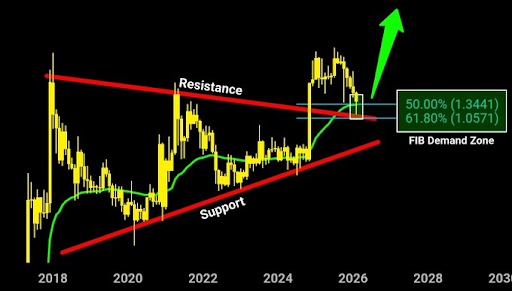
Source: Chart from ChartNerd on X

Meanwhile, the analyst stated that the key objective now is for XRP to stay above $1 for continuation higher. He warned that a drop below this level could lead to a crash to $0.70, which would be the worst-case scenario relative to prior highs from 2023 to 2024 that have not been backtested.

Crypto analyst TARA recently warned that XRP could drop to as low as $0.87 if the Bitcoin crash extends to $52,200. Crypto analyst CasiTrades also predicted that the altcoin could see one last move down, dropping to as low as $0.90. However, she also stated that a successful reclaim of $1.65 could invalidate this move down.

Sellers Are Losing Momentum

Crypto analyst BitGuru stated that XRP sellers appear to be losing momentum. This came as he noted that the altcoin has been in a clear macro downtrend but is now reacting strongly from a major historical demand zone around $1.30 to $1.35. The analyst added that after months of lower highs and distribution, this area is acting as a base and that the sharp rejection from below suggests that sellers are losing momentum.

Crypto analyst Javon Marks provided a bullish outlook for the altcoin in the long term, stating that altcoin season looks to be nearing and that the token is known to thrive in those times. During this projected altcoin season, he expects XRP to recover back above $2.47 and rally towards $4.8, marking a new all-time high (ATH). The analyst added that a rally to $15 remains on the radar for the cryptocurrency.

At the time of writing, the XRP price is trading at around $1.37, down in the last 24 hours, according to data from CoinMarketCap.

XRP trading at $1.37 on the 1D chart | Source: XRPUSDT on Tradingview.com

Perguntas relacionadas

QAccording to ChartNerd, what is the key level that XRP must stay above to confirm a move to the upside?

AThe key level that XRP must stay above is the psychological $1 level.

QWhich two technical analysis indicators did ChartNerd mention have reached historically oversold levels, signaling a potential bullish reversal?

AThe MACD and RSI indicators have reached historically oversold levels.

QWhat is the worst-case scenario price target for XRP if it drops below the $1 level, as warned by ChartNerd?

AThe worst-case scenario would be a crash to $0.70.

QWhat price area does analyst BitGuru identify as a major historical demand zone that XRP is reacting strongly from?

AThe major historical demand zone is around $1.30 to $1.35.

QWhat long-term price targets did analyst Javon Marks project for XRP during an anticipated altcoin season?

AJavon Marks projected that XRP could recover above $2.47, rally towards $4.8 for a new all-time high, and that a rally to $15 remains on the radar.

Leituras Relacionadas

Sequoia Dialogue with Jensen Huang: Computing Model Undergoes a 60-Year Transformation; You Won't Be Replaced by AI, But You Will Be Dimensionality-Reduced by 'Those Who Master AI'

NVIDIA founder and CEO Jensen Huang, in a conversation with Sequoia Capital's Konstantine Buhler, argues that we are witnessing the most significant computing shift in 60 years—from retrieval-based to generative computing. Instead of just storing and retrieving data, future systems will generate highly personalized content (text, images, video) on demand, powered by massive "AI factories." Huang envisions a global "intelligence network" that will envelop the planet, following the historical patterns of energy and communication grids. He outlines a five-layer investment framework: 1) Energy, 2) Chips/Computers, 3) Infrastructure (data centers), 4) AI Models, and 5) Applications. He predicts this ecosystem will reach a scale of $20 trillion annually. Crucially, Huang pushes back against fears of AI-driven job loss. He distinguishes between specific "tasks" (e.g., typing, analyzing images) and overall "jobs" (e.g., CEO, radiologist). While AI automates tasks, it increases efficiency and demand for the higher-value problem-solving aspects of professions, thus creating more jobs and "up-leveling" careers. The real risk, he asserts, is not being replaced by AI, but being outperformed by someone who effectively leverages it. He urges everyone to embrace AI as a tool for augmented capability and innovation.

marsbitHá 5m

Sequoia Dialogue with Jensen Huang: Computing Model Undergoes a 60-Year Transformation; You Won't Be Replaced by AI, But You Will Be Dimensionality-Reduced by 'Those Who Master AI'

marsbitHá 5m

"I Don't Need a Better Model Anymore": A Panorama of AI Users Under a Reddit Hot Post

Titled "I Don't Need a Better Model Anymore": AI User Reactions on Reddit Anthropic recently released Claude Fable 5, its first publicly available 'Mythos'-tier model, achieving 80.3% on the SWE-Bench Pro benchmark and significantly outperforming its predecessor and competitors. However, a viral Reddit post titled "Claude Fable made me realize I don't need better models anymore" highlighted a growing user sentiment of "good enough." Top comments expressed "model fatigue," with users stating that earlier models like Opus 4.5/4.8 already sufficed for their workflows. High cost was a key concern, as Fable 5's API is nearly twice the price of Opus 4.8, with users questioning the return on investment and suggesting the field has hit a plateau. The most frequent complaint targeted Fable 5's stringent safety filters. Designed to intercept high-risk requests (e.g., cybersecurity), the system was perceived as overly conservative. Users reported frequent rejections for routine security-related tasks, leading to automatic fallbacks to the older Opus model. Paying users were particularly frustrated, feeling they paid a premium for a less usable product. Dissenting voices came from users with heavy, complex tasks. For workloads like high-energy physics simulations with thousands of code lines, Fable 5's improved long-context understanding and error detection represented a significant, worthwhile leap—described as moving from a "college player to an NBA starter." The debate underscores a divergence between benchmark performance and practical utility. For most users, current models meet their needs, making further advances relevant only for extreme use-cases. The discussion also raised concerns about a potential "Public AI Freeze," where the most powerful models (like the restricted Mythos 5) remain exclusive to enterprises and governments, while public offerings stagnate. The launch presents two report cards: one of technical excellence and another of user skepticism. Fable 5's ultimate reception may depend on Anthropic's ability to refine its safety filters and justify its cost for specialized, high-demand users.

marsbitHá 13m

"I Don't Need a Better Model Anymore": A Panorama of AI Users Under a Reddit Hot Post

marsbitHá 13m

When AI Traffic Surpasses Humans, How Do You Prove You're Human?

With AI-generated web traffic surpassing human activity, websites face a crisis as AI agents bypass ads, avoid clicks, and scrape data without generating revenue. This disrupts the ad-based internet economy, diverting traffic and reducing site visits. In response, sites are blocking AI crawlers and deploying traps like Cloudflare's "honeypot" pages. Traditional CAPTCHAs are now ineffective against advanced AI. The focus has shifted to behavioral biometrics—analyzing unique human patterns such as cursor movement, typing rhythm, and keystroke dynamics. Companies like IBM and BioCatch use this data to distinguish humans from bots, even detecting fraud through behavioral inconsistencies. Two competing approaches aim to verify human identity centrally. Sam Altman’s World (formerly Worldcoin) uses iris scanning to create unique credentials, though it faces privacy concerns and regulatory bans. Alternatively, cryptographic zero-knowledge proofs offer anonymous verification without revealing personal data, championed by Vitalik Buterin to avoid centralized surveillance. However, both systems have flaws. Centralized solutions risk biometric data misuse, while decentralized models may be exploited through identity rental markets in economically unequal regions. Despite challenges, the author favors cryptographic methods for preserving privacy over pervasive behavioral monitoring that permanently captures and controls personal biometric data.

marsbitHá 21m

When AI Traffic Surpasses Humans, How Do You Prove You're Human?

marsbitHá 21m

2026 Landscape of Decentralized AI: Why is Blockchain the Inevitable "Antidote" for AI?

**The 2026 Landscape of Decentralized AI: Why Blockchain is the "Cure" AI Cannot Ignore** Decentralized AI addresses fundamental bottlenecks of centralized AI: scarce and expensive computational resources, excessive control concentration, unverifiable model outputs, and increasing difficulty in acquiring training data due to privacy and regulation. Blockchain offers a path to make intelligence open, verifiable, and economically accessible. The technical stack comprises three layers: 1. **Applications & Services**: The main crypto use cases are "Agentic Finance" (converting natural language into on-chain actions) and "Agentic Payments" for machine-to-machine commerce. Projects like Giza, Infinity Labs, Coinvest AI, and x402 (handling 173M+ transactions) are key players. 2. **Middleware**: This coordination layer enables agents to discover, identify, and transact. Notable projects include Gokite AI (specialized L1), Virtuals (an OS for the agent economy), and especially Bittensor—a network of specialized subnets forming competitive AI micro-economies. 3. **Infrastructure**: The capital-intensive layer providing raw resources. It includes decentralized compute (Akash, Render, Aethir), verifiable inference (Venice AI, OpenGradient), distributed training (Prime Intellect, Templar AI), decentralized storage (Filecoin, Walrus), and privacy/verification layers (Nillion, Arcium, Phala Network) using technologies like ZKPs, MPC, and TEEs. The outlook for 2026-2027 indicates AI demand outpacing infrastructure, with AI agents as a primary growth engine. Computation is becoming an asset class, with on-chain markets as its financial layer. Tokenomics is emerging as a structural advantage for coordinating capital, compute, and data in decentralized AI networks. While still early—with adoption uneven and revenue often trailing token incentives—projects like Bittensor, NEAR, and Virtuals demonstrate a shift from speculative narrative to a new model for coordinating intelligence.

marsbitHá 24m

2026 Landscape of Decentralized AI: Why is Blockchain the Inevitable "Antidote" for AI?

marsbitHá 24m

a16z Crypto Partner: Cash Flow is the Moat

Cash Flow as the Moat: A Playbook for Crypto Founders Historically, the most enduring businesses have been built by positioning themselves within the "flow of funds"—facilitating the creation and transfer of value in a network and extracting a portion of it. Cryptocurrency is the first modern technology natively built for this purpose. For startups, failing to architect products and businesses to leverage these principles means missing a major opportunity. Blockchains are inherently network businesses. Each transaction settles on a shared ledger, and every new participant strengthens the underlying network for all. Well-designed network tokens amplify this by aligning users, developers, and validators around growing the network, with value flowing back to contributors in a transparent feedback loop. This model is not new; companies from railroads and Standard Oil to Google, Meta, and AWS have thrived by inserting themselves into critical flows of value (goods, attention, compute). Financial markets make it even clearer: firms like Visa and major market makers generate immense revenue not by predicting markets but by being in the path of transactions. The combination of fund flow and network effects creates one of the most durable business structures. The high margins in traditional finance (payments, custody, lending, FX) represent prime targets. Crypto founders have the opportunity to build the next version—programmable, instant, global, and natively in the flow of funds. The frontier extends beyond finance to areas like computing/GPUs, AI training data, energy, robotics, and space—markets without entrenched intermediaries, ripe for building new, efficient value rails on programmable infrastructure. Founders should ask: Are you in the flow of funds today? Does your revenue scale 10x with the value of activity on your platform? Where in your target market are profit margins highest relative to value created? The opportunity is clear: embed your startup into the new flows of value and let the network effects accumulate.

marsbitHá 27m

a16z Crypto Partner: Cash Flow is the Moat

marsbitHá 27m

Trading

Spot
Futuros

Artigos em Destaque

O que é XRP 2.0

XRP 2.0: Uma Nova Fronteira no Landscape das Criptomoedas Introdução ao XRP 2.0 No reino em constante evolução das criptomoedas, novos projetos surgem continuamente, lutando por atenção e adoção. Uma dessas iniciativas promissoras é o XRP 2.0, um novo projeto de criptomoeda concebido para aproveitar a tecnologia de blockchain avançada e as metodologias de criptografia robustas. Embora o nome tenha paralelos com o XRP da Ripple, é crucial notar que o XRP 2.0 opera de forma independente, focando em melhorar a segurança das transações, a privacidade e a escalabilidade. À medida que o panorama financeiro digital abraça cada vez mais soluções descentralizadas, o XRP 2.0 visa contribuir de forma significativa para a web3 e a expansão global dos projetos de criptomoedas. O que é o XRP 2.0? No seu núcleo, o XRP 2.0 é um projeto de criptomoeda que visa criar um ecossistema de moeda digital seguro e descentralizado. Sua tecnologia fundamental integra princípios de blockchain sofisticados com técnicas de criptografia de ponta. O objetivo abrangente do XRP 2.0 é estabelecer-se como uma plataforma confiável e eficiente que possibilita a execução rápida de transações, priorizando a proteção de privacidade aprimorada para os seus usuários. O projeto é promovido como uma solução para muitas limitações enfrentadas pelas criptomoedas existentes, propondo um sistema que pode lidar com um volume maior de transações com velocidade e privacidade melhoradas. Esta versatilidade posiciona o XRP 2.0 como um concorrente significativo em um mercado repleto de várias moedas digitais. Quem é o Criador do XRP 2.0? A identidade do criador por trás do XRP 2.0 foi identificada como 'Wilbur.' No entanto, detalhes abrangentes sobre Wilbur ou a sua entidade associada permanecem elusivos. O anonimato de muitos criadores de criptomoedas não é um fenômeno incomum na indústria, muitas vezes concebido para manter um grau de privacidade e segurança. Quem são os Investidores do XRP 2.0? Até agora, informações específicas relacionadas às fundações ou organizações de investimento que apoiam o XRP 2.0 não estão disponíveis publicamente. No setor das criptomoedas, o apoio de investidores reputados pode influenciar significativamente a credibilidade e o sucesso de um projeto, no entanto, a transparência em relação aos apoiantes financeiros do XRP 2.0 não foi estabelecida. Como Funciona o XRP 2.0? O XRP 2.0 destaca-se por empregar uma combinação de tecnologia blockchain e algoritmos de criptografia avançados que asseguram transações seguras e descentralizadas. Sua estrutura inovadora inclui características únicas projetadas para fomentar o envolvimento dos usuários e ampliar as funcionalidades além das transações convencionais de criptomoedas. Entre essas características, o XRP 2.0 incorpora capacidades potenciadas por IA, como funcionalidades de texto-para-imagem e texto-para-fala. Estas adições são projetadas para melhorar a experiência interativa dos usuários, promovendo uma maior aplicabilidade em vários setores. Ao unir avanços tecnológicos com um design centrado no utilizador, o XRP 2.0 pretende captar a atenção de uma diversa gama de indivíduos e empresas que procuram integrar soluções de criptomoedas em suas estruturas operacionais. Cronologia do XRP 2.0 Compreender o XRP 2.0 requer examinar os marcos que definiram sua jornada até agora: 23 de Julho de 2023: O XRP 2.0 é apresentado como um novo projeto de criptomoeda, visando revolucionar as capacidades de transação seguras e descentralizadas no domínio do blockchain. 8 de Setembro de 2023: O lançamento de outro projeto, XRP20, ocorre, marcando o surgimento de um token ERC-20 na blockchain Ethereum que permanece não relacionado ao XRP 2.0. 13 de Novembro de 2023: O XRP Ledger passa por uma atualização significativa com o lançamento da versão 2.0.0 do software do servidor rippled. É importante notar que este desenvolvimento está desconectado do projeto de criptomoeda XRP 2.0. Pontos-chave sobre o XRP 2.0 Para destilar a essência do XRP 2.0, vários fatores críticos emergem: Características Únicas: A inclusão de características como texto-para-imagem e texto-para-fala potenciadas por IA diversifica ainda mais as aplicações potenciais do XRP 2.0. Tecnologia Blockchain: A estrutura utiliza mecanismos de blockchain avançados e protocolos de criptografia, assegurando um ambiente seguro e descentralizado para transações. Escalabilidade e Privacidade: O XRP 2.0 prioriza proteção de privacidade aprimorada nos processos de transação e a escalabilidade necessária para acomodar uma base de utilizadores crescente. Sem Afiliação com a Ripple: Importante, apesar do seu nome, o XRP 2.0 não tem qualquer lealdade ou colaboração com o XRP da Ripple, distinguindo sua estrutura operacional e objetivos dentro do ecossistema das criptomoedas. Conclusão O XRP 2.0 representa uma empreitada ambiciosa no domínio das criptomoedas, visando oferecer uma combinação de segurança, privacidade e eficiência em transações digitais. Ao integrar tecnologias sofisticadas e características amigáveis ao utilizador, o projeto propõe-se a ampliar os horizontes do que as criptomoedas podem alcançar na economia digital atual. Embora o anonimato do seu criador e a falta de investidores divulgados possam levantar questões para alguns, o foco do XRP 2.0 em funcionalidades avançadas e descentralização aumenta seu apelo num mercado de criptomoedas cada vez mais congestionado. À medida que o panorama das criptomoedas continua a evoluir, o XRP 2.0 pode ainda emergir como um jogador crucial na expansão de soluções de blockchain seguras e escaláveis.

99 Visualizações TotaisPublicado em {updateTime}Atualizado em 2024.12.03

O que é XRP 2.0

Como comprar XRP

Bem-vindo à HTX.com!Tornámos a compra de XRP (XRP) simples e conveniente.Segue o nosso guia passo a passo para iniciar a tua jornada no mundo das criptos.Passo 1: cria a tua conta HTXUtiliza o teu e-mail ou número de telefone para te inscreveres numa conta gratuita na HTX.Desfruta de um processo de inscrição sem complicações e desbloqueia todas as funcionalidades.Obter a minha contaPasso 2: vai para Comprar Cripto e escolhe o teu método de pagamentoCartão de crédito/débito: usa o teu visa ou mastercard para comprar XRP (XRP) instantaneamente.Saldo: usa os fundos da tua conta HTX para transacionar sem problemas.Terceiros: adicionamos métodos de pagamento populares, como Google Pay e Apple Pay, para aumentar a conveniência.P2P: transaciona diretamente com outros utilizadores na HTX.Mercado de balcão (OTC): oferecemos serviços personalizados e taxas de câmbio competitivas para os traders.Passo 3: armazena teu XRP (XRP)Depois de comprar o teu XRP (XRP), armazena-o na tua conta HTX.Alternativamente, podes enviá-lo para outro lugar através de transferência blockchain ou usá-lo para transacionar outras criptomoedas.Passo 4: transaciona XRP (XRP)Transaciona facilmente XRP (XRP) no mercado à vista da HTX.Acede simplesmente à tua conta, seleciona o teu par de trading, executa as tuas transações e monitoriza em tempo real.Oferecemos uma experiência de fácil utilização tanto para principiantes como para traders experientes.

1.6k Visualizações TotaisPublicado em {updateTime}Atualizado em 2026.06.02

Como comprar XRP

Discussões

Bem-vindo à Comunidade HTX. Aqui, pode manter-se informado sobre os mais recentes desenvolvimentos da plataforma e obter acesso a análises profissionais de mercado. As opiniões dos utilizadores sobre o preço de XRP (XRP) são apresentadas abaixo.

活动图片














