XRP on the Edge of a Cliff? Failing to Hold This Line Could Lead to a Halving

金色财经Publicado em 2025-12-17Última atualização em 2025-12-17

Resumo

XRP is currently at a critical technical juncture, with analysts warning of a potential sharp decline if key support levels are not held. The price recently dropped about 6%, breaching the important $2.00 support and even touching $1.88. The $1.85–$1.90 zone has acted as a recurring support since November 2024, but it is now being heavily challenged. Analyst Ali Martinez highlights that XRP has broken below the lower boundary of its year-long consolidation range around $1.92. A daily close below this level could trigger a further decline toward the $1.00 area—a drop of nearly 50%. Some traders also note a potential bearish rounding top or double-top pattern formation, which may lead to a slow grind down toward the 200-day moving average or even lower. However, not all sentiment is negative. Some traders point to a bullish divergence near $1.80 and suggest that a strong break above $2.20 could propel XRP toward $2.80–$3.00 within a month. Longer-term, the current price action is compared to the accumulation phase of 2023–2024, with the possibility of a major bullish cycle in 2025–2026. In summary, the short-term key level to watch is the $1.88–$1.92 support zone. A break below could lead to significant downside, while holding and breaking out above resistance may open the door to renewed bullish momentum.

While the broader market is slowly recovering, XRP is also struggling to climb from its lows, but honestly, its current position isextremely critical. Many analysts have already sounded the alarm: if this price level isn't held, XRP could face a severe downturn.

A Life-or-Death Line for Bulls and Bears, Being Tested Repeatedly

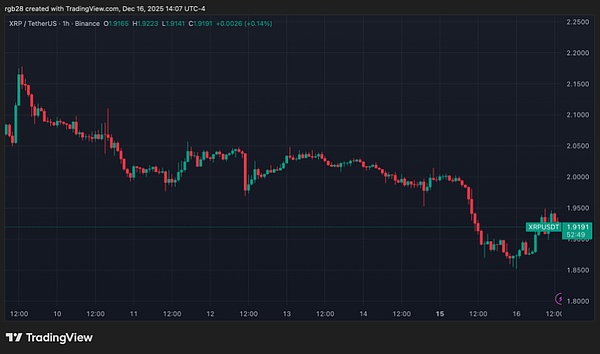
At the beginning of this week, the market pulled back, and XRP fell by approximately 6%, breaking below the crucial support level of $2. Over the past month, XRP has largely been oscillating between $2.00 – $2.25, only briefly dipping below during earlier corrections. But this time, the trend is noticeably weaker, even touching a low of $1.88, which made many bulls nervous.

The good news:? The $1.85 – $1.90 zone has been a "lifeline" since November 2024. Every time the price corrects to this area, funds enter the market to pull it back above $2.

The bad news:? This line is being repeatedly depleted.

Analysts Warn: A Real Break Below Could Mean Significant Downside

Analyst Ali Martinez pointed out that XRP has already broken below the lower edge of its core consolidation range from the past year (around $1.92).
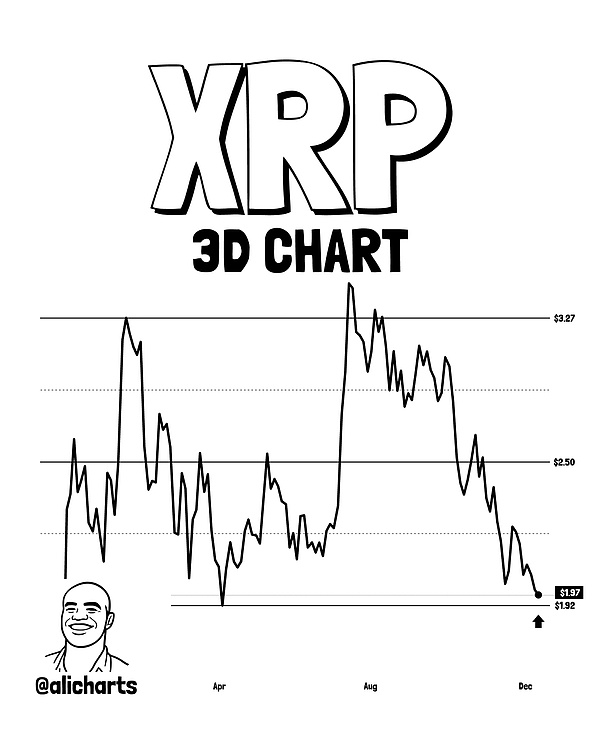
If the daily chart fails to reclaim $1.92, then be cautious—the worst-case scenario could be a retreat all the way to around $1, a drop of nearly 50%.

Another trader added that the current chart resembles a rounded top / double top structure.
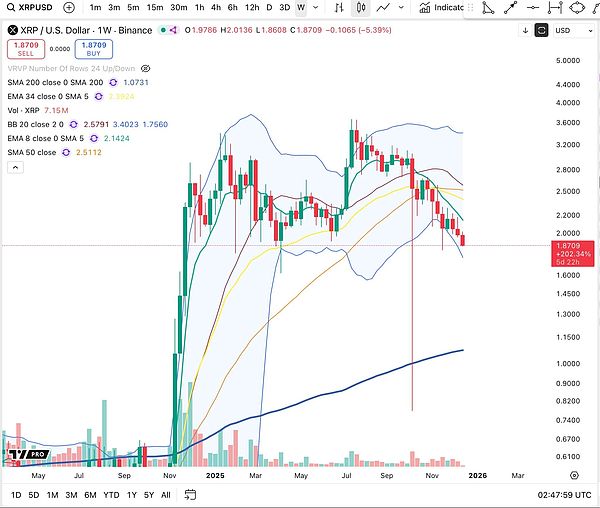
Once $1.88 is lost and the pattern is confirmed, the price could slowly "grind lower" towards the 200-day moving average or even the $1 zone.

But the Bulls Haven't Completely Surrendered

Of course, not everyone is bearish. Some traders believe that a bullish divergence has appeared near $1.8 for XRP, and the short-term structure isn't bad.
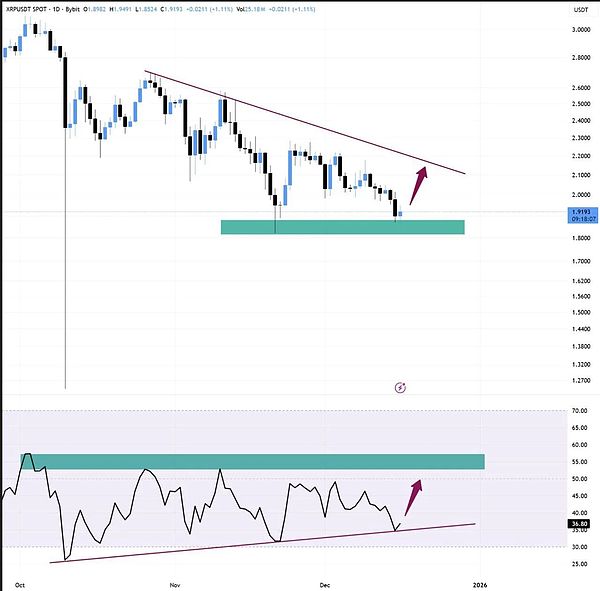
If it can subsequently break strongly above $2.20, then reaching $2.8 – $3.0 within a month isn't out of the question.

From a longer-term perspective, some believe the current price action is similar to the accumulation phase of 2023–2024, and the real major行情 (big move) might not unfold until 2025–2026.
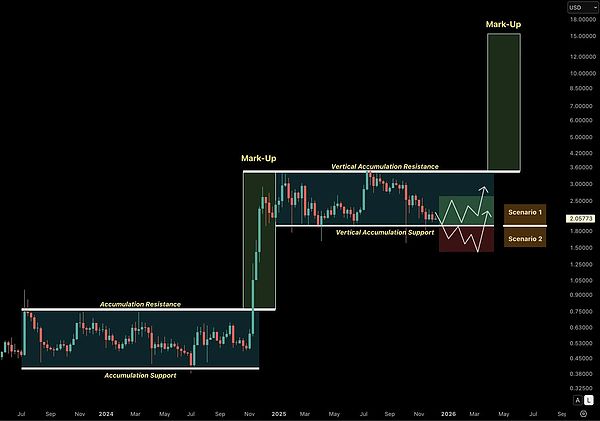
Conclusion in one sentence:

In the short term, $1.88–$1.92 is the life-or-death line; from a medium to long-term perspective, XRP may still experience a major行情 (big move) after this "grinding consolidation".
The above is merely market opinion and not investment advice. The crypto sphere is risky, so trade carefully.

Like, share, and follow me, I'll guide you to catch more market trends, laughing together through bull and bear markets! Let's keep going!

Struggling in the crypto world? Don't tough it out alone!Xiao Yun shares real-time swing and long-term strategies, letting you stand on the shoulders of giants, quickly leapfrog wealth classes. Missing one wave might mean missing 100x gains! Join us!

Criptomoedas em alta

Perguntas relacionadas

QWhat is the critical support level for XRP that analysts are warning about?

AThe critical support level for XRP is between $1.88 and $1.92. If this level is not held, analysts warn of a potential sharp decline.

QAccording to analyst Ali Martinez, what could be the worst-case price target for XRP if it fails to hold the key support?

AAccording to analyst Ali Martinez, if XRP fails to hold the key support and cannot reclaim $1.92 on a daily basis, the worst-case scenario could see it retrace to around $1, a drop of nearly 50%.

QWhat potential bullish scenario is mentioned if XRP manages to break above a certain resistance level?

AIf XRP manages to break above $2.20 with strength, it could potentially rally to between $2.8 and $3.0 within a month.

QWhat chart pattern does another trader suggest XRP is forming, which could lead to a decline?

AAnother trader suggests that the chart resembles a rounding top or double top formation. If $1.88 is lost, this pattern could be confirmed, leading to a slow decline towards the 200-day moving average or even the $1 area.

QWhat is the longer-term outlook for XRP mentioned in the article, beyond the immediate price action?

AThe longer-term outlook suggests that the current price action is similar to the accumulation phase of 2023-2024, and a major bull run could potentially unfold in 2025-2026.

Leituras Relacionadas

He Just Raised 2.7 Billion, and Li Fei-Fei Also Invested

Pete Florence, a former senior research scientist at Google DeepMind and a key contributor to the Vision-Language-Action (VLA) model architecture, is deliberately distancing his startup, Generalist AI, from the trendy "world model" label. He argues that the industry should prioritize concrete goals over buzzwords. His goal is to create robots that can perform a vast range of unseen tasks with high speed and success rates, without needing task-specific training data. Recently, his company raised $400 million (¥2.7 billion) at a $2 billion valuation. Notable investors include NVIDIA's NVentures, Bezos Expeditions, NFDG, as well as Xiaomi co-founder Lin Bin, Zoom founder Eric Yuan, and renowned AI scientist Fei-Fei Li. Florence's approach stems from his academic background at MIT under Professor Russ Tedrake, focusing on understanding the physical world. After joining DeepMind, he developed models like Transporter Network and co-created the VLA framework. He left in 2025 to found Generalist AI. The company has launched two models: GEN-0, which demonstrated that scaling laws apply to physical motion, and GEN-1. GEN-1 was trained on over 500,000 hours of physical interaction data collected via a specialized wearable device. It achieves a 99% success rate on precise mechanical tasks like folding boxes and maintains performance three times faster than its predecessor. Florence believes GEN-1 is reaching a commercial utility threshold similar to the GPT-3 inflection point. The substantial funding round, following GEN-1's release, signifies strong investor confidence in Generalist AI's practical, goal-driven path to creating versatile, useful robots, regardless of the "world model" terminology.

marsbitHá 5m

He Just Raised 2.7 Billion, and Li Fei-Fei Also Invested

marsbitHá 5m

Two Legends Lost in Three Days: Is Google's AI Talent Dam Cracking?

In three days, Google lost two AI legends. On June 18, Noam Shazeer, co-author of the seminal "Attention is All You Need" paper and Gemini co-lead, left for OpenAI. Just 48 hours later, John Jumper, 2024 Nobel laureate and AlphaFold lead, departed DeepMind for Anthropic. This follows Andrej Karpathy joining Anthropic in May. These moves highlight a structural trend: top AI talent is concentrating at mission-driven, pre-IPO firms like OpenAI and Anthropic, while Google becomes a primary source. The exodus stems from a core mission mismatch. Google's ad-centric model often subordinates AI research to product and revenue goals, creating friction for pioneers like Shazeer, who returned in 2024 only to leave again. In contrast, OpenAI and Anthropic offer singular focus on pushing AI boundaries, whether towards AGI or safety-aligned models, which deeply appeals to top researchers like Jumper. Financial incentives amplify the pull. With both OpenAI and Anthropic nearing IPO, employees stand to gain immensely from equity, an upside Google's mature stock cannot match. Furthermore, the 2023 merger of Google Brain and DeepMind, intended to consolidate strength, has instead created cultural tension and slowed the path from research to product, as evidenced by Gemini's pace. This talent redistribution is reshaping the AI landscape. While Google retains vast data and compute resources, its true crisis is the quiet, continuous loss of the people who define the field's future. The real moat in AI is not infrastructure, but the concentration of brilliant minds—a battle Google is currently losing.

marsbitHá 2h

Two Legends Lost in Three Days: Is Google's AI Talent Dam Cracking?

marsbitHá 2h

Behind the AI Report Card, Lies a Chinese 'Exam Setter'

Beyond the familiar performance charts like MMLU-Pro and MMMU, which major AI models strive to ace, stands a key "examiner": Chinese-Canadian researcher Wenhu Chen. An assistant professor at the University of Waterloo and founder of TIGERLab, Chen addresses the crucial need for more rigorous AI evaluation. As models like GPT-4 began scoring near-perfect results on older benchmarks like MMLU, it became difficult to distinguish their true capabilities. In response, Chen introduced MMLU-Pro in 2024, featuring harder, more reasoning-focused questions with more answer choices, successfully reintroducing meaningful performance gaps. His work extends to multi-modal evaluation with MMMU and its enhanced version, MMMU-Pro. These benchmarks test a model's ability to understand and reason with complex information from images, charts, and text across diverse academic subjects, exposing the significant challenges even top models face in genuine comprehension. Chen's background in complex QA, table reasoning, and his experience at Google DeepMind on projects like Gemini inform his approach. He understands that effective benchmarks must anticipate how models might "cheat" by memorizing data or avoiding visual analysis. His lab also actively researches video understanding and generation models (e.g., UniVideo, Vamba), ensuring his evaluation work is grounded in practical model-building challenges. Now at Meta's Super Intelligence Lab, Chen continues his focus on multi-modal data and evaluation, representing the deep yet often unseen contributions of Chinese talent in shaping the fundamental tools of the AI industry.

marsbitHá 2h

Behind the AI Report Card, Lies a Chinese 'Exam Setter'

marsbitHá 2h

Alliance Co-founder's Letter to Entrepreneurs: Written at the Moment Cursor Sold for $600 Billion

Alliance Co-founder's Letter to Entrepreneurs: On Cursor's $60 Billion Sale Many aspiring founders see massive exits like Cursor's $60B sale and wonder why they can't achieve the same, often concluding opportunities are exhausted. But great companies aren't built in obvious, crowded spaces. Cursor, like Stripe, Figma, and Shopify before it, started with a non-consensus belief about the future. Before ChatGPT, they believed AI would transform knowledge work. They focused on a genuinely exciting domain, became their own customer, and obsessed over power users. Their journey involved years of "glass-chewing" effort before the market was ready. The pattern is consistent: identify a long-term technological shift, find a missed entry point, and execute for years before the trend becomes obvious. First-generation products (PayPal, Adobe, Amazon) prove a market exists. Second-generation winners (Stripe, Figma, Shopify) rebuild that market around new insights, technology, or changing customer behaviors. Founders must identify their phase in the cycle. Early entrants like Coinbase or Cursor focus on making new technology usable for power users. Later entrants find the "yin" to the established "yang"—the blind spots incumbents miss as they grow distant from individual users. The key is deep market immersion. Use every product in your space. Talk to users. Build an audience. Stop looking for ideas and start *seeing* them everywhere. Then, choose one. The idea must offer a 10x improvement or solve a "hair-on-fire" pain point—something severe enough that users are already crafting workarounds. When building, avoid feature bloat. Ask: why would someone switch? Great startups rarely force new behaviors; they improve familiar workflows with drastically lower friction (e.g., Cursor forked VS Code instead of creating a new editor). Distribution is the underestimated moat. Before product-market fit, achieve distribution-market fit. How do customers discover new tools? Founders like those at Airbnb, Stripe, and Cursor did unscalable, manual work to recruit early users. The final, unteachable ingredient is resilience. Cursor built for years pre-market, faced rejection, and persisted. So did Airbnb, Nvidia, and Rain (which launched post-FTX collapse). The lesson isn't that these founders were smarter, but that they stayed in the game long enough for their insights to compound. Framework: Spot technological cycles. Cultivate unique insight. Obsess over your market. Talk to customers. Find a hair-on-fire problem. Build the simplest wedge. Win your distribution channel. Above all, don't quit when it gets hard. Most people won't do these things consistently. The few who do build the next generation of great companies. Go build.

marsbitHá 2h

Alliance Co-founder's Letter to Entrepreneurs: Written at the Moment Cursor Sold for $600 Billion

marsbitHá 2h

Trading

Spot
Futuros

Artigos em Destaque

O que é XAG

O Contrato Perpétuo XAGUSDT é o símbolo de negociação para prata cotada em dólares americanos, representando 1 onça troy de prata.

8 Visualizações TotaisPublicado em {updateTime}Atualizado em 2026.06.18

O que é XAG

Como comprar XAG

Bem-vindo à HTX.com!Tornámos a compra de Silver (XAG) simples e conveniente.Segue o nosso guia passo a passo para iniciar a tua jornada no mundo das criptos.Passo 1: cria a tua conta HTXUtiliza o teu e-mail ou número de telefone para te inscreveres numa conta gratuita na HTX.Desfruta de um processo de inscrição sem complicações e desbloqueia todas as funcionalidades.Obter a minha contaPasso 2: vai para Comprar Cripto e escolhe o teu método de pagamentoCartão de crédito/débito: usa o teu visa ou mastercard para comprar Silver (XAG) instantaneamente.Saldo: usa os fundos da tua conta HTX para transacionar sem problemas.Terceiros: adicionamos métodos de pagamento populares, como Google Pay e Apple Pay, para aumentar a conveniência.P2P: transaciona diretamente com outros utilizadores na HTX.Mercado de balcão (OTC): oferecemos serviços personalizados e taxas de câmbio competitivas para os traders.Passo 3: armazena teu Silver (XAG)Depois de comprar o teu Silver (XAG), armazena-o na tua conta HTX.Alternativamente, podes enviá-lo para outro lugar através de transferência blockchain ou usá-lo para transacionar outras criptomoedas.Passo 4: transaciona Silver (XAG)Transaciona facilmente Silver (XAG) no mercado à vista da HTX.Acede simplesmente à tua conta, seleciona o teu par de trading, executa as tuas transações e monitoriza em tempo real.Oferecemos uma experiência de fácil utilização tanto para principiantes como para traders experientes.

4 Visualizações TotaisPublicado em {updateTime}Atualizado em 2026.06.18

Como comprar XAG

Como comprar XAU

Bem-vindo à HTX.com!Tornámos a compra de Gold (XAU) simples e conveniente.Segue o nosso guia passo a passo para iniciar a tua jornada no mundo das criptos.Passo 1: cria a tua conta HTXUtiliza o teu e-mail ou número de telefone para te inscreveres numa conta gratuita na HTX.Desfruta de um processo de inscrição sem complicações e desbloqueia todas as funcionalidades.Obter a minha contaPasso 2: vai para Comprar Cripto e escolhe o teu método de pagamentoCartão de crédito/débito: usa o teu visa ou mastercard para comprar Gold (XAU) instantaneamente.Saldo: usa os fundos da tua conta HTX para transacionar sem problemas.Terceiros: adicionamos métodos de pagamento populares, como Google Pay e Apple Pay, para aumentar a conveniência.P2P: transaciona diretamente com outros utilizadores na HTX.Mercado de balcão (OTC): oferecemos serviços personalizados e taxas de câmbio competitivas para os traders.Passo 3: armazena teu Gold (XAU)Depois de comprar o teu Gold (XAU), armazena-o na tua conta HTX.Alternativamente, podes enviá-lo para outro lugar através de transferência blockchain ou usá-lo para transacionar outras criptomoedas.Passo 4: transaciona Gold (XAU)Transaciona facilmente Gold (XAU) no mercado à vista da HTX.Acede simplesmente à tua conta, seleciona o teu par de trading, executa as tuas transações e monitoriza em tempo real.Oferecemos uma experiência de fácil utilização tanto para principiantes como para traders experientes.

4 Visualizações TotaisPublicado em {updateTime}Atualizado em 2026.06.18

Como comprar XAU

Discussões

Bem-vindo à Comunidade HTX. Aqui, pode manter-se informado sobre os mais recentes desenvolvimentos da plataforma e obter acesso a análises profissionais de mercado. As opiniões dos utilizadores sobre o preço de A (A) são apresentadas abaixo.

活动图片